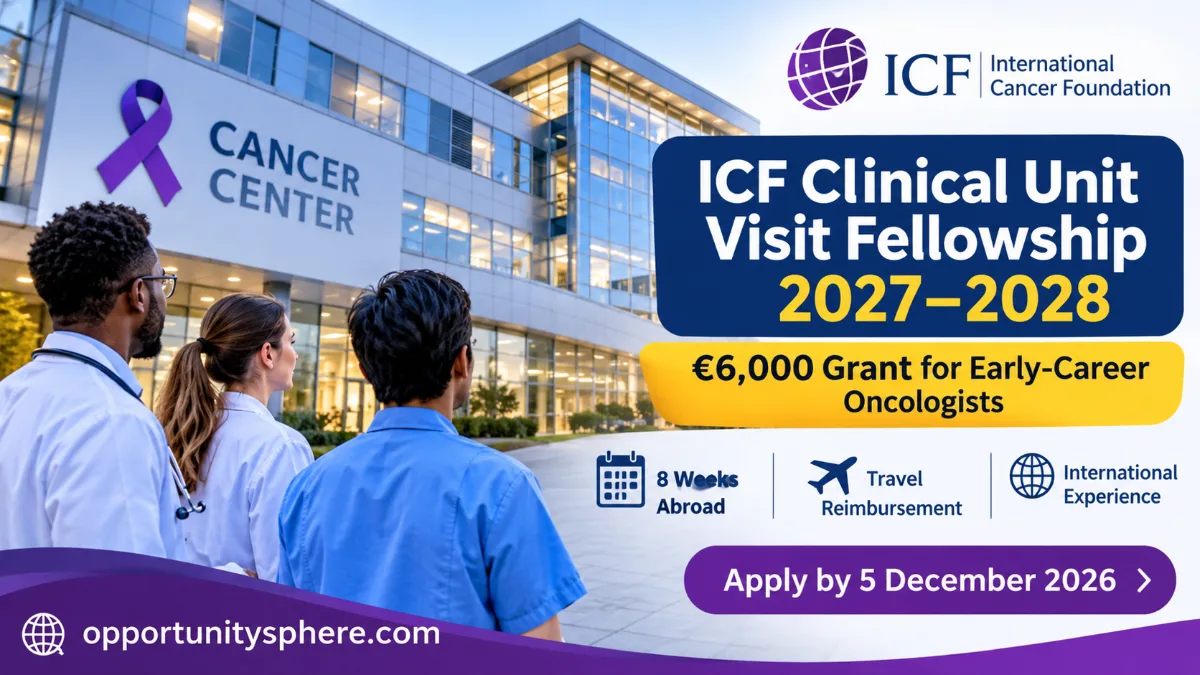
ICF Clinical Unit Visit Fellowship 2027–2028 – €6,000 Grant for Early-Career Oncologists
Offered by International Cancer Foundation (ICF)
Location
International
Funding
Partially Funded
Study level
Graduate, Researchers, Professional
Field of study
Life Sciences, Health & Medical Sciences
Application deadline
December 5, 2026
About This Fellowship
The International Cancer Foundation (ICF) Clinical Unit Visit Fellowship 2027–2028 is an eight-week international professional development programme designed for early-career oncologists and doctors undergoing specialist training in oncology.
The programme provides an opportunity to undertake a structured educational visit at an approved oncology host institution, where fellows can observe clinical practices, learn from experienced specialists, explore different approaches to cancer care and exchange knowledge with professionals working in other healthcare systems.
The fellowship is coordinated by the International Cancer Foundation and is associated with the European Society for Medical Oncology (ESMO). Its central aim is to strengthen oncology expertise through international learning and encourage fellows to transfer useful knowledge and experience to their home institutions.
Unlike a conventional academic scholarship, this programme is a short-term clinical learning placement. It is intended for medical professionals who are already involved in oncology practice or oncology-related clinical research and have specific professional skills they want to develop.
The fellowship is educational and observational in nature. It does not automatically provide independent clinical practice rights or guarantee direct patient contact. Any patient-facing activity must comply with the host institution's rules, supervision arrangements and applicable professional regulations.
Fellowship duration and structure
The standard fellowship lasts eight weeks and must take place in person at an oncology institution approved by ICF.
Applicants are expected to identify a host institution that matches their professional development needs and the priorities of their home institution.
The visit can be tailored to a clearly defined learning objective. For example, a fellow may wish to focus on a particular cancer type, patient group, oncology service or area of clinical practice.
The fellowship should have a practical learning plan explaining:
The oncology area the applicant wants to develop.
The clinical or educational activities proposed at the host institution.
The skills and knowledge the applicant expects to acquire.
How the experience will benefit the applicant's home institution.
How the knowledge gained can be shared or applied after returning home.
The fellowship must start within 12 months of the award notification. The standard duration is eight weeks; shortened, postponed, split or otherwise modified visits require exceptional circumstances and prior written approval from ICF.
What the fellowship offers
1. €6,000 fellow grant
ICF normally provides a grant of €6,000 for the standard eight-week fellowship. This is a contribution towards the fellow's accommodation and living expenses during the approved visit.
The grant is not a salary and may not cover every expense associated with travelling and staying in the host country.
2. Travel reimbursement
Reasonable travel expenses may be reimbursed after completion of the fellowship, subject to ICF's reimbursement limits and the submission of complete supporting documents.
Travel reimbursement is not paid in advance. Applicants should therefore consider how they will finance their travel before receiving reimbursement.
3. Host institution support
The host institution receives a separate administrative contribution of €1,000 to help cover hosting and coordination expenses, such as administrative arrangements and access badges.
This amount is paid to the host institution, not to the fellow.
4. International professional exposure
Fellows gain the opportunity to observe how another oncology institution organises cancer care, clinical services and related professional activities.
5. Knowledge exchange and professional collaboration
The programme encourages interaction with experienced oncology professionals and the development of professional relationships that may support future collaboration.
6. Knowledge transfer to the home institution
An important objective is to ensure that the experience benefits more than the individual fellow. Applicants are expected to explain how they will share relevant learning with colleagues and contribute to improving oncology practice or research in their home professional environment.
Eligibility requirements
The fellowship is specifically intended for early-career oncologists and doctors undergoing oncology training. Applicants must meet the following requirements:
1. Professional background
Applicants must be either:
Early-career oncologists; or
Oncologists currently undergoing specialist training.
This programme is not intended for general medical students, undergraduate students or healthcare professionals whose work is unrelated to oncology.
2. Clinical experience
Applicants must have at least two years of clinical experience in one of the following areas by the expected start of the fellowship:
Internal medicine.
Medical oncology.
Radiation oncology.
Surgical oncology.
The experience requirement is based on the expected start of the visit, not simply the date the application is submitted.
3. Current professional activity
Applicants must be actively involved in oncology practice and/or oncology-related clinical research.
4. English and host-country language proficiency
Applicants must be proficient in English and have sufficient knowledge of the working language of the proposed host institution or host country.
This is particularly important where the proposed programme involves direct patient contact or regular patient-facing activities. The host institution's language requirements and professional regulations will apply.
5. Support from the home institution
Applicants must have support from their current home institution.
This is important because the fellowship is designed to strengthen professional capacity and encourage the transfer of knowledge back to the applicant's institution.
6. A suitable host institution
Applicants should identify and contact an oncology institution that is appropriate for their learning objectives.
A confirmed host institution is strongly encouraged. However, applicants who have not secured a host at the time of application may still apply by providing details of their preferred institution, proposed learning objectives, preferred dates and efforts made to arrange the visit.
The proposed host institution and programme must be approved by ICF.
Choosing an oncology host institution
One of the most important parts of this application is identifying a suitable host institution.
Applicants should look for a recognised oncology centre with the clinical expertise, facilities and professional environment needed to support their proposed learning objectives.
The ESMO Host Institutes list provides a useful starting point for identifying potential institutions. However, applicants are not restricted to institutions on that list. They may propose another suitable recognised oncology institution, subject to ICF approval.
Before contacting a potential host, applicants should:
Identify the cancer speciality or clinical area they want to study.
Research institutions with relevant expertise.
Identify a department or specialist whose work aligns with their objectives.
Explain what they hope to learn during the eight-week visit.
Ask whether the institution can accommodate and supervise the proposed educational visit.
Applicants are strongly encouraged to secure host acceptance before submitting their application. Applications with a confirmed host institution and an acceptance letter may receive priority during the selection process.
Required application documents
A complete application must include the following:
1. Completed online application form
Applicants must complete the official ICF application form and provide the requested personal, professional and institutional information.
2. Motivation letter
The motivation letter should explain why the applicant wants to participate, their professional development needs and how the proposed visit will improve their oncology practice or research.
It should also explain how the experience will benefit their home institution.
3. Recommendation letter
A recommendation letter is required from the applicant's home institution, department head, mentor or supervisor.
The letter should demonstrate institutional support for the proposed visit and explain why the applicant is a suitable candidate.
4. Host acceptance letter, where available
Applicants who have already secured a host institution should provide an acceptance letter.
Where possible, the letter should identify the proposed department, mentor, visit dates and planned learning activities.
5. Curriculum Vitae (CV)
The application requires CV information covering:
Professional work experience.
Education and specialist training.
Language abilities.
Participation in clinical trials.
Research activities.
Publications and published abstracts, where applicable.
Applicants should ensure that their CV clearly demonstrates their oncology experience and current professional activities.
6. Visit proposal, where available
Applicants who have developed a proposed programme for their visit should include it.
The proposal should describe the intended learning objectives, relevant clinical area, proposed activities and expected professional benefits.
If no host institution has been confirmed:
Applicants must upload a letter explaining:
Their preferred host institution.
The proposed focus of the visit.
Their expected learning objectives.
Their preferred dates.
Why a host institution has not yet been confirmed.
The steps already taken to secure a host.
All application materials must be submitted in English. Applicants should consult the official application guidelines for the detailed document requirements.
How to apply
Applications must be submitted online through the International Cancer Foundation's application portal.
Follow these steps:
Visit the official ICF Clinical Unit Visit Fellowship 2027–2028 application page.
Read the full eligibility criteria, programme conditions and application guidelines.
Identify an oncology institution that matches your professional development objectives.
Contact the proposed host institution and seek acceptance for an eight-week educational visit.
Obtain a recommendation letter from your home institution, department head, mentor or supervisor.
Prepare your motivation letter, CV information and visit proposal, where available.
Complete the online application form in English.
Upload the required documents. If you have not secured a host institution, provide the required explanation and details of your preferred host.
Review your application carefully and submit it before the deadline.
Applicants may save an application as a draft and return to it later. However, applications that remain incomplete or in draft form after the deadline will not be considered.
How applications are assessed
Applications are reviewed after the deadline. The selection process considers several factors, including:
The applicant's professional background and experience.
The strength of the motivation letter.
The relevance and clarity of the proposed clinical visit.
The suitability of the host institution.
The quality of the proposed learning programme.
The potential for transferring knowledge to the home institution.
The expected long-term professional and institutional benefits.
Eight-week fellowship proposals are prioritised. Applications with a confirmed host institution and a valid host acceptance letter may also receive priority.
Selection is not automatic for applicants who meet the minimum eligibility requirements. The quality and practical value of the proposed visit are important considerations.
Results are expected to be communicated by 1 April 2027.
Selected applicants must formally accept the award and complete the required administrative arrangements, including the Fellowship Agreement and host institution confirmation. Where a visa is required, the applicable visa approval must be obtained before grant payment.
Important funding and travel considerations
Although the fellowship provides a €6,000 grant and reasonable travel reimbursement, applicants should plan their finances carefully.
The fellow remains responsible for arranging and meeting obligations relating to:
Travel arrangements and any costs not covered by the reimbursement rules.
Accommodation and living expenses beyond the grant.
Visa and immigration procedures.
Work permits or institutional authorisations, where applicable.
Insurance.
Local transportation.
Taxes and other personal obligations.
The €6,000 grant is a contribution towards living and accommodation costs, not a guarantee that all expenses will be covered.
Applicants should read the full general conditions before accepting an award and avoid making non-refundable travel arrangements before receiving the necessary approvals.
Application advice
The most important part of this application is demonstrating a clear professional reason for undertaking the visit.
A general statement about wanting international exposure is unlikely to be as persuasive as a specific learning plan. Applicants should identify a particular area of oncology they want to improve and explain how the proposed host institution can help them achieve that objective.
For example, an applicant working in medical oncology might propose an observational visit focused on multidisciplinary cancer management, treatment planning or the organisation of a particular oncology service. Another applicant may wish to study approaches to radiation oncology, surgical oncology or a specific tumour type.
The application should also explain how the knowledge gained will be transferred to the home institution. Candidates can discuss plans to share learning through departmental presentations, professional training sessions, revised clinical protocols or collaboration with colleagues, where appropriate.
Do not wait until the final days to identify a host institution. Contacting a suitable centre, discussing a realistic eight-week programme and obtaining an acceptance letter can take time. A confirmed host is encouraged and may strengthen the application.
Finally, make sure the proposed activities are educational and observational and comply with the host institution's professional and regulatory requirements. Do not assume that the fellowship automatically authorises independent treatment of patients or clinical practice in another country.
Important dates
Application opens: 5 October 2026
Application deadline: 5 December 2026
Results announced: By 1 April 2027
Fellowship duration: Eight weeks
Fellowship start: Within 12 months of award notification
Applications must be completed and submitted through the official portal before the deadline.
Related Opportunities
Explore other scholarships, fellowships, grants, research opportunities and more that may match your interests.