Offered by Federation of European Biochemical Societies (FEBS)
Location
International — FEBS countries (Europe and neighbouring regions)
Funding
Partially Funded
Study level
PhD, Postdoctoral, Researchers
Field of study
Natural Sciences, Life Sciences, Health & Medical Sciences
Application deadline
December 10, 2026
About This Fellowship
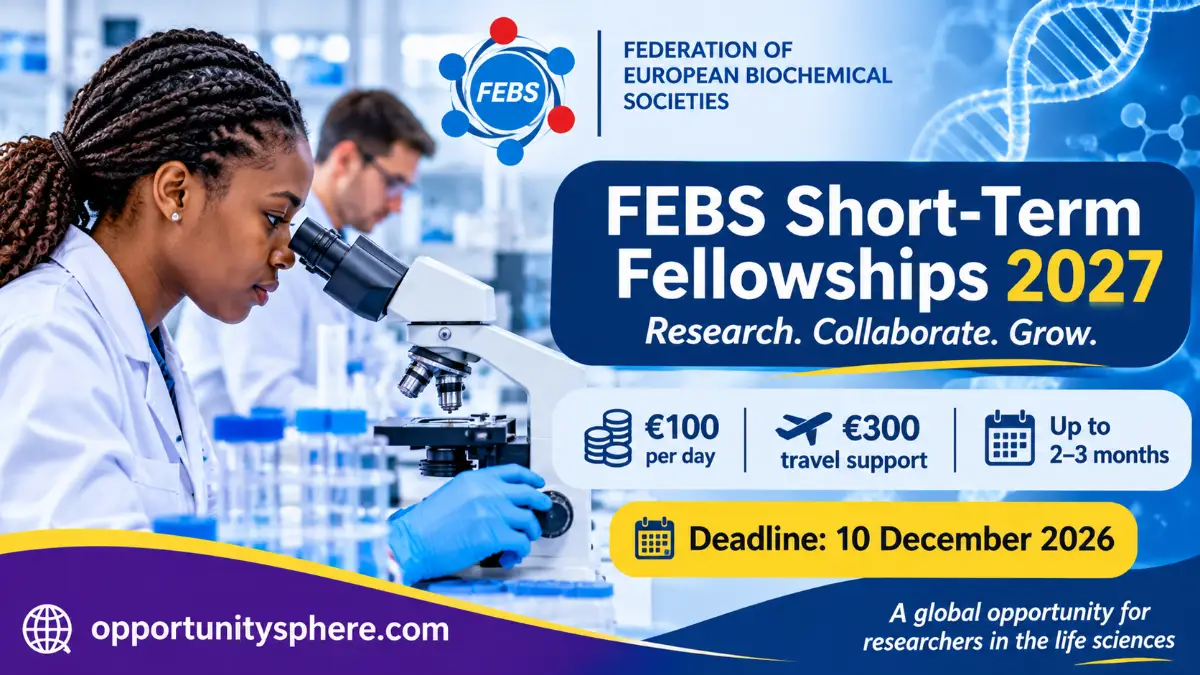
The FEBS Short-Term Fellowships are research mobility awards offered by the Federation of European Biochemical Societies (FEBS). They support PhD students and early-career researchers in molecular life sciences who need to undertake a short research visit at a laboratory in another FEBS country.
The programme is designed to help researchers gain access to specialised equipment, scientific expertise, experimental techniques and research environments that may not be available at their usual institutions. It also encourages collaboration between laboratories and helps early-career scientists build professional relationships that can support future research projects.
Unlike a degree scholarship, this is a short research-placement fellowship. It does not fund a full PhD programme, a master's degree, conference attendance or a general training course. The proposed visit must involve a defined research activity that can be carried out more effectively through collaboration with the selected host laboratory.
What does the fellowship provide?
Successful applicants receive financial support towards the cost of carrying out their research visit:
Daily subsistence allowance: €100 per day.
Travel contribution: A fixed €300 towards travel between the applicant's place of residence and the host laboratory.
Possible additional travel support: FEBS may consider extra assistance in exceptional circumstances where the €300 contribution is insufficient for necessary travel.
Research visit duration: Normally up to two months. A visit of up to three months may be considered when the longer period is properly justified.
The allowance is intended to help cover the fellow's subsistence and travel costs. It should not be interpreted as a full scholarship covering every expense. FEBS does not provide allowances for dependants, and its general fellowship guidelines state that medical and travel insurance are not provided. Applicants should therefore budget for any additional accommodation, living, insurance, visa and other expenses not covered by the award.
Who is eligible to apply?
The fellowship is intended for researchers in molecular life sciences who fall into one of the following categories:
Applicants currently enrolled in a doctoral programme may apply. FEBS strongly recommends that PhD applicants have at least one published paper as a main author. A clear research direction and a convincing explanation of how the proposed visit will contribute to the doctoral project are important.
2. Early-career researchers who have completed a PhD
Researchers who obtained their PhD within the previous four years may apply. They are expected to demonstrate a well-recognised publication record and the ability to undertake the proposed research project.
FEBS may take properly justified career breaks, including parental leave, into consideration when assessing the four-year period.
The geographical and membership requirements are essential. Applicants must:
Be members of a FEBS Constituent Society.
Be working in a laboratory located in a FEBS country.
Propose to visit a laboratory in a different FEBS country.
Not already be working at the proposed host laboratory when applying.
The host must be a laboratory in a non-profit academic institution in a different FEBS country. Membership alone does not remove the requirement to be working in a FEBS country.
FEBS has Constituent Societies in European and neighbouring countries. Its published list includes countries such as Germany, France, Italy, Spain, Portugal, Türkiye, Israel, Morocco and Tunisia, among others. Nigeria is not included in the current list of FEBS Member or Associate Member Society countries. Consequently, researchers whose current laboratory is in Nigeria will generally not meet the geographical eligibility requirement. Nigerian researchers who are currently working in an eligible FEBS country should check the full rules and their society membership status before applying.
What kind of research visit can be proposed?
The fellowship is intended for a specific scientific purpose. A strong application should explain what the applicant needs to learn or accomplish at the host laboratory and why the work cannot be adequately completed at their current institution.
Examples of suitable research objectives may include:
Learning a specialised molecular biology or biochemical technique.
Using advanced laboratory equipment that is unavailable at the home institution.
Applying a new analytical method to an ongoing research project.
Developing expertise in a specialised area of cell biology, molecular genetics or protein research.
Establishing a new scientific collaboration with a laboratory that has relevant expertise.
Conducting experiments that will strengthen a doctoral thesis or an early-career research programme.
The proposed visit should be scientifically worthwhile and realistic within the requested period. It should not simply be an opportunity to travel or observe general laboratory activities. The application must demonstrate the scientific value of the visit and the suitability of the host institution.
Application periods for the 2027 fellowships
FEBS has introduced two application calls for research visits taking place between March 2027 and February 2028.
First call
Applications opened: 1 November 2026
Application deadline: 10 December 2026
Expected results: By the end of January 2027
Second call
Applications open: 1 May 2027
Application deadline: 10 June 2027
Expected results: By the end of July 2027
Applicants should select the call that best matches their intended research visit. The first call is currently open. Researchers who are not ready to submit by 10 December may consider preparing for the second call, provided their planned visit falls within the programme's eligible period.
Documents and information required
Applications are submitted online and must be completed in English. Applicants should prepare the following information and documents:
1. Curriculum vitae
The CV should provide a concise overview of the applicant's research background. It should include academic qualifications, current and previous positions, research expertise, technical skills, awards, grants and other relevant experience. Participation in research stays, conferences, courses and teaching activities may also be included.
2. Publication list
Applicants must provide a list of their scientific publications using the reference format required by The FEBS Journal. PhD students are strongly encouraged to have at least one publication as a main author, while postdoctoral applicants are expected to demonstrate a strong publication record.
3. Research proposal
A research proposal of no more than two A4 pages of single-spaced text is required. FEBS specifies the following headings:
Title of the proposed research.
Nature of the work and outline of the experiments.
Why travelling to a laboratory in another country is necessary.
Why the particular host laboratory has been selected, including up to five relevant publications from that laboratory.
Why the proposed work requires the requested duration.
The proposal should be focused and practical. Applicants should avoid describing an entire doctoral thesis or a broad research programme when the fellowship only supports a short visit. Instead, explain the specific experiments, training or techniques that will be completed during the visit.
4. Host acceptance form
The host acceptance form is available through the application system. It must be signed by the head of the host institute or department and by the head of the research group or groups in which the applicant will work.
This means applicants should identify and contact a suitable host laboratory before submitting their application. They should discuss the proposed work, agree on the visit period and obtain the required institutional approval.
5. FEBS Constituent Society membership confirmation
Applicants must upload a dated letter from the relevant FEBS Constituent Society confirming their membership and stating the date they joined the society. This is a formal eligibility document, not simply an optional reference.
6. Referee details and supporting letter
Applicants must provide the contact details of an experienced scientist who knows their work. The referee must not work at the proposed host institute. FEBS sends the referee a link to upload a letter of support directly. Applicants should contact their referees early so that the letter can be submitted on time.
How are applications assessed?
Applications are evaluated by members of the FEBS Excellence Awards and Fellowships Committee. The published assessment criteria include:
The applicant's curriculum vitae and research background.
The scientific quality of the proposed project.
The suitability of the host laboratory for the proposed work.
A competitive proposal should show a clear connection between the applicant's research needs and the expertise available at the host institution. It should explain what new knowledge or technical capability the applicant will gain, what work will be completed during the visit and how the collaboration may benefit the applicant's research.
The host laboratory should be selected for a clear scientific reason. Applicants are expected to identify relevant publications from the host group and explain how its expertise relates to the proposed project.
Important restrictions applicants should know
There are several programme rules worth checking before applying:
The fellowship cannot be used to supplement or extend another fellowship or scholarship.
Applicants must disclose other funding applications or awards relating to the same project or visit.
Research visits must not overlap with the period from 22 December to 3 January.
FEBS will not award more than one fellowship to an individual host laboratory within a six-month period.
Only one application from a given home laboratory can be considered within a six-month period.
The fellowship does not fund attendance at courses, symposia, meetings or congresses.
Applicants must wait at least two years before a second FEBS Short-Term Fellowship award can be considered.
What happens after the research visit?
Fellows are required to submit a scientific report to FEBS within three months of completing the visit. The report must be no longer than two pages and should contain an introduction, materials and methods, results, discussion and one or two figures.
Any presentation related to work completed during the fellowship must include the FEBS logo and acknowledgement of the fellowship. Relevant future publications should also acknowledge FEBS support using the wording specified in the programme guidelines.
Practical advice before applying
Start by checking the FEBS eligibility requirements rather than spending time preparing a proposal before confirming that you qualify. The society membership, home laboratory location and host laboratory location requirements are mandatory.
If you meet these conditions, identify a host laboratory whose expertise directly addresses a gap in your current research. Contact the group leader early, explain the proposed research visit and confirm that the laboratory can host you during the intended period. Allow enough time for the host acceptance form and referee letter, as both involve other people and institutional processes.
Keep the proposal within the two-page limit and make the purpose of the visit very clear. Explain why the technique, equipment or expertise is unavailable at your home institution, why the chosen laboratory is suitable and what you expect to achieve within the requested period.
Finally, calculate the likely cost of the visit before accepting an award. The €100 daily allowance and €300 travel contribution are helpful, but they are not a guarantee that every expense will be covered. Applicants should make arrangements for insurance and any additional costs themselves.
Related Opportunities
Explore other scholarships, fellowships, grants, research opportunities and more that may match your interests.