Harvard LEAD Fellowship 2027–2028 for Global Health Leaders from Low- and Middle-Income Countries
Offered by Harvard Global Health Institute (HGHI), in collaboration with the Department of Global Health and Population at Harvard T.H. Chan School of Public Health
Location
United States
Funding
Fully Funded
Study level
Professional, Postdoctoral
Field of study
Health & Medical Sciences
Application deadline
November 15, 2026
About This Fellowship
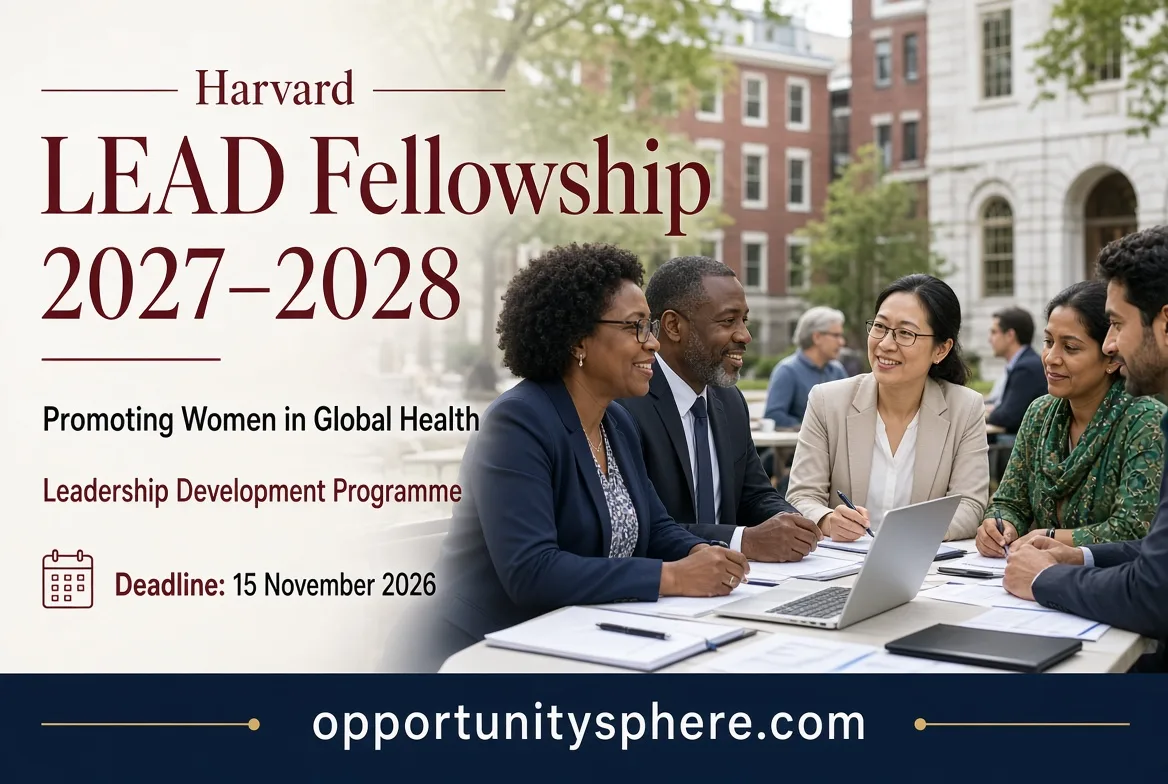
The Harvard LEAD Fellowship for Promoting Women in Global Health is a year-long leadership development programme offered by the Harvard Global Health Institute (HGHI), in collaboration with the Department of Global Health and Population at Harvard T.H. Chan School of Public Health.
The programme is designed for experienced global health professionals who want to strengthen their leadership capabilities, develop their professional vision and create a wider impact within their organisations, sectors and home countries. Rather than functioning as a conventional academic scholarship, LEAD combines personalised leadership development, mentorship, executive education and a practical project plan.
The 2027–2028 cohort will participate in a programme running from 1 September 2027 to 31 August 2028. Most of the initial programme engagement takes place virtually, followed by a six-week residential experience in Cambridge, Massachusetts, expected in April 2028.
What makes this fellowship different?
Experienced health professionals often have demanding responsibilities that leave limited time for reflection, strategic planning and deliberate leadership development. LEAD provides a structured opportunity to step back from daily work, examine professional goals and develop the skills needed to influence health programmes, organisations and policies more effectively.
The programme is highly personalised. Fellows develop leadership and career plans based on their own professional experience, goals and areas for growth. Participants also join a community of global health professionals and build relationships with mentors, Harvard faculty and peers from different countries and disciplines.
The fellowship is particularly relevant to professionals whose work extends beyond individual technical responsibilities into leadership, institutional improvement, health policy, research management, advocacy or health-system development.
Fellowship structure and activities
1. Virtual leadership development
The fellowship begins in September 2027 with virtual engagement. During the fall semester, fellows work on their personal growth and leadership plans, participate in coaching and prepare for the residential component. The virtual period is designed to be relatively light, and fellows are not generally expected to leave their regular work responsibilities during this phase.
Preparation includes planning training activities, developing the project plan, organising mentorship arrangements and completing the requirements for participation in the in-person programme.
2. Individual leadership coaching
Fellows receive one-to-one executive leadership coaching to help them reflect on their leadership style, strengths, development needs and professional ambitions. This personalised support can help participants turn broad career goals into specific development priorities.
Fellows are connected with Harvard faculty mentors whose expertise aligns with their interests. Participants are encouraged to meet their mentors regularly, often monthly, to discuss career development, leadership challenges and potential collaboration opportunities.
4. Executive education
During the residential experience, fellows participate in an executive education course. Previous cohorts have participated in the Women and Power course offered by Harvard Kennedy School. The course for the 2027–2028 cohort should be confirmed through the programme's official information.
5. Leadership masterclasses
The fellowship includes private leadership masterclasses led by Harvard faculty and other experts. Past topics have included negotiation, public speaking, communication, decision-making, conflict resolution, crisis leadership and persuasive writing.
6. Speaking and networking opportunities
Fellows may have opportunities to speak at global health events, share their professional expertise and connect with leaders working in different areas of health. These opportunities can help participants expand their professional networks, communicate their ideas more effectively and develop future collaborations.
7. Independent project work
Each fellow develops a project plan connected to their professional goals and the needs of their organisation or home country. The project is an opportunity to apply leadership development to a practical issue rather than treating the fellowship solely as a training experience.
Funding and financial support
The fellowship financially supports the six-week residential experience in Cambridge, Massachusetts. According to the official programme information, covered expenses include:
Round-trip flights to and from the United States.
Housing during the residential period.
J-1 visa fees.
Fees for the relevant executive education course.
A stipend for living and logistical expenses, including food and local transportation during the residential period.
The programme is therefore described as a funded fellowship, but applicants should understand the scope of that support. The published information specifically identifies coverage for the residential experience. Applicants should not assume that their regular salary, all expenses throughout the entire 12-month programme or every personal expense will be covered.
The programme also provides non-financial benefits, including leadership coaching, mentorship, training, access to professional networks and opportunities to develop a stronger leadership profile.
Who is eligible to apply?
The fellowship welcomes applicants from different regions, professional disciplines, sectors and gender identities. Although the programme's title emphasises promoting women in global health, the published eligibility requirements state that applicants of all genders and gender identities are welcome.
Applicants must meet the following requirements:
Relevant master's degree: Candidates must hold at least a master's degree in a relevant field.
Professional experience: Applicants must work full-time in global health and have at least 10 years of professional experience beyond their education. Work completed as a university student does not count towards this requirement.
Current location and future plans: Applicants must currently be based and working in a low- or middle-income country and intend to return there after the fellowship.
Leadership experience: Candidates should demonstrate substantial leadership experience and the potential to develop further as leaders in global health.
Employer and institutional support: Applicants need support from their home institution and an organisational champion who can serve as a reference. Their institution must also support the planned six-week leave of absence or equivalent arrangement in April 2028.
Residential participation and visa eligibility: Fellows must be eligible to obtain a J-1 visa and be available to reside in Cambridge, Massachusetts, for six weeks during the residential programme.
Previous fellowship restriction: During the two years before arriving at Harvard, candidates must not have participated in a full-time fellowship lasting four months or longer.
Meeting the minimum requirements does not guarantee selection. Candidates should also demonstrate that their experience, leadership goals and proposed project fit the purpose of the fellowship.
Required application materials
Applicants should prepare the following documents and responses:
1. CV or résumé
A professional CV that clearly presents relevant qualifications, career progression, leadership responsibilities, achievements and experience in global health.
2. Letter of intent
A letter of no more than 1.5 pages describing the applicant's professional journey in global health and explaining why the LEAD Fellowship would be transformative for their organisation and country.
3. Four short essays
Each essay must be no longer than 2,000 characters. The required topics are:
Career development and training activities.
Project plan.
The candidate's plan to provide mentoring.
The fellowship's expected impact on the candidate's organisation, field and home country.
4. Letter of institutional commitment
A letter from the home institution supporting the candidate's participation and proposed project. It must also document the institution's commitment to allow the candidate to take leave or an equivalent break during the six-week residential period in April 2028.
5. Letter of mentor commitment
A letter from a person within the applicant's organisation or professional network who acts as a champion of the applicant's professional development.
6. Two additional reference letters
At least one reference must come from the applicant's current or most recent professional engagement. This reference must be from someone other than the person providing the mentor commitment letter.
Applicants should follow the official application portal's instructions for submission and any additional formatting requirements.
How applications are assessed
The programme is designed for professionals with a strong record of work and the potential to develop further as global health leaders. Applicants should be prepared to demonstrate:
Relevant experience and a clear professional trajectory in global health.
Evidence of leadership responsibility and the potential to influence others.
A thoughtful plan for career development and leadership growth.
A realistic project plan connected to an organisational or national priority.
A commitment to mentoring others and supporting future leaders.
A credible explanation of how the fellowship could benefit the applicant's organisation, professional field and home country.
Institutional support for participation and the residential leave requirement.
The application should present a coherent connection between the applicant's past work, future goals, proposed project and the benefits they expect to bring back to their professional setting.
Application advice: how to prepare a competitive application
1. Demonstrate leadership through concrete examples. Do not rely on job titles alone. Describe a programme you helped lead, a team you coordinated, a policy or practice you influenced, a research initiative you advanced, or an organisational problem you helped solve. Explain your own contribution and what changed as a result.
2. Make your project plan specific and achievable. Identify the problem, the people or institution affected, the proposed intervention, the steps required and the expected results. Avoid a project that is simply a broad ambition to improve global health. A focused project with realistic milestones is easier to explain and evaluate.
3. Connect the fellowship to a real organisational need. Explain why your institution would benefit from your participation. For example, you may want to strengthen a health programme, improve staff development, support evidence-informed decision-making or build partnerships that address a defined service gap.
4. Treat the mentoring essay as a practical commitment. Describe whom you intend to mentor, the knowledge or experience you can share, how often you plan to engage and what support you could realistically provide. A credible mentoring plan is more persuasive than a general statement that you intend to inspire young professionals.
5. Explain how benefits will extend beyond you. The fellowship asks applicants to consider its impact on their organisation, field and home country. Describe how you might share lessons with colleagues, improve a programme, mentor emerging leaders or apply a leadership framework in your workplace. Avoid promising national-level changes that are beyond your authority or resources.
6. Obtain institutional support early. The institutional commitment letter is a substantive part of the application, not a routine formality. Discuss your proposed project and the six-week residential requirement with your employer early enough for the institution to consider the request and prepare a suitable letter.
7. Choose referees carefully. Select people who can speak specifically about your professional contribution, leadership, reliability and potential. Give referees sufficient information about the fellowship and your project so that their letters can address your candidacy meaningfully. Keep the mentor commitment letter separate from the required additional reference letters.
8. Keep the essays focused. Each essay has a 2,000-character limit. Draft your key points first, remove repetition and use specific examples. Ensure the career development plan, project plan, mentoring plan and impact essay complement one another instead of repeating the same information.
9. Plan realistically for the residential period. Confirm that your institution can accommodate the six-week absence in April 2028. Consider responsibilities that need to be delegated, the timing of important work commitments and your eligibility to obtain the required visa.
10. Start the application well before the deadline. Allow time to refine the letter of intent, check the character limits, coordinate institutional documentation and secure all reference letters. An otherwise strong application can be weakened by missing documents or an incomplete submission.
Important dates
Application deadline: 15 November 2026, 11:59 p.m. EST.
Equivalent deadline in Nigeria: 16 November 2026, 5:59 a.m. WAT.
Fellowship period: 1 September 2027 to 31 August 2028.
Expected residential period: Six weeks in April 2028.
Expected notification: Spring 2027.
Related Opportunities
Explore other scholarships, fellowships, grants, research opportunities and more that may match your interests.