Offered by University of Cambridge – Department of Pathology
Location
United Kingdom
Funding
Fully Funded
Study level
PhD
Field of study
Health & Medical Sciences, Life Sciences, Natural Sciences
Application deadline
December 2, 2026
About This PhD and Research Opportunity
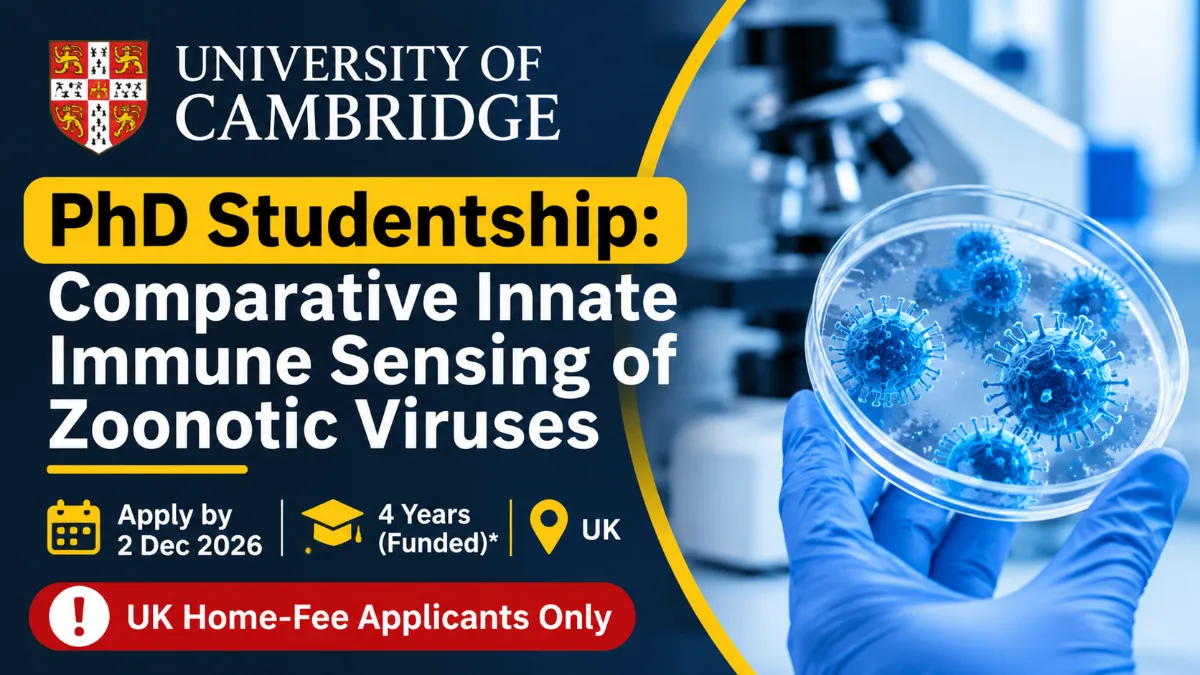
The University of Cambridge, through its Department of Pathology, is inviting applications for a four-year PhD studentship investigating how the immune systems of different animal species recognise and respond to viruses that can cross species barriers.
The research project, titled Comparative Innate Immune Sensing of Zoonotic Viruses, will be supervised by Professor Brian Ferguson. It is part of the Department of Pathology's funded doctoral research opportunities, with the successful candidate expected to begin in October 2027.
The project addresses an important question in infectious disease research: why do some viruses cause severe illness when they infect a new animal species, while others produce less severe infections or fail to establish themselves?
Viruses that move between animals and humans are known as zoonotic viruses. Their emergence can lead to outbreaks and, in some cases, serious public health threats. However, the outcome of infection is not determined by the virus alone. The immune system of the infected host also plays a major role in determining whether a virus is detected, controlled or able to spread.
This PhD will investigate differences in the early immune-recognition mechanisms of different host species. By comparing how their cells detect viral material and activate immune responses, the researcher will help identify biological factors that influence cross-species infection, viral adaptation and the emergence of zoonotic diseases.
The studentship is particularly relevant to applicants interested in virology, immunology, molecular biology, infectious diseases, host-pathogen interactions and comparative biology.
Important eligibility restriction: The studentship is funded for applicants who qualify for UK Home-rate tuition fees only. Although the project is based in the UK and may be of interest to international researchers, applicants who are required to pay overseas tuition fees are not eligible under this particular funding arrangement.
1. Understanding the research project
When a virus enters an animal or human body, the immune system must recognise that something foreign is present and activate protective responses.
One of the body's earliest defence mechanisms is the innate immune system. Unlike adaptive immunity, which develops more specialised responses after exposure, innate immunity provides an immediate system of defence against invading pathogens.
A central part of this early defence involves proteins called pattern recognition receptors (PRRs).
These receptors recognise molecular features associated with viruses and other pathogens. Once they detect viral material, they activate signalling pathways that help the infected cell and surrounding tissues respond to the infection.
However, these recognition systems are not necessarily identical across animal species.
A virus that is efficiently detected by the immune system of one species may interact differently with the immune system of another. Differences in receptor structure, signalling strength and immune regulation may influence whether the virus can establish an infection, reproduce, evade immune detection or cause severe disease.
The PhD project will investigate these differences using comparative approaches in molecular virology and immunology.
The findings may improve understanding of why certain viruses can cross species barriers and why the severity of infection can vary between hosts.
2. What the researcher will investigate
The project will examine how differences in pattern recognition receptor signalling influence viral infection and host responses across species.
The main research questions include:
How do different species recognise viral infections?
The researcher will compare the pattern recognition receptor pathways involved in detecting viral material in different host species. This will help identify which immune-recognition mechanisms are conserved across species and which show important differences.
How do immune-signalling pathways influence infection outcomes?
After a virus is detected, immune cells activate signalling pathways that regulate antiviral responses. The project will examine how differences in the strength and regulation of these signals affect the outcome of infection.
Why can a virus behave differently in different hosts?
A virus may infect more than one species but produce different disease outcomes. The research will investigate how variations in host immune recognition and downstream responses contribute to these differences.
How do viruses avoid immune detection?
Some viruses have developed mechanisms that interfere with the host's immune response. These mechanisms are often described as viral immune evasion.
The project will investigate how viruses evade or manipulate innate immune responses and whether these strategies work differently depending on the immune system of the host species.
What determines whether a virus can cross a species barrier?
By combining comparative immunology and molecular virology, the research aims to identify biological factors that may help explain why some viruses adapt successfully to new hosts while others do not.
The broader objective is to improve understanding of the molecular interactions that determine the outcome of cross-species viral infections.
3. Main scientific areas covered by the PhD
The project brings together several areas of biomedical and biological research.
A. Innate immunology
The researcher will investigate the body's early defence mechanisms, particularly the processes through which cells recognise viral infections and initiate immune responses.
This includes understanding how pattern recognition receptors detect viral components and activate intracellular signalling pathways.
B. Pattern recognition receptor signalling
Pattern recognition receptors are important components of the innate immune system. Different receptors recognise different molecular features of pathogens.
The research will compare these pathways across host species to determine how differences in receptor activity and downstream signalling affect antiviral responses.
C. Molecular virology
Molecular virology examines viruses at the molecular and cellular levels, including how they enter host cells, replicate, interact with host proteins and influence cellular functions.
This project uses molecular virology to understand the relationship between viral characteristics and the immune systems of different hosts.
D. Host-pathogen interactions
Host-pathogen interaction research examines how infectious organisms and their hosts influence one another.
In this project, the focus is on how host immune systems respond to viral infections and how viruses may adapt to or interfere with those responses.
E. Comparative biology
The comparative approach is important because the research is not limited to one host species. It will examine similarities and differences in immune-recognition pathways across different animals.
Understanding these differences may provide insight into why certain pathogens can infect multiple species and how their behaviour changes when they enter a new host.
4. Why this research matters
Understanding zoonotic viruses is important because emerging infectious diseases can have consequences for human health, animal health, agriculture and global public health.
The ability of a virus to move from one species to another is influenced by several factors, including the compatibility between the virus and the biological systems of its new host.
Innate immune recognition is one of the mechanisms that can determine whether an infection is controlled or progresses.
The research may contribute to:
Better understanding of the early immune responses involved in viral infections.
Identification of differences in immune-recognition mechanisms across animal species.
Improved knowledge of how viruses evade or manipulate host immune defences.
A clearer understanding of the biological factors associated with cross-species viral transmission.
Research that may support future approaches to predicting and preventing the emergence of novel viral pathogens.
The project is fundamental biomedical research. It is not an advertised clinical trial or a direct vaccine-development position. Its primary focus is understanding the molecular and immunological mechanisms behind viral infection and host responses.
5. Funding and financial support
The University of Cambridge describes the Pathology studentships as fully funded opportunities.
For this particular studentship, the advertised financial support covers:
A doctoral maintenance stipend at the current Research Council rate.
University tuition fees at the UK Home fee rate.
Funding for four years, beginning in October 2027.
The stipend is intended to support the student's living expenses during the doctoral programme.
Important: Who can receive this funding?
The official vacancy explicitly states that the studentship is available only to applicants who qualify for UK Home-rate tuition fees.
This means that an applicant's nationality alone does not determine eligibility. Their fee status must meet the university's Home-fee criteria.
Applicants who are classified as overseas fee-paying students cannot assume that the studentship will cover their international tuition fees. The vacancy states that applications from ineligible candidates will not be considered.
Before applying, check your fee status using the university's official guidance:
The university is looking for applicants with a strong academic background in a relevant subject.
Applicants should hold, or expect to obtain, the equivalent of a UK upper second-class honours degree (2:1) or higher in an undergraduate honours degree or Master's degree in a relevant discipline.
Relevant academic backgrounds may include:
Immunology.
Virology.
Molecular Biology.
Microbiology.
Biomedical Sciences.
Biochemistry.
Medical Sciences.
Infection Biology.
Biological Sciences.
Veterinary Sciences.
Other closely related biomedical or biological disciplines.
Applicants should also meet the University of Cambridge's admission requirements for the PhD in Pathology.
English-language requirements
The Department requires potential students to have fulfilled the English-language requirements for admission by the time of interview.
Applicants should review the relevant requirements before submitting their application, particularly if their previous degree was not taught in English or they are required to provide an approved English-language test result.
Applicants must qualify for UK Home tuition fees. The university will not consider applications from candidates who do not meet this funding eligibility requirement.
Being academically qualified or having a relevant Master's degree does not override the fee-status restriction.
7. What applicants should demonstrate
A strong application should show more than an interest in viruses or infectious diseases.
The project involves specialised research in molecular biology and immunology. Applicants should explain how their academic training, research experience and scientific interests prepare them for doctoral work in this area.
Useful areas to address include:
Understanding of immunology: Explain your knowledge of innate immunity, immune recognition, inflammatory responses or antiviral defence mechanisms, where applicable.
Molecular biology experience: Describe relevant laboratory training or research involving molecular techniques, cellular processes, proteins, genes or pathogen-host interactions.
Knowledge of virology or microbiology: Explain any previous study or research involving viruses, microorganisms, infectious diseases or host-pathogen relationships.
Research experience: Discuss your undergraduate or Master's research, laboratory projects, dissertations, publications or other relevant scientific work.
Scientific motivation: Explain why you want to investigate comparative immune responses and how this research connects with your longer-term academic or professional interests.
Applicants should be honest about their experience. A strong application explains what the candidate has actually studied or done rather than claiming laboratory techniques or research expertise they have not acquired.
8. Application documents and procedure
Applications must be submitted online through the University of Cambridge's Applicant Portal for the PhD in Pathology (BLPA22).
The university requires a complete application by the deadline.
Prepare the following:
Academic transcripts: Provide records of your previous university education, showing the courses completed and grades obtained.
Degree certificates: Upload the relevant certificates or evidence of expected completion, where applicable.
Two academic references: The university requires two academic references. Your referees must submit their references before the studentship closing date.
Motivation statement: Explain why you want to pursue a PhD in this research area.
Research interests and background: Describe your academic interests and previous experience relevant to the project.
Relevant qualities and experience: Explain the skills, research experience and personal qualities you would bring to the role.
English-language evidence: Ensure you meet the department's language requirements by the interview stage, as required.
The vacancy specifically asks applicants to explain their motivation for pursuing a PhD in this area, outline their research interests and background, and describe the qualities and experience they would bring to the position.
How to submit your application
Step 1: Check your fee status.
Before beginning the application, confirm that you qualify for UK Home tuition fees. This is essential for this particular studentship.
Step 2: Review the PhD in Pathology admission requirements.
Visit the course page and read the academic and English-language requirements.
Step 4: Prepare your research motivation statement.
Explain why comparative innate immune sensing interests you, what relevant scientific background you have and how your previous research has prepared you for doctoral study.
Step 5: Arrange two academic references.
Contact your referees early. Your application is not considered complete until both academic references and all other supporting documents have been received.
Step 6: Submit before the deadline.
Quote reference PK51376 in your application and in correspondence about the studentship.
9. Selection process
The Department of Pathology will assess applications against the academic and research requirements of the project.
Applicants should be prepared to discuss their academic background, scientific interests, research experience and motivation for pursuing doctoral research in comparative immunology and virology.
The department requires applicants to have met the applicable English-language requirements by the interview stage.
The university encourages applications from all sections of society and actively supports equality, diversity and inclusion.
10. Important dates
Activity
Date
Vacancy published
12 October 2026
Application deadline
2 December 2026
Expected start date
October 2027
Studentship duration
4 years
Deadline reminder: All supporting documents, including both academic references, must be submitted by 2 December 2026. Applicants should not wait until the final day to contact their referees.
Important note for applicants
This is a specialised four-year doctoral research opportunity in comparative immunology and virology. It may be particularly attractive to graduates with strong backgrounds in molecular biology, microbiology, immunology, biomedical sciences and related disciplines.
However, the funding is restricted to applicants who qualify for UK Home tuition fees. Applicants should confirm their fee status before preparing their application. The official University of Cambridge vacancy announcement is the final authority on eligibility and funding conditions.
Related Opportunities
Explore other scholarships, fellowships, grants, research opportunities and more that may match your interests.