Pierre Elliott Trudeau Foundation Scholarship 2027
Offered by Pierre Elliott Trudeau Foundation
Location
Canada
Funding
Fully Funded
Study level
PhD
Field of study
Social Sciences
Application deadline
November 6, 2026
About This PhD and Research Opportunity
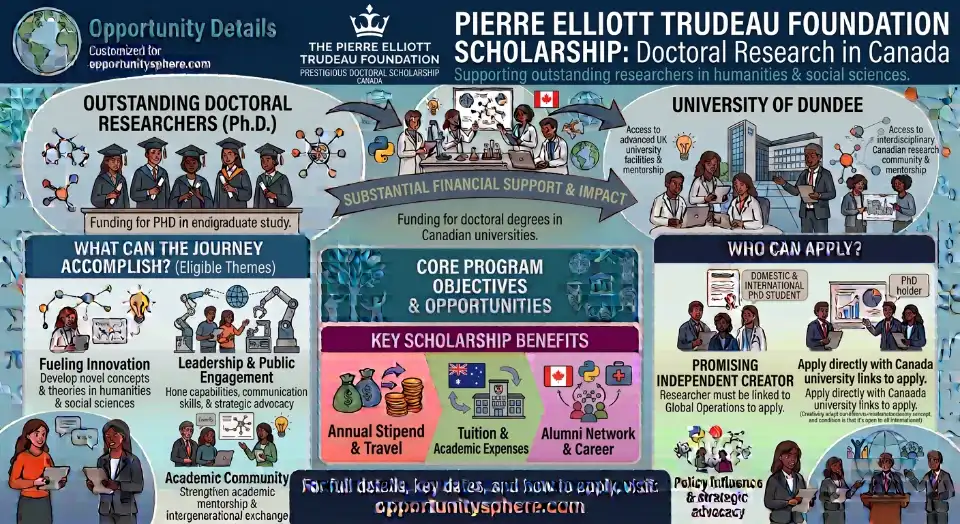
The Pierre Elliott Trudeau Foundation Scholarship is a prestigious doctoral funding programme supporting outstanding researchers whose work addresses important social, political, cultural and environmental questions. The programme is designed for PhD students in the humanities and social sciences whose research connects with the Foundation’s mission and its four foundational themes.
Unlike funding programmes that focus primarily on academic grades or a narrowly defined research discipline, the Foundation looks for scholars who can combine academic excellence with intellectual curiosity, leadership potential, meaningful engagement with society and the ability to communicate research beyond the university environment.
The scholarship is intended to help doctoral researchers develop both as academics and as engaged contributors to public life. In addition to financial support, successful scholars participate in a community of researchers, mentors and professionals from different disciplines and sectors. This environment can help scholars explore how research informs public discussion, institutional decision-making and responses to complex societal challenges.
The programme is particularly relevant to doctoral students whose work has implications beyond a single academic discipline. For example, a research project may examine the relationship between environmental change and rural livelihoods, the effects of public policy on vulnerable communities, the role of citizenship in democratic participation, or the relationship between international cooperation and human rights. Such examples illustrate possible areas of relevance; eligibility depends on the actual research question and its alignment with the Foundation’s themes.
Scholarship Benefits and Financial Support
The Foundation publishes two main forms of financial support for its doctoral scholars.
1. Annual Stipend: Up to CAD 50,000
Scholars may receive up to CAD 50,000 per year for three years to support tuition and living expenses during their doctoral studies.
This support can help scholars manage costs associated with university study and everyday living. The amount awarded is subject to the Foundation’s rules and may be adjusted when a scholar receives other funding.
2. Research, Travel and Networking Allowance: Up to CAD 20,000 per Year
Scholars may also receive up to CAD 20,000 annually for three years to support research-related activities, travel, networking and participation in Foundation programming.
This allowance is intended to help scholars pursue relevant academic and professional activities connected with their doctoral projects. Applicants should review the Foundation’s terms to understand which expenses qualify and what documentation or approval may be required.
3. Maximum Potential Value of CAD 210,000
The maximum published value is calculated as follows:
Up to CAD 50,000 annually for three years: CAD 150,000.
Up to CAD 20,000 annually for three years: CAD 60,000.
Maximum combined value: CAD 210,000 over three years.
This is the maximum potential package, not a guarantee that every recipient will receive the full amount. The stipend may be adjusted according to the Foundation’s rules on other funding, and the additional allowance is intended for eligible research, travel and networking expenses rather than unrestricted personal spending.
4. Leadership Development and Mentorship
The programme places importance on leadership, public engagement and the ability to connect academic knowledge with real-world challenges. Scholars benefit from opportunities to interact with mentors and professionals and to develop skills that complement their formal doctoral training.
These experiences can help scholars strengthen their ability to explain complex research, work with people from different professional backgrounds and consider how their findings may contribute to society.
5. An Interdisciplinary Research Community
Scholars join a network that brings together people working across academic disciplines and professional sectors. This community provides opportunities to exchange ideas, develop collaborations and learn how different fields approach shared challenges.
For doctoral researchers, interdisciplinary engagement can be particularly valuable when a project involves several connected issues, such as climate change, governance, public health, inequality, migration or international development.
6. Professional Networking and Alumni Connections
The Foundation’s wider network includes scholars, mentors, fellows and alumni. Membership can help recipients establish professional relationships and identify opportunities for collaboration beyond their immediate research group.
These connections may be useful when researchers seek to communicate findings to non-academic audiences, work with community organisations or explore how their research relates to policy and practice.
Understanding the Foundation’s Four Research Themes
Applicants must demonstrate that their doctoral research aligns with at least one of the Foundation’s four foundational themes.
1. Human Rights and Dignity
This theme concerns the protection of human dignity, rights, equality and the conditions that enable individuals and communities to participate fully in society.
Potentially relevant research may examine access to justice, discrimination, social inclusion, human rights protections, displacement, the treatment of marginalised populations or the relationship between public institutions and individual rights.
Applicants working in this area should explain the specific human-rights question their research addresses and why the issue matters beyond an academic discussion.
2. Responsible Citizenship
Responsible citizenship concerns the responsibilities, relationships and forms of participation through which people contribute to public life and collective well-being.
Possible research areas include civic participation, democratic institutions, public trust, community engagement, political inclusion, social responsibility and the role of citizens in shaping public policy.
A strong application should make clear how the research contributes to understanding citizenship or the ways individuals and institutions respond to shared challenges.
3. Canada and the World
This theme considers Canada’s place in the international community and the relationships between Canada and global developments.
Potentially relevant topics include international relations, diplomacy, migration, global governance, international cooperation, development policy and cross-border social or political challenges.
International research can be relevant when it clearly connects with the theme and addresses issues important to Canada’s future. Applicants should explain that connection rather than assuming that any international or comparative project automatically qualifies.
4. People and Their Natural Environment
This theme focuses on relationships between people, societies and the natural environment.
Potential research areas include climate change, environmental governance, biodiversity, natural-resource management, sustainability, environmental justice, food systems and the social consequences of environmental change.
For example, a project on how changing environmental conditions affect rural livelihoods could be relevant if it has a clear research question, a sound methodology and a strong connection to the Foundation’s theme.
Applicants should identify the theme most closely connected to their work and explain how the research contributes to understanding or addressing the issue. Projects may have interdisciplinary dimensions, but the connection should be demonstrated clearly.
Eligibility Criteria
The Foundation’s published eligibility requirements for the 2027 competition include the following.
1. Doctoral Study Status
Applicants must be in the first or second year of their PhD programme at the time of application. Applicants should confirm how the Foundation defines doctoral year and whether their enrolment circumstances meet the competition rules.
2. Eligible Field of Research
The research must be broadly related to the humanities or social sciences and address issues relevant to Canada’s future. Applicants must also demonstrate alignment with at least one of the Foundation’s four foundational themes.
A department’s name alone does not determine eligibility. Research conducted in an interdisciplinary department may qualify if the actual doctoral project meets the Foundation’s requirements.
3. Citizenship and University Enrolment
The Foundation identifies three eligible applicant categories:
Canadian students enrolled at a Canadian university.
Canadian students enrolled at a university outside Canada.
International students enrolled at a Canadian university.
International students enrolled at universities outside Canada are not eligible under the published requirements.
For international applicants, this means that being interested in Canadian research or having an overseas supervisor is not enough. The university-enrolment condition must also be satisfied.
4. Academic Excellence
Applicants should demonstrate strong academic achievement, intellectual ability and research potential. The Foundation assesses the overall application, including academic records and recommendation letters.
Academic excellence is important, but applicants should not rely on grades alone. They should also explain the quality, significance and feasibility of their research and show how their work relates to the Foundation’s mission.
5. Leadership and Social Engagement
The Foundation seeks candidates who demonstrate leadership potential, a commitment to society and an interest in making a meaningful contribution beyond academia.
Leadership can be demonstrated through relevant work, community engagement, collaboration, professional responsibilities, knowledge-sharing activities or initiatives connected to the applicant’s research. Applicants should describe their actual contributions and avoid exaggerating their roles.
6. Three Reference Letters
The application requires three references:
One from the applicant’s PhD supervisor.
One from another academic referee.
One from a referee outside academia.
Applicants should follow the Foundation’s instructions for selecting and submitting these references. All three must be received by the stated deadline.
Application Process: Two Stages
The 2027 competition introduced a two-stage application process. Completing the eligibility-verification form was the first step; it was not the complete scholarship application.
Stage 1: Eligibility Verification
Prospective applicants were required to review the official eligibility criteria and submit the eligibility-verification request by 2 October 2026.
The Foundation uses this step to confirm whether applicants meet the basic requirements for the competition. Only applicants whose eligibility is confirmed can proceed to the full application.
Because the deadline has passed, applicants should check their email and application correspondence if they submitted a request. Those who did not submit one should contact the Foundation to ask whether any option remains available.
Stage 2: Full Scholarship Application
Applicants whose eligibility has been confirmed can proceed to the full application using the instructions provided by the Foundation.
The full application should communicate the applicant’s academic background, doctoral research, alignment with the Foundation’s themes and potential for meaningful engagement beyond academia. Applicants should follow the current form carefully and provide all required information and documents.
Mandatory Information Sessions
The Foundation’s 2027 application page lists mandatory information sessions during the weeks of 5 October and 12 October 2026.
Applicants who received eligibility confirmation should check their invitations and instructions to determine which session they must attend and how attendance is recorded. They should not assume that reading the application guidance alone fulfils a mandatory participation requirement.
Reference Letters
The deadline for receipt of all three references is 30 October 2026 at 9:00 a.m. Eastern Time.
Applicants should contact referees early, explain the purpose of the scholarship and provide a concise summary of the doctoral project and relevant achievements. The PhD supervisor should be able to discuss the research and the applicant’s academic development. The second academic referee should provide an independent assessment, while the non-academic referee should be able to speak to relevant engagement, leadership or contributions outside academic work.
Applicants should confirm that referees understand the submission process and deadline. A promise to submit a letter is not the same as a letter being received by the Foundation.
Complete Application Deadline
The Foundation’s main 2027 application page lists 6 November 2026 at 5:00 p.m. Eastern Time as the deadline for submitting the complete application.
Because some university guidance pages have displayed a different time, applicants should follow the deadline and time shown in the official application portal and any direct instructions from the Foundation. Do not wait until the final hour to submit.
How to Prepare a Strong Scholarship Application
1. Explain the Research Problem Clearly
Begin by identifying the specific problem or question your doctoral research addresses. Explain why it matters, what is not yet adequately understood and how your work will contribute new knowledge.
Avoid describing the project only in broad terms. A focused explanation helps reviewers understand what you intend to investigate and why the research is worthwhile.
2. Demonstrate Alignment With a Foundation Theme
Identify the foundational theme that most directly relates to your research. Explain the connection explicitly and support it with the research question, objectives and anticipated contribution.
Do not simply repeat the theme’s name. Show how the project advances understanding of the issue and why the connection is meaningful.
3. Establish Academic Quality and Feasibility
Explain the research approach, methods, data or materials needed, and the steps required to complete the work. Demonstrate that the project is achievable within the doctoral programme and that the methodology is appropriate for the question.
Where relevant, describe progress already made, preliminary findings or access to the resources needed for the project. Only include information that is accurate and supportable.
4. Show Potential for Broader Impact
The Foundation values research that can contribute to society beyond the university. Explain who may benefit from the research, how the findings could be communicated and what practical or intellectual contribution the work may make.
Avoid promising outcomes that the research cannot guarantee. A realistic explanation of potential impact is more credible than unsupported claims of transformation.
5. Provide Concrete Evidence of Leadership
Describe specific examples of leadership, collaboration, service, outreach or knowledge sharing. Explain your role, what you contributed and what you learned.
Applicants do not need to present themselves as experts in every area. The aim is to demonstrate genuine engagement, initiative, responsibility and the capacity to work constructively with others.
6. Choose Referees Strategically
Select people who know your work well enough to provide detailed, credible assessments. Discuss the scholarship requirements with them and give them sufficient time to prepare their letters.
For the non-academic reference, choose someone who can speak meaningfully about your engagement or leadership outside academia, in line with the Foundation’s requirements.
7. Check Consistency Across the Application
Ensure that the research description, objectives, proposed contribution and theme alignment tell a coherent story. The application should make it easy for reviewers to understand what you plan to study, why it matters and why you are well positioned to carry it out.
Proofread the application and verify all dates, programme details and supporting information before submission.
Documents and Information to Prepare
Applicants should use the official application checklist as the definitive guide. Depending on the form’s requirements, preparation may involve:
Academic history and transcripts.
Details of the doctoral programme and university enrolment.
A clear description of the doctoral research project.
An explanation of alignment with one or more Foundation themes.
Information demonstrating academic achievement and research potential.
Examples of leadership, engagement or knowledge sharing.
Details for the PhD supervisor and other academic referee.
Details for a non-academic referee.
Any additional documents or information requested in the official application form.
This is a preparation guide, not a guarantee that every item listed is required in precisely this format. Follow the Foundation’s current instructions and do not substitute optional documents for required application materials.
Can International Students Apply?
Yes. International students may be eligible if they are enrolled in a doctoral programme at a Canadian university and meet the other requirements.
The Foundation also allows eligible Canadian students enrolled at universities outside Canada to apply. However, international students enrolled outside Canada are not eligible under the published criteria.
International applicants should verify their enrolment status and the location of their doctoral university before investing time in the application.
Frequently Asked Questions
1. Is the Pierre Elliott Trudeau Foundation Scholarship fully funded?
The scholarship provides up to CAD 50,000 annually for tuition and living expenses and up to CAD 20,000 annually for eligible research, travel and networking activities for three years. The maximum published package is CAD 210,000. Actual funding is subject to the Foundation’s award rules and adjustments for other funding.
2. Can students from Nigeria apply?
Nigerian applicants may be eligible if they are international students enrolled in a doctoral programme at a Canadian university and meet all other criteria. Nigerian citizenship alone does not establish eligibility, and international students enrolled at universities outside Canada are not eligible under the published rules.
3. Can I apply if I am in the third year of my PhD?
The 2027 competition is for students in the first or second year of their doctoral programme at the time of application. Applicants should consult the Foundation’s official criteria if their enrolment circumstances require interpretation.
4. Must my research be entirely within one discipline?
No single department label determines eligibility. The Foundation considers research broadly related to the humanities and social sciences, including relevant interdisciplinary projects. The work must align with at least one of the four foundational themes.
5. How many references are required?
Three references are required: one from the PhD supervisor, one from another academic referee and one from a referee outside academia.
6. Can I still submit the eligibility-verification form?
The published deadline was 2 October 2026, which has passed. Contact the Foundation directly if you missed it, but do not assume that late requests will be accepted.
7. When are the references due?
The stated deadline for receipt of all three references is 30 October 2026 at 9:00 a.m. Eastern Time.
8. When is the complete application due?
The Foundation’s main 2027 application page lists 6 November 2026 at 5:00 p.m. Eastern Time. Applicants should follow the live portal and direct instructions from the Foundation if they display a specific deadline.
9. Does the scholarship include leadership development?
Yes. The programme includes opportunities for leadership development, mentorship, interdisciplinary exchange and participation in the Foundation’s scholar community.
10. Does receiving another scholarship affect the award?
It can. The Foundation states that the value of its scholarship is adjusted according to other funding received, subject to its rules. Applicants should declare additional funding as required and review the official terms.
Final Advice
The Pierre Elliott Trudeau Foundation Scholarship is intended for doctoral researchers who combine academic excellence with a clear research purpose, engagement with important societal issues and the potential to contribute beyond academia. Its financial package can provide substantial support, while its leadership and interdisciplinary components offer additional opportunities for professional development.
For the 2027 competition, the first step was eligibility verification, and the 2 October 2026 deadline has passed. Applicants who already received confirmation should now concentrate on meeting the mandatory participation requirements, ensuring all three references arrive on time and completing the full application before the official deadline.
Related Opportunities
Explore other scholarships, fellowships, grants, research opportunities and more that may match your interests.