The application deadline for this opportunity has passed. You can still review the details, but the listing is no longer presented as open for applications.
Grant
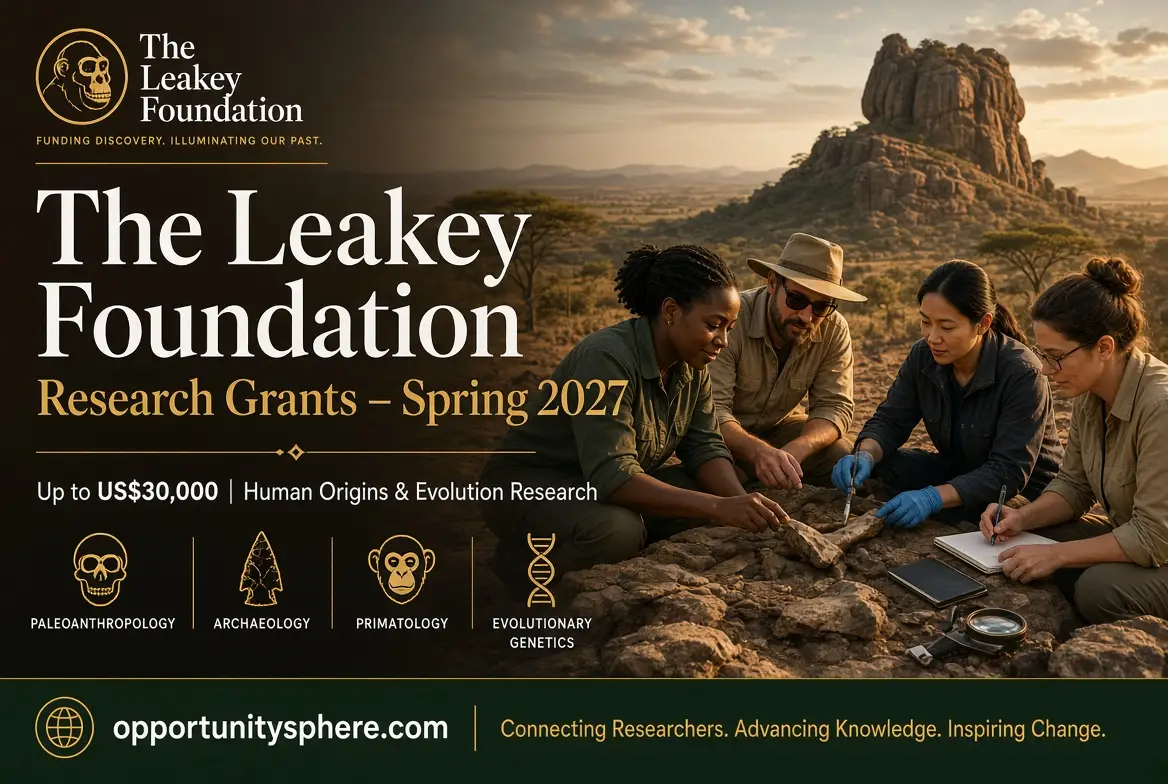
Leakey Foundation Research Grants – Spring 2027 | Funding of Up to US$30,000 for Human Origins Research
Offered by The Leakey Foundation
Location
Worldwide
Funding
Paid
Study level
PhD, Researchers
Field of study
Environmental Sciences, Life Sciences, Natural Sciences
Application deadline
January 10, 2026
Application Closed
About This Grant
The Leakey Foundation invites applications for its Spring 2027 Research Grants, supporting innovative scientific investigations into human origins, evolution and behaviour. The programme provides research funding to advanced doctoral candidates and established researchers working in disciplines that contribute to understanding the evolutionary history of humans and our closest living relatives.
The foundation supports both PhD dissertation research and postdoctoral investigations, with particular interest in exploratory research, innovative approaches and multidisciplinary projects that can expand scientific understanding of the human story.
Its research grant programme covers several scientific disciplines, including archaeology, biological anthropology, paleoanthropology, primate behavioural ecology, genetics, geology, anatomy, morphology, paleobotany and paleoclimatology.
The foundation's work is based on the understanding that studying human origins requires evidence from different scientific fields. Fossil discoveries, archaeological materials, genetic information, environmental records, anatomical studies and observations of living primates can all contribute to explaining how humans evolved, adapted and developed different forms of behaviour.
Through this funding opportunity, researchers can obtain financial support for essential project activities such as fieldwork, research travel, field living expenses, supplies and other eligible research costs.
The Spring 2027 application cycle has a deadline of 10 January 2027. Successful PhD candidates may receive up to US$20,000, while researchers who already hold a PhD may request up to US$30,000.
Research Areas and Funding Priorities
The Leakey Foundation exclusively supports research relevant to human origins and evolution. Applicants must demonstrate a clear connection between their proposed investigations and the scientific questions underlying the foundation's mission.
🔒Application Closed
The listed deadline has passed. Check the official website to see whether the organisation has announced an extension or a new application period.
Stay in the loop
Your Next Opportunity Could Be One Email Away
Receive updates about scholarships, jobs, internships, fellowships and grants so you can discover opportunities worth exploring.
Stay Updated
Never miss an opportunity.
Get updates on scholarships, jobs, internships, grants, fellowships, conferences, and other opportunities delivered straight to your inbox.
Its current research priorities include the following areas:
1. Paleoanthropology of the Miocene, Pliocene and Pleistocene
The foundation supports research investigating the evolutionary history of early humans and their ancestors through the study of fossils, archaeological evidence, geological records and other relevant materials from different prehistoric periods.
The Miocene, Pliocene and Pleistocene epochs represent important stages in the history of primate and human evolution. Research in this area may investigate early hominins, evolutionary relationships, anatomical changes, environmental conditions and the development of behaviours associated with human ancestry.
Relevant projects may involve fossil analysis, archaeological investigations, comparative anatomy, geological studies and the interpretation of evidence from prehistoric environments.
2. Primate Evolution, Behaviour, Morphology and Ecology
Research involving non-human primates is another major priority because understanding their evolutionary history, behaviour and biological characteristics can provide important insights into primate evolution and the evolutionary context of humans.
Supported research areas include:
Primate evolution and evolutionary relationships.
Behavioural ecology and social organisation.
Primate morphology and comparative anatomy.
Reproductive and feeding behaviour.
Primate endocrinology and hormonal studies.
Primate genetics and evolutionary biology.
Isotope studies and other approaches to understanding diet, movement and environmental adaptation.
Ecological factors influencing primate behaviour and survival.
Projects may investigate wild primate populations, their social interactions, feeding patterns, habitat use, reproductive systems and adaptations to environmental conditions.
Researchers may also examine how behavioural and biological characteristics vary between primate species and populations.
3. Modern Hunter-Gatherer Groups
The foundation also identifies research involving contemporary hunter-gatherer populations as a funding priority.
Studies in this area may investigate human behaviour, subsistence strategies, social organisation, adaptation to different environments and other questions relevant to understanding human origins and evolution.
Researchers should demonstrate how their proposed investigation contributes to broader scientific questions about human evolutionary history rather than presenting a general social or cultural study without a clear connection to the foundation's mission.
Who Is Eligible to Apply?
The grants are open to qualified researchers from any country. There are no citizenship or nationality restrictions, meaning eligible researchers from Africa, Europe, Asia, the Americas and other regions may submit applications.
However, the foundation has specific academic and institutional requirements.
Advanced PhD candidates
Doctoral researchers may apply for dissertation research funding if they have advanced to candidacy, meaning they have completed all doctoral requirements apart from the dissertation or thesis.
The foundation also allows students who have not yet formally advanced to candidacy to apply if they expect to achieve that status before funding decisions are made. For the Spring cycle, applicants in this situation must expect to advance before the foundation's April funding decisions and should notify the grants office once they have advanced.
PhD candidates may request up to US$20,000.
Post-PhD researchers
Researchers who already hold a PhD or equivalent qualification in anthropology or a related discipline may apply for funding to conduct relevant research.
This category includes postdoctoral researchers and senior scientists undertaking investigations that contribute to understanding human origins, evolution or behaviour.
Post-PhD applicants may request up to US$30,000.
Institutional affiliation
Applicants must be affiliated with a recognised university, museum or research institution.
The Leakey Foundation does not provide grants directly to unaffiliated individuals. Applicants should therefore ensure that their institutional affiliation and the arrangements for administering the grant are clearly established before applying.
International applicants
Researchers do not need to be citizens or residents of the United States. Applications are accepted from eligible researchers worldwide, provided their research falls within the foundation's scientific priorities and they meet the academic and institutional requirements.
Who is not eligible?
The research grants are not intended for undergraduate students or Master's students. Applicants must either hold a PhD or be enrolled in a doctoral programme and satisfy the foundation's advanced-candidacy requirements or the permitted expected-candidacy arrangement.
The foundation also does not generally support projects that are unrelated to human origins and evolution. A proposal may be scientifically valuable but still fall outside the programme if it does not establish a direct connection to the foundation's mission.
Funding Amount and What the Grant Covers
The foundation provides different funding limits depending on the applicant's academic stage:
PhD candidates: Up to US$20,000.
Post-PhD researchers: Up to US$30,000.
The grant is intended to cover expenses directly related to conducting the proposed research and essential to completing the project.
Eligible expenses may include:
Research and fieldwork travel: Transportation required to reach research sites, collect data, conduct field investigations or access relevant research materials.
Fieldwork living expenses: Reasonable living expenses incurred while undertaking approved research activities away from the applicant's usual location.
Research supplies and materials: Consumables and other supplies necessary for carrying out the proposed investigations.
Research assistance and other essential research costs: Relevant project expenses that are necessary for the successful completion of the research and permitted under the foundation's guidelines.
Applicants must prepare budgets that clearly connect each requested expense to the proposed research activities.
Expenses the grant does not cover
The foundation specifically excludes several categories of expenditure. Applicants should not include the following as requested grant costs:
Salary and fringe benefits for the applicant or senior project personnel.
Childcare expenses.
Equipment purchases.
Travel to academic meetings or conferences.
Institutional overhead and indirect administrative costs.
Publication costs.
Institutional support costs.
Tuition fees.
The foundation also does not provide funding for dissertation writing or general publication assistance.
The grant is administered through an affiliated institution, and institutions are not permitted to deduct overhead or administrative charges from the award.
Research Proposal and Application Requirements
Applicants must prepare a research proposal that demonstrates scientific merit, relevance to human origins and evolution, methodological strength and practical feasibility.
The foundation evaluates proposals based on factors including the scientific importance of the research, the appropriateness of the methods, the feasibility of the proposed activities, the project budget, the qualifications of the investigators and the relevance of the research to understanding human origins.
Applicants should therefore pay particular attention to the following areas when developing their proposals.
1. Research problem and objectives
Clearly explain the scientific question the proposed study intends to answer.
The research problem should be directly related to human origins, evolutionary history, primate biology or another area identified in the foundation's funding priorities.
Applicants should establish why the investigation is necessary and how the expected findings could contribute to existing scientific knowledge.
2. Literature review and scientific background
Demonstrate an understanding of previous research relating to the proposed subject.
Identify important scientific findings, unresolved questions and areas where further investigation is required.
The proposal should show how the planned research builds on existing evidence and contributes something meaningful to the field.
3. Research methodology
Explain how the proposed research will be conducted.
Depending on the discipline and project, relevant methods may include fossil analysis, archaeological excavation, genetic analysis, comparative anatomy, behavioural observation, ecological surveys, geological investigation, isotope analysis and other appropriate scientific techniques.
Applicants should explain their study design, research materials, data collection procedures and analytical approaches.
4. Research feasibility
Demonstrate that the proposed project can realistically be completed with the available time, institutional support and requested funding.
Researchers should consider access to research sites, permits, laboratory facilities, fieldwork arrangements, research materials and other practical requirements.
5. Detailed research budget
Prepare a realistic budget showing how the requested funding will support the proposed research.
All requested costs should be directly connected to the project, necessary for completing the research and consistent with the foundation's eligible expenditure rules.
Applicants should not include prohibited expenses such as personal salaries, equipment, tuition, conference travel or institutional overhead.
6. Applicant qualifications and institutional affiliation
The proposal should be supported by the applicant's relevant academic experience, research background and institutional affiliation.
Researchers should ensure that their qualifications and experience are appropriate for the proposed work and that the institution can administer the grant.
How Applications Are Reviewed
The Leakey Foundation uses a scientific review process to assess applications.
The grants department first checks submissions for completeness and eligibility. Proposals that meet the initial requirements are then considered through a scientific peer-review process involving researchers with relevant expertise.
The foundation's Scientific Executive Committee evaluates proposals and peer-review feedback before making award recommendations to the Board of Trustees for approval.
Selection is competitive and depends on several considerations, including:
Scientific merit and originality.
Relevance to human origins and evolution.
Strength and appropriateness of the research methodology.
Feasibility of the proposed project.
Qualifications and research experience of the investigators.
Reasonableness of the proposed budget.
Available funding and the quality of the applicant pool.
Submitting an eligible application does not guarantee funding. Applicants should ensure that their proposals demonstrate a clear scientific contribution and a realistic plan for achieving the stated research objectives.
Application Instructions
Applications must be submitted online through the Leakey Foundation's official research grants page.
Interested researchers should follow these steps:
Visit the official Leakey Foundation Research Grants webpage.
Read the current application instructions and eligibility requirements carefully.
Download the latest application instructions and materials packet. The foundation requires applicants to use the updated version ending in 26.1; older versions may not be accepted.
Select the appropriate application route based on whether you are a PhD candidate or already hold a PhD.
Indicate whether the application is a new proposal or a resubmission.
Prepare the research proposal and supporting information in accordance with the current instructions.
Develop a detailed budget containing only eligible project expenses.
Submit the completed application through the online application system before the deadline.
The application portal provides separate submission routes for new and resubmitting PhD candidates, as well as new and resubmitting post-PhD applicants.
Important resubmission policy: The foundation introduced an updated rule under which proposals may be resubmitted only once, regardless of how many times they were submitted previously. Applicants considering resubmission should read the current instructions carefully.
Researchers who have previously received a Leakey Foundation grant may apply again, provided they have fulfilled all reporting and other obligations associated with their previous award.
Application Deadline and Notification
The deadline for the Spring 2027 application cycle is 10 January 2027.
The foundation indicates that applicants to the Spring cycle are normally notified of decisions in mid-May.
The foundation operates two regular research grant cycles each year:
Spring cycle: 10 January.
Fall cycle: 15 July.
Researchers should use the application instructions for the relevant cycle and submit their applications through the correct online portal.
Important Information for Applicants
This opportunity is particularly suitable for researchers working in paleoanthropology, biological anthropology, archaeology, primatology, genetics and related scientific disciplines.
However, the subject of the proposed research is just as important as the applicant's academic qualification. The foundation exclusively supports investigations related to human origins and evolution. General biological, agricultural, environmental or social science research without a clear connection to this mission will not normally qualify.
Applicants should also remember that the grant is intended for direct research expenditure and is not a personal scholarship, salary award or tuition-support programme.
The strongest applications will establish a clear scientific question, demonstrate the relevance of the study to human origins, use appropriate research methods and present a realistic budget.
For researchers undertaking relevant doctoral dissertation or postdoctoral investigations, the programme offers an opportunity to secure substantial support for fieldwork and other essential research activities while contributing to an important area of scientific discovery.
Related Opportunities
Explore other scholarships, fellowships, grants, research opportunities and more that may match your interests.