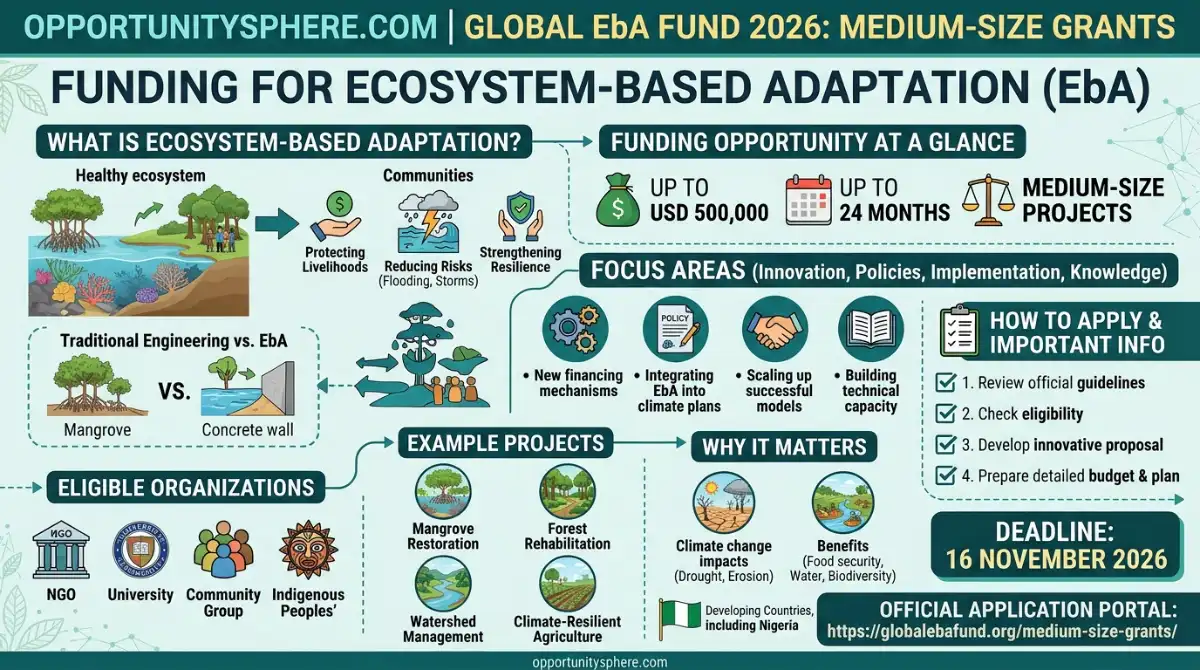
Global EbA Fund 2026 Medium-Size Grants – Funding of Up to $500,000 for Climate Adaptation Projects
Offered by Global Ecosystem-based Adaptation Fund (Global EbA Fund), supported by the International Union for Conservation of Nature (IUCN) and the United Nations Environment Programme (UNEP).
Location
Global (Eligible Developing Countries)
Funding
Fully Funded
Study level
Not Applicable
Field of study
Agriculture & Agricultural Sciences, Environmental Sciences, Other
Application deadline
November 16, 2026
About This Grant
The Global Ecosystem-based Adaptation (EbA) Fund 2026 Medium-Size Grants provide funding of up to USD 500,000 to eligible organisations developing innovative approaches to strengthen climate resilience through ecosystem protection, restoration and sustainable management.
The funding opportunity is designed to address a major challenge in climate adaptation: many promising ecosystem-based solutions exist, but they struggle to attract investment, influence government policies or expand beyond individual communities and pilot projects. Through this grant window, the Global EbA Fund aims to support initiatives that remove these barriers and create practical pathways for scaling up ecosystem-based adaptation.
Unlike conventional environmental grants that may concentrate primarily on conservation activities or direct field interventions, this funding opportunity places particular emphasis on innovation, institutional collaboration, policy influence, financing mechanisms and the wider adoption of ecosystem-based adaptation.
Understanding Ecosystem-based Adaptation
Ecosystem-based Adaptation (EbA) involves using biodiversity and ecosystem services as part of strategies that help people adapt to climate change. It connects environmental protection with the practical needs of communities whose livelihoods, safety and economic activities are affected by changing climatic conditions.
For example, mangrove restoration can reduce the vulnerability of coastal settlements to erosion, flooding and storm surges while supporting fisheries and other local livelihoods. Forest conservation and restoration can help regulate water flows, protect biodiversity and reduce land degradation. Similarly, restoring watersheds can improve water availability and strengthen the ability of agricultural communities to cope with irregular rainfall and drought.
However, the Global EbA Fund's Medium-Size Grants are not simply intended to finance routine tree planting, forest rehabilitation or other isolated conservation activities. Proposals must demonstrate how their interventions will address wider barriers to ecosystem-based adaptation, contribute to an enabling environment and generate results that can be sustained or replicated.
The Three Priority Areas of the 2026 Medium-Size Grants
The current funding window identifies three thematic priority areas. Applicants should understand these priorities and explain how their proposed projects contribute to the fund's objectives.
1. Innovative Finance Solutions for Ecosystem-based Adaptation
One major obstacle to scaling up ecosystem-based adaptation is the shortage of sustainable financing. Many nature-based interventions produce important environmental and social benefits but lack the investment structures needed to attract long-term financial support.
This priority area supports innovative approaches that mobilise private capital, blended finance and partnerships between environmental organisations, businesses, financial institutions and other stakeholders.
Relevant project approaches may include developing investment-ready business models for ecosystem restoration, creating financial partnerships that encourage private-sector participation in climate adaptation, and designing financing mechanisms that make sustainable land and ecosystem management economically viable.
For example, an organisation working with coastal communities could develop a financially sustainable model that connects mangrove conservation, local livelihoods and responsible private investment. The proposal would need to explain how the model can attract investment, deliver measurable adaptation benefits and remain viable beyond the grant period.
2. Ecosystem-based Adaptation for Human Development and Security
Climate change can intensify competition over natural resources, worsen existing vulnerabilities and increase pressure on communities already affected by insecurity, displacement or fragile economic conditions.
This priority area encourages projects that integrate ecosystem-based adaptation into human development, resilience and security strategies, particularly in fragile and conflict-affected settings.
Projects should identify specific environmental, financial, regulatory or institutional barriers that prevent investment in climate adaptation in high-risk areas. They should also explain how community-designed interventions can protect vulnerable populations, improve the management of shared natural resources and reduce climate-related pressures that may contribute to local tensions.
For instance, a project could develop a community-led natural resource management framework in a climate-vulnerable area where competition over land or water is increasing. Beyond the environmental intervention, the proposal would need to demonstrate how the approach strengthens local cooperation, addresses identified investment barriers and contributes to measurable improvements in community resilience.
3. Strengthening Connections Between People, Nature, Climate and Land
The third priority focuses on improving coordination between climate change adaptation, biodiversity conservation, sustainable land management and disaster risk reduction.
The fund encourages organisations to work with national governments and relevant stakeholders to strengthen connections between international environmental commitments, particularly the United Nations Framework Convention on Climate Change (UNFCCC), the Convention on Biological Diversity (CBD) and the United Nations Convention to Combat Desertification (UNCCD).
Projects under this theme should demonstrate how existing policies, institutions, environmental programmes and financing opportunities can work together rather than operate independently.
For example, an environmental organisation could work with research institutions and relevant government stakeholders to develop a coordinated framework linking national climate adaptation plans, biodiversity strategies and land restoration programmes. Such a project should demonstrate how this coordination can improve investment decisions, reduce duplication and produce practical benefits for communities and ecosystems.
What Makes a Strong Project Proposal?
The Global EbA Fund is particularly interested in projects that address gaps in existing environmental or climate adaptation work. Applicants should therefore avoid presenting an ordinary conservation project without explaining its wider strategic contribution.
A strong proposal should establish a clear connection between the climate problem, the proposed intervention, the expected results and the mechanism through which those results can be sustained or expanded.
For example, an organisation proposing a watershed restoration initiative should explain more than the number of hectares it intends to restore. It should identify the climate-related water challenges affecting the target communities, explain the institutional or financial barriers limiting effective watershed management, and demonstrate how the proposed intervention will address those barriers.
The proposal should also show how the work builds on existing knowledge, partnerships, programmes or experience. The fund specifically states that projects should not be standalone interventions or consist exclusively of field implementation.
Applicants are therefore encouraged to demonstrate how their projects can influence policy, strengthen institutional capacity, develop investment opportunities, improve technical knowledge or create a model that other communities and organisations can replicate.
Who Can Apply?
The funding opportunity is open to legally recognised organisations that meet the fund's eligibility and due diligence requirements.
Eligible applicant categories include:
National and international non-governmental organisations (NGOs and INGOs).
Intergovernmental organisations.
Community-based organisations.
Indigenous Peoples' organisations.
Universities and other academic institutions.
Research institutes and think tanks.
Eligible private-sector companies.
Consortia of organisations working collaboratively to advance ecosystem-based adaptation.
Organisations applying as a consortium must identify a lead applicant. This lead organisation will be responsible for the grant agreement and will serve as the principal contracting organisation if the proposal is successful.
Government institutions can participate in project partnerships and consortia, but they cannot receive funding directly from the Global EbA Fund. The fund also does not permit grant sub-awards to government entities at any level.
Private-sector organisations may be considered under specific conditions. However, funding cannot be used for sector-specific obligations, compensatory or replacement measures, or activities that are primarily for-profit. The proposal must demonstrate a wider public-interest contribution.
Important: Individuals cannot apply for this grant in their personal capacity. It is not intended to finance individual postgraduate studies, PhD research or personal academic expenses. Researchers and environmental professionals may, however, work with an eligible institution that can submit a qualifying organisational project.
Geographical Eligibility and Opportunities for African Organisations
The fund supports projects with global, thematic or country-specific geographical coverage, subject to its eligibility rules.
Country-specific projects must target countries eligible for Official Development Assistance (ODA). Regional and multi-country proposals may also be considered where the participating countries meet the applicable geographical requirements.
For organisations in Nigeria and other African countries, this creates opportunities to develop projects addressing climate-related challenges such as coastal vulnerability, land degradation, declining biodiversity, water insecurity, agricultural resilience and the sustainable management of natural resources.
However, geographical relevance alone does not establish eligibility. Applicants must also demonstrate that their project meets the fund's technical requirements, builds on existing work, involves relevant local partners and contributes to the selected strategic objectives and action pillars.
Funding Amount and Project Duration
Successful applicants may receive grants of up to USD 500,000 per project.
The maximum project implementation period is 24 months.
The requested budget should be proportionate to the proposed activities, staffing arrangements, implementation timeline and expected results. Applicants should provide a clear budget breakdown and demonstrate that the requested funding represents good value for money.
The fund does not guarantee that every successful applicant will receive the maximum grant amount. Funding decisions are subject to eligibility checks, proposal assessment and the fund's selection process.
Application Documents Required
Applicants must prepare the documents specified in the official Medium-Size Grants application package.
These include:
Applicant Declaration: The formal declaration required from the lead applicant organisation.
Co-applicant Mandate: Required where the proposal involves co-applicant organisations, in accordance with the application instructions.
Medium-Size Grants Application Form: The main application document containing the organisational and project information requested by the fund.
Theory of Change, Logframe and Project Activities Form: This document explains the relationship between the identified problem, planned activities, expected outputs, outcomes and measurable results.
Project Proposal Budget Template: The financial breakdown showing how the requested grant will be allocated to project activities and implementation requirements.
Due Diligence and Financial Capacity Questionnaire: This provides information needed to assess the lead organisation's institutional and financial capacity.
Applicants should download the official documents and follow the instructions accompanying each form. The Theory of Change, Logframe and Project Activities Form must be uploaded directly to the application portal.
How Proposals Will Be Evaluated
The fund assesses proposals based on the strength of their project approach, potential for innovation, sustainability and the capacity of the applicant organisation.
The official evaluation framework assigns the following weights:
1. Project Approach – 40%
This is the largest component of the assessment. Proposals must demonstrate that the intervention genuinely qualifies as ecosystem-based adaptation and clearly explain how it will reduce the vulnerability of people or improve their resilience to identified climate impacts.
The project design should include a logical Theory of Change, feasible activities, an appropriate timeline, measurable indicators and a budget that corresponds to the proposed work.
The fund also considers whether the project meaningfully involves women, young people, Indigenous Peoples and other marginalised groups, where relevant. Local knowledge and gender perspectives should be incorporated into project planning and implementation.
2. Innovative and Catalytic Contribution – 20%
Applicants must demonstrate how their projects can address systemic barriers that prevent ecosystem-based adaptation from being adopted or expanded.
Innovation may involve new financing arrangements, policy approaches, institutional partnerships, technical solutions or methods for improving the wider implementation of EbA.
The proposal should explain why the approach is valuable beyond the immediate project location.
3. Sustainability – 20%
The project should demonstrate how its results will continue beyond the grant period.
Applicants should explain how activities, partnerships, financing arrangements or policy improvements can be maintained, replicated or expanded after the funding ends. Connections with relevant national and international climate and environmental policies should also be established.
4. Institutional Arrangements and Budget – 20%
The lead organisation must demonstrate adequate financial capacity, appropriate internal controls, relevant technical personnel and experience implementing projects of comparable scope.
The budget should be detailed, realistic and clearly connected to the project's activities and expected outcomes.
Monitoring and Measurable Results
Applicants must identify at least three relevant indicators from the Global EbA Fund's Core Indicator Framework and incorporate them into the project's logical framework.
This requirement is important because the fund wants projects to demonstrate measurable progress rather than simply report that activities have taken place.
For example, depending on the selected project and applicable indicators, an organisation may need to track improvements in institutional capacity, the adoption of ecosystem-based adaptation approaches, the development of financing mechanisms or the integration of EbA into relevant policies.
The indicators selected should be relevant to the proposed intervention and supported by an appropriate monitoring and reporting arrangement.
Important Restrictions Applicants Should Understand
Before investing time in preparing an application, organisations should take note of the following conditions:
The project must qualify as ecosystem-based adaptation and address identifiable climate impacts.
The project must build on existing work, knowledge, experience or partnerships rather than operate as an isolated intervention.
Projects must demonstrate innovative or catalytic potential.
The project must fall under one Global EbA Fund Strategic Objective and no more than two of its three Action Pillars.
Local institutions and organisations must be involved as partners.
The lead applicant and its partners must be legally recognised entities.
Government organisations may participate but cannot receive the grant funding or sub-grants.
The fund does not finance individual academic studies or personal scholarships.
Standalone projects consisting exclusively of field implementation are not eligible under the stated requirements.
Direct seed-grant programmes are not supported.
Applications must be submitted in English. Official organisational documents and registration records must also be translated into English where necessary.
Applications must be submitted through the official online application platform.
Practical Advice Before Applying
Organisations interested in this opportunity should begin by identifying which of the three priority areas most closely matches their existing work.
They should then examine their current projects, institutional partnerships and available evidence to determine whether they can develop a proposal that addresses a specific barrier to ecosystem-based adaptation.
A proposal should not simply state that an organisation intends to restore forests, plant trees or protect wetlands. It should explain why the intervention is necessary, what currently prevents its wider adoption, how the proposed project will address that obstacle and what measurable change is expected.
Applicants should also identify suitable local partners early, review the fund's Core Indicator Framework, prepare their Theory of Change and ensure that the budget is consistent with the project activities.
The official call recommends completing the application documents offline before submitting the final application through its online portal. This is particularly useful for organisations that may experience internet connectivity challenges.
About the Global EbA Fund
The Global Ecosystem-based Adaptation Fund supports initiatives that help overcome barriers to scaling up ecosystem-based adaptation around the world. Its work focuses on encouraging innovative solutions, building partnerships, strengthening institutional capacity, supporting knowledge development and improving the integration of EbA into policies and financing strategies.
The fund is supported by the International Union for Conservation of Nature (IUCN) and the United Nations Environment Programme (UNEP).
Application Deadline and Official Application
The application window for the 2026 Medium-Size Grants runs from 12 October to 16 November 2026.
Interested and eligible organisations should review the official call document, Grants Procedures Manual, eligibility checklist and application templates before submitting a proposal.
The grant is competitive, and meeting the basic eligibility conditions does not guarantee selection.
Application Deadline: 16 November 2026.
Related Opportunities
Explore other scholarships, fellowships, grants, research opportunities and more that may match your interests.