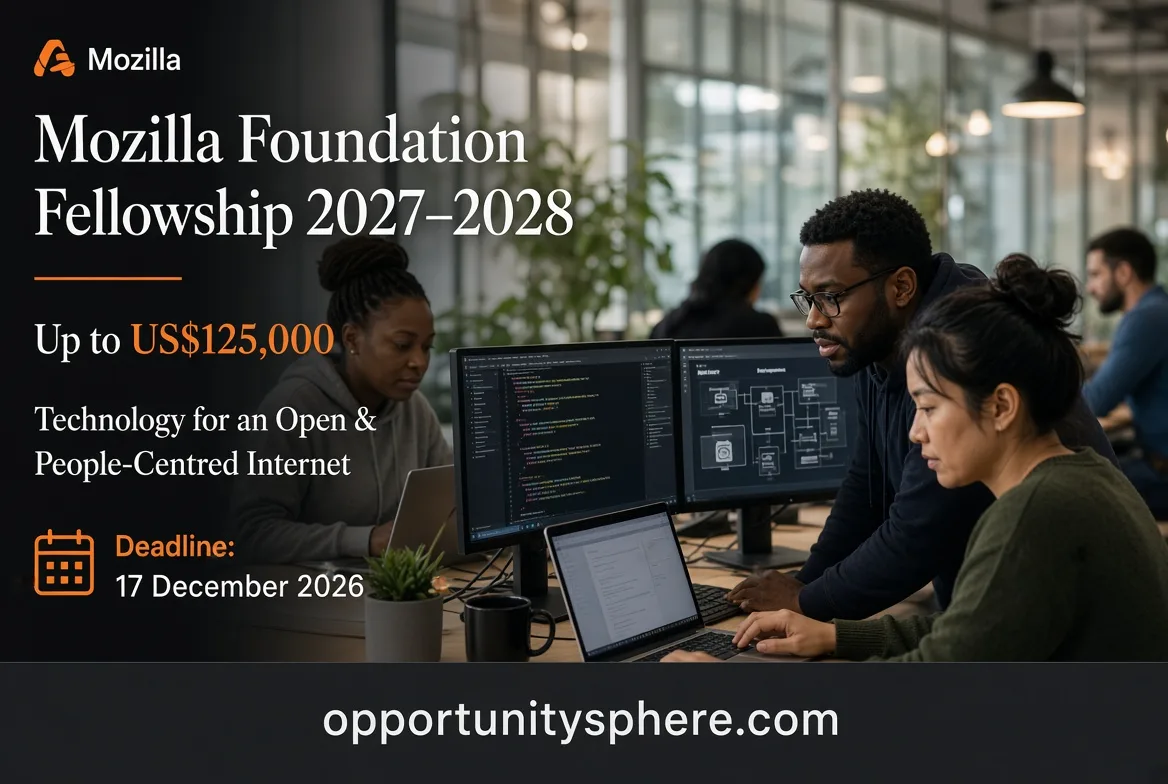
Mozilla Foundation Fellowship 2027–2028 for Innovators Worldwide (Up to $125,000)
Offered by Mozilla Foundation
Location
Remote
Funding
Paid
Study level
Not Applicable
Field of study
Computer Science & IT, Communication & Media, Social Sciences, Other
Application deadline
December 17, 2026
About This Fellowship
The Mozilla Foundation is inviting applications for its 2027–2028 Fellowship programme, an opportunity supporting individuals developing innovative technology solutions that promote a more open, accessible, secure and people-centred digital future.
Mozilla Foundation will award 10 fellowships for the 2027–2028 period. The programme is designed for builders, innovators, researchers, founders and technology professionals working on ideas that challenge existing approaches to technology and create meaningful benefits for communities.
The fellowship will support projects addressing emerging technology challenges, including artificial intelligence, biotechnology, digital infrastructure, cybersecurity, open-source technology and the future of the internet.
Unlike conventional academic scholarships, this programme is designed around the development of practical projects and technological solutions. Applicants are expected to demonstrate their ability to build, develop or advance something that can make a meaningful difference in their chosen field.
The fellowship runs for 12 months, beginning on 1 June 2027. It is a remote opportunity, with selected fellows also participating in key Mozilla Foundation activities and events. Travel expenses for designated fellowship gatherings, including the fellowship kickoff and MozFest 2027, are covered.
Fellowship Tracks and Financial Support
The programme has two tracks designed for individuals at different stages of their professional development.
1. Embedded Fellows
This track is intended for rising and mid-career professionals who have demonstrated technical expertise and experience developing meaningful projects but may not yet have achieved widespread recognition in their fields.
Embedded Fellows collaborate with a selected civil society organisation to develop a project addressing a specific challenge identified by that organisation.
Each selected Embedded Fellow receives a total package of US$100,000, consisting of:
US$75,000 fellowship stipend.
US$25,000 project budget.
The host organisation provides mentorship, collaboration opportunities and connections to the communities the project is intended to benefit.
This organisation works with young people in Indonesia who develop policy proposals in their local languages. The proposed challenge involves creating open-source tools that can help communities understand, analyse and identify shared priorities across multilingual policy contributions.
Fundación Kamanau – Chile
This organisation focuses on human rights and neurotechnology. Its project challenge involves developing an open platform for reporting and analysing incidents involving artificial intelligence, neurotechnology and human rights.
LAS Foundation – Germany
This foundation works at the intersection of art, science and technology. Its proposed project involves developing an experimental planetary observatory that allows communities, scientists and other contributors to examine environmental and satellite data, identify gaps and contribute alternative perspectives.
Quantum Village – United States
This organisation works to make quantum technology more accessible to independent technologists, makers and communities. The project challenge includes developing open-source tools and practical resources that reduce barriers to experimenting with quantum technology.
Slum & Rural Health Initiative – Nigeria
This Nigerian organisation works to improve access to healthcare in underserved communities. Its fellowship project focuses on developing community-owned approaches to mental health data governance, privacy, consent and benefit-sharing.
The proposed work will explore how African communities can have greater control over mental health information used in artificial intelligence development, with the involvement of young people, individuals with lived experience and community health workers.
Location note: Nigeria is the preferred location for the Slum & Rural Health Initiative host. Its stated time-zone preference is West Africa Time (UTC+1).
2. Independent Fellows
This track is designed for senior and established innovators with a strong record of independent leadership and demonstrated technical expertise.
Independent Fellows pursue their own ambitious projects rather than working through one of the designated host organisations.
The programme is looking for individuals capable of developing innovative products, platforms, tools, systems and other solutions that could influence the future direction of technology.
Each selected Independent Fellow receives a total package of US$125,000, consisting of:
US$100,000 fellowship stipend.
US$25,000 project budget.
Applicants should demonstrate a record of building and delivering meaningful projects, strong technical expertise and the ability to lead ambitious work independently.
Focus Areas for the 2027–2028 Fellowship
Mozilla Foundation has identified eight areas for this fellowship cycle. Applicants should select the area that most closely matches their proposed project.
1. Neurotechnology, Biotechnology and Physical Artificial Intelligence
This area supports technology that interacts with the human body, biological systems and the physical environment.
Potential projects may include brain-computer interfaces that protect personal neural data, community-controlled biological datasets, open biotechnology tools and environmental monitoring systems that allow communities to understand changes in their surroundings.
2. Hard Infrastructure: Computing, Energy, Quantum Technology and Extreme Environments
This focus area addresses the infrastructure shaping the next generation of technology.
Projects may explore open computing hardware, energy-efficient data infrastructure, quantum technology, satellite systems, environmental monitoring and technologies that allow communities to understand and influence decisions involving critical infrastructure.
3. Raising p(bloom): Artificial Intelligence That Benefits More People
Mozilla is interested in artificial intelligence that improves people's lives while ensuring that communities retain meaningful control over how the technology is developed and used.
Potential projects may include locally relevant AI tools, resource-efficient artificial intelligence, independent AI evaluation systems and solutions that make advanced technology more accessible to underserved communities.
4. Business Models for a Post-Agentic Web
This area explores how creators, publishers, developers and online communities can continue to benefit economically as artificial intelligence agents, paywalls and automated systems change how people access information.
Possible projects include new payment systems for online content, consent-based data markets, cooperative ownership models and open protocols that allow digital services to exchange value without depending entirely on centralised platforms.
5. Shared Security and Audit Infrastructure for Small Organisations
This focus area aims to make cybersecurity and technology auditing more accessible to smaller organisations that cannot afford expensive security services.
Projects may include affordable security testing tools, shared incident-response systems, open-source auditing resources and practical ways for small businesses, nonprofits and community organisations to assess the technology they use.
6. Sovereign AI, Public Infrastructure and Maintenance
Mozilla is interested in technologies that communities and public institutions can own, operate and maintain rather than depending entirely on external technology providers.
Possible projects include community-owned datasets, locally operated AI systems, privacy-preserving technologies, open public infrastructure and tools that help organisations maintain digital systems over time.
7. Creative Advocacy
One Independent Fellowship position is reserved for creative advocacy.
This area supports individuals who use creative technology, public campaigns, satire, artistic interventions and innovative communication approaches to challenge existing assumptions about technology and encourage public discussion.
Applicants should have a demonstrated ability to use creative work to attract attention, communicate ideas and influence conversations.
8. Wildcard Projects
Applicants whose projects do not fit neatly into the listed focus areas may still apply under the Wildcard category.
The proposed work must nevertheless align with Mozilla Foundation's broader mission of building technology that serves people, supports openness and creates meaningful public benefit.
Who Can Apply?
The fellowship is open to individuals from different professional backgrounds and sectors. Applicants do not have to work for a nonprofit organisation, but their proposed projects must have a charitable purpose and create meaningful public benefit.
Applicants should demonstrate the following:
A strong record of building, developing or delivering meaningful projects.
Relevant technical expertise or experience appropriate to the proposed project.
A clear understanding of the people or communities who will benefit from the work.
The ability to complete the proposed project within the 12-month fellowship period.
A willingness to collaborate, share knowledge and participate in the international fellowship community.
The legal ability to receive fellowship and grant funding from Mozilla Foundation.
Applications must be submitted in English. Applicants may use translation tools to improve clarity, but their responses must reflect their own original ideas and experiences.
Important legal and location requirement: Applicants must be legally eligible to receive funding from Mozilla Foundation, which is a US-based 501(c)(3) organisation. Mozilla may request additional information during its eligibility review. The application form also screens applicants based on their current location. Therefore, applicants should check their eligibility through the official application portal before investing significant time in preparing their submissions.
Additional Eligibility Requirements for Embedded Fellows
Applicants selecting the Embedded Fellowship track must meet the relevant location and time-zone requirements for their chosen host organisation.
The RFP identifies Chile, Germany, Indonesia, Nigeria and the United States as the main locations for Embedded Fellows, while also allowing flexibility for remote work across compatible time zones.
For applicants interested in the Nigerian host organisation, Slum & Rural Health Initiative, Nigeria is the stated location preference.
Independent Fellows should also complete the official location and legal eligibility checks in the application form.
What Mozilla Looks for in Successful Applicants
Mozilla Foundation evaluates applicants based on more than the originality of their ideas. The programme seeks individuals who can demonstrate three important qualities:
Trailblazing: Applicants should be working on ideas that challenge established approaches and help shape emerging technology fields.
Rigorous: Applicants should demonstrate that they can turn ideas into practical results. Evidence of completed projects, prototypes, research, deployments or other work is valuable.
Community-driven: Applicants should demonstrate an understanding of the communities affected by their work and a commitment to involving those communities in the development and governance of their projects.
Projects that simply improve an existing extractive system without questioning who benefits, or that are designed about communities rather than with them, are unlikely to be a good fit.
What Fellows Receive Beyond the Financial Support
In addition to the fellowship stipend and project budget, selected fellows receive access to several professional development and networking opportunities.
These include:
Membership in an international cohort of technology innovators.
All-expenses-paid travel to key Mozilla Foundation events, including the fellowship kickoff in July 2027 and MozFest 2027.
Guidance and support from a dedicated programme manager and senior curricular adviser.
Regular one-to-one meetings, problem-solving support and professional introductions.
Access to Mozilla's wider technology network, including teams associated with Firefox, Thunderbird and Mozilla.ai.
Coaching and workshops for technology professionals developing leadership skills.
Opportunities to present their work through Mozilla-owned platforms and events.
Continued access to the Mozilla Fellows community after completing the programme.
Fellows are expected to dedicate approximately five to ten hours each month to fellowship community activities, in addition to the time required to develop their individual projects.
Intellectual Property and Project Ownership
An important feature of this fellowship is its approach to intellectual property.
According to the RFP, fellows retain copyright, patent and other proprietary interests in materials they produce during the fellowship.
However, selected fellows are expected to release code and non-confidential materials created during the programme under open licences agreed upon in consultation with Mozilla Foundation.
Fellows are also expected to document and share their work regularly so that other people and organisations can learn from and build upon the results.
Application Procedure
The application process begins with a Letter of Intent (LOI). Only a small number of applicants will be invited to submit a full application.
Stage 1: Review the Official Call and Select a Fellowship Track
Visit the official Mozilla Foundation announcement and download the full Request for Proposals.
Review the focus areas, host organisation descriptions, eligibility requirements and funding arrangements.
Decide whether your experience and project are better suited to the Embedded or Independent Fellowship.
Stage 2: Submit a Letter of Intent
Complete the official Letter of Intent application form.
The application requests information including:
Full name and contact details.
Current location and country.
Current professional role and organisation.
LinkedIn profile and GitHub profile, where applicable.
A public builder profile, such as a project repository, demonstration, dataset, deployment, research paper or other work that Mozilla can review.
Professional website or portfolio, where available.
Relevant professional experience.
Preferred fellowship track and focus area.
Proposed project title and summary.
Target users and communities.
Evidence of progress or traction.
Proposed project outputs and expected impact.
Project milestones and implementation plans.
Explanation of the project's charitable purpose and public benefit.
Professional background and technical expertise.
Motivation for joining the fellowship.
Applicants selecting the Embedded track must also identify their preferred host organisation and explain how their expertise aligns with its work and community needs.
Stage 3: Shortlisting
Mozilla Foundation will review the Letters of Intent and invite selected applicants to submit a full application.
Applicants should note that submitting an LOI does not guarantee an invitation to the next stage.
Stage 4: Full Application
Shortlisted applicants will receive instructions for completing the full application.
The full application deadline is 12 March 2027.
Stage 5: Final Selection
Mozilla Foundation will notify final applicants on 30 April 2027.
Successful fellows are expected to begin the programme on 1 June 2027.
Important Application Dates
Activity
Date
Letter of Intent portal opens
20 October 2026
Letter of Intent deadline
17 December 2026
Invitation to submit full application
16 February 2027
Full application deadline
12 March 2027
Final applicants notified
30 April 2027
Fellowship begins
1 June 2027
Fellowship duration
12 months
Deadline time: 11:59 PM Pacific Time (UTC-8) on 17 December 2026.
Application Advice
Applicants should approach this fellowship as a project-development opportunity rather than a conventional scholarship application. A strong application should explain not only what the proposed technology will do, but also why it is needed, who will use it and how it will create meaningful public benefit.
One of the most important things to prepare is evidence of previous work. Mozilla specifically encourages applicants to provide something reviewers can examine, such as a working prototype, public repository, demonstration, dataset, deployment, research paper or portfolio. Applicants should avoid relying entirely on broad descriptions of their skills without showing what they have actually built or accomplished.
The proposed project should also be realistic enough to complete within 12 months. Break the work into clear stages and identify the practical outputs expected at each stage. A project that has a defined target community, a credible implementation plan and measurable results is easier to assess than an idea with no clear route to completion.
For applicants interested in the Embedded Fellowship, study the selected host organisation carefully. Each host has a specific challenge, and your proposal should demonstrate how your technical experience can help address that challenge. Nigerian applicants should pay particular attention to the Slum & Rural Health Initiative's project on community ownership, privacy, consent and benefit-sharing in mental health data.
Independent Fellowship applicants should demonstrate a stronger record of independent leadership and explain how their proposed work could influence the wider technology field.
Finally, read Mozilla's intellectual property and open-work expectations before applying. Selected fellows retain ownership of their work but are expected to share code and non-confidential outputs under open licences agreed with Mozilla. Applicants should be comfortable with this approach before accepting an award.
AI application policy: Mozilla permits applicants to use AI tools for brainstorming, clarification and translation support. However, submitted responses must reflect the applicant's own original ideas, work and voice. Applications that appear heavily or entirely AI-generated may receive additional review. Applicants should therefore write their own substantive responses rather than submit generic AI-generated application answers.
Related Opportunities
Explore other scholarships, fellowships, grants, research opportunities and more that may match your interests.