Offered by Machine Learning Alignment & Theory Scholars (MATS)
Location
London, United Kingdom / Berkeley, United States / Washington, DC, United States
Funding
Fully Funded
Study level
Graduates, Researchers
Field of study
Computer Science & IT
Application deadline
October 31, 2026
About This Fellowship
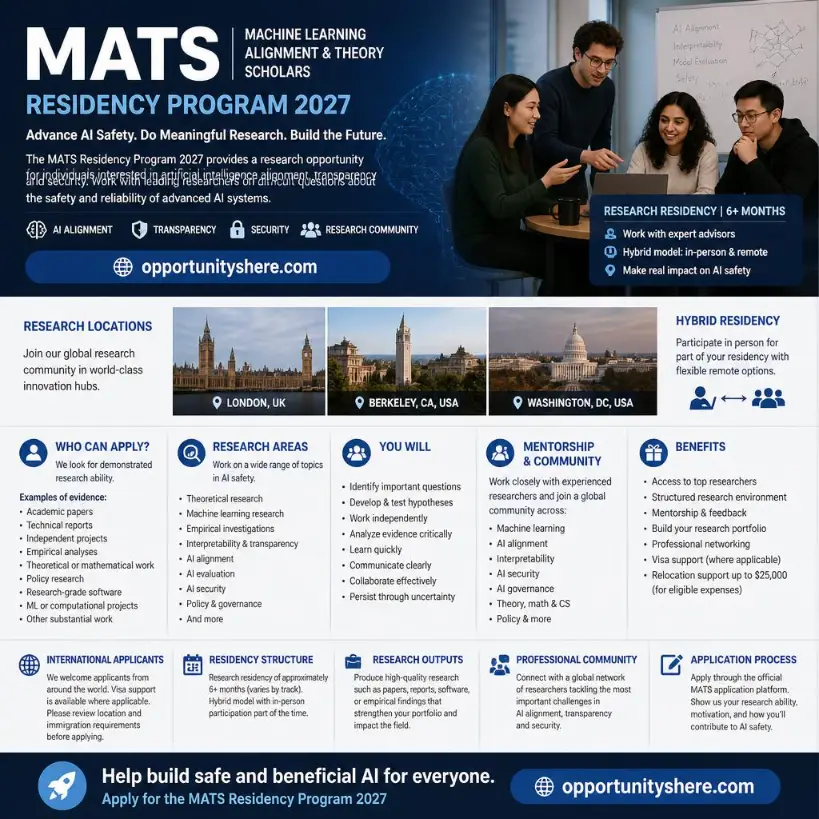
The MATS Residency Program 2027 provides a research opportunity for individuals interested in artificial intelligence alignment, transparency and security. The programme is designed for people who have already demonstrated the ability to conduct substantial research and who want to develop their research skills further while working with experienced researchers, mentors and advisors.
MATS, which stands for Machine Learning Alignment & Theory Scholars, supports researchers working on difficult questions related to the safety and reliability of advanced artificial intelligence systems. The programme can accommodate different research approaches, including theoretical, technical, empirical and policy-oriented work.
Rather than being limited to applicants who already have a formal background in AI safety, MATS considers evidence of broader research ability. Applicants may demonstrate their potential through academic research, technical projects, software development, empirical investigations, mathematical work, policy analysis or other serious research activities.
The residency can therefore be relevant to researchers from several backgrounds who are interested in transitioning into or developing further expertise in AI safety and related areas.
1. Eligibility
The MATS Residency is intended for applicants who can demonstrate substantial research ability.
Applicants should be able to show evidence that they have worked on difficult, open-ended problems using rigorous research methods.
Previous work does not necessarily have to have been formally published or specifically described as artificial intelligence safety research.
Examples of evidence that may demonstrate research ability include:
Academic research papers.
Technical reports.
Independent research projects.
Serious empirical analyses.
Mathematical or theoretical work.
Policy research and analysis.
Research-grade software projects.
Machine learning or computational projects.
Other substantial technical or analytical work.
Applicants should be able to explain what they worked on, why the problem was important, how they approached it and what they learned from the research process.
2. Research Experience
MATS places considerable emphasis on demonstrated research ability rather than simply academic credentials.
Applicants should ideally have experience dealing with problems where there is no straightforward answer or established procedure to follow.
The programme is particularly interested in applicants who can:
Continue working on difficult problems despite uncertainty.
Applicants should therefore use their application to demonstrate actual examples of their research ability rather than relying exclusively on degrees, grades or job titles.
3. Research Areas
MATS supports research connected to AI alignment, transparency and security.
Depending on the research programme and advisor, residents may work on different aspects of artificial intelligence safety.
Potential research approaches can include:
Theoretical research.
Machine learning research.
Empirical investigations.
AI interpretability and transparency.
AI alignment.
AI evaluation.
AI security.
Technical AI safety.
Policy and governance research.
Other research relevant to the development and safe deployment of advanced AI systems.
The exact research opportunities available to a resident depend on the research track, current projects and the availability of appropriate advisors.
4. Technical and Empirical Research
Some MATS research projects involve technical investigations of machine learning systems.
Depending on the project, researchers may investigate how AI systems behave, how their internal processes can be understood, how models can be evaluated or how potential risks can be identified and reduced.
Applicants with backgrounds in computer science, mathematics, statistics, machine learning, software engineering or related technical disciplines may find these areas particularly relevant.
However, applicants do not necessarily need to have followed a conventional AI safety career path before applying.
5. Theoretical Research
MATS also supports theoretical work related to AI alignment and machine learning.
Researchers interested in mathematical reasoning, formal models, decision theory, theoretical computer science or related areas may be able to contribute to theoretical AI safety research.
Applicants with strong mathematical or theoretical backgrounds should demonstrate how their previous work has prepared them to investigate difficult and open-ended questions.
6. Policy and Governance Research
AI safety is not exclusively a technical field.
Some research supported through the broader MATS community can involve policy, governance, societal impacts and other questions surrounding the development and deployment of advanced AI systems.
Applicants with backgrounds in economics, public policy, law, international relations, political science or related fields should carefully examine the specific research opportunities available during the relevant application cycle to determine whether their experience fits the programme's current research tracks.
7. Residency Structure
The MATS programme operates as a research residency with different possible durations depending on the particular research track.
Residency arrangements can range from approximately six months to longer periods, with the exact duration determined by the programme and research placement.
The programme operates using a hybrid model.
MATS has research locations in:
London, United Kingdom.
Berkeley, California, United States.
Washington, DC, United States.
Residents are expected to participate in person for at least part of their residency, although the exact working arrangements can depend on the relevant programme and research group.
Applicants should therefore be prepared for an arrangement that combines remote and in-person research.
8. Research Mentorship
One of the central features of the MATS Residency is the opportunity to work with experienced researchers.
Residents are matched with research programmes and advisors based on their interests, skills and the research opportunities available.
Through this arrangement, participants can receive feedback on their research ideas, methods and results.
Researchers can also gain experience working within a research environment where they are expected to formulate questions, investigate them rigorously and communicate their findings.
9. Benefits
MATS provides several forms of support to successful residents.
Benefits can include:
Access to experienced AI safety researchers and advisors.
A structured research environment.
Opportunities to conduct original research.
Research mentorship.
Feedback on research projects.
Opportunities to build a research portfolio.
Professional networking with researchers in AI safety.
Exposure to different approaches to AI alignment and safety.
Visa support where applicable.
Relocation support for eligible participants.
The programme's current information also describes relocation assistance of up to $25,000 for eligible expenses, including certain costs associated with relocation and dependants.
Applicants should verify the exact financial and relocation terms applicable to their residency before making travel or relocation arrangements.
10. Research Portfolio Development
The residency can provide an opportunity for participants to strengthen their research portfolios.
During the programme, residents can work on research questions that may lead to technical reports, papers, software, empirical findings or other research outputs.
The experience can be particularly useful for researchers considering longer-term careers in AI safety, machine learning research or related technical and policy fields.
Participants should nevertheless understand that the exact research outputs depend on the project, research track and individual progress.
11. Professional Community
Residents become part of a wider community of researchers working on AI alignment, machine learning and related questions.
This can provide opportunities to meet researchers from different academic and professional backgrounds.
Participants may interact with people working on:
Machine learning.
AI alignment.
AI interpretability.
AI security.
AI governance.
Theoretical computer science.
Mathematics.
AI policy.
Other areas connected with advanced AI research.
Exposure to this broader community can help residents understand different approaches to AI safety and identify potential future research collaborations.
12. International Applicants
MATS can be relevant to researchers from different countries, subject to the eligibility requirements of the specific residency and the ability to meet applicable immigration and programme requirements.
The programme provides visa support where required for eligible residents.
Applicants who would need to relocate internationally should carefully review the current visa, location and residency requirements before applying.
Visa support does not necessarily mean that every applicant will automatically qualify for immigration permission, so candidates should allow sufficient time for any required immigration process.
13. Application Process
Applicants should submit their applications through the official MATS application platform.
The application is intended to help the programme assess the applicant's research experience, technical ability, interests and potential fit with available research projects.
Applicants should therefore prepare evidence of previous research work before beginning the application.
Useful materials may include:
Research papers.
Technical reports.
GitHub or other research-code projects.
Academic projects.
Independent research.
Previous empirical investigations.
Mathematical or theoretical work.
Policy analysis.
Other substantial evidence of research ability.
Applicants should explain their contribution to previous projects clearly, particularly when the work was completed collaboratively.
14. 2027 Winter Intake Timeline
The 2027 Winter intake opened on 25 August 2026.
The application deadline is 31 October 2026, Anywhere on Earth (AoE).
The programme indicates that applicants should expect to hear about application outcomes by the end of November 2026.
Applicants should submit their materials before the deadline rather than waiting until the final hours because international applicants may also need to consider additional visa or relocation requirements if selected.
15. What Makes a Strong Application
Applicants should focus on demonstrating research ability rather than simply listing qualifications.
A strong application can clearly explain:
A difficult problem the applicant has previously worked on.
Why the problem was challenging or important.
The methods used to investigate it.
The applicant's individual contribution.
The results or lessons obtained.
What the applicant would do differently with additional time or resources.
The applicant's current research interests.
Why AI safety or related research questions are relevant to those interests.
Applicants transitioning from another research field should explain how their existing skills can transfer to AI safety research.
For example, a researcher with a background in mathematics might demonstrate theoretical reasoning, while a software engineer might demonstrate research-grade programming and empirical experimentation.
16. Professional Development
The residency can help participants develop skills needed for longer-term research careers.
These may include:
Developing research questions.
Conducting independent investigations.
Working with research advisors.
Writing technical documents.
Presenting research findings.
Collaborating with other researchers.
Reviewing and responding to research feedback.
Working with unfamiliar technical concepts.
These skills can be useful beyond the residency itself and may support future academic, nonprofit, industry or independent research opportunities.
17. Important Note
MATS is designed primarily for applicants who already have evidence of substantial research ability.
Applicants should therefore not rely exclusively on academic qualifications when preparing their applications.
A degree in computer science, mathematics or another technical field can be useful, but the programme is interested in evidence that an applicant can actually conduct rigorous research.
Previous work does not necessarily need to have been specifically focused on AI safety.
Applicants from other technical or research backgrounds should consider whether their existing work demonstrates the type of independent problem-solving and research ability that the programme seeks.
18. Application Information
The MATS Residency Program 2027 Winter intake opened on 25 August 2026.
The application deadline is 31 October 2026, Anywhere on Earth.
Applicants should submit their application through the official MATS application platform and provide clear evidence of their previous research work.
Candidates should also review the current residency locations, research tracks, eligibility requirements, funding arrangements and visa information before applying.
Related Opportunities
Explore other scholarships, fellowships, grants, research opportunities and more that may match your interests.