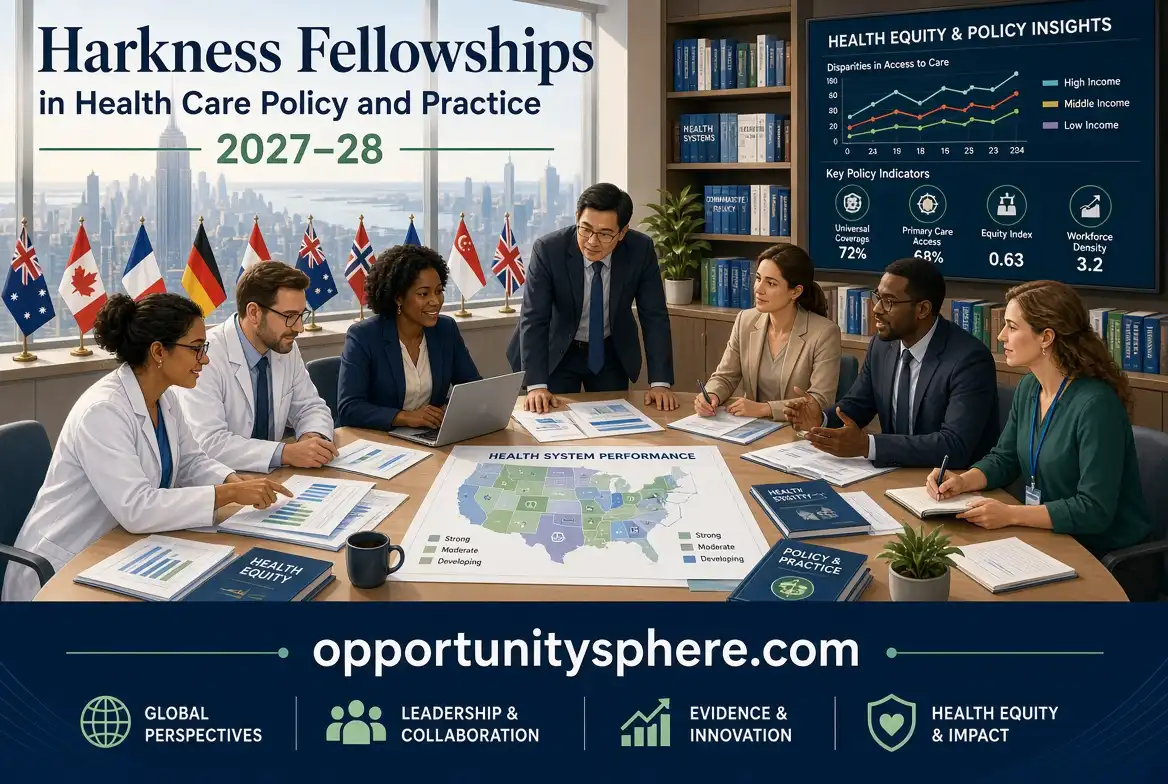
Harkness Fellowships in Health Care Policy and Practice 2027–28
Offered by The Commonwealth Fund
Location
United States
Funding
Fully Funded
Study level
Professional, Researchers
Field of study
Health & Medical Sciences
Application deadline
November 1, 2026
About This Fellowship
The Harkness Fellowships in Health Care Policy and Practice 2027–28 provide an opportunity for experienced health professionals and health-policy specialists from selected countries to spend approximately 10 to 12 months in the United States conducting independent, policy-oriented research.
The fellowship is administered by The Commonwealth Fund, a U.S.-based foundation that works on health policy and health system issues. The programme has a long history, having first been established in 1925. It was originally created to strengthen international understanding of health care policy and practice and has developed into a fellowship programme focused on cross-national learning, research and leadership development.
Unlike a conventional university scholarship, the Harkness Fellowship is designed for professionals who have already developed expertise in health care, health services research, policy, clinical practice, management or related fields. Fellows spend their fellowship period working on a research project that examines a significant health policy or health care delivery issue affecting both the United States and their home country.
During the fellowship, participants are placed with an appropriate U.S. mentor or host organization and gain the opportunity to examine the U.S. health system while bringing their own country's experience into the research. The programme also includes leadership activities, seminars and opportunities to interact with other health policy professionals.
The Commonwealth Fund describes the programme as a leadership-development experience for midcareer professionals, including policymakers, researchers, clinical leaders, health care executives and journalists. :contentReference[oaicite:2]{index=2}
1. Who can apply?
The Harkness Fellowship has a relatively specific geographical eligibility requirement.
For the 2027–28 fellowship, applicants must be established residents of one of the following countries:
Australia
Canada
France
Germany
The Netherlands
New Zealand
Norway
Singapore
United Kingdom
Applicants must also be eligible to receive a J-1 Research Scholar Visa for the fellowship period.
In addition, applicants are expected to remain committed to continuing their careers in the country from which they apply after completing the fellowship. :contentReference[oaicite:3]{index=3}
This geographical restriction is particularly important. The Harkness Fellowship is not open to applicants from every country, so prospective applicants should confirm that they meet the residency requirement before investing substantial time in preparing an application.
2. What type of professional is the fellowship looking for?
The programme is aimed at people who have progressed beyond the early stages of their careers and have already developed meaningful expertise in health policy or health care practice.
The Commonwealth Fund identifies potential applicants from a range of professional backgrounds, including:
Government and health-policy professionals
Health services researchers
Clinical professionals
Health care managers
Health care executives
Health policy analysts
Journalists specialising in health care
Other professionals whose work has a significant connection to health policy or health care delivery
The important factor is not simply having a job in the health sector. Applicants are expected to demonstrate expertise in health policy issues and a record of informing health policy or practice through research, policy analysis, care delivery, clinical leadership or related professional work. :contentReference[oaicite:4]{index=4}
3. Is there an age limit?
There is no formal age requirement or age limit for the Harkness Fellowship.
However, the absence of an age limit does not mean that the programme is intended for recent graduates. The Commonwealth Fund specifically describes Harkness as a programme for midcareer professionals whose professional development has reached a stage at which an international research and leadership experience can have a meaningful effect on their work.
Applicants therefore need to demonstrate professional experience and a track record relevant to the fellowship's objectives rather than relying simply on their academic qualifications. :contentReference[oaicite:5]{index=5}
4. What does a Harkness Fellow do in the United States?
A central component of the fellowship is the fellow's research project.
Each fellow develops a project dealing with a health policy or health care delivery issue that has relevance to both the United States and the fellow's home country.
The project should not simply describe the U.S. health system. The purpose is to enable the fellow to investigate an issue comparatively, learn from U.S. approaches and consider how the findings could inform policy or practice in the fellow's home country.
The Commonwealth Fund works with selected fellows to identify appropriate U.S. mentors with expertise related to their proposed research.
This arrangement gives fellows access to specialists and organizations that can help them understand the policy, research and practical dimensions of their chosen topic. :contentReference[oaicite:6]{index=6}
5. What topics can a proposed project address?
The Commonwealth Fund's principal areas of interest include:
Improving health insurance coverage
Improving access to health care
Improving the quality of care
Improving the efficiency of health care delivery
Advancing health equity
The Fund's current international health policy work also includes issues such as health care affordability, inequities in access and international comparisons of health system performance.
A strong proposal therefore needs to connect the applicant's professional expertise with a genuine health policy or health care delivery question.
For example, a researcher might investigate how two health systems approach access to care, how a particular policy affects health equity, how health services can be delivered more efficiently, or how evidence can be translated into health policy.
The specific research question needs to be developed by the applicant; the Commonwealth Fund does not provide a fixed list of projects from which applicants simply choose. :contentReference[oaicite:7]{index=7}
6. What is the research proposal requirement?
The application requires a preliminary project proposal of up to five pages, excluding references.
The proposal should describe a policy-oriented research project that fits within the Commonwealth Fund's areas of interest.
The organisation specifically encourages applicants to think about the feasibility of their proposed research.
For quantitative projects, applicants should consider whether appropriate datasets exist and whether those datasets can actually be accessed.
For qualitative projects, applicants should consider how information would be collected, including possibilities such as:
Document analysis
Interviews
Focus groups
Other appropriate qualitative methods
This means that the proposal should go beyond explaining why a health problem is important. Applicants need to demonstrate that the proposed research can realistically be conducted during the fellowship period. :contentReference[oaicite:8]{index=8}
7. What does the fellowship provide financially?
The Harkness Fellowship provides substantial financial support for the fellowship year.
The Commonwealth Fund states that each Harkness Fellowship can provide up to US$130,000 in total award support.
The award can include:
Round-trip airfare to the United States
A monthly living stipend
Relocation and setup support
Support for appropriate project-related work conducted in the fellow's home country
Funding for research-related travel
Support for case studies and conferences
Research expenses
Travel associated with designated fellowship seminars and meetings
An allowance associated with the U.S. mentor or placement
Health insurance while in the United States
U.S. federal and state tax payments
The current programme information also lists a monthly living stipend of approximately US$8,500, although the precise terms can vary by country and the stipend is adjusted periodically for cost of living. :contentReference[oaicite:9]{index=9}
Applicants should therefore distinguish between the headline fellowship value and the actual amount they personally receive as unrestricted income. A significant part of the award is allocated to research, travel, insurance, taxes and other fellowship-related expenses.
8. Is there support for applicants with families?
Yes.
The programme provides an additional family supplement for fellows who are accompanied by a spouse or children under the age of 18.
The Commonwealth Fund states that the additional allowance can be approximately US$60,000, including associated airfare, living allowance and health insurance support. Exact arrangements can vary. :contentReference[oaicite:10]{index=10}
The fellowship also provides information and support for fellows making the transition to living in the United States.
9. How long is the fellowship?
The fellowship requires a substantial period of residence in the United States.
For the 2027–28 cohort, fellows are expected to arrive in the United States around mid-to-late August or early September 2027.
Fellows are required to spend at least 10 months in the United States, with the fellowship lasting approximately 10 to 12 months depending on the individual's programme and arrival date. :contentReference[oaicite:11]{index=11}
This is therefore not a short conference fellowship or a few-week professional exchange. Applicants need to be prepared to dedicate a significant part of the year to the programme.
10. What professional development does the fellowship offer?
The research project is only one part of the Harkness experience.
Fellows participate in leadership-development activities and a series of meetings and seminars throughout the fellowship year.
The programme includes regular virtual meetings in which fellows discuss health policy issues and leadership, alongside seminars involving experts from government, health care organisations, industry and academia.
Fellows also gain an opportunity to develop a detailed understanding of the U.S. health care system and its policy environment.
The international nature of the programme is important. Fellows do not simply study the United States independently; they join a group of professionals from different participating countries and develop relationships that can continue after the fellowship. :contentReference[oaicite:12]{index=12}
11. What happens at the end of the fellowship?
Harkness Fellows are expected to communicate the findings and lessons from their research.
The Commonwealth Fund encourages fellows to produce outputs such as:
Peer-reviewed journal articles
Research or policy reports
Policy briefs
Data briefs
Opinion pieces
Blogs
Audio or video materials
Other outputs appropriate to the research and intended audience
The expectation is that the research should have practical value rather than remaining solely as an academic exercise.
Near the end of the fellowship, fellows present their findings to Commonwealth Fund staff and other health policy experts as part of the final reporting process. :contentReference[oaicite:13]{index=13}
12. What documents are required?
The 2027–28 application requires several substantial components.
Applicants need to provide:
Professional objectives statement
This explains the applicant's professional direction and what they hope to accomplish through the fellowship.
Curriculum vitae
The CV should demonstrate the applicant's professional experience, research, leadership and other accomplishments relevant to health policy or practice.
Preliminary project proposal
The proposal can be up to five pages, excluding references, and should describe the proposed policy-oriented research project.
Three reference letters
The application requires:
One institutional or organisational reference from someone in a senior leadership or supervisory position within the applicant's current organisation
Two professional references from people who can comment on the applicant's qualifications, accomplishments and potential contribution to health policy or practice
All references are requested through the application system, and applicants are responsible for ensuring that their referees submit their letters before the deadline.
Three examples of work
Applicants must also provide three examples of professional work products. These may include journal articles, reports or other written work. Unpublished work can also be submitted if the applicant provides an explanation of the work and its purpose. :contentReference[oaicite:14]{index=14}
13. What makes this application different from a normal fellowship application?
One of the major differences is the emphasis on an applicant's existing professional record.
A student applying for a conventional scholarship might primarily be assessed through academic grades, admission results and a study plan.
The Harkness Fellowship instead asks a more experienced professional to demonstrate:
What they have already contributed to health policy or practice
What issue they want to investigate
Why the issue matters in their home country
Why comparison with the United States would be useful
How the research could contribute to policy or system-level change
Why the applicant is personally prepared to carry out the project
How the experience fits into their longer-term professional work
The application therefore needs to connect the applicant's past experience, proposed research and future professional contribution.
14. Can the fellowship be used to obtain a Master's or PhD?
No.
This is an important distinction for Opportunity Sphere readers.
The Harkness Fellowship does not provide funding for an academic degree. It is a professional research and leadership fellowship.
Applicants should therefore not treat it as an alternative route to a Master's or PhD programme. The fellowship is intended for professionals who already have the education and experience necessary to undertake the proposed research. :contentReference[oaicite:15]{index=15}
15. Does the applicant need to know their U.S. host or mentor before applying?
Applicants do not need to have everything arranged independently before applying.
The Commonwealth Fund works with selected fellows to identify potential U.S. mentors whose expertise matches the fellow's research interests.
This allows the fellowship to create a research environment around the proposed project rather than requiring every applicant to secure an American host institution on their own before submitting the application. :contentReference[oaicite:16]{index=16}
Nevertheless, applicants should have a clear understanding of the type of research environment and expertise they would need to successfully complete their project.
16. What happens during selection?
Applications are reviewed by Commonwealth Fund staff and expert panels associated with the participating countries.
Applicants may be invited to an interview after the initial review.
The selection process considers factors including:
Professional qualifications
Leadership potential
Commitment to improving health care
Quality of the proposed research
Policy relevance of the proposed project
Strength of reference letters
Interview arrangements vary according to the applicant's country. The Commonwealth Fund states that interviews may be conducted virtually or in person. :contentReference[oaicite:17]{index=17}
17. Is previous application experience required?
No.
Applicants do not need to have previously participated in the Harkness programme.
The Commonwealth Fund also states that people who have applied previously may apply again in subsequent years. :contentReference[oaicite:18]{index=18}
18. What should applicants consider before applying?
The fellowship involves a major professional and personal commitment.
Before applying, prospective candidates should consider whether:
Their country of residence is eligible.
Their professional background fits the programme.
They have sufficient experience in health policy or health care practice.
They can identify a research question with relevance to both countries.
They have enough evidence of previous professional work.
Their organisation can support the fellowship period.
They can spend 10–12 months in the United States.
Their proposed project can realistically be completed within the fellowship period.
They have suitable referees who can provide detailed professional references.
Their existing publications, reports or other work products demonstrate the experience described in the application.
This is particularly important because the fellowship is designed around an applicant's existing professional career rather than simply academic potential.
19. Application deadline for 2027–28
The Harkness Fellowship 2027–28 application is currently open.
Opening date: 1 June 2026
Deadline:1 November 2026
The Commonwealth Fund states that applications must be submitted through the official Harkness Fellowship application portal. Applicants should also allow enough time for all three reference letters to be submitted before the deadline. :contentReference[oaicite:19]{index=19}
20. Who is this opportunity most relevant to?
The Harkness Fellowship is particularly relevant to established professionals working at the intersection of health care, research and policy.
Potentially relevant applicants include health services researchers, policy researchers, clinicians involved in health-system improvement, health care managers, government health-policy professionals and health journalists with substantial experience in health policy.
It is not intended as a general scholarship for undergraduate students, recent graduates or people simply looking for financial support for a university degree.
The strongest fit is someone who already has a professional record and can use an international research experience to investigate a concrete health policy or health care delivery question.
21. An opportunity for international knowledge exchange
One of the distinctive features of Harkness is its two-way approach to international learning.
A fellow spends time studying the U.S. health care system, but the purpose is not simply to take U.S. practices home and reproduce them unchanged.
The proposed research is expected to be relevant to both the United States and the fellow's home country. This creates an opportunity to examine differences in health systems, identify approaches that may be transferable, and understand the circumstances under which particular policies or models work.
The fellowship therefore combines research, professional development and international exchange.
Eligible applicants should register through the official Harkness Fellowship application portal and complete the 2027–28 application before the 1 November 2026 deadline.
Related Opportunities
Explore other scholarships, fellowships, grants, research opportunities and more that may match your interests.