FOR-GHP Fellowship in Outbreak Readiness for Global Health Protection 2026
Offered by FOR-GHP Consortium / Global Health Protection Programme
Location
Sub-Saharan Africa, with training activities in Germany, Ghana and Uganda
Funding
Fully Funded
Study level
Professional
Field of study
Life Sciences, Health & Medical Sciences
Application deadline
October 21, 2026
About This Fellowship
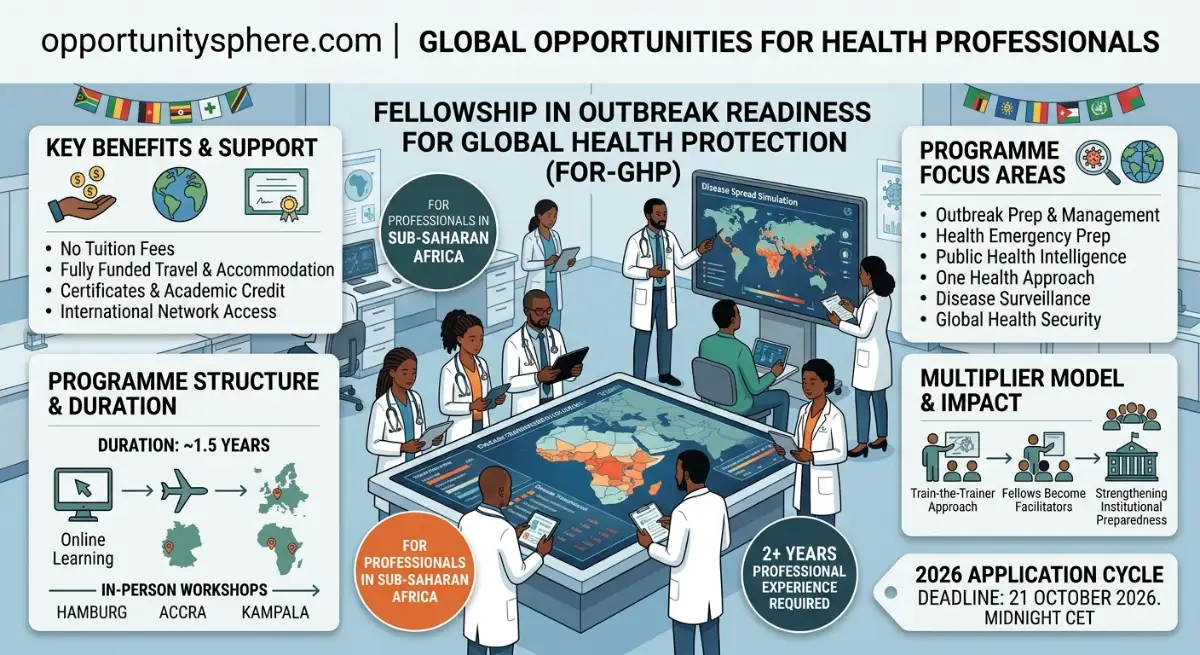
The Fellowship in Outbreak Readiness for Global Health Protection (FOR-GHP) is a 1.5-year professional development programme designed to strengthen outbreak preparedness, emergency response and public health resilience across sub-Saharan Africa.
The fellowship is aimed at public health and biomedical professionals who are already working within health systems and want to strengthen their knowledge and practical skills in outbreak preparedness, health emergency management and global health protection.
Rather than focusing only on individual professional development, FOR-GHP uses a multiplier approach. Fellows are trained not only to apply the knowledge they gain in their own professional roles, but also to share relevant knowledge and skills with colleagues, institutions and professional networks. This approach is intended to help extend the impact of the programme beyond individual participants.
The programme brings together African and international organisations and experts working in areas such as public health, tropical medicine, field epidemiology, health emergency preparedness and global health security.
Through a combination of online learning, practical activities, simulations and in-person workshops, participants develop competencies that can be applied to outbreak preparedness and response within their own professional environments.
1. Eligibility
The fellowship is intended primarily for public health and biomedical professionals working in sub-Saharan Africa.
Applicants should have at least two years of professional experience in public health, biomedical sciences or a closely related field.
Relevant academic and professional backgrounds may include:
Public Health.
Medicine.
Epidemiology.
Microbiology.
Biology.
Tropical Medicine.
Biomedical Sciences.
Health Sciences.
Other closely related disciplines relevant to outbreak preparedness and global health protection.
Applicants should be able to demonstrate professional involvement in areas connected with health systems, disease prevention, surveillance, emergency preparedness, outbreak response or related public health activities.
Strong English-language proficiency is also expected because the programme involves online learning, professional communication, workshops and other academic or training activities conducted in English.
2. Employer Endorsement
An important component of the fellowship is support from the applicant's current employer.
Applicants are required to obtain an endorsement from their current employer, reflecting the professional nature of the programme.
This requirement is important because fellows are expected to participate in learning activities, workshops and other programme components while continuing to engage with their professional environments.
Applicants should therefore discuss the fellowship with their employer early in the application process and confirm that they can participate in the required programme activities.
Employer support may also be relevant to the programme's multiplier approach, since fellows are expected to use their training within their institutions and professional networks.
3. Programme Focus
FOR-GHP focuses on strengthening professional capacity in areas directly related to infectious disease outbreaks and health emergencies.
Major areas of focus include:
Outbreak preparedness and management
Health emergency preparedness
Public health intelligence
Disease surveillance
One Health
Global health security
Emergency response
Institutional preparedness and resilience
Knowledge sharing and professional capacity building
The programme is designed to help participants understand how health systems can prepare for outbreaks before they occur and how professionals can contribute effectively when health emergencies arise.
The One Health component is particularly relevant because many infectious disease threats involve interactions between human health, animal health and environmental factors.
4. Multiplier Approach
One of the distinctive features of FOR-GHP is its multiplier model.
Participants are not trained solely for their own professional advancement. They are also expected to become facilitators and multipliers who can share knowledge with colleagues and contribute to strengthening preparedness within their institutions.
Through this approach, fellows may use what they learn to:
Share relevant knowledge with colleagues.
Support institutional training activities.
Strengthen preparedness practices within their organisations.
Contribute to professional networks.
Apply outbreak-readiness concepts in their workplace.
Help improve organisational capacity to respond to health emergencies.
The model is therefore intended to create benefits at both the individual and institutional levels.
5. Programme Structure
The FOR-GHP fellowship lasts approximately 1.5 years and uses a blended-learning structure.
Participants combine online learning with practical and face-to-face activities.
The programme may include:
Online learning modules.
eLearning activities.
Case studies.
Practical assignments.
Simulations.
In-person workshops.
Professional networking activities.
Institutional or workplace-based activities.
The blended format allows participants to continue their professional responsibilities while undertaking structured fellowship training.
In-person components are scheduled in different locations, including Hamburg, Accra and Kampala, according to the programme schedule.
Participants should therefore be prepared to undertake international travel where required and should ensure that their professional commitments allow them to participate fully.
6. Practical Learning and Simulations
The fellowship places emphasis on applying knowledge rather than relying exclusively on theoretical instruction.
Through case studies, simulations and practical activities, participants can explore how public health professionals respond to complex outbreak and emergency situations.
This may involve examining issues such as:
outbreak detection;
preparedness planning;
public health intelligence;
coordination;
emergency response;
communication;
surveillance;
institutional resilience; and
collaboration across different professional sectors.
The practical orientation can help participants connect the concepts introduced through eLearning with the situations they may encounter in their professional environments.
7. Benefits
The FOR-GHP fellowship provides several forms of professional and educational support.
Key benefits include:
No tuition fees: Participants do not pay tuition fees for the fellowship programme.
Professional training: Fellows receive structured training in outbreak preparedness, emergency response and global health protection.
Blended learning: Participants gain access to online learning combined with practical and in-person activities.
International exposure: The programme connects participants with professionals and organisations working across different countries and health systems.
Professional network: Fellows become part of an international network of public health professionals.
Certificate: Successful participants receive a certificate associated with completion of the programme.
Academic credit: The programme includes academic credit associated with the fellowship.
Travel support: Travel and accommodation support is provided for required in-person programme components according to the programme's arrangements.
These benefits make the fellowship relevant to professionals seeking structured development without leaving their existing professional environment for the entire duration of the programme.
8. Career Development
FOR-GHP can be relevant to professionals whose careers involve disease prevention, surveillance, outbreak response and health emergency management.
The programme may be particularly useful for professionals working in areas such as:
Disease surveillance.
Field epidemiology.
Public health programmes.
Outbreak investigation.
Health emergency management.
Infectious disease prevention.
Laboratory and biomedical services.
One Health programmes.
Global health security.
Public health policy and preparedness.
By combining technical training with leadership, facilitation and multiplier activities, the fellowship aims to help participants strengthen both their individual professional capacity and the preparedness of the organisations in which they work.
9. Institutional Impact
The programme's multiplier approach means that the expected impact extends beyond the individual fellow.
Participants may have opportunities to introduce or strengthen preparedness knowledge within their own workplaces after completing relevant components of the programme.
For example, a fellow may be able to share newly acquired knowledge with colleagues, contribute to internal training, participate in preparedness planning or support institutional discussions around outbreak response.
This makes the fellowship particularly relevant to professionals who have responsibilities that allow them to influence public health practice within their organisations.
10. Application Materials
Applicants should carefully prepare the documents required by the official application system.
Depending on the application requirements, applicants may need to provide:
A motivation letter explaining their interest in the fellowship.
Evidence of relevant professional experience.
An endorsement from their current employer.
Reference letters.
Academic or professional information.
Other supporting documentation requested by the programme.
Applicants may also be required to complete online learning modules or other activities as part of the selection process.
The motivation statement should clearly explain why the applicant is interested in outbreak preparedness and global health protection and how the fellowship connects with their current professional responsibilities.
Applicants should also demonstrate how they expect to apply and share the knowledge gained through the programme.
11. Application Information
The application deadline is 21 October 2026 at midnight Central European Time (CET).
Applications should be submitted electronically through the official programme platform.
Applicants should begin preparing their application materials well before the deadline, particularly because an employer endorsement and reference letters may be required.
Before submitting an application, candidates should confirm that:
They meet the professional experience requirement.
Their academic or professional background is relevant.
They can participate in the required online activities.
Their employer can provide the required endorsement.
They can attend the required in-person components.
They have prepared the required supporting documents.
Their application is submitted before the stated deadline.
12. Important Note
FOR-GHP is a professional fellowship rather than a conventional full-time academic degree programme. Applicants should therefore consider how the programme fits with their existing employment and professional responsibilities.
Because the fellowship includes international workshops and other scheduled activities, employer support is an important consideration. Candidates should confirm their availability for the required activities before applying.
Applicants should also review the official programme information carefully because schedules, participation requirements, travel arrangements and application procedures may be subject to programme-specific conditions.
Application Deadline: 21 October 2026, midnight Central European Time
Funding: Fully funded professional fellowship; no tuition fees, with travel and accommodation support for required in-person components according to programme arrangements
Duration: Approximately 1.5 years
Study Level: Professionals, Researchers, Faculty & Academics
Field: Public Health, Medicine, Epidemiology, Microbiology, Biology, Tropical Medicine, Biomedical Sciences, Global Health and related fields
Eligibility: Public health and biomedical professionals working in sub-Saharan Africa with at least two years of relevant professional experience
Location: Sub-Saharan Africa; in-person components may take place in Hamburg, Accra and Kampala
Related Opportunities
Explore other scholarships, fellowships, grants, research opportunities and more that may match your interests.