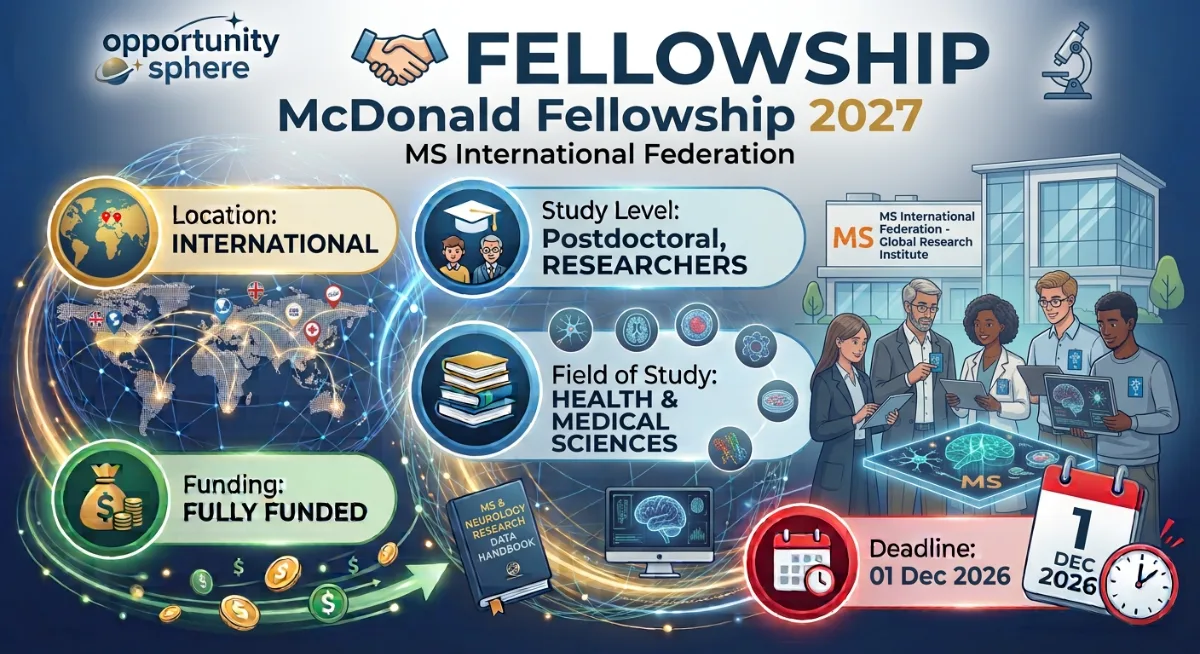
The McDonald Fellowship is an international research fellowship administered by the MS International Federation (MSIF) for early-career researchers from low- and middle-income countries who are working in areas relevant to multiple sclerosis.
The fellowship enables successful researchers to spend two years working with a research institution outside their own country. During the placement, fellows may develop specialised research expertise, learn new techniques and methods, or undertake part of a collaborative research project with an established research team.
The programme is particularly focused on strengthening multiple sclerosis research and patient-care capacity in low- and middle-income countries. Fellows are expected to use the expertise, skills and professional networks developed during the fellowship to continue MS research and/or contribute to patient care in low- and middle-income countries after the fellowship.
Research projects with clear potential benefits for people living with multiple sclerosis in low- and middle-income countries are prioritised.
Who Can Apply
Applicants must meet MSIF's specific eligibility requirements. In particular, candidates must:
Have postgraduate-level education, with at least an MSc and preferably a PhD or MD, in an area relevant to multiple sclerosis.
Have fewer than five years of postdoctoral research experience. Career breaks and other circumstances that affected the applicant's research career may be taken into account.
Be a citizen of a low-, lower-middle- or upper-middle-income country according to the World Bank classification.
Be working or studying in a low- or middle-income country when applying, or be working/studying in another country on a project that began within the six months before the application.
Have a research project relevant to multiple sclerosis.
Identify a suitable host institution and host supervisor outside their own country before beginning the application.
The fellowship may also be used to part-fund a PhD where the applicant has already been accepted onto a recognised PhD programme within the six months before applying but does not have sufficient funding to cover the full cost.
Research Areas
The proposed project must have a clear connection to multiple sclerosis. Possible areas include:
Other research involving MS or closely related conditions where the relevance to MS is clearly explained
Projects involving related conditions such as NMOSD or MOGAD may be considered when the proposal clearly explains how the research contributes to understanding multiple sclerosis.
International Host Institution
The fellowship is built around a collaboration between the applicant and an international host institution.
Applicants must identify a suitable project and host supervisor before starting the application. The host supervisor should be able to provide the research environment, supervision and expertise needed for the proposed work.
This makes early communication with potential host institutions particularly important. The research proposal should be agreed with the host supervisor before the application is submitted.
Fellowship Funding
The fellowship provides a grant of €55,000 per year for two years.
The payment is made to the host institution and is used to support the fellow. The award is therefore not simply a tuition scholarship; it is structured around an international research placement.
Under MSIF's fellowship terms, funding can support costs associated with the fellowship, including the fellow's salary and eligible expenses such as travel, accommodation, visa-related costs, insurance, subsistence and certain research-related expenses. The precise use of funds is governed by the fellowship's terms and conditions.
What Fellows Gain
The two-year placement provides time to develop expertise that may not be available at the applicant's home institution. Depending on the project, this can include exposure to specialised research techniques, laboratory facilities, clinical research environments, analytical methods, international research networks and established MS research teams.
The fellowship can also provide a foundation for longer-term collaboration between the fellow, their home institution and the international host.
MSIF's previous fellowship recipients have worked on projects spanning areas such as MS epidemiology, treatment outcomes, biomarkers and disease mechanisms, demonstrating the range of research that can be supported.
Knowledge Transfer and Long-Term Impact
A central feature of the programme is what happens after the international research placement.
Applicants should be able to demonstrate how the expertise gained through the fellowship can contribute to MS research or patient care in low- and middle-income countries. This may involve introducing research methods, strengthening local research programmes, developing collaborations, improving clinical knowledge or applying newly acquired technical expertise.
Projects with a clear potential benefit for people living with MS in low- and middle-income countries receive priority.
Application Requirements
The application is a joint process involving the researcher and the proposed host.
Applicants need to:
Identify an appropriate MS-related research project.
Identify a suitable host institution and host supervisor outside their own country.
Agree the proposed project with the host supervisor.
Complete the online application form.
Prepare a clear 500-word lay summary of the proposed research.
Arrange for the host supervisor to provide the required supporting statement.
Obtain two reference letters from referees who are different from the host supervisor.
Submit the complete application and ensure all supporting material is received by the applicable deadline.
The lay summary is an important component of the application. MSIF asks applicants to explain the research problem, why it matters, what the proposed research will investigate and how the results could affect people living with MS, using language that can be understood by a non-specialist reader.
Selection
Applications are assessed by an MSIF McDonald Fellowship panel that includes scientists, clinicians and people affected by multiple sclerosis from different parts of the world.
Projects are considered in relation to their scientific quality and relevance to MS, while particular priority is given to research with clear potential benefits for people with MS in low- and middle-income countries.
Reporting Requirements
Fellows have reporting responsibilities during and after the fellowship.
A short report is required at the end of the first year, and continuation of second-year funding depends on submission of this report. At the end of the fellowship, fellows must provide a final report and expenditure summary. MSIF also requests electronic copies of relevant outputs such as papers, abstracts and posters resulting from the fellowship.
Important Correction for Applicants
There is no 2027 application round for the McDonald Fellowship. According to the current MSIF programme page, the next application round will be in 2028.
Therefore, the previously stated 1 December 2026 deadline does not apply to a 2027 McDonald Fellowship. Applicants interested in the next round should monitor MSIF's official fellowship page for the opening date and deadline when the 2028 call is released.
The fellowship should begin within 12 months of the award being made.
Recent Fellowship Examples
The programme has supported researchers from low- and middle-income countries working with international MS research institutions. In 2026, for example, MSIF announced a fellowship project involving research on microglial states and repair failure in MS, while another project examined anti-CD20 treatment outcomes in non-active progressive MS using real-world data.
These examples illustrate that the programme can support both laboratory-based and clinically oriented research approaches.
How to Apply
The 2028 application portal will be made available when the next call opens.
Applicants should begin by identifying a suitable MS research topic, potential host institution and host supervisor, then discuss the proposed project with the host before the application round opens.
Related Opportunities
Explore other scholarships, fellowships, grants, research opportunities and more that may match your interests.