The application deadline for this opportunity has passed. You can still review the details, but the listing is no longer presented as open for applications.
Fellowship, PhD & Research
Jesus College Cambridge Science Research Fellowship 2026
Offered by Jesus College, University of Cambridge
Location
United Kingdom
Funding
Paid
Study level
Researchers, Postdoctoral
Field of study
Life Sciences, Natural Sciences
Application deadline
September 30, 2026
Application Closed
About This Fellowship
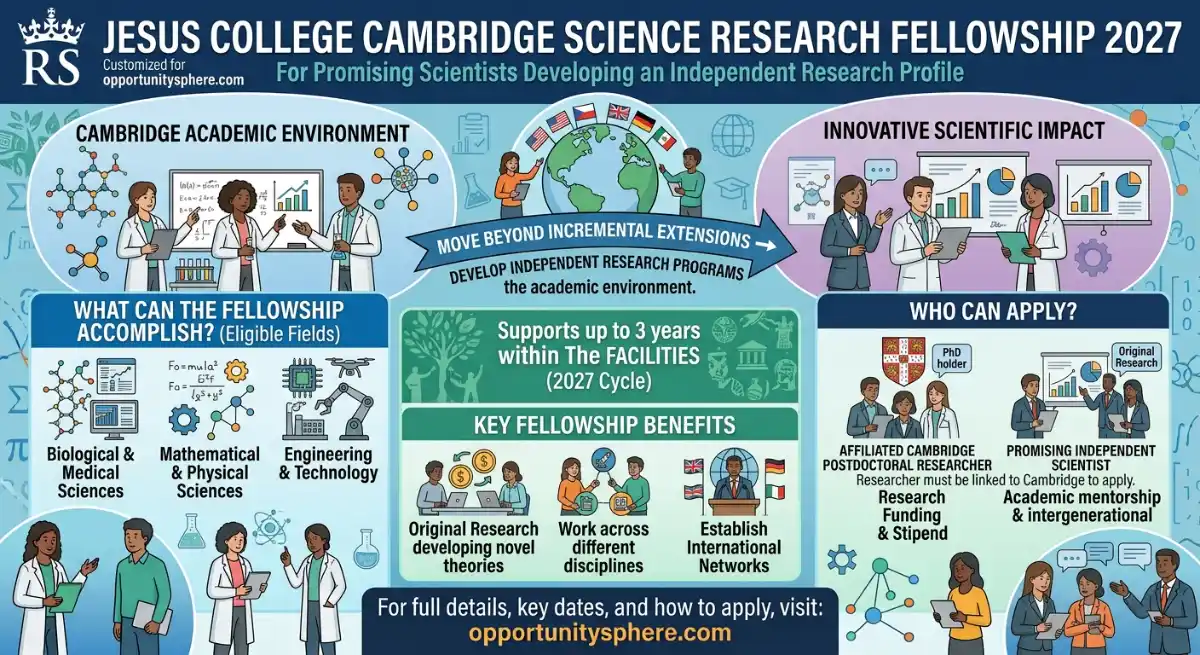
The Jesus College Cambridge Science Research Fellowship 2027 is a prestigious early-career research opportunity at Jesus College, University of Cambridge, designed for promising scientists who are developing an independent research profile. The fellowship provides an opportunity to spend three years within the Cambridge academic environment while pursuing original research in a broad range of scientific, mathematical, engineering, medical, and technology-related disciplines.
The fellowship is particularly suited to researchers who are moving from doctoral or early postdoctoral work toward greater research independence. Successful fellows become members of Jesus College and benefit from access to Cambridge's wider research environment, alongside a salary, research support, college facilities, and opportunities to participate in the academic and social life of the College.
For the 2027 competition, applicants should prepare well in advance because the application requires a substantial research statement and confidential references. The stated application deadline is 30 September 2026 at 5:00 PM BST.
1. Fellowship Overview
Host Institution: Jesus College, University of Cambridge
Opportunity Type: Science Research Fellowship
Location: Cambridge, United Kingdom
Target Applicants: Early-career researchers in eligible scientific and technical disciplines
Career Stage: Final-stage PhD candidates and recent doctoral researchers
Fellowship Duration: Normally 3 years
Expected Start: Normally 1 October 2027
Application Deadline:30 September 2026 at 5:00 PM BST
Application Method: Online application through the Jesus College Research Fellowship portal
Advertisement
🔒Application Closed
The listed deadline has passed. Check the official website to see whether the organisation has announced an extension or a new application period.
Stay in the loop
Your Next Opportunity Could Be One Email Away
Receive updates about scholarships, jobs, internships, fellowships and grants so you can discover opportunities worth exploring.
Stay Updated
Never miss an opportunity.
Get updates on scholarships, jobs, internships, grants, fellowships, conferences, and other opportunities delivered straight to your inbox.
Research Environment: Jesus College and relevant University of Cambridge departments, laboratories, research groups, and facilities
The fellowship is intended to give researchers the time and institutional environment needed to establish a strong independent research programme. Rather than being limited to a single narrowly defined project area, the competition covers a broad range of scientific disciplines.
Applicants should therefore focus on demonstrating the significance of their research, their ability to work independently, the originality of their proposed programme, and the contribution they could make to the broader Cambridge research community.
2. Scientific Areas Covered
The competition encompasses a wide range of disciplines across the sciences and related technical fields. Applicants from interdisciplinary backgrounds may also be considered where their proposed research has a substantial connection to an eligible scientific area.
Relevant areas may include:
Biological Sciences: Biology, ecology, environmental science, biological anthropology, veterinary science, and related areas.
Medical and Biomedical Sciences: Medicine, biomedical research, physiological sciences, and associated research areas.
Chemistry: Organic, inorganic, physical, analytical, materials, and interdisciplinary chemistry.
Physics: Theoretical and experimental physics, astrophysics, condensed matter, quantum science, and related areas.
Mathematics: Pure mathematics, applied mathematics, statistics, mathematical modelling, and mathematical sciences.
Computer Science: Artificial intelligence, machine learning, computational science, data science, theoretical computer science, and related fields.
Engineering: Engineering research involving technological development, computational methods, materials, systems, energy, and related areas.
Chemical Engineering and Biotechnology: Research involving biological processes, industrial biotechnology, biochemical engineering, and related technologies.
Environmental and Earth-Related Sciences: Research addressing ecosystems, environmental processes, climate-related questions, natural resources, and associated scientific problems.
Interdisciplinary applications can be particularly relevant where the research question genuinely requires methods or knowledge from multiple fields. For example, a project might combine computational science with biology, engineering with environmental science, or mathematical modelling with epidemiology.
The important consideration is that the proposed work should have a clear scientific research foundation and demonstrate the applicant's capacity to make an original contribution.
3. Duration and Research Appointment
The fellowship is normally held for three years, with the 2027 appointment expected to begin around 1 October 2027.
A three-year period provides considerably more time than many short-term postdoctoral fellowships. This allows a fellow to develop a coherent research programme rather than concentrating exclusively on a single short experiment or publication.
During the fellowship, the researcher can develop new research questions, undertake experiments or fieldwork where appropriate, analyse data, publish findings, collaborate with other researchers, and establish a longer-term academic research profile.
The appointment also places the fellow within the Cambridge collegiate system. This means that the fellowship is not simply a research grant; it combines an academic research position with membership of a Cambridge college.
4. Financial Package and Research Support
The fellowship provides financial and institutional support intended to enable the researcher to concentrate on research.
Key elements of the package include:
Salary: The fellowship is remunerated at the relevant University of Cambridge salary scale, with the advertised starting point stated as Step 35, approximately £32,882 per annum.
Research Support: Fellows may receive a research allocation or "bench fee" of approximately £12,000 per year, subject to the applicable arrangements and annual review.
College Membership: Successful candidates become members of Jesus College and participate in its academic community.
Dining Benefits: College dining privileges are available, including the advertised provision of a daily lunch or dinner.
Accommodation Assistance: Research Fellows may receive assistance in obtaining subsidised College accommodation, subject to availability.
Pension: Eligible fellows may have access to the applicable University pension arrangements.
Research Environment: Fellows can work within the wider University of Cambridge research ecosystem and engage with relevant departments, laboratories, research groups, libraries, and specialist facilities.
The research allowance can be particularly useful for projects requiring laboratory materials, specialist services, fieldwork, computing resources, data collection, conference participation, or other legitimate research expenses.
Applicants should nevertheless distinguish between salary and research funding. The salary supports the fellow personally, while research allocations are intended for approved costs associated with conducting the research programme.
5. Eligibility and Career Stage
The fellowship is aimed specifically at researchers who are at an early stage of establishing an independent academic career.
Applicants are generally expected to fall into one of two broad categories:
Final-stage doctoral researchers who are approaching completion of their PhD.
Recent PhD graduates or early-career postdoctoral researchers who are beginning to establish an independent research record.
Career timing is important. The competition is not intended primarily for established senior academics who have already spent many years leading independent research programmes.
Candidates who have undertaken more than approximately five years of full-time research after their degree may generally fall outside the intended career stage, although individual circumstances and career interruptions may need to be considered according to the official fellowship rules.
Researchers who have taken career breaks, parental leave, undertaken non-standard career pathways, or experienced other circumstances affecting their research timeline should carefully consult the official fellowship particulars before deciding whether the relevant career-stage requirements apply to them.
6. What the Selection Committee Will Look For
A strong application needs to demonstrate more than academic ability. The fellowship is intended to identify researchers with the potential to develop into independent research leaders.
Important elements include:
Research originality: The proposed work should address a meaningful research question and offer a clearly identifiable contribution.
Scientific significance: Applicants should explain why the research matters to their discipline.
Research independence: The application should demonstrate that the candidate is developing their own research direction rather than simply continuing a supervisor's programme.
Methodological strength: The proposed methods should be appropriate, realistic, and sufficiently developed.
Track record: Previous research, publications, conference contributions, awards, datasets, software, experimental achievements, or other relevant outputs can demonstrate research potential.
Feasibility: The proposed programme should be achievable within the three-year fellowship period.
Future potential: The committee needs to see how the fellowship could contribute to the applicant's development as an independent scientist.
Cambridge relevance: Applicants should demonstrate how the University and College environment could support the proposed work.
The proposal should therefore connect the applicant's previous research experience with the new research programme. The committee should be able to see a logical progression from what the applicant has already accomplished to what they intend to investigate next.
7. Research Statement
The research statement is one of the most important components of the initial application.
The stated limit is up to 2,000 words, and the statement needs to perform two related functions: explain the significance of the applicant's previous research and present the research they intend to undertake during the fellowship.
A useful structure can include:
A. Previous Research
Begin by explaining the central problem addressed by the applicant's previous research.
Rather than providing a chronological list of publications, applicants should identify the main scientific questions they have addressed and explain what their work has contributed.
For example, a researcher could describe:
The scientific problem investigated.
The methods used.
The principal findings.
What was novel about the work.
Publications or other outputs resulting from the research.
How the previous work led to new research questions.
B. Current Research Direction
The next section should establish the research problem that the fellowship will address.
Applicants should explain:
What remains unknown.
Why the gap is scientifically important.
What hypothesis, question, or problem will be investigated.
What new approach the applicant proposes.
Why the proposed research is timely.
C. Proposed Research Programme
The proposed work should then be described in enough detail for the committee to understand the research strategy.
This may include:
Research objectives.
Specific questions or hypotheses.
Experimental or analytical methods.
Data collection.
Laboratory or field approaches.
Modelling or computational methods.
Expected results.
Potential challenges and alternative approaches.
D. Expected Contribution
The statement should conclude by explaining what the project could add to the field.
This does not require claiming that the research will solve an entire scientific problem. Instead, applicants should identify the specific knowledge, method, dataset, technology, or conceptual advance that the fellowship could produce.
8. Demonstrating Research Independence
One of the central challenges for early-career researchers is showing that they are ready to become independent investigators.
Applicants should therefore distinguish their proposed programme from the research of their PhD or postdoctoral supervisors.
This does not mean abandoning their existing expertise. In fact, the strongest applications can build logically on previous experience while introducing a genuinely new research direction.
For example, a researcher might have previously studied one crop pest but propose a broader investigation of ecological interactions, climate effects, biological control, or molecular mechanisms during the fellowship.
Similarly, a computational scientist might use techniques developed during doctoral research to address a substantially different scientific question.
The key is to demonstrate intellectual ownership of the proposed research programme.
9. Referees and Confidential Reports
Applicants are required to nominate two confidential referees.
Referees should ideally be established academics who know the applicant's research well enough to provide detailed evidence of their abilities.
A strong referee should be able to comment on areas such as:
Research originality.
Scientific ability.
Independence.
Analytical and methodological skills.
Publication record.
Capacity for future research leadership.
Contribution to the scientific community.
Suitability for an early-career research fellowship.
Applicants should contact referees well before the deadline rather than waiting until the final days of the competition.
When approaching a referee, it is useful to provide:
Current CV.
Draft research statement.
Summary of proposed fellowship research.
List of recent publications.
Fellowship deadline.
Instructions for submitting the confidential report.
The applicant remains responsible for ensuring that referees understand the deadline and submission procedure.
10. Application Procedure
The application process can be approached systematically.
Step 1: Confirm Eligibility
Before preparing the application, review the official fellowship particulars carefully.
Confirm that your academic discipline, career stage, doctoral status, and research profile fall within the competition's requirements.
Step 2: Study the Fellowship Requirements
Read the complete official particulars rather than relying only on summaries.
Pay particular attention to:
Eligible disciplines.
Career-stage requirements.
Word limits.
Reference requirements.
Submission deadlines.
Shortlisting procedures.
Any requirements that apply after the initial application.
Step 3: Create Your Research Plan
Before writing the final statement, develop a clear research framework.
Identify:
The central research problem.
The knowledge gap.
Research objectives.
Proposed methods.
Expected contribution.
Three-year timetable.
Potential challenges.
Cambridge resources relevant to the work.
Step 4: Prepare the Research Statement
Write the statement so that the reader can understand both the applicant's previous achievements and the future research programme.
Avoid turning the document into an extended literature review. The committee needs to understand the applicant's own contribution and proposed research direction.
Step 5: Select and Contact Referees
Approach two appropriate referees early and provide them with the necessary supporting information.
Do not assume that a referee's previous recommendation automatically means they have sufficient information about the new project.
Step 6: Complete the Online Application
Create an account on the Jesus College Research Fellowship application system and enter the required information.
Upload the research statement and any other documents requested by the portal.
Step 7: Monitor Reference Submissions
Check the application system to ensure that nominated referees have completed their confidential reports.
If a report remains outstanding, contact the referee well before the deadline.
Step 8: Submit Before the Deadline
The stated closing time is 5:00 PM BST on 30 September 2026.
Applicants should avoid leaving submission until the final hour because technical problems, incomplete fields, missing references, or upload difficulties can create unnecessary problems.
11. What Happens After the Initial Application
The selection process does not necessarily end with the initial submission.
According to the stated competition timetable, shortlisted candidates may be contacted in November 2026 and asked to provide additional material.
This can include:
A sample of written work of up to 40,000 words, such as selected thesis chapters or published research papers.
A 500-word statement explaining the importance of the candidate's current and proposed research.
Applicants should therefore retain well-organised copies of their strongest academic work.
A thesis chapter should not automatically be submitted simply because it is long. The selected material should demonstrate the applicant's ability to conduct rigorous research and communicate complex scientific ideas clearly.
Published papers may also be appropriate where they provide strong evidence of the candidate's research contribution.
12. Preparing the Written Work in Advance
Because shortlisted candidates may have a relatively short period to provide additional materials, it is sensible to identify potential written samples before submitting the initial application.
Other substantial scholarly writing appropriate to the fellowship requirements.
The selected work should collectively demonstrate research quality rather than simply represent the largest amount of material available.
Applicants should also check the official instructions carefully if they are shortlisted because the exact requirements and submission arrangements should be followed as provided by Jesus College.
13. Building a Three-Year Research Programme
A three-year fellowship requires a research plan that is ambitious but achievable.
A useful programme can be divided into stages.
Year 1 – Foundation and Data Generation
The first year can focus on establishing the research infrastructure, refining methods, collecting initial data, conducting experiments, or developing computational frameworks.
Where appropriate, the fellow may also begin initial publications based on early findings.
Year 2 – Main Research Phase
The second year can concentrate on the main experimental, analytical, computational, or field component of the project.
At this stage, the fellow should be generating substantial results and developing collaborations where they are scientifically useful.
Year 3 – Integration and Dissemination
The final year can focus on completing experiments or analyses, integrating results, publishing findings, presenting research, and developing the next stage of the research programme.
The three-year structure should not be treated as rigid. Research projects frequently change direction when new evidence emerges, so applicants should demonstrate a clear plan while allowing reasonable flexibility.
14. Making the Cambridge Connection
An important part of the application is explaining why the research belongs in the Cambridge environment.
Applicants should investigate relevant Cambridge departments, research groups, laboratories, researchers, equipment, datasets, or methodological expertise that could contribute to the proposed project.
The Cambridge connection should be specific.
Instead of simply stating that Cambridge is a world-leading university, explain what the applicant would actually use or gain from the environment.
For example, an applicant might identify:
A specialist laboratory.
A particular analytical facility.
A research group working on a related scientific problem.
A unique dataset.
Specialist instrumentation.
Computational infrastructure.
Interdisciplinary expertise.
Opportunities for collaboration with researchers in another department.
This demonstrates that the applicant has developed a realistic understanding of the research environment.
15. Common Application Problems to Avoid
Several issues can weaken an otherwise promising application.
An overly broad research question: A three-year fellowship should have a clearly defined scientific focus.
Insufficient evidence of independence: Simply extending a supervisor's existing project may make it difficult to demonstrate an independent research identity.
Excessive technical detail without context: Methods should support the scientific argument rather than overwhelm it.
Weak explanation of significance: Applicants should explain why the problem matters rather than assuming its importance is obvious.
Unrealistic scope: Too many experiments, datasets, locations, or research objectives can make the project appear difficult to complete.
Generic Cambridge references: Statements about Cambridge's reputation are less informative than identifying specific resources relevant to the project.
Late reference requests: Referees need sufficient time to prepare thoughtful confidential reports.
Poor connection between past and future research: The proposed project should emerge logically from the applicant's research development while establishing a distinct direction.
16. How to Present the Applicant's Research Record
The fellowship is aimed at researchers who are developing an independent academic identity, so the application should present achievements strategically.
Applicants can highlight:
Peer-reviewed publications.
First-author or corresponding-author research.
Significant datasets.
Software or computational tools.
Conference presentations.
Research awards.
Grants or research funding.
Laboratory or field expertise.
Interdisciplinary collaborations.
Research-related teaching or mentoring.
The emphasis should be on evidence rather than a long list of accomplishments.
For example, instead of simply stating that an applicant has published several papers, the research statement can briefly explain the scientific problem addressed and the applicant's specific contribution.
17. Preparing Before 30 September 2026
Applicants working toward the 2027 competition can use the remaining preparation period efficiently.
A practical preparation schedule is:
Immediately: Confirm eligibility and read the official fellowship documentation.
Early preparation: Identify two referees and inform them of the deadline.
Research planning: Define the central question and three-year research programme.
Writing stage: Prepare and revise the 2,000-word research statement.
Final review: Check the application against every requirement in the official instructions.
Before submission: Confirm that references and supporting materials are progressing.
Final days: Review all entered information and submit before the 30 September 2026, 5:00 PM BST deadline.
Applicants should keep copies of the final submitted materials because shortlisted candidates may need to build upon the same research programme in subsequent stages.
18. Professional Development Through the Fellowship
Beyond the immediate research project, a three-year Cambridge fellowship can provide an environment in which an early-career scientist develops a broader academic profile.
Potential areas of professional development include:
Building collaborations across disciplines.
Developing a sustained publication programme.
Establishing an independent research identity.
Presenting work to specialist and interdisciplinary audiences.
Developing grant-writing experience.
Participating in academic seminars and conferences.
Mentoring or contributing to teaching activities where appropriate.
Building connections within the Cambridge research community.
Developing the foundation for future academic or research positions.
The value of these opportunities depends on how actively a fellow engages with the academic environment and develops relationships around their research.
19. Final Application Checklist
Before submitting the application, candidates should verify the following:
I meet the stated career-stage requirements.
My research falls within an eligible scientific or technical discipline.
I have reviewed the official fellowship particulars.
My proposed research is clearly defined.
My research programme is realistic for three years.
I have explained the significance of the research.
I have demonstrated my research independence.
I have connected my previous research to the proposed project.
I have identified relevant Cambridge research resources.
My research statement is within the required word limit.
I have nominated two suitable referees.
My referees have received sufficient information and notice.
I have completed all required sections of the online application.
I have checked the application for errors and omissions.
I have submitted before 5:00 PM BST on 30 September 2026.
20. Key Takeaway
The Jesus College Cambridge Science Research Fellowship offers early-career scientists an opportunity to develop a sustained independent research programme within the University of Cambridge environment. The three-year structure, salary, research support, College membership, and access to the wider Cambridge research community make it particularly relevant to researchers who are moving from doctoral or early postdoctoral work toward greater independence.
A strong application should bring together three elements: evidence of high-quality previous research, a clearly defined and original future research programme, and a convincing explanation of why the applicant and proposed work would benefit from the Cambridge environment.
The application deadline for the 2027 competition is 30 September 2026 at 5:00 PM BST, so prospective applicants should begin preparing their research statement, supporting materials, and confidential references well before the closing time.
Related Opportunities
Explore other scholarships, fellowships, grants, research opportunities and more that may match your interests.