Fellowship
ECDC Fellowship Programme – EPIET/EUPHEM 2027
Offered by European Centre for Disease Prevention and Control (ECDC)
Location
European Union / European Economic Area
Funding
Fully Funded
Study level
Professional, Researchers
Field of study
Health & Medical Sciences, Life Sciences, Natural Sciences
Application deadline
October 26, 2026
About This Fellowship
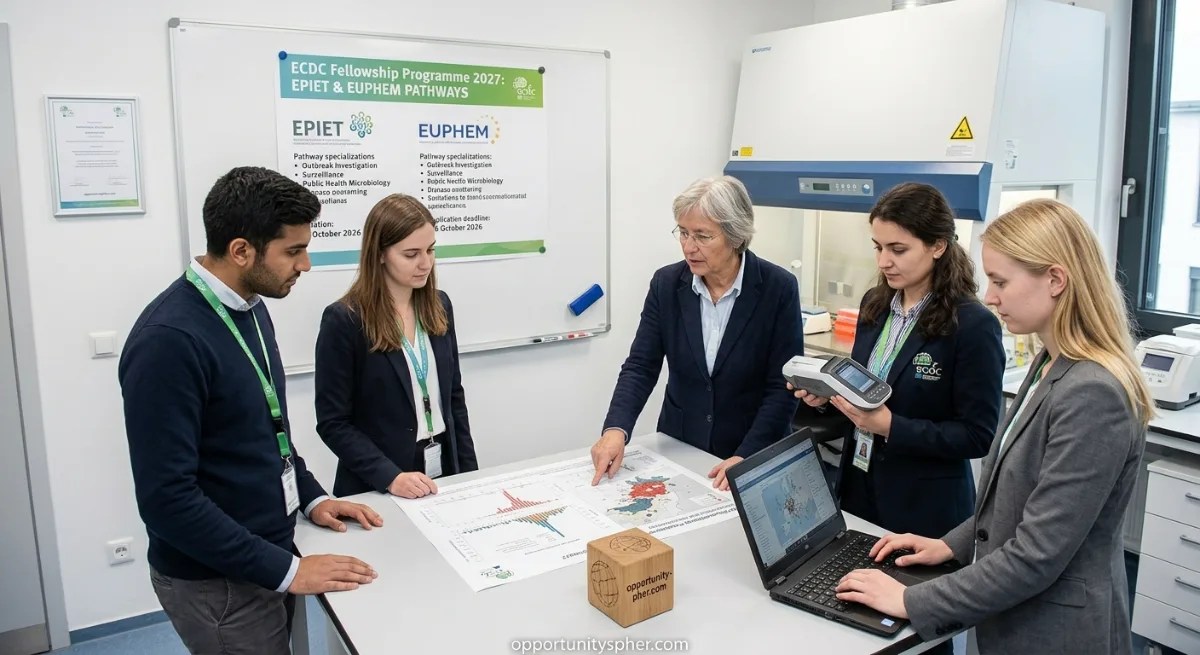
The European Centre for Disease Prevention and Control (ECDC) Fellowship Programme provides specialised two-year professional training for public health professionals seeking to develop advanced practical competencies in field epidemiology or public health microbiology. The 2027 recruitment cycle covers two major training pathways: the European Programme for Intervention Epidemiology Training (EPIET) and the European Public Health Microbiology Training Programme (EUPHEM).
The programme is designed around practical, competency-based learning rather than conventional classroom education alone. Fellows are placed within recognised public health institutions, laboratories and other approved training sites where they participate in real public health activities under the supervision of experienced professionals. Through this approach, participants gain experience working on infectious disease threats and public health challenges while developing skills that can be applied in their future careers.
The EPIET pathway focuses on applied field epidemiology. Fellows receive training in areas such as disease surveillance, outbreak investigation, epidemiological analysis, public health response, risk assessment and evaluation of public health interventions. During their fellowship, participants may contribute to investigations of communicable disease events and other epidemiological activities, giving them the opportunity to apply theoretical knowledge to real-world public health situations.
The EUPHEM pathway is intended for professionals interested in public health microbiology. It combines laboratory-based microbiological training with epidemiological and public health applications. Fellows develop competencies relevant to the detection, characterisation, investigation and control of infectious disease threats and gain experience working at the interface between laboratory science and public health decision-making.
Both pathways combine supervised practical assignments, formal training, applied research and professional development. Fellows may be involved in surveillance activities, outbreak investigations, laboratory investigations, scientific analysis, research projects, technical reporting and communication of public health findings. The programme therefore provides exposure to several stages of the public health response process rather than concentrating on a single technical discipline.
An important component of the fellowship is the opportunity to work within the European public health community. Fellows interact with epidemiologists, microbiologists, laboratory scientists and other specialists from different institutions and countries. This creates opportunities for professional collaboration and exposure to different approaches to infectious disease surveillance, prevention and control.
The two-year structure allows participants to progressively develop their professional competencies. Training activities are linked to practical assignments, enabling fellows to gain experience while receiving guidance and feedback from supervisors and other experts. The programme is particularly relevant for professionals who intend to build careers involving infectious disease epidemiology, public health microbiology, national or international disease surveillance, outbreak preparedness and response, or related areas of public health.
Advertisement
Check the official website for the latest eligibility requirements, application instructions and deadlines.