9th MIM Society Conference 2027 – Call for Abstracts, Research Presentations and Symposia
Offered by Multilateral Initiative on Malaria Society (MIM Society)
Location
Rwanda
Funding
Not specified
Study level
Undergraduate, Graduate, Researchers, Professional
Field of study
Health & Medical Sciences, Life Sciences
Application deadline
November 30, 2026
About This Conference
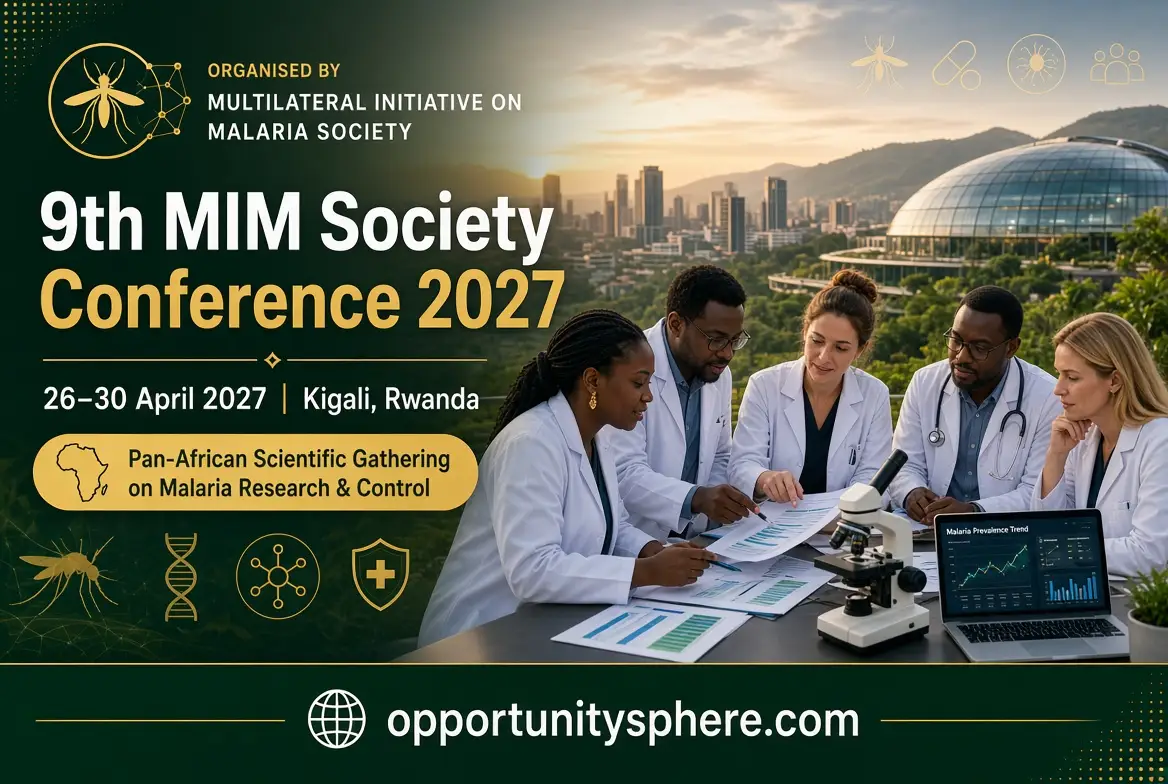
The 9th MIM Society Conference 2027 is a major Pan-African scientific gathering organised by the Multilateral Initiative on Malaria Society (MIM Society). The conference will take place from 26 to 30 April 2027 in Kigali, Rwanda, bringing together malaria researchers, scientists, public health professionals, policymakers, malaria control programme representatives, research institutions and other stakeholders working to reduce the burden of malaria.
Founded in 1997, the Multilateral Initiative on Malaria was established to address the gap between Africa's substantial malaria burden and the need for stronger research capacity, scientific collaboration and evidence-based interventions. Over the years, the initiative has developed into an important platform connecting African researchers and institutions with international research networks, funding organisations and policymakers. Its conference series provides opportunities to share scientific evidence, discuss emerging challenges, strengthen research partnerships and translate research findings into practical malaria-control strategies.
The 2027 meeting continues this work by creating a platform for scientific exchange and collaboration among researchers and organisations from malaria-endemic countries and other parts of the world. It is particularly relevant to professionals whose research or work contributes to malaria prevention, diagnosis, treatment, surveillance, vector control, drug development, public health policy and the strengthening of malaria research systems.
Who Should Consider Participating?
The conference is relevant to a broad range of people working in malaria research and control. Potential participants include:
University lecturers, academic researchers and research fellows working on malaria and related infectious diseases.
PhD and postgraduate students conducting research in parasitology, medical entomology, epidemiology, molecular biology, public health and tropical medicine.
Postdoctoral and early-career researchers seeking opportunities to present their findings and establish research collaborations.
Medical doctors, clinicians, laboratory scientists and other healthcare professionals involved in malaria diagnosis, treatment and prevention.
Entomologists and vector-control specialists studying malaria-transmitting mosquitoes, insecticide resistance, vector behaviour and environmental influences on transmission.
Researchers investigating antimalarial medicines, drug resistance, malaria vaccines, immunology and new approaches to disease prevention.
Public health practitioners, policymakers and representatives of national malaria control programmes.
Research institutions, government agencies, international organisations and development partners supporting malaria research and elimination programmes.
The official 2027 call welcomes participation from researchers, policymakers and malaria-control professionals across Africa and beyond. It does not publish a restrictive nationality or academic-degree requirement for general conference participation. Prospective contributors should nevertheless check the relevant submission instructions for their chosen participation category.
Scientific Areas and Research Interests
The MIM Society's wider scientific and institutional work covers several important areas of malaria research. These provide useful guidance for researchers considering whether their work is relevant to the conference.
Malaria Parasites and Parasitology: Research on malaria parasites, their biology, development, transmission, genetic diversity and interactions with human hosts. Studies that improve understanding of parasite behaviour, transmission patterns and disease progression are relevant to this area.
Malaria Vector Control and Medical Entomology: Research on mosquito vectors responsible for malaria transmission, including vector ecology, mosquito behaviour, insecticide resistance, insecticide-treated nets, indoor residual spraying and other vector-management interventions. Studies examining the effects of environmental change and climate conditions on mosquito distribution and transmission are also relevant.
Malaria Diagnosis and Case Management: Research aimed at improving malaria detection, treatment and patient management. This includes diagnostic technologies, treatment effectiveness, antimalarial drug resistance, access to effective medicines and improvements in clinical management.
Antimalarial Drug Development: Scientific work examining new antimalarial compounds, drug discovery, therapeutic effectiveness, resistance mechanisms and strategies for maintaining the effectiveness of existing treatments.
Vaccinology and Immunology: Research on malaria vaccine development, vaccine effectiveness, immune responses, protective immunity and the scientific challenges involved in improving malaria prevention through immunisation.
Malaria Surveillance and Digital Health: Research on disease monitoring, malaria data systems, digital technologies, surveillance methods and tools that can improve the collection, analysis and use of malaria information for public health decisions.
Climate Change and Malaria: Studies examining how rainfall, temperature, environmental changes, land use and other climatic factors influence mosquito populations, malaria transmission and the effectiveness of control programmes.
Public Health Policy and Malaria Elimination: Research that connects scientific findings with malaria-control strategies, health-system strengthening, community-level interventions, resource allocation and evidence-informed policy.
These areas reflect MIM Society's wider technical priorities and should be used as a guide when assessing the relevance of a proposed contribution. Applicants should consult the current submission portal for any specific conference tracks or topic classifications.
Call for Abstracts and Research Presentations
One of the principal participation opportunities is the submission of research findings for consideration for oral or poster presentation.
The conference registration and submission portal provides a dedicated abstract-submission option. The official website describes the abstract as a 300-word submission. Researchers should therefore prepare a concise scientific summary that communicates the purpose, methods, important findings and relevance of their work within the applicable word limit.
A strong research abstract should clearly identify the problem being investigated, explain the research objective, briefly describe the methods used, report the main findings and state the contribution of the research to malaria science, public health practice or policy.
Potential contributions may include completed research on malaria parasite biology, mosquito-vector control, insecticide resistance, malaria epidemiology, antimalarial drug development, vaccine research, diagnostic methods, treatment outcomes, surveillance systems and other relevant scientific areas.
Researchers should submit original and accurately reported findings and ensure that the abstract represents the work they intend to present. The current 2027 call directs applicants to the online submission portal for the applicable submission requirements. Applicants should not rely on abstract instructions from previous conference editions without confirming that they also apply to the 2027 meeting.
Symposium Submissions
In addition to individual research abstracts, the conference provides an opportunity to propose thematic symposia involving multiple speakers.
This option is particularly relevant to research teams, academic departments, professional networks, institutions and collaborative projects that want to bring together several perspectives on an important malaria-related issue.
A symposium proposal can provide a structured opportunity to examine a shared scientific or policy question through presentations from different speakers. Potential discussions may address emerging research findings, malaria-control innovations, scientific capacity development, regional research priorities or challenges requiring collaboration between researchers and implementation partners.
Interested groups should use the symposium-submission option on the official portal and follow the instructions provided there. A symposium proposal is distinct from an individual abstract submission.
Conference Registration, Exhibition and Partnerships
The official conference portal also provides separate options for general conference registration, exhibition participation and sponsorship.
Conference registration: For researchers, policymakers, malaria-control professionals and other interested participants who wish to attend the scientific meeting.
Abstract submission: For researchers who wish to present their research findings through an oral or poster presentation.
Symposium submission: For groups wishing to propose a thematic session involving multiple speakers.
Exhibition: For organisations interested in displaying relevant products, services, technologies, research activities or institutional work.
Sponsorship: For organisations and partners interested in supporting the conference and engaging with the wider malaria research and policy community.
These are distinct participation routes. Submitting an abstract does not automatically mean that an applicant has registered for the conference, secured an exhibition space or obtained sponsorship.
Why the Conference Matters for African Malaria Research
Malaria remains a major public health challenge, particularly in sub-Saharan Africa. Addressing it requires more than isolated interventions; it involves sustained scientific research, stronger health systems, effective prevention, improved diagnostics, appropriate treatment, reliable surveillance and collaboration between research institutions and public health authorities.
MIM Society was established to strengthen precisely these connections. Its wider work includes research facilitation, capacity strengthening, scientific knowledge sharing, advocacy for research excellence and collaboration across the malaria research community.
For early-career researchers, the conference offers an opportunity to communicate their findings to a wider scientific audience, receive feedback and connect with researchers working on related problems. For established academics and research institutions, it provides a platform to exchange evidence, identify shared research priorities and develop collaborations. For public health professionals and policymakers, it offers opportunities to engage with scientific developments that may inform malaria-control programmes and policy decisions.
The 9th MIM Society Conference is therefore particularly relevant to researchers and professionals who want to contribute to the scientific, institutional and policy efforts required to strengthen malaria prevention and control across Africa and other endemic regions.
Important Dates and Participation Information
Conference: 9th MIM Society Conference 2027.
Dates: 26–30 April 2027.
Venue: Kigali, Rwanda.
Abstract-submission deadline: 30 November 2026.
Abstract presentation formats: Oral and poster presentations.
Symposium proposals: Accepted through a separate submission option on the official portal.
Conference registration: Available through the official registration portal.
Funding: The current public call does not confirm guaranteed travel, accommodation or participation funding.
Applicants should complete their submissions before the deadline and check the official portal for the latest requirements, registration information and any updates from the organisers.
Related Opportunities
Explore other scholarships, fellowships, grants, research opportunities and more that may match your interests.