The application deadline for this opportunity has passed. You can still review the details, but the listing is no longer presented as open for applications.
Scholarship
Murdoch University Research Training Program Scholarship 2027
Offered by Murdoch University
Location
Australia
Funding
Fully Funded
Study level
Master's, PhD
Field of study
All Fields
Application deadline
September 30, 2026
Application Closed
About This Scholarship
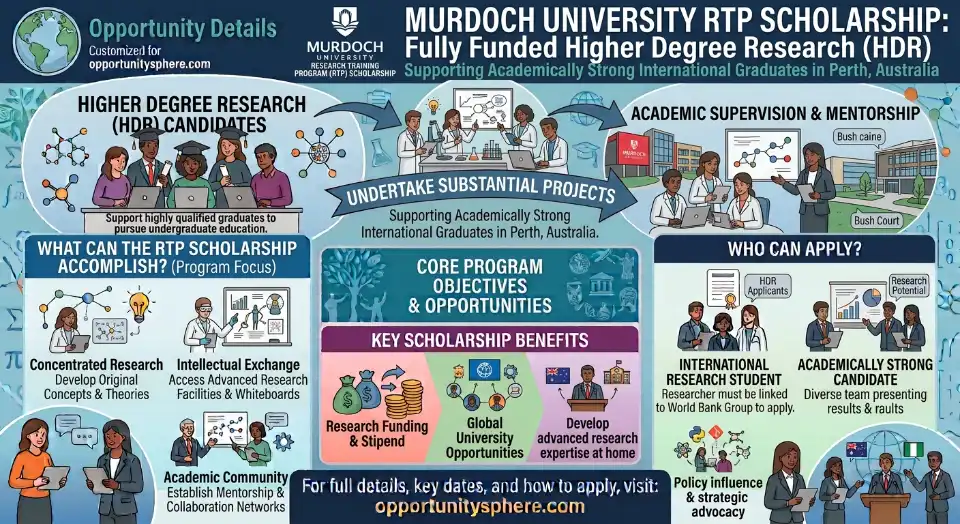
The Murdoch University Research Training Program (RTP) Scholarship provides financial support for eligible international students undertaking higher degree research at Murdoch University in Australia.
The scholarship is intended for research candidates who have demonstrated strong academic achievement and have the potential to undertake advanced postgraduate research. Rather than supporting a conventional taught Master's degree, the opportunity is designed around higher degree research, making it particularly relevant to students who want to develop a substantial research project under academic supervision.
For international students considering research study in Australia, funding is an important part of the decision-making process. A research degree can involve several years of study, specialised research facilities, academic supervision and the development of advanced research skills. The RTP framework is designed to provide financial support that can help eligible research candidates undertake this type of study.
The scholarship can support eligible research Master's and doctoral study, subject to the applicable programme and scholarship conditions.
A major part of the application process is therefore not simply demonstrating that you have good grades. Applicants should be able to show that they have the academic preparation, research experience and research direction necessary to undertake an advanced research degree.
What Makes This Different From a Taught Scholarship?
The first thing prospective applicants should understand is that this is a research training opportunity.
A research Master's or PhD normally involves a substantial independent research project rather than a programme made up primarily of taught courses and examinations.
This means that applicants need to think about the research question they want to investigate and the academic environment in which they want to investigate it.
Your application may therefore be considered from several perspectives:
Your previous academic performance
Advertisement
🔒Application Closed
The listed deadline has passed. Check the official website to see whether the organisation has announced an extension or a new application period.
Stay in the loop
Your Next Opportunity Could Be One Email Away
Receive updates about scholarships, jobs, internships, fellowships and grants so you can discover opportunities worth exploring.
Stay Updated
Never miss an opportunity.
Get updates on scholarships, jobs, internships, grants, fellowships, conferences, and other opportunities delivered straight to your inbox.
The quality and feasibility of your proposed research
Your suitability for the selected research degree
Your potential to complete advanced research
The availability of appropriate supervision
Your ability to satisfy the university's admission requirements
Your eligibility for the scholarship
For this reason, applicants should approach the scholarship as both a research-degree opportunity and a funding opportunity.
Who Is This Scholarship Designed For?
The scholarship is intended for eligible international students seeking to undertake higher degree research at Murdoch University.
Potential applicants may include graduates who have completed an appropriate Honours or Master's qualification and are now ready to progress into doctoral research.
It may also be relevant to research candidates who already have experience through:
Undergraduate research projects
Honours research
Master's dissertations
Research assistantships
Academic projects
Conference presentations
Journal publications
Laboratory or field research
Data analysis
Research-related professional experience
Not every applicant will have publications, and the absence of publications does not automatically mean that a candidate lacks research potential.
What matters is the overall evidence of preparation for advanced research.
Applicants should demonstrate how their previous academic and research experience has prepared them for the proposed programme.
Research Master's or PhD?
The scholarship may support eligible research Master's and doctoral study, but applicants should first determine which research degree is appropriate for their academic background and career plans.
A research Master's can provide an opportunity to develop advanced research skills and complete a substantial research project.
A PhD represents a longer and more advanced programme in which the candidate is expected to make an original contribution to knowledge through independent research.
Applicants should therefore avoid selecting a degree simply because it provides a longer funding period.
The appropriate degree will depend on factors such as previous qualifications, research experience, academic preparation, career objectives and the requirements of the proposed research area.
Before applying, prospective candidates should confirm that their previous qualification meets the entry requirements for the particular research degree.
The Importance of Your Research Topic
A research scholarship application is fundamentally different from applying for a general study programme.
You are not simply saying that you want to study at Murdoch University.
You need to demonstrate what you want to research.
A useful research topic should identify a genuine problem, question or knowledge gap that can be investigated through an appropriate research methodology.
Your proposal should give the university a clear idea of:
The research problem.
The background to the problem.
What is already known.
What remains unclear or under-researched.
The objectives of the research.
The proposed methodology.
The expected contribution.
Why the research is relevant.
Why Murdoch University provides an appropriate research environment.
The proposal does not necessarily need to answer every question at the beginning. Research evolves during postgraduate study.
However, applicants should demonstrate that they have thought seriously about what they want to investigate.
Finding the Right Research Environment
Choosing a university for a research degree is not only about the institution's overall reputation.
The specific research environment matters.
Applicants should investigate whether Murdoch University has researchers, research groups, facilities and expertise that align with their proposed area.
This is particularly important for research projects requiring specialised resources.
For example, a laboratory-based project may require access to particular equipment and laboratory facilities. A project involving field research may require appropriate field sites and research expertise. A computational project may require suitable computing resources and researchers with relevant methodological expertise.
The closer the relationship between your proposed project and the available research environment, the easier it may be to demonstrate why Murdoch University is an appropriate place for the research.
Finding a Potential Supervisor
Depending on the research programme and application requirements, prospective students may need to identify an appropriate supervisor or research area before submitting their application.
This is an important step that should not be rushed.
Applicants should look for researchers whose current interests overlap meaningfully with the proposed research.
When reviewing potential supervisors, consider:
Their current research interests
Recent publications
Research projects
Methodological expertise
Relevant research groups
Whether they supervise students in your proposed area
Whether their expertise complements your research proposal
A supervisor does not necessarily need to have published on the exact same research question.
What matters is whether their expertise can provide meaningful academic support for the proposed research.
Applicants should also follow Murdoch University's current procedures for contacting prospective supervisors and determining supervisory arrangements.
What Academic Achievement Means in a Research Application
Strong academic performance is one part of the application.
Applicants should present their academic history clearly through official transcripts and certificates.
Where relevant, applicants should also highlight particularly strong performance in subjects related to their proposed research.
For example, a candidate applying for a research degree in biological sciences may wish to demonstrate relevant preparation through previous coursework, research projects, laboratory training or a research dissertation.
Similarly, applicants in social sciences, business, engineering, environmental sciences or other fields should make the connection between their academic background and proposed research clear.
A high academic record is useful, but the application should also demonstrate research readiness.
Research Potential
Research potential can be demonstrated in several ways.
Applicants may have gained research experience through a Master's dissertation, Honours project, undergraduate thesis, research assistant position, professional research project or other academic activity.
Other evidence may include:
Peer-reviewed publications
Conference papers
Research reports
Research presentations
Technical reports
Data-analysis projects
Laboratory experience
Field research
Research methods training
Independent academic projects
Applicants should not simply list these activities.
Where possible, explain what you actually did and what skills you developed.
For example, instead of merely stating that you completed a research project, your CV can identify the research question, methodology, analytical techniques and outcome.
This gives the selection team a clearer picture of your research preparation.
The Scholarship Support
The scholarship provides financial support intended to assist eligible international research students during their higher degree research programme.
The information provided for this opportunity indicates a tax-exempt living allowance of approximately A$37,000 per year, subject to the applicable scholarship conditions.
The scholarship may also provide tuition fee support or a fee offset under the relevant Research Training Program arrangements.
This distinction is important.
Applicants should check the current scholarship conditions to understand exactly what costs are covered, how the fee arrangements operate and whether any additional expenses remain the student's responsibility.
Possible additional expenses can include accommodation, travel, health-related costs, books, personal expenses and other costs associated with living and studying in Australia.
The scholarship should therefore be considered as a package of research-study support rather than assumed to cover every expense associated with relocating to Australia.
What the Research Experience Can Provide
Beyond financial support, undertaking a research degree at Murdoch University can provide an environment in which students develop advanced research capabilities.
Depending on the research area, students may have access to:
Research facilities
Academic supervision
Research seminars
Workshops
Specialist research equipment
Research groups
Academic networks
Interdisciplinary activities
Conferences and scholarly events
Research training
Collaboration opportunities
The specific opportunities available will depend on the student's discipline, research group and degree.
For a research student, these activities can be important because postgraduate research involves much more than completing a thesis.
Students are also developing the ability to formulate research questions, evaluate evidence, analyse information, communicate findings and contribute to scholarly discussions.
Preparing Your Research Proposal
The research proposal is likely to be one of the most important documents in an application involving a research degree.
A useful proposal should be focused rather than excessively broad.
Start by identifying the central research problem.
Then explain why the problem matters and what is currently known about it.
After establishing the background, identify the gap your research intends to address.
The methodology should then explain how you intend to investigate the problem.
Depending on the discipline, this could involve:
Laboratory experiments
Field studies
Surveys
Interviews
Statistical analysis
Modelling
Computational analysis
Archival research
Literature-based investigation
Qualitative research
Mixed-methods research
The proposed methodology should be realistic for the available time and research environment.
Your Research Proposal Should Answer Five Basic Questions
1. What do you want to investigate?
State the research problem clearly.
2. Why is it important?
Explain the scientific, academic, social, environmental, economic or professional relevance where appropriate.
3. What is missing from current knowledge?
Identify the research gap.
4. How will you investigate it?
Describe the proposed methodology.
5. What could your research contribute?
Explain the expected contribution to knowledge or practice.
These questions can help prevent a proposal from becoming a general essay about an interesting subject.
English-Language Requirements
International applicants must satisfy applicable English-language requirements.
The specific test, minimum score and circumstances under which evidence may be waived or accepted can depend on the applicant's educational history and the university's current admission rules.
Applicants should therefore check the current Murdoch University requirements rather than assuming that a particular English-language qualification will automatically be accepted.
Where evidence is required, applicants should prepare it before submitting the application.
Documents to Prepare
Applicants should organise their supporting documents early.
These may include:
Academic certificates.
Academic transcripts.
Curriculum vitae.
Research proposal.
Motivation or personal statement where required.
Evidence of English-language proficiency where applicable.
Evidence of previous research experience.
Publications or other research outputs where applicable.
References or recommendation letters where required.
Identification documents.
Documents relating to the proposed research or supervisor where required.
Any additional documents requested by Murdoch University.
Applicants should check whether documents need to be certified, translated or submitted in a particular format.
Scholarship Application and Admission Are Not Necessarily the Same Thing
One of the most important points for applicants is that research admission and scholarship consideration may involve separate requirements or assessment processes.
Being academically eligible for a research degree does not necessarily mean that an applicant will automatically receive a scholarship.
Likewise, preparing a strong scholarship application does not remove the need to satisfy the university's admission requirements.
Applicants should carefully review the instructions for the specific scholarship round and determine:
How research-degree admission is submitted
How scholarship consideration is requested
Whether a separate scholarship application is required
Whether supervisor approval is required
Whether the research proposal is used for both admission and scholarship assessment
Whether additional scholarship documents are required
This distinction can prevent applicants from completing only one part of the process.
A Practical Application Plan
Stage 1 — Explore the research areas
Start by identifying the research discipline and areas at Murdoch University that align with your academic background.
Stage 2 — Check the degree
Determine whether a research Master's or PhD is appropriate for your qualifications and experience.
Stage 3 — Explore supervisors
Identify researchers whose expertise is relevant to your proposed project.
Stage 4 — Develop the research idea
Turn your broad interest into a focused research question.
Stage 5 — Prepare the proposal
Develop the background, research gap, objectives, methodology and expected contribution.
Stage 6 — Organise your academic record
Collect transcripts, certificates and other evidence of academic achievement.
Stage 7 — Strengthen the research CV
Highlight research projects, publications, presentations, methods and relevant experience.
Stage 8 — Check English requirements
Determine whether you need to provide English-language evidence and arrange the required documentation.
Stage 9 — Review scholarship instructions
Confirm exactly how scholarship consideration works for the current round.
Stage 10 — Submit before the deadline
Review the complete application carefully before submission.
Deadline: 30 September 2026
The application deadline provided for this scholarship is 30 September 2026.
Applicants should avoid waiting until the final day, particularly where supervisor discussions, academic references, document certification or separate admission processes may be involved.
Because scholarship rounds and university procedures can change, prospective applicants should verify the deadline and all submission requirements on the official Murdoch University scholarship page before submitting.
What Can Strengthen a Research Scholarship Application?
Applicants can improve the clarity of their application by ensuring that the different documents support the same overall story.
For example, the proposed research should make sense in light of the applicant's academic background.
The CV should provide evidence that the applicant has the skills needed to undertake the project.
The research proposal should demonstrate an understanding of the research problem.
The choice of research environment should make sense for the proposed methodology.
And the applicant's career plans should provide a reasonable explanation for pursuing the research degree.
This consistency can make the application easier for reviewers to understand.
International Research Experience
For international students, undertaking research in Australia can also provide exposure to a different academic and research environment.
Students may work alongside researchers from different countries and disciplines and develop professional networks that extend beyond their home institution.
Research training can also provide transferable skills relevant outside academia, including:
Critical analysis
Data interpretation
Project management
Scientific writing
Problem-solving
Research communication
Evidence-based decision-making
Presentation skills
Collaboration
Independent project management
These skills can be relevant to academic, government, industry, research and professional careers.
Important Things to Check Before Applying
Confirm that you qualify as an international student under the applicable rules.
Confirm that your intended research degree is eligible.
Verify that your previous qualification provides the appropriate preparation for research study.
Review the available research areas.
Identify a suitable research environment.
Determine whether a potential supervisor should be contacted before application.
Develop a clear and feasible research proposal.
Check English-language requirements.
Prepare all academic documents.
Check the scholarship-specific application instructions.
Confirm whether scholarship consideration is automatic or requires a separate indication/application.
Verify the current funding conditions.
Confirm the application deadline.
Submit all required materials before the stated deadline.
Why This Opportunity May Be Relevant to Research Candidates
The Murdoch University Research Training Program Scholarship is particularly relevant to international graduates who want to progress from previous academic study into advanced independent research.
For candidates with an Honours or Master's research background, the opportunity can provide a pathway toward doctoral research.
For doctoral candidates, it can provide financial support while they undertake a substantial research programme and develop the skills required for a long-term research career.
The combination of living support, applicable tuition arrangements, academic supervision and access to a research environment can make the scholarship an important funding opportunity for eligible international research students.
Final Note
Prospective applicants should begin by treating this as two connected decisions: choosing the right research degree and preparing a competitive scholarship application.
The first step is to identify a research area at Murdoch University that genuinely matches your academic background and future research interests. From there, applicants can explore potential supervision arrangements, develop their research proposal and prepare the academic evidence required for admission and scholarship consideration.
The scholarship information, funding arrangements and application requirements should be checked against the current Murdoch University scholarship round before submission.
Applicants should also remember that meeting the basic eligibility requirements does not necessarily guarantee an award. Scholarship selection can involve competitive assessment of academic achievement, research potential, the proposed research and other factors specified for the particular round.
Related Opportunities
Explore other scholarships, fellowships, grants, research opportunities and more that may match your interests.