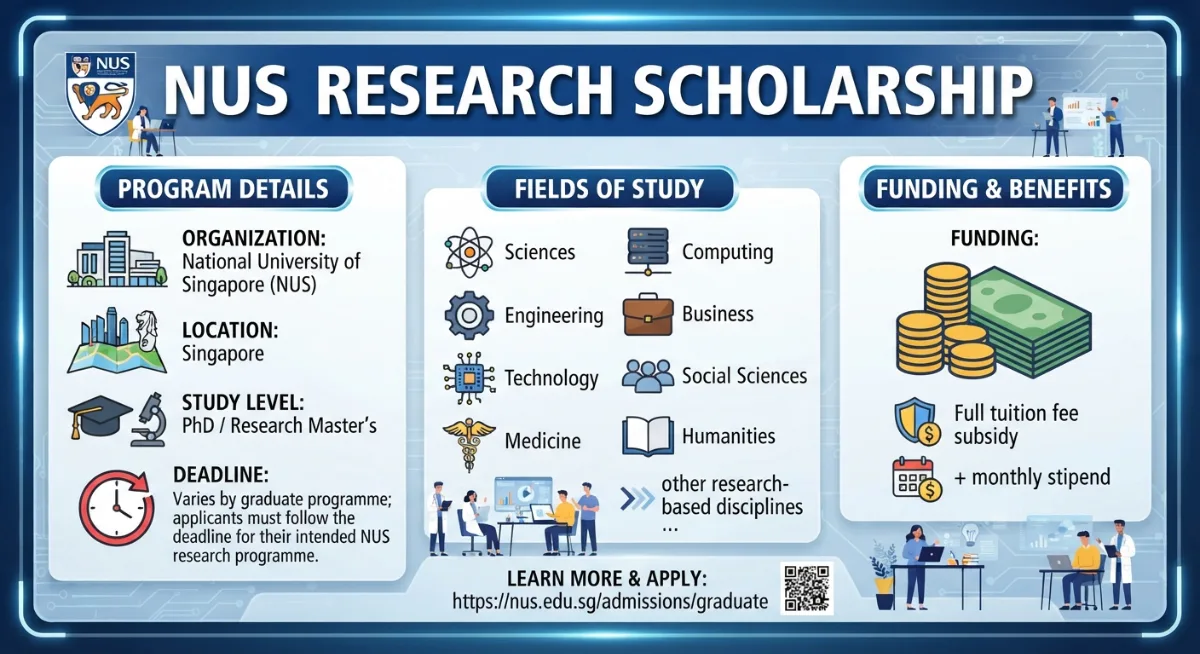
The NUS Research Scholarship supports outstanding graduate students undertaking full-time research leading to a higher degree at the National University of Singapore. The scholarship is available to both international students and Singaporean students, making it one of NUS’s broad research-funding routes for applicants seeking doctoral or research master's study.
Rather than being tied to one specific academic discipline, the scholarship can support eligible students across NUS research-based graduate programmes. This means applicants should first identify a suitable PhD or research master's programme, examine its research areas and admission requirements, and then apply for admission while indicating their interest in the NUS Research Scholarship.
For international applicants, the scholarship provides a monthly stipend and full tuition fee subsidy. Scholarship holders are expected to devote themselves to their research programme and may also be required to undertake teaching or departmental duties depending on the requirements of their faculty or programme.
The scholarship is initially awarded for one year and can be renewed subject to satisfactory academic and research performance. For PhD candidates, the scholarship can generally continue through the fourth year of candidature, while research master's candidates can generally receive support through the second year.
Eligibility
Applicants should meet the following general requirements:
Be applying for a full-time graduate research programme at NUS leading to a PhD or eligible research master's degree.
Hold a good academic record, normally equivalent to at least Second Class Honours (Upper Division) or Honours (Distinction) at undergraduate level.
Have strong academic potential and a clear interest in research.
Meet the admission requirements of the specific NUS graduate research programme being applied to.
Be eligible for the applicable Ministry of Education (MOE) tuition subsidy required for the NUS Research Scholarship.
International students are eligible to apply. The scholarship is not restricted to Singaporean applicants.
Applicants should also satisfy any additional requirements imposed by their chosen school, faculty or department. These can include research proposals, English-language requirements, interviews, referee reports, relevant academic background and other programme-specific conditions.
Scholarship Benefits
Successful applicants can receive:
Full tuition fee subsidy.
International PhD students: S$3,000 monthly stipend.
International research master's students: S$2,900 monthly stipend.
Singapore Permanent Resident research master's students: S$3,000 monthly stipend.
Singapore Citizen PhD and research master's students: S$3,800 monthly stipend.
PhD scholars who pass the qualifying examination within the stipulated period may receive an additional S$500 per month for a specified period, subject to the applicable conditions.
PhD awards can generally extend to the end of the fourth year of candidature, subject to renewal and satisfactory progress.
Research master's awards can generally extend to the end of the second year.
The stipend rates stated above took effect from 1 January 2026 and should be checked against the latest NUS scholarship information when applying.
What You Need to Know About the Funding
The NUS Research Scholarship is connected to admission into an NUS research degree. Applicants should therefore think of the scholarship and academic programme as part of the same application strategy rather than treating the scholarship as a completely separate award.
The scholarship does not provide a general travel allowance, and NUS does not guarantee employment after completion of the degree. Scholarship holders must also normally be in Singapore throughout the scholarship period except during approved leave.
Some faculties or departments may require scholarship holders to assist with teaching, tutorials or other departmental activities. The exact expectations can differ by programme.
Choosing a Research Programme
Because the scholarship is available across many research disciplines, applicants should identify the NUS department or programme that best matches their proposed research before preparing the application.
Potential areas include:
Biological and Life Sciences
Medicine and Biomedical Sciences
Chemistry
Environmental and Earth Sciences
Engineering
Computer Science and Artificial Intelligence
Data Science and Statistics
Materials Science
Physics
Mathematics
Architecture and Design
Business and Economics
Public Policy
Law and related research areas
Humanities
Social Sciences
Interdisciplinary research
The availability of a particular research area, supervisor and funded position depends on the graduate programme.
Application Requirements
Requirements vary by programme, but applicants should generally be prepared to provide:
Academic transcripts and degree certificates.
Curriculum vitae.
Statement of purpose or personal statement where required.
Research proposal or description of intended research.
Details of proposed research interests.
Referee recommendations.
Proof of English-language proficiency where required.
Passport identification page for international applicants.
Other documents requested by the specific graduate programme.
Some departments may request additional materials such as writing samples, publications, GRE scores, interviews or evidence of previous research experience.
For example, NUS departments may assess applicants not only on grades but also on the quality and feasibility of their proposed research, methodological preparation, research experience and compatibility with available faculty expertise.
Important Application Strategy
Applicants should not wait until the scholarship deadline to begin identifying a supervisor or research area.
A strong application should demonstrate a clear connection between:
Your previous academic training.
Your research experience.
The research problem you want to investigate.
The NUS department or research group where you want to conduct the work.
The expertise of potential supervisors.
The contribution your proposed research could make.
Programme-specific deadlines can also be earlier than applicants expect. For example, NUS's College of Design and Engineering lists 15 January 2027 as the closing date for international applicants to its August 2027 research programmes, while other NUS departments use different deadlines.
Applicants should therefore check the deadline of their exact programme rather than relying on a general NUS date.
Selection and Renewal
The scholarship is competitive and only a limited number of awards are available each academic year.
Applications are assessed alongside the applicant's suitability for the relevant graduate research programme. Academic performance, research potential, proposed research and fit with the department can therefore be important parts of the assessment.
The scholarship is initially awarded for one year. Renewal depends on satisfactory performance and the recommendation of the relevant faculty or programme.
For PhD candidates, the normal maximum scholarship period extends to the end of the fourth year of candidature. For research master's candidates, it extends to the end of the second year.
Important Conditions
The scholarship is intended for full-time graduate research study.
International scholarship holders must fulfil the requirements of the Graduate Assistantship Programme.
Scholars may be required to assist with teaching or departmental work.
The scholarship does not include a general travel allowance.
NUS does not guarantee employment after graduation.
Continued funding is subject to satisfactory academic and research progress.
Programme-specific admission requirements still apply even if an applicant meets the general scholarship criteria.
Applicants should check whether their intended programme accepts international applicants and whether the research area has suitable supervisors.
How to Apply
Identify an NUS PhD or eligible research master's programme that matches your academic background and research interests.
Review the programme's research areas, admission requirements and available supervisors.
Prepare your academic documents, CV, research proposal and other required materials.
Submit the graduate programme application through the NUS graduate admissions system.
Indicate your interest in the NUS Research Scholarship where the application system or programme instructions require it.
Complete all scholarship and admission requirements before the programme-specific deadline.
Monitor your application and email for requests for additional documents, interviews or other information.
Deadline
There is no single university-wide deadline for the NUS Research Scholarship. The relevant deadline is determined by the graduate research programme to which the applicant is applying.
For example, for the August 2027 intake, NUS College of Design and Engineering lists 15 January 2027 for international applicants, while other NUS faculties and departments have different closing dates.
Applicants should therefore verify the deadline for their exact programme before submitting an application.
Related Opportunities
Explore other scholarships, fellowships, grants, research opportunities and more that may match your interests.