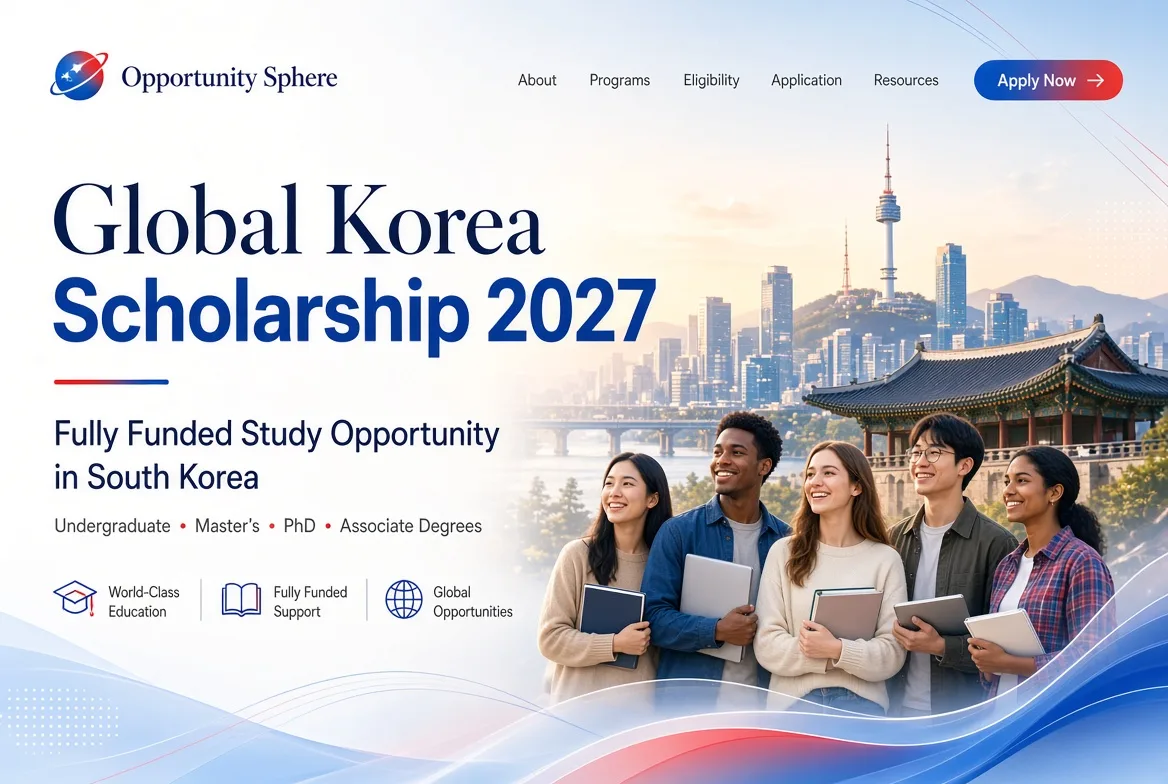
Global Korea Scholarship (GKS) 2027 – Fully Funded Korean Government Scholarship for International Students
Offered by National Institute for International Education (NIIED), South Korea
Location
South Korea
Funding
Fully Funded
Study level
Undergraduate, Master's, PhD
Field of study
All Fields
Application deadline
Not specified
About This Scholarship
About this opportunity
The Global Korea Scholarship (GKS) 2027 is a fully funded scholarship programme offered by the Government of the Republic of Korea to provide international students with the opportunity to pursue higher education at participating universities in South Korea. The programme is administered by the National Institute for International Education (NIIED) under Korea’s Ministry of Education and is intended to promote international educational exchange, strengthen relationships between Korea and participating countries, and support talented students from around the world.
GKS is open to students from countries designated by NIIED and supports both undergraduate and graduate-level study. Depending on the specific GKS track and level, applicants may pursue an Associate Degree, Bachelor’s Degree, Master’s Degree, or Doctoral Degree at participating Korean universities. The programme covers a substantial portion of the costs associated with studying in Korea, allowing successful scholars to concentrate on their academic development and international experience.
For the 2027 undergraduate intake, the Korean government has officially released the GKS-U application guidelines and university information. The 2027 programme includes both Embassy Track and University Track routes, with participating universities and application procedures specified in the official programme materials. Applicants should carefully check the applicable track, participating institutions, eligible departments, document requirements, and deadlines before submitting an application.
One of the major advantages of GKS is its combination of academic funding and cultural experience. Scholars can study at Korean higher education institutions while also receiving support for Korean-language training where required under their scholarship programme. The programme therefore provides more than financial assistance: it gives international students an opportunity to experience Korea's education system, develop international networks, and study in a country known for its universities, research institutions, technology, and innovation.
The scholarship covers a range of academic disciplines offered by participating institutions. Depending on the university and programme selected, applicants may find opportunities in areas such as engineering, natural sciences, agriculture and life sciences, medicine and health sciences, information technology, business, economics, social sciences, humanities, education, environmental sciences, arts, and other fields. Applicants must consult the official university and department information because not every programme is available at every institution.
1. Eligibility Requirements
Eligibility requirements depend on the specific GKS programme and degree level, so applicants should always consult the latest official guidelines for their intake. General requirements include:
Applicants must hold citizenship of a country designated by NIIED as eligible for GKS.
Korean citizens are not eligible to apply.
Applicants with Korean citizenship or circumstances specifically excluded under the applicable GKS guidelines should not apply.
Graduate applicants must hold the appropriate previous degree. A Master's applicant generally needs a Bachelor's degree, while a Doctoral applicant generally needs a Master's degree by the required date.
Undergraduate applicants must meet the required high-school education and graduation conditions.
Applicants must satisfy the applicable academic performance requirements.
Applicants must meet the age requirements established for their particular GKS programme.
Applicants must satisfy any additional conditions contained in the official application guidelines.
For the undergraduate programme, the current GKS information specifies an age requirement of under 25 years as of March 1 of the applicable year, together with academic and educational requirements. For graduate programmes, the general GKS information specifies that applicants must be under 40 years of age as of September 1 of the inviting year, with certain exceptions for eligible academic professors from ODA-recipient countries.
2. Study Levels
GKS provides scholarship opportunities at different levels of higher education, depending on the programme and annual intake.
Available study levels may include:
Associate Degree
Bachelor's Degree
Master's Degree
Doctoral Degree
The scholarship duration also depends on the degree programme. For example, the general GKS information lists one year of Korean-language training plus two years for a Master's degree and one year of Korean-language training plus three years for a Doctoral degree. Undergraduate scholarship periods vary according to the type of degree programme.
3. Fields of Study
Students can pursue programmes across a wide range of disciplines offered by participating Korean universities. Potential areas include:
Engineering and Technology
Computer Science and Information Technology
Natural Sciences
Agriculture and Life Sciences
Medicine and Health Sciences
Environmental Sciences
Business and Economics
Social Sciences
Humanities
Education
Arts and Culture
International Studies
Other academic fields offered by participating universities
Applicants should not assume that every field is available at every university. The official GKS university and department information should be consulted when choosing a programme.
4. Scholarship Benefits
Successful GKS scholars receive financial and academic support designed to reduce the cost of studying in South Korea. Depending on the applicable programme and guidelines, benefits include:
Round-trip airfare
Tuition fee support
Korean-language training expenses
Monthly allowance
Academic or study-related allowances
Medical insurance or health-related support
Other programme-specific benefits provided under the applicable GKS guidelines
The official NIIED information confirms that GKS provides support including airfare, Korean-language training, tuition and monthly allowances. Specific amounts and additional benefits can vary according to the programme, degree level and current year's guidelines.
5. Application Routes
Applicants generally apply through one of two major GKS routes:
Embassy Track
Under the Embassy Track, applicants submit their applications through the Korean diplomatic mission designated for their country. The embassy conducts the first stage of screening before successful candidates proceed to subsequent stages involving NIIED and, where applicable, participating universities.
University Track
Under the University Track, applicants apply directly to a participating Korean university designated under the GKS programme. Each university may establish its own application procedures, submission period and initial screening arrangements within the framework of the GKS guidelines.
Applicants should carefully determine which track is available to them because application procedures, participating institutions, quotas and deadlines can differ between countries, universities and programme levels.
6. Selection Process
The GKS selection process involves several stages. In general, applications are first screened by the relevant embassy or participating university, depending on the application track. Candidates who pass the initial screening proceed to further evaluation by NIIED and, for applicable Embassy Track candidates, additional university-level review.
The selection process may therefore involve document screening, institutional evaluation, NIIED review and university-level consideration before final scholars are announced. Applicants should carefully follow the instructions associated with their specific application track.
Because selection procedures and schedules can change from one intake to another, applicants should rely on the official 2027 GKS application guidelines rather than previous years' timelines.
7. Typical Application Documents
Depending on the degree level and application track, applicants may be required to provide documents such as:
Completed GKS application form
Personal statement
Study plan
Recommendation letter
Academic transcripts
Graduation certificate or expected graduation certificate
Proof of citizenship
Documents establishing the citizenship of parents, where required
Proof of academic qualifications
Language proficiency documents, where applicable
Awards, certificates or other supporting documents where permitted
Other documents specified in the official GKS guidelines
Applicants should pay particular attention to document authentication, translations, certification and submission instructions, because incorrectly prepared documents may affect an application's eligibility.
8. Important Application Information
The GKS application schedule is not identical for every applicant. Deadlines can vary depending on the country, application track, university and degree level.
For the 2027 undergraduate programme, the Korean government has published the official application guidelines and participating university information. Embassy Track and University Track applications have their own procedures and timelines, so applicants should check the applicable announcement carefully.
Applicants should therefore check the Korean Embassy in their country or the participating university directly for the exact application deadline rather than relying on a single worldwide deadline.
9. Why Consider the Global Korea Scholarship?
The Global Korea Scholarship provides international students with an opportunity to pursue a degree in South Korea with substantial financial support. Scholars can study at participating Korean universities, gain international academic experience, develop connections with students and researchers from different countries, and experience Korean language and culture.
The programme is particularly relevant to students who are interested in pursuing higher education in Asia while receiving government-funded scholarship support. Its availability across different degree levels and academic disciplines also makes it relevant to students at different stages of their educational journey.
For prospective applicants, the most important step is to identify an eligible programme and university, carefully review the 2027 GKS guidelines, prepare the required documents, and submit the application through the correct Embassy or University Track within the stated deadline.
Related Opportunities
Explore other scholarships, fellowships, grants, research opportunities and more that may match your interests.