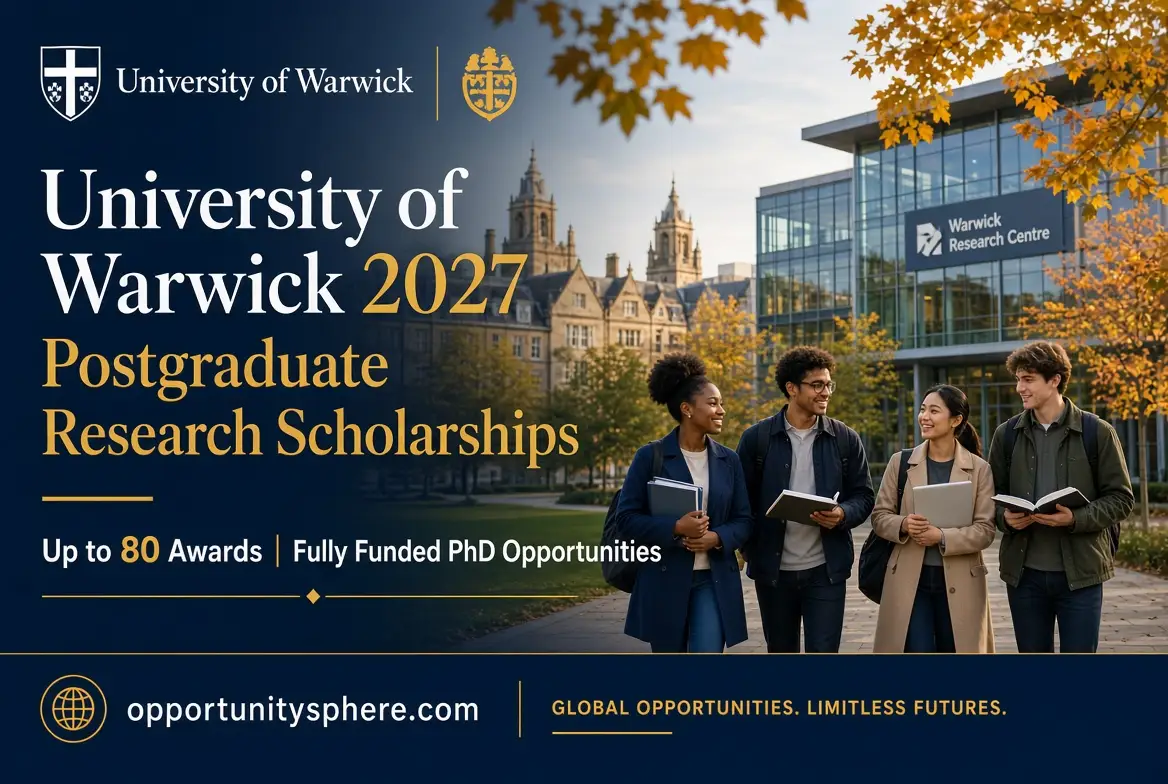
University of Warwick Postgraduate Research Scholarships 2027 – Fully Funded PhD Scholarships in the UK
Offered by University of Warwick
Location
United Kingdom
Funding
Fully Funded
Study level
PhD
Field of study
All Fields
Application deadline
December 10, 2026
About This Scholarship
The University of Warwick Postgraduate Research Scholarships 2027 provide an opportunity for qualified graduates and researchers to undertake advanced postgraduate research at one of the United Kingdom's research-intensive universities. For the October 2027 academic intake, the university is offering up to 80 doctoral funding awards across six scholarship streams, covering a range of academic disciplines and applicant backgrounds.
Unlike a scholarship competition restricted to one subject area, Warwick's funding scheme is organised around several distinct routes. Each route has its own purpose, eligibility conditions and, in some cases, specific expectations regarding the proposed research or the applicant's circumstances. This means that applicants should not simply submit a general PhD application and assume that they will automatically be considered for every available award. Identifying the appropriate funding stream is an important part of preparing a successful application.
The competition is particularly relevant to candidates whose proposed research addresses significant academic, scientific, technological, environmental, economic or social questions. Depending on the selected department and research programme, applicants may pursue work in engineering, biological and life sciences, environmental studies, computer science, mathematics, business, economics, education, law, social sciences, arts and humanities, or research that brings several disciplines together.
1. Understanding the Six Scholarship Streams
The university has established six funding streams to support different research priorities and applicant groups.
Faculty Chancellors Scholarships: These awards support outstanding postgraduate researchers undertaking doctoral work within Warwick's academic faculties. They are suitable for applicants with a strong academic background and a well-developed research proposal that fits the expertise and research priorities of their proposed department. The scheme is open to applicants of different nationalities and fee statuses.
Interdisciplinary Chancellors Scholarships: This route is intended for research that meaningfully connects two or more academic disciplines. It is not enough for a proposal to mention different subjects; the research question, methodology or expected contribution should demonstrate why an interdisciplinary approach is necessary. Applicants should also establish how their proposed work aligns with an eligible Warwick research centre, research spotlight or institutional research priority.
For example, a project combining agricultural science, environmental modelling and data analysis may be interdisciplinary if these areas are integrated to address one clearly defined research problem. Similarly, research connecting public health with social policy, engineering with environmental sustainability, or computer science with biological research may be relevant where the proposed design genuinely requires expertise from multiple fields.
Arts and Humanities Research Council (AHRC) Doctoral Scholarships: These awards support eligible doctoral research in arts and humanities disciplines. Applicants should ensure that their proposed project falls within the relevant AHRC subject remit and meets the university's requirements. A strong application should demonstrate the academic significance of the research, its contribution to existing scholarship and the suitability of Warwick's research environment for carrying it out.
Doctoral Access Pathway Scholarships: This funding stream is designed to improve access to doctoral education for applicants who self-identify as Black or of Black heritage. It accepts applicants of any nationality or fee status, subject to the scheme's other eligibility and application requirements. Applicants considering this route should pay close attention to the additional scholarship statement and instructions required by the university.
Doctoral Access Sanctuary Scholarships: This stream supports eligible applicants with qualifying asylum-related, refugee protection or other recognised sanctuary circumstances under the university's specified conditions. It has additional status and documentation requirements. Applicants should therefore examine the official criteria carefully rather than assuming that international nationality alone makes them eligible.
China Scholarship Council Scholarships: This funding route is intended for eligible applicants who meet the China Scholarship Council's nationality, passport, residency and other conditions. It requires a People's Republic of China passport and is not a general international scholarship route.
The distinction between these streams is important. Although they form part of one competition, they are not interchangeable. An applicant should select a route based on the actual eligibility conditions and research focus rather than applying to a stream simply because it appears to offer a desirable funding package.
2. Scholarship Funding and Research Support
The financial package is one of the major attractions of the competition. Under the relevant funding streams, successful applicants receive full payment of eligible academic tuition fees, including the applicable UK or international fee level, together with a tax-free maintenance stipend to help meet living expenses during their doctoral studies.
The Faculty Chancellors, Interdisciplinary Chancellors, AHRC Doctoral and Doctoral Access Pathway streams provide a maintenance stipend at the applicable UK Research and Innovation (UKRI) rate for 3.5 years. These streams also include a £5,000 Research Training and Support Grant (RTSG) for eligible research-related expenditure.
The Research Training and Support Grant is particularly relevant because doctoral research can involve expenses beyond ordinary tuition and accommodation. Depending on the research discipline and the university's approval conditions, research-related expenditure may include activities and resources needed to carry out the approved project. Applicants should nevertheless consult the university's funding rules before assuming that a particular expense will be covered.
The Doctoral Access Sanctuary Scholarship provides support for up to four years, including a £5,000 Research Training and Support Grant, subject to the scheme's specific conditions.
Other provisions available under the relevant streams include annual leave arrangements, opportunities to suspend studies where permitted, support relating to disability and professional development opportunities. Eligible international award holders may also be able to seek assistance towards certain visa and immigration costs under applicable streams. Such assistance should not be interpreted as an automatic reimbursement for every immigration-related expense.
It is important to distinguish between the general competition and the benefits attached to individual awards. The £5,000 research grant and the stated 3.5-year or four-year funding periods should not be assumed to apply identically to all six streams. Applicants should confirm the precise package attached to their chosen award.
3. Who Is Eligible to Apply?
The competition is intended for applicants seeking admission to an eligible postgraduate research programme at the University of Warwick for the October 2027 intake.
Eligible programmes include PhD, MPhil/PhD, EngD and qualifying integrated Master's and doctoral programmes. Applicants must satisfy the academic admission requirements of their chosen department as well as the conditions of the scholarship stream for which they are applying.
For international candidates, including applicants from Nigeria and other African countries, the Faculty Chancellors, Interdisciplinary Chancellors and AHRC Doctoral streams are particularly important because they accept applicants across different nationalities and fee categories.
However, being eligible to apply does not necessarily mean that an applicant will be competitive. Candidates should be able to demonstrate the academic preparation, research potential and subject knowledge required for advanced independent research. Their proposed project should also be realistic, clearly defined and appropriate for the expertise available within the department.
Applicants should pay particular attention to the following:
Academic preparation: Review the entry requirements of the intended department and programme. Previous degrees, academic performance and relevant research experience should provide an appropriate foundation for the proposed doctoral work.
Research suitability: Identify a research question that can be investigated within the proposed doctoral period. A broad topic without a clear problem, objectives or research direction may be difficult to assess.
Supervisory and departmental fit: Investigate the department's research strengths and identify whether Warwick has the academic expertise and research facilities needed for the proposed project.
Funding-stream eligibility: Confirm the conditions of the specific award, especially where additional subject, identity, nationality, residency or immigration requirements apply.
Application completeness: Prepare the required academic documents, research proposal and references early enough to allow the admission and scholarship applications to be completed separately.
A candidate interested in a general doctoral scholarship should not select the China Scholarship Council or Sanctuary route without first satisfying its specific conditions. Equally, applicants considering the Interdisciplinary Chancellors award should make the interdisciplinary nature of their proposed research evident rather than relying on the title of their project alone.
4. Preparing a Strong Doctoral Research Proposal
The research proposal is an important part of a postgraduate research application because it allows the department to assess whether the candidate understands the proposed research problem and has a workable plan for investigating it.
Applicants should avoid submitting a proposal that merely describes a broad subject of interest. A stronger proposal identifies a specific research problem, explains why that problem deserves investigation and establishes how the proposed study will contribute to existing knowledge.
A well-prepared proposal should normally address the following areas:
Research background and problem: Introduce the subject and explain the specific issue that the research intends to investigate. Relevant literature should be used to establish what is already known and where important questions remain unresolved.
Research aim and objectives: State the overall purpose of the proposed study and identify the objectives that will guide the investigation. Objectives should be specific enough to inform the research design.
Research questions or hypotheses: Present the central questions the project intends to answer. Where appropriate, formulate testable hypotheses that arise logically from the research problem and existing evidence.
Methodology: Explain how the research will be conducted. Depending on the discipline, this may involve laboratory experiments, field investigations, surveys, interviews, archival research, statistical analysis, computational modelling, theoretical analysis or a combination of methods. The methodology should be suitable for answering the stated research questions.
Original contribution: Explain what the study is expected to add to the field. This may involve new empirical evidence, a methodological contribution, a new theoretical interpretation or practical findings relevant to policy, industry, society or scientific development.
Feasibility: Demonstrate that the research can realistically be completed within the available doctoral period. Applicants should consider access to data, research facilities, equipment, participants, field sites and other resources required for the project.
For the Interdisciplinary Chancellors Scholarship, applicants should additionally explain how the disciplines will work together to address the research problem and identify the relevant Warwick research centre or institutional priority with which the project aligns.
Candidates should also investigate potential supervisors before submitting their proposals. Reading recent publications from the department and understanding its ongoing research activities can help applicants determine whether their project is a good academic fit. Where appropriate, contacting a potential supervisor with a concise explanation of the proposed research may help establish whether the department has relevant expertise, although applicants should follow the department's own guidance on contacting supervisors.
5. How the Application Process Works
The application involves two connected but separate stages: applying for admission to a postgraduate research programme and submitting the scholarship application.
Stage One: Apply for a postgraduate research programme.
Applicants should first identify an eligible research programme at the University of Warwick and review the department's admission requirements. They should prepare the documents requested for the programme, which may include academic transcripts, degree certificates, a research proposal, references, a curriculum vitae and evidence of relevant qualifications or experience.
The proposed research should be suitable for the chosen department. Applicants should not choose a programme solely because it appears in a scholarship category; they should confirm that the department can support the research academically and provide the necessary supervision.
The deadline for the postgraduate research course application is 7 December 2026.
Stage Two: Register for and complete the scholarship application.
After submitting the course application, candidates receive an automated email containing a seven-digit applicant identification number. This number is needed to register for the university's scholarship application portal.
Applicants must then complete the relevant scholarship application and provide the additional information required for their selected funding stream. Depending on the award, this may include specific statements or explanations demonstrating how the proposed research or applicant meets the stream's requirements.
For example, an Interdisciplinary Chancellors applicant should explain the contribution of each discipline to the research and how the project aligns with an eligible Warwick research priority. Applicants seeking the Doctoral Access Pathway should carefully follow the additional statement requirements for that scheme.
Candidates should ensure that the information in their scholarship application is consistent with the research proposal and admission application. Any differences in the proposed research, programme or applicant information should be resolved before submission.
Stage Three: Ensure references are submitted.
References form a separate part of the application timetable. Applicants should approach their referees well before the deadline, provide them with relevant information about the proposed programme and scholarship, and confirm that they have received the university's reference request.
A common application mistake is to complete the applicant's own sections but leave insufficient time for referees to submit their recommendations. Applicants should monitor the application portal and make sure that all required supporting materials are received by the university.
6. Important Application Deadlines
The University of Warwick has specified separate deadlines for the admission application, scholarship application and references.
Application stage
Deadline
Postgraduate research course application
7 December 2026
Scholarship application
10 December 2026
Reference submission
21 December 2026
Expected scholarship offers
5 March 2027
All stated deadlines are at 16:59 GMT. Applicants should work towards completing each stage ahead of the deadline rather than treating the final submission date as the day to begin preparing their documents.
The university expects to communicate scholarship offers on 5 March 2027. Applicants should continue to monitor their email and application accounts for updates or requests for additional information.
7. Practical Advice for International Applicants
For applicants outside the United Kingdom, the first important consideration is choosing a funding stream that genuinely accepts their nationality and fee status. The Faculty Chancellors and Interdisciplinary Chancellors awards are particularly relevant to international candidates, while the AHRC Doctoral stream may also be suitable for applicants whose research falls within its subject remit.
A second consideration is the difference between admission eligibility and scholarship eligibility. Meeting the academic requirements for a PhD does not automatically guarantee scholarship consideration. Candidates must satisfy the additional requirements of the funding competition and submit the scholarship application within the prescribed period.
Applicants should also pay attention to the financial implications of the award. Full academic fee coverage and a maintenance stipend can substantially reduce the cost of doctoral study in the UK, but candidates should examine the applicable stipend, funding duration and any conditions attached to their particular stream. They should not assume that every award covers every personal or relocation expense.
Finally, applicants should prepare their research proposals with the intended department in mind. A proposal that is academically interesting but does not fit the expertise, facilities or research priorities of the university may be less suitable than one that demonstrates a clear connection between the research problem and Warwick's academic environment.
8. Why the Warwick Competition Is Worth Considering
The Warwick Postgraduate Research Scholarships provide an opportunity to pursue doctoral research with substantial financial support while becoming part of an established university research environment. The competition is particularly valuable because it combines several funding routes rather than limiting applicants to one academic discipline or a single type of research project.
For successful candidates, the benefits extend beyond the payment of tuition fees. A maintenance stipend provides support for living expenses during the research period, while the Research Training and Support Grant available under several streams can contribute towards the costs of carrying out doctoral work. Access to departmental research expertise, academic supervision, professional development and university facilities also forms an important part of the research experience.
The competition may be especially attractive to international researchers who would otherwise find the cost of doctoral study in the United Kingdom difficult to meet. However, the availability of up to 80 awards should not be interpreted as a guarantee of funding. Applicants will need to meet both the academic admission requirements and the specific conditions of their chosen scholarship stream.
Before applying, candidates should read the official competition guidance, confirm the eligibility of their intended programme, identify the correct funding route and allow sufficient time to complete both applications and secure their references.
Related Opportunities
Explore other scholarships, fellowships, grants, research opportunities and more that may match your interests.