The application deadline for this opportunity has passed. You can still review the details, but the listing is no longer presented as open for applications.
Scholarship
University of Southern Queensland International Research Scholarship 2027
Offered by University of Southern Queensland
Location
Australia
Funding
Fully Funded
Study level
PhD, Master's
Field of study
All Fields
Application deadline
September 27, 2026
Application Closed
About This Scholarship
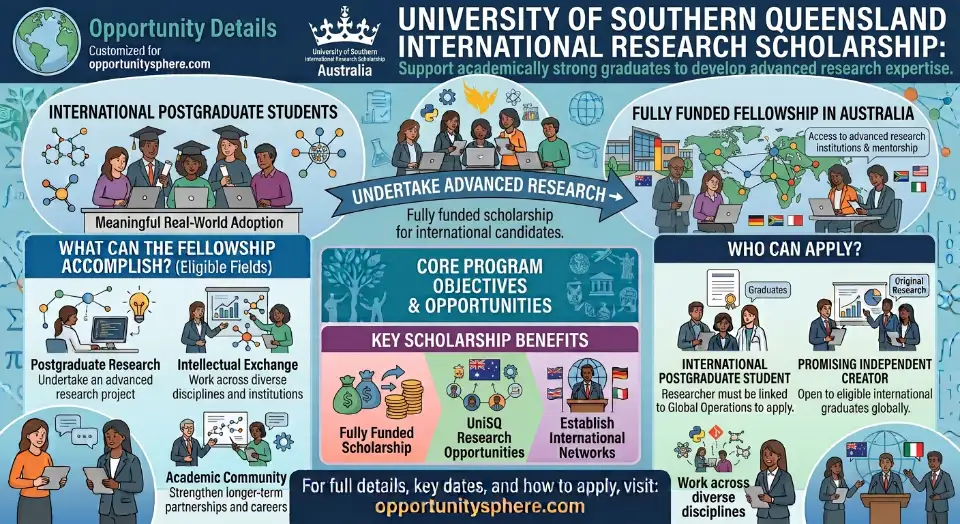
The University of Southern Queensland International Research Scholarship provides funding opportunities for eligible international students who wish to undertake postgraduate research at the University of Southern Queensland (UniSQ) in Australia. The scholarship is intended for academically strong candidates who demonstrate research potential and have a clear interest in developing advanced research expertise within an appropriate field of study.
For international students considering postgraduate research in Australia, research scholarships can provide important financial support while also creating an opportunity to work within an established academic and research environment. At UniSQ, scholarship-supported research students can undertake advanced study under academic supervision while gaining experience in research methods, academic communication, data analysis, scholarly writing and other skills relevant to their discipline.
The scholarship is particularly relevant to applicants who already have a strong academic background and can demonstrate that they are prepared for independent research. Previous research projects, a dissertation or thesis, conference participation, publications, professional research experience and other academic achievements may help applicants demonstrate their readiness for postgraduate research.
The specific research opportunities available can vary according to the university's research strengths, available supervisors and current projects. Applicants should therefore carefully review the research areas available at UniSQ and ensure that their proposed topic is academically appropriate and can be supported within the university.
1. Who Should Consider Applying?
This opportunity may be suitable for international students who want to progress from coursework-based study into advanced research or who are already developing an academic or research career.
Potential applicants may include graduates with a strong bachelor's or master's degree, researchers seeking doctoral training, professionals whose careers require advanced research skills, and students who have completed a substantial research project as part of their previous degree.
Advertisement
🔒Application Closed
The listed deadline has passed. Check the official website to see whether the organisation has announced an extension or a new application period.
Stay in the loop
Your Next Opportunity Could Be One Email Away
Receive updates about scholarships, jobs, internships, fellowships and grants so you can discover opportunities worth exploring.
Stay Updated
Never miss an opportunity.
Get updates on scholarships, jobs, internships, grants, fellowships, conferences, and other opportunities delivered straight to your inbox.
A strong academic record is important, but applicants should also consider how convincingly they can explain their research interests. A scholarship application is stronger when the proposed research direction is clearly connected to the applicant's previous academic training and future goals.
Applicants should also investigate whether UniSQ has suitable researchers, facilities and research groups for their proposed topic before preparing the final application.
2. Eligibility Requirements
Applicants should satisfy the requirements applicable to both the relevant research degree and the scholarship.
Generally, applicants should:
Be international students eligible to study in Australia.
Meet the admission requirements for the relevant postgraduate research programme.
Demonstrate strong academic achievement in previous tertiary study.
Demonstrate research potential through previous academic work, a thesis or dissertation, research experience, publications or other relevant achievements where applicable.
Meet the University's English-language requirements.
Have a suitable research topic that fits within an available research area.
Identify an appropriate research supervisor where this is required by the programme or application process.
Meet any additional requirements specified for the particular research degree.
Provide complete and accurate academic and personal information.
Submit the required application and supporting documentation within the applicable scholarship timeframe.
Meeting the minimum admission requirements does not necessarily mean that an applicant will automatically receive scholarship funding. Applicants should prepare their research proposal and supporting documents carefully and demonstrate why their proposed research is appropriate for the available research environment.
3. Academic and Research Background
Research scholarships are intended for applicants who can demonstrate readiness for advanced academic work. For this reason, applicants should present their academic history clearly.
A strong application may include evidence such as:
A high-quality undergraduate or master's degree.
A substantial research project or thesis.
Previous research assistantship or research-related employment.
Peer-reviewed publications where applicable.
Conference presentations or academic presentations.
Research awards or academic distinctions.
Relevant technical, analytical or laboratory skills.
Professional experience directly related to the proposed research.
Applicants who do not yet have publications should not assume that they are automatically unsuitable. A well-developed research project, strong academic performance and evidence of research skills may also demonstrate research potential.
4. Choosing a Research Topic
One of the most important parts of a postgraduate research application is identifying a realistic and academically appropriate research topic.
Applicants should avoid selecting a topic simply because it sounds interesting. The proposed research should be connected to their previous academic preparation and should be capable of being completed within the duration and resources of the proposed degree.
Before submitting an application, applicants should consider:
Whether UniSQ has expertise in the proposed research area.
Whether there are researchers who could potentially supervise the project.
Whether the necessary research facilities or resources are available.
Whether the topic is sufficiently focused.
Whether the proposed research addresses a clearly identifiable problem.
Whether the project is achievable within the available time.
Whether the research can contribute meaningful knowledge to the field.
A clearly defined research question can make it easier for potential supervisors and scholarship assessors to understand the purpose and significance of the proposed study.
5. Research Proposal
Where a research proposal is required, it should explain the proposed research in a clear and structured manner.
A strong proposal may contain:
Research title – A concise description of the proposed study.
Background – Explanation of the broader research problem.
Problem statement – The specific issue the research intends to address.
Research gap – What remains insufficiently understood in the existing literature.
Aim and objectives – What the research intends to accomplish.
Research questions or hypotheses – The questions the investigation will address.
Methodology – How data will be collected and analysed.
Expected contribution – The knowledge or practical value the project may provide.
References – Relevant academic literature supporting the proposed research.
Applicants should avoid making the proposal unnecessarily broad. A focused project is generally easier to explain, evaluate and supervise than a proposal attempting to investigate several unrelated problems.
6. Finding a Suitable Supervisor
Depending on the research programme and application requirements, applicants may need to identify a potential supervisor.
When searching for a supervisor, applicants should examine the research interests of academic staff and look for genuine overlap between the proposed research and the supervisor's expertise.
A good supervisor match should be based on research compatibility rather than simply choosing an academic with a senior title or well-known profile.
Applicants contacting potential supervisors should provide a concise introduction, explain their academic background, briefly describe their proposed research and attach relevant information where appropriate.
It is also important to check UniSQ's current instructions because supervisor-contact requirements can differ between research programmes.
7. Scholarship Benefits
Successful scholarship recipients may receive financial and academic support subject to the conditions of the particular scholarship round.
Potential benefits include:
Tuition fee support for eligible research study.
Living stipend support according to the applicable scholarship conditions.
The opportunity to undertake postgraduate research at an Australian university.
Access to university research facilities and academic resources.
Academic supervision from experienced researchers.
Participation in research seminars and academic activities.
Opportunities to attend conferences and engage with the wider research community.
Development of advanced research and professional skills.
Exposure to Australia's research and innovation environment.
Opportunities to develop international academic networks.
The exact value, duration and conditions of financial support should be confirmed from the scholarship information applicable to the applicant's intended research degree and scholarship round.
8. Academic and Professional Development
The value of a research scholarship extends beyond financial assistance.
Postgraduate research students develop skills that can be useful in universities, research institutions, government, industry and other professional environments. These can include academic writing, literature review, research design, statistical or qualitative analysis, scientific communication, project management and presentation skills.
International research experience can also expose students to different research practices and academic networks. For applicants intending to pursue an academic career, the experience may contribute to the development of a research profile and provide opportunities to collaborate with researchers in Australia and internationally.
9. Required Documents
Applicants should prepare their supporting documents well before the application deadline.
Documents may include:
Academic certificates.
Academic transcripts.
Curriculum vitae.
Research proposal where required.
Personal or motivation statement.
Evidence of English-language proficiency where applicable.
Passport identification page.
Academic references where required.
Evidence of previous research experience where applicable.
Publications or evidence of scholarly work where relevant.
Additional documents requested by the university or specific research programme.
Applicants should ensure that names, dates, qualifications and other information are consistent across all documents. Where documents are not in the required language, applicants should follow the university's instructions regarding certified translations.
10. Application Process
A typical application process may involve the following steps:
Review the postgraduate research programmes available at UniSQ.
Identify a research area that matches your academic background and interests.
Check the admission requirements for the intended research degree.
Review the scholarship conditions and eligibility requirements.
Investigate potential supervisors or research groups where required.
Develop a suitable research topic.
Prepare a research proposal if required.
Prepare your academic certificates and transcripts.
Update your curriculum vitae.
Prepare your motivation or research statement.
Arrange references or recommendation documents where required.
Prepare evidence of English-language proficiency if applicable.
Complete the university's admission and scholarship application process.
Upload all required supporting documents.
Review the application carefully before submission.
Submit before the applicable deadline.
Applicants should not wait until the final day to begin the process, particularly where supervisor discussions, document certification or English-language testing may be necessary.
11. How to Strengthen Your Application
Applicants can improve the clarity of their application by ensuring that all parts of the submission tell a consistent academic story.
For example, the applicant's previous degree, research experience, proposed research topic and future career plans should have a logical connection.
The research proposal should also demonstrate that the applicant understands the research problem rather than simply describing a general area of interest. Supporting the proposal with relevant and reasonably current academic literature can help establish the academic context of the proposed work.
Applicants should also proofread their documents carefully. A strong academic profile can be undermined by incomplete answers, inconsistent information, unclear writing or missing documents.
12. Common Application Mistakes to Avoid
Applicants should avoid:
Submitting a research proposal that is too broad.
Choosing a topic without checking whether it fits UniSQ's research expertise.
Ignoring the specific admission requirements of the intended research degree.
Assuming that meeting admission requirements guarantees a scholarship.
Submitting incomplete academic records.
Using a generic motivation statement for every university.
Failing to explain the significance of the proposed research.
Waiting until the deadline to resolve supervisor or documentation issues.
Providing inconsistent information across application documents.
Failing to check the current scholarship conditions before submission.
13. Application Checklist
Before submitting an application, applicants should confirm that they have:
☐ Confirmed their international student eligibility.
☐ Selected an appropriate postgraduate research degree.
☐ Checked the academic entry requirements.
☐ Confirmed the English-language requirements.
☐ Identified a suitable research area.
☐ Investigated potential supervisors where required.
☐ Prepared a research proposal where required.
☐ Updated their academic CV.
☐ Gathered academic certificates and transcripts.
☐ Prepared a motivation or personal statement.
☐ Arranged references where required.
☐ Prepared proof of English proficiency where applicable.
☐ Prepared passport identification information.
☐ Checked all programme-specific requirements.
☐ Submitted the application before the applicable deadline.
14. Important Note About the Deadline
The stated application deadline for this opportunity is 27 September 2026. Applicants should not rely solely on a general scholarship deadline because research scholarship rounds and individual postgraduate research programmes may have different application conditions.
Before applying, candidates should verify the current scholarship round, eligible research degrees, available research areas, supervisor requirements, funding conditions and application instructions directly with the University of Southern Queensland.
15. Final Overview
The University of Southern Queensland International Research Scholarship provides an opportunity for eligible international students to pursue postgraduate research in Australia while receiving scholarship support subject to the conditions of the relevant award.
The opportunity is particularly relevant to applicants with strong academic backgrounds, demonstrated research potential and a clearly defined research interest that fits an available research area at UniSQ.
A successful application requires more than simply completing an online form. Applicants should carefully investigate the research environment, develop a focused research direction, prepare strong supporting documents and ensure that their proposed study is compatible with the university's admission and research requirements.
Because scholarship conditions and research opportunities can change between application rounds, prospective applicants should verify all current requirements and funding details before submitting their application.
Related Opportunities
Explore other scholarships, fellowships, grants, research opportunities and more that may match your interests.