The application deadline for this opportunity has passed. You can still review the details, but the listing is no longer presented as open for applications.
Scholarship
Swinburne Research Stipend Scholarships – Round 2
Offered by Swinburne University of Technology
Location
Australia
Funding
Fully Funded
Study level
PhD, Master's
Field of study
All Fields
Application deadline
October 9, 2026
Application Closed
About This Scholarship
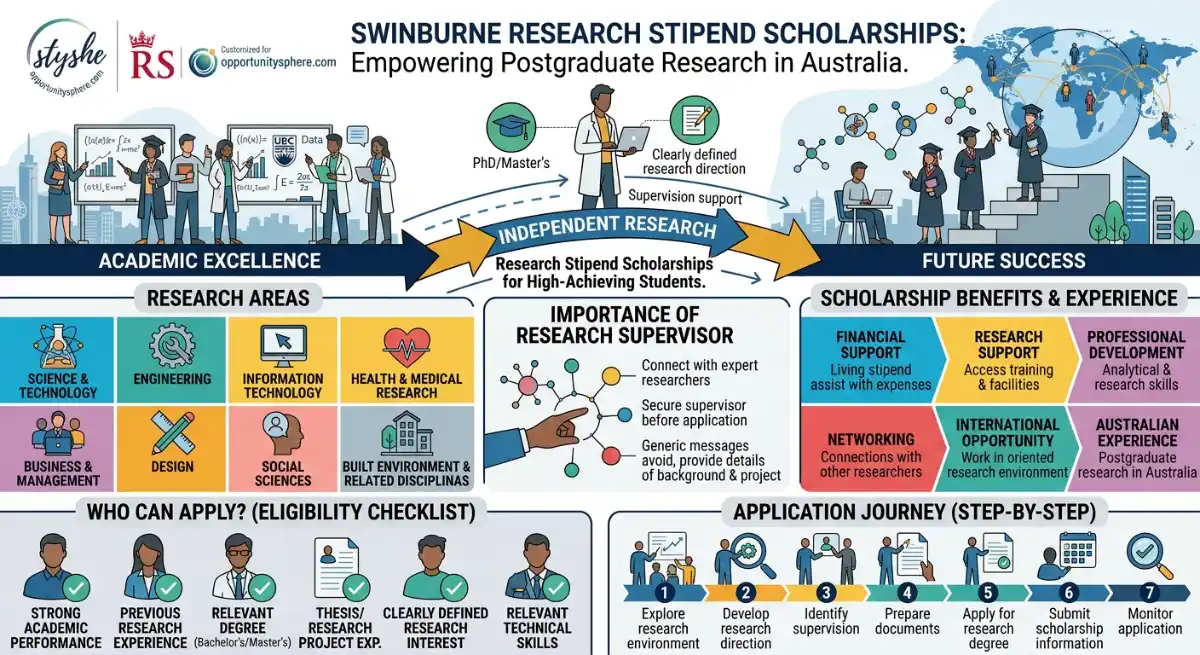
The Swinburne Research Stipend Scholarships support high-achieving students undertaking postgraduate research at Swinburne University of Technology in Australia. The scholarships are intended for candidates who can demonstrate strong academic performance, research potential and the ability to undertake advanced independent research.
The opportunity is particularly relevant to students who are considering a research-based master's degree or PhD and want to develop their academic career within an established research environment.
Rather than being a conventional coursework scholarship, the award is connected with postgraduate research. This means that applicants are expected to have a clearly defined research direction and, where required, demonstrate that their proposed project can be supported by an appropriate research group or academic supervisor.
For prospective international students, the scholarship can provide an opportunity to undertake advanced research in Australia while gaining experience within an internationally oriented university environment.
What Makes This Scholarship Different?
A research scholarship application is not simply an application for financial assistance. The proposed research project, academic background and relationship with the University's research environment can all be important parts of the application.
Applicants are therefore encouraged to investigate Swinburne's research areas before submitting their application. Understanding the University's research strengths can help applicants identify a project that is realistic, relevant and suitable for available supervision.
A well-prepared application should show a clear connection between the applicant's previous academic training, proposed research and longer-term academic or professional goals.
Research Areas
Swinburne University of Technology conducts research across a wide range of disciplines. Applicants should explore the University's current research areas and identify where their proposed project may fit.
Depending on the available research programmes and supervisors, opportunities may exist across areas such as:
Advertisement
🔒Application Closed
The listed deadline has passed. Check the official website to see whether the organisation has announced an extension or a new application period.
Stay in the loop
Your Next Opportunity Could Be One Email Away
Receive updates about scholarships, jobs, internships, fellowships and grants so you can discover opportunities worth exploring.
Stay Updated
Never miss an opportunity.
Get updates on scholarships, jobs, internships, grants, fellowships, conferences, and other opportunities delivered straight to your inbox.
Other specialist research areas offered by the university.
The availability of a particular research topic should be confirmed directly with Swinburne because supervisors, projects and research priorities can change.
Who Is This Opportunity For?
The scholarship is designed for applicants who are prepared to undertake substantial independent research.
A suitable candidate would normally be able to demonstrate several of the following:
Strong academic performance.
Previous research experience.
A relevant bachelor's or master's qualification.
Experience completing a thesis or substantial research project.
A clearly defined research interest.
Relevant technical or methodological skills.
Academic or professional achievements related to the proposed field.
The ability to communicate a research problem clearly.
Potential to contribute to the University's research community.
International applicants can be considered under the applicable scholarship arrangements, provided they meet the relevant admission and scholarship requirements.
Academic Requirements
Applicants must first satisfy the admission requirements for the research degree they intend to undertake.
This means that scholarship applicants should not focus only on the funding component. They should also establish whether their academic qualifications are suitable for the intended research programme.
Academic transcripts are therefore important because they allow the university to assess previous academic performance and determine whether the applicant meets the required standard for research study.
Where a previous degree included a substantial research component, applicants should make this clear in their application.
The Importance of a Research Supervisor
Potential applicants are encouraged to identify a suitable research supervisor before submitting their application where this is required or recommended.
Finding a supervisor whose expertise matches the proposed project can help ensure that the research is compatible with the University's existing research environment.
When contacting a potential supervisor, applicants should avoid sending a generic message to multiple academics. A more useful approach is to briefly explain:
Their academic background.
Their previous research experience.
The research area they want to investigate.
Why the supervisor's research is relevant to the proposed project.
The type of research they hope to undertake at Swinburne.
Applicants should also review the university's current instructions regarding supervisor contact because requirements can vary between research programmes.
Developing the Research Proposal
Where a proposal is required, applicants should use it to demonstrate that they understand the research problem and have considered how it could be investigated.
A good proposal can include:
Research background
Explain the broader issue and establish why the topic deserves investigation.
Research problem
Identify the specific gap, challenge or unanswered question that the research will address.
Aim and objectives
Clearly state what the research intends to accomplish.
Research questions
Present focused questions that can realistically be answered during the research degree.
Methodology
Describe the proposed methods, study design, data collection and analytical approach where appropriate.
Expected contribution
Explain what new knowledge, evidence, methods or practical insights the research could contribute.
Research significance
Show why the project matters to the academic field or wider society, industry or professional practice where relevant.
Applicants should avoid presenting a proposal that is so broad that it would be difficult to complete within the timeframe of a postgraduate research degree.
Scholarship Benefits
Successful applicants may receive financial and research-related support according to the applicable scholarship conditions.
Benefits may include:
Research stipend to assist with living expenses during the research degree.
Potential Research Training Program (RTP) support, where applicable under the relevant scholarship arrangement.
Access to research training and professional development opportunities.
Use of relevant university research facilities and academic resources.
Academic guidance and supervision from experienced researchers.
The opportunity to work within an internationally oriented research environment.
Opportunities to participate in research seminars, workshops and academic activities.
Development of advanced research and analytical skills.
Opportunities to build connections with other researchers.
Experience conducting postgraduate research in Australia.
The exact amount, duration and conditions of the scholarship should be confirmed in the scholarship information applicable to the relevant research degree and intake.
What the Research Experience Can Offer
Beyond the financial component, undertaking a research degree at Swinburne can provide experience in the full research process.
Students may develop skills in areas such as:
Research design.
Critical literature analysis.
Data collection.
Data interpretation.
Academic writing.
Scientific or scholarly communication.
Conference presentation.
Research project management.
Collaboration.
Research ethics and responsible research practices.
These skills can be valuable for graduates considering academic careers as well as careers in industry, government, research institutions and other knowledge-intensive sectors.
Documents You Should Prepare
Applicants should begin preparing their documents before the scholarship application opens or before the relevant round closes.
The application may require:
Academic certificates.
Academic transcripts.
Curriculum vitae.
Research proposal.
Details of proposed research.
Potential supervisor information.
Academic references.
Evidence of research experience.
English-language proficiency evidence where required.
Other documents requested for the research degree or scholarship.
Applicants should ensure that their CV focuses on relevant academic and research achievements rather than simply listing every activity they have undertaken.
Where applicants have publications, conference presentations, research projects, awards or other scholarly achievements, these should be presented clearly.
Application Journey
The application can be approached as a series of stages:
Stage 1 — Explore the research environment
Review Swinburne's research areas and identify areas that correspond with your academic background.
Stage 2 — Develop your research direction
Define the problem you want to investigate and determine whether the project is realistic for a postgraduate research degree.
Stage 3 — Identify supervision
Look for academics or research groups whose expertise aligns with your proposed project.
Stage 4 — Prepare your documents
Gather transcripts, certificates, CV, proposal, references and English-language evidence where required.
Stage 5 — Apply for the research degree
Complete the relevant postgraduate research admission process.
Stage 6 — Submit scholarship information
Follow the applicable instructions for consideration for the research stipend scholarship.
Stage 7 — Monitor your application
Check the relevant university communication channels for requests for additional information and updates concerning the application.
How to Prepare a Strong Application
Applicants should make sure that their documents tell a consistent story.
For example, if an applicant has a master's degree in environmental science and proposes a PhD project in an unrelated discipline with no explanation of the transition, the connection may be unclear.
A stronger application would explain how the applicant's previous training and research experience prepared them for the proposed project.
The same principle applies to the research proposal. The proposed project should connect logically with the applicant's academic background and demonstrate an understanding of the research area.
International Applicants
International applicants should check both the scholarship requirements and the University's requirements for international research students.
This may include requirements concerning:
Academic qualifications.
English-language proficiency.
Research experience.
Supporting documentation.
Passport information.
Visa-related matters.
Research degree admission.
Supervisor arrangements.
Applicants should not assume that satisfying the scholarship requirements automatically satisfies every requirement for admission or study in Australia.
Duration and Funding Conditions
The duration of the scholarship depends on the research degree and the conditions attached to the relevant scholarship.
Research scholarships can have specific rules concerning the period of support, continuation of funding, academic progress and other conditions.
Applicants should therefore check the scholarship terms applicable to their particular research programme rather than relying on information from an earlier scholarship round.
Before You Apply
It is useful to have the following ready:
☐ A suitable research area.
☐ A clearly defined research topic.
☐ A relevant academic background.
☐ Updated academic transcripts.
☐ Academic certificates.
☐ A research-focused CV.
☐ A research proposal where required.
☐ Potential supervisor information.
☐ Academic references.
☐ English-language evidence where applicable.
☐ Evidence of previous research experience.
☐ A completed research-degree application.
☐ A completed scholarship application where separately required.
Things Applicants Should Check Carefully
Before submitting, applicants should confirm:
Whether their intended research degree is eligible.
Whether international applicants are included in the relevant scholarship arrangement.
Whether a supervisor must be contacted before application.
Whether a research proposal is compulsory.
The current English-language requirements.
The current scholarship value.
The period of financial support.
Any RTP conditions.
The relevant application round and closing date.
Final Note
The Swinburne Research Stipend Scholarships can provide an opportunity for academically strong research students to undertake postgraduate research in Australia while receiving financial support under the applicable scholarship conditions.
The most important preparation step is to understand the relationship between the proposed research project and Swinburne's research environment. Applicants should investigate potential supervisors, develop a focused research idea and prepare documents that clearly demonstrate their academic preparation and research potential.
Because scholarship rounds and research opportunities can change, applicants should verify the current eligibility requirements, funding arrangements and application instructions before submitting an application.
Related Opportunities
Explore other scholarships, fellowships, grants, research opportunities and more that may match your interests.