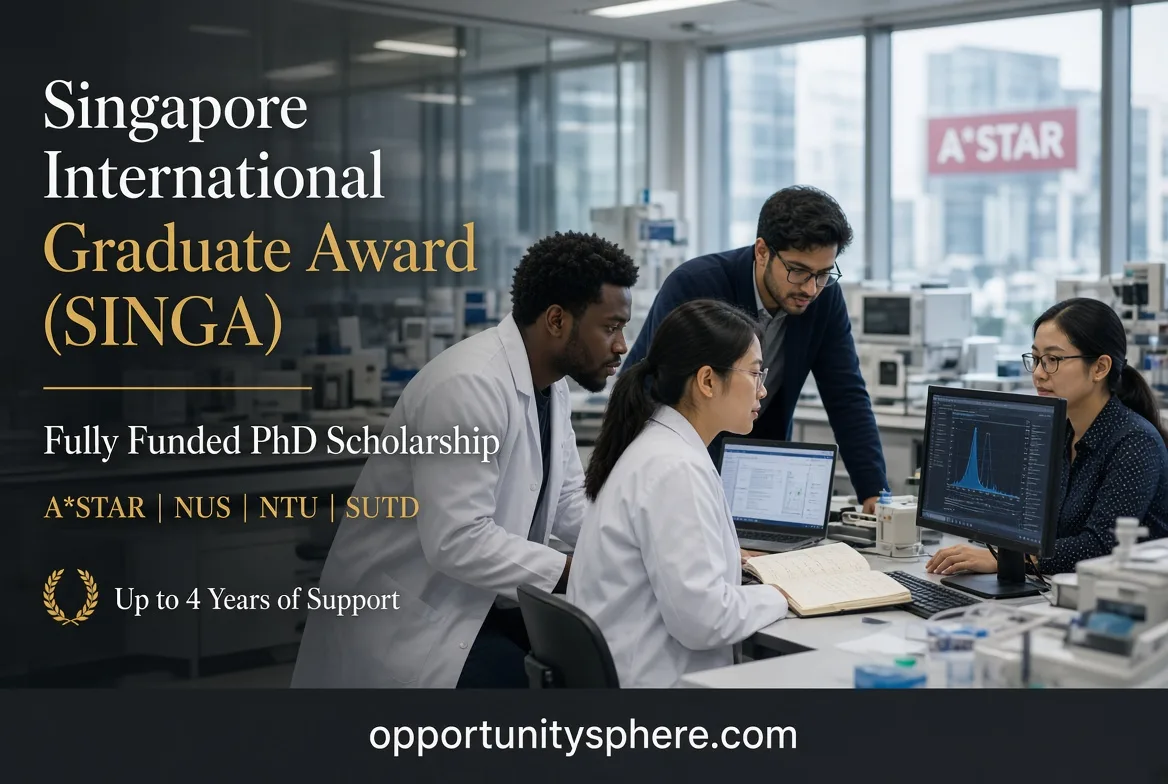
Singapore International Graduate Award (SINGA) 2027 – Fully Funded PhD Scholarship in Singapore
Offered by Agency for Science, Technology and Research (A*STAR), Singapore
Location
Singapore
Funding
Fully Funded
Study level
PhD
Field of study
Computer Science & IT, Physical Sciences, Life Sciences, Engineering
Application deadline
December 1, 2026
About This Scholarship
The Singapore International Graduate Award (SINGA) is a competitive, fully funded doctoral scholarship for international graduates who want to pursue research-based PhD studies in Singapore. It is administered by Singapore's Agency for Science, Technology and Research (A*STAR), in collaboration with leading universities and research institutions.
The programme provides an opportunity to undertake doctoral research in a well-established scientific research environment, with access to experienced supervisors, specialised laboratories, advanced research equipment and international research collaborations.
SINGA supports doctoral research through participating institutions, including:
National University of Singapore (NUS).
Nanyang Technological University (NTU).
Singapore University of Technology and Design (SUTD).
Singapore Management University (SMU).
Singapore Institute of Technology (SIT).
The available degree programmes and research opportunities depend on the participating institution and the projects offered during the application cycle.
Unlike scholarships that support students in a broad range of academic disciplines, SINGA is primarily focused on science and engineering research. Its research areas include:
Biomedical Sciences: Biochemistry, molecular biology, genetics, immunology, microbiology, neuroscience, cancer research and related biomedical disciplines.
Computing and Information Sciences: Computer science, artificial intelligence, data science, information systems and related computing research.
Physical Sciences: Chemistry, physics, materials science and other fundamental or applied scientific disciplines.
Engineering and Technology: Electrical and electronic engineering, mechanical engineering, chemical engineering, materials engineering, environmental engineering and related technological fields.
Applicants should consult the current research project listings to identify the specific topics and supervisors accepting applications.
Scholarship Benefits and Financial Support
SINGA provides financial support for up to four years of doctoral study. The award is designed to cover major educational and living expenses during the PhD programme.
The published scholarship benefits include:
1. Full Tuition Fee Coverage
Successful scholars receive full tuition fee support for the duration of the funded doctoral programme, subject to the scholarship's terms and conditions.
2. Monthly Living Stipend
The monthly stipend is approximately:
S$2,700 per month before passing the PhD Qualifying Examination.
S$3,200 per month after passing the qualifying examination.
This represents an increase of S$500 per month after the qualifying examination.
At the initial rate, the stipend amounts to S$32,400 annually. At the increased rate, it amounts to S$38,400 annually.
The qualifying examination is an important academic milestone in doctoral training. The increased stipend is therefore conditional on successfully meeting the institution's examination requirements.
3. Airfare Grant
Awardees receive a one-time airfare grant of up to S$1,500 to support their journey to Singapore.
4. Settling-in Allowance
A one-time settling-in allowance of S$1,000 is provided to assist with initial relocation expenses.
These allowances and stipend rates are subject to the applicable award terms and any revisions by the programme administrators.
Who Can Apply?
SINGA is open to international applicants from different countries, including eligible applicants from Nigeria and other African countries.
The programme generally looks for candidates who demonstrate:
Excellent academic performance in their previous university studies.
A strong interest in scientific research and doctoral-level study.
Good written and spoken English communication skills.
Strong academic recommendations from university lecturers or research supervisors.
The academic preparation required for their intended research discipline.
Applicants with a strong Bachelor's degree may be considered for direct doctoral entry, depending on the institution's admission requirements. A Master's degree can also provide relevant preparation for doctoral research.
The programme is intended for international research students. Applicants should check the current nationality and previous-study restrictions on the official SINGA application website before applying.
Meeting the basic eligibility requirements does not guarantee an award. Selection is competitive and depends on academic merit, research suitability, the quality of the application and the assessment of the participating institutions.
What Makes a Competitive Applicant?
Having good grades is important, but doctoral scholarship applications require more than academic results.
Applicants should be able to demonstrate that they can undertake independent research, understand scientific literature, analyse research problems and communicate findings effectively.
Relevant experience may include:
Completing a research-based undergraduate or postgraduate dissertation.
Participating in laboratory or field research.
Publishing academic articles in recognised journals.
Presenting research at academic conferences.
Working as a research assistant.
Gaining experience with laboratory techniques, scientific instruments, statistical analysis or programming relevant to the intended research area.
For example, an applicant interested in biomedical research could strengthen their application by demonstrating experience in molecular biology, microbiology, cell culture, laboratory analysis or related research methods.
Similarly, a candidate interested in artificial intelligence or computing should demonstrate relevant technical skills, research projects, programming experience or previous work involving data analysis.
These experiences are not necessarily mandatory requirements for every project, but they can help demonstrate research readiness.
Documents and Information to Prepare
Applicants should begin preparing their documents before opening the online application.
The application process generally requires:
A valid international passport.
A recent passport-sized photograph.
Bachelor's degree academic transcripts.
Master's degree academic transcripts, where applicable.
Bachelor's and Master's degree certificates, where applicable.
An updated academic CV.
Academic referee details.
Academic recommendation reports submitted by the referees.
Any additional information or documents requested by the selected university or research programme.
Academic transcripts and certificates should be available in English. Where original documents are issued in another language, applicants should arrange acceptable translations.
Applicants should also prepare a clear summary of their research interests and identify the research projects they intend to pursue.
English-language test results such as IELTS or TOEFL may be requested by the participating university during its admission assessment. Applicants should not assume that an exemption automatically applies to every university simply because the SINGA application has different document requirements.
How to Apply for SINGA 2027
Applications are submitted online through the official SINGA application system.
For the August 2027 intake, the reported application deadline is 1 December 2026.
The application process involves the following steps:
Step 1: Explore Available Research Projects
Visit the official SINGA website and examine the research areas and available projects. Do not begin by choosing a university alone. First identify research topics that genuinely match your academic background.
Step 2: Identify Suitable Research Supervisors
Review the research interests and expertise of potential supervisors. Examine their research groups, recent publications and the projects they are offering.
This helps you determine whether the research environment is suitable for your intended doctoral work.
Step 3: Prepare Your Academic Documents
Arrange your academic transcripts, degree certificates, passport, CV and other required information. Make sure the names and dates on your documents are consistent.
Step 4: Complete the Online Application
Register on the official application platform, complete the required sections and indicate your preferred research areas or projects as instructed by the application system.
Step 5: Arrange Academic Recommendations
Provide the details of appropriate academic referees. Choose lecturers, dissertation supervisors or researchers who know your academic ability and can provide specific evidence of your research potential.
Allow them sufficient time to complete and submit their recommendations.
Step 6: Submit Your Application
Review all information before submitting. Check that your documents are readable, your academic history is accurate and your selected research interests are appropriate.
Step 7: Attend an Interview if Shortlisted
Applicants who progress through the selection process may be invited to an interview. Be prepared to discuss your academic background, previous research, scientific interests and reasons for choosing the proposed research area.
Successful candidates will receive further instructions concerning admission and the scholarship award.
Important Advice for Applicants
One of the most important parts of a SINGA application is selecting a research project that fits your previous training.
For example, a graduate with a Master's degree in microbiology should look for research involving microbiology, molecular biology, infectious diseases or related areas rather than applying indiscriminately to unrelated engineering projects.
Applicants should also read the publications and research profiles of potential supervisors. This can help them understand the type of work being undertaken and prepare more informed answers during an interview.
Your CV should be an academic CV rather than a general employment CV. Include your educational qualifications, dissertation title, research experience, laboratory or technical skills, publications, conference presentations, awards and relevant professional experience.
If you have published academic work, include the full publication details and a working DOI or journal link where available. If you have not published, do not invent publications or exaggerate your research experience. A well-explained dissertation or research project can still demonstrate your ability.
For your referees, choose people who can discuss your actual research performance. A recommendation from someone who supervised your dissertation or worked closely with you academically is often more informative than a generic recommendation from someone who barely knows your work.
Finally, do not wait until the deadline to request transcripts or recommendations. University administrative processes can take time, and incomplete applications may not receive consideration.
Frequently Asked Questions
Is SINGA open to Nigerian applicants?
Yes. The programme is open to international applicants, and Nigerian graduates can apply provided they satisfy the applicable eligibility and admission requirements.
How much does SINGA pay monthly?
The published stipend is S$2,700 per month initially, increasing to S$3,200 per month after passing the PhD Qualifying Examination, subject to the applicable award terms.
How long does the scholarship last?
The scholarship provides financial support for up to four years of doctoral study.
Does SINGA cover tuition fees?
Yes. Full tuition fee support is included in the scholarship.
Do applicants need a Master's degree?
Not necessarily. Direct PhD entry may be possible for applicants with strong Bachelor's qualifications, depending on the admission requirements of the participating institution and programme.
Is the scholarship available to students from Africa?
Yes. Applicants from eligible African countries, including Nigeria, can apply.
Do applicants need IELTS or TOEFL?
English proficiency is important. Whether an English-language test is required depends on the relevant university's admission requirements and the applicant's circumstances. Check the specific requirements before applying.
Is there a service bond after graduation?
SINGA is described in current scholarship listings as bond-free, meaning awardees are not generally required to work for the Singapore government after completing their studies. Confirm the applicable award agreement before accepting an offer.
Related Opportunities
Explore other scholarships, fellowships, grants, research opportunities and more that may match your interests.