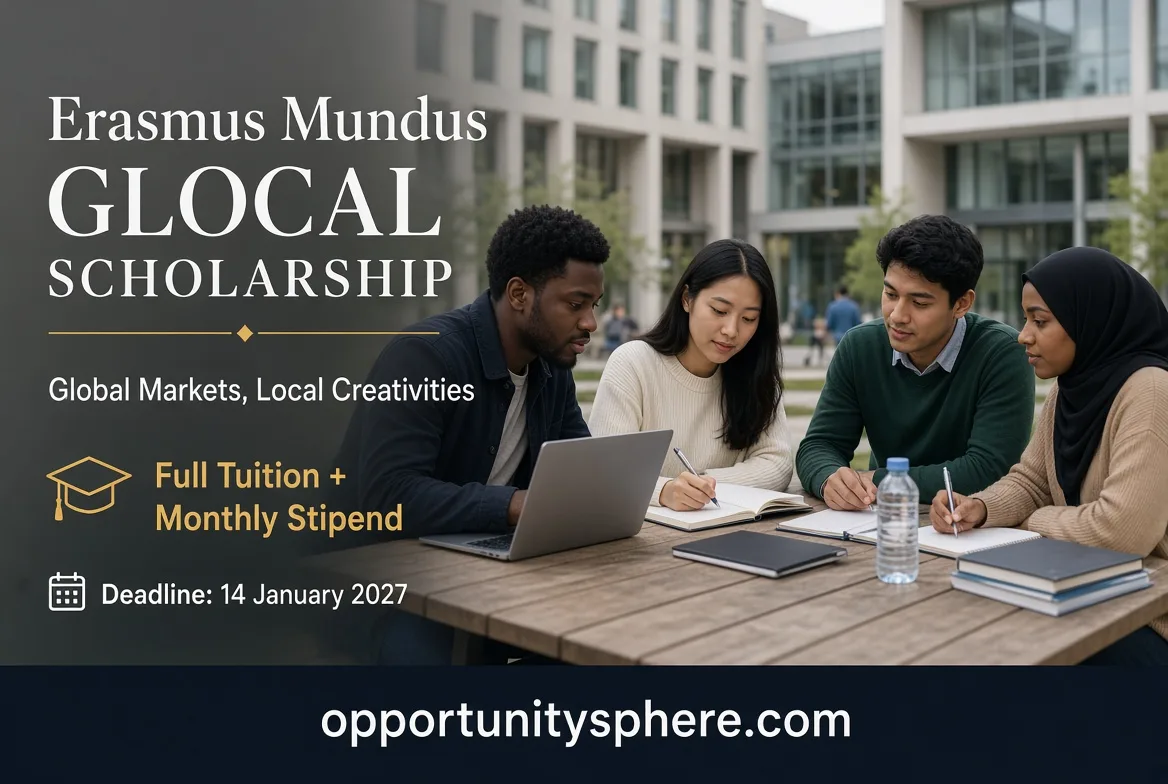
Erasmus Mundus GLOCAL Scholarship 2027–2029 – Fully Funded Master’s in Europe and Beyond
Offered by GLOCAL Consortium – University of Glasgow and Partner Universities
Location
Multiple countries – United Kingdom, Spain, Sweden, Germany, the Netherlands, Japan and Colombia (depending on the selected study track)
Funding
Fully Funded
Study level
Master's
Field of study
Arts & Humanities, Social Sciences, Economics, Political Science, Development Studies, Business & Management
Application deadline
January 14, 2027
About This Scholarship
The Global Markets, Local Creativities (GLOCAL) programme is a two-year, full-time international master's degree supported by the European Union through the Erasmus Mundus Joint Masters initiative. It is delivered by a consortium of seven universities, giving students the opportunity to study in different countries and gain an international perspective on global markets, economic development, entrepreneurship, culture and public policy.
The programme examines how local businesses, cities, communities and institutions respond to global economic changes. It combines perspectives from history, economics, business, political economy and cultural studies to help students understand the relationship between globalisation and local development.
For the September 2027 intake, Erasmus Mundus scholarships are available to outstanding applicants from around the world.
Full tuition-fee coverage: Scholarship recipients are not required to pay programme tuition fees. The scholarship and GLOCAL consortium jointly cover the tuition costs.
Monthly living allowance: Students can choose between two payment arrangements.
Health and insurance coverage: Full insurance coverage is included.
Travel and installation support: The scholarship payment arrangements include an option for advance payments intended to help with travel, visa and initial relocation expenses.
How the monthly scholarship is paid
Successful applicants can choose one of the following arrangements after accepting the scholarship:
Option 1: Monthly allowance with advance payments
Three advance payments of €1,000 each, scheduled for August before the first semester, May at the end of Year 1, and September at the beginning of Year 2.
A monthly subsistence payment of €1,275 throughout the two-year programme.
The three advance payments are deducted from the overall scholarship award; they are not additional payments on top of the total award.
Option 2: Higher monthly allowance
€1,400 per month for the full two-year programme.
No separate travel or installation advance payment.
Applicants should consider their initial relocation expenses and personal financial circumstances when choosing a payment arrangement.
Programme structure and participating universities
GLOCAL lasts 24 months and awards 120 ECTS credits. Students follow a selected study track and study at three partner universities during the programme.
The seven participating universities are:
University of Glasgow – United Kingdom
Universitat de Barcelona – Spain
Uppsala University – Sweden
Georg-August-Universität Göttingen – Germany
Erasmus University Rotterdam – Netherlands
Kyoto University – Japan
Universidad de los Andes – Colombia
The programme offers eight study tracks for the 2027–2029 intake. Track H is not recruiting for this intake, so applicants should choose from the available tracks and check the current programme overview before applying.
Available study tracks
Track A – Global History and Creative Industries
Focuses on the historical development of global markets and the relationship between economic change and creative industries.
Track B – Global Markets and Development
Examines global economic development, markets and the historical factors influencing economic activity.
Track C – Sustainable Business Development
Explores entrepreneurship, business development and sustainability, with attention to emerging markets.
Track D – Industrial Dynamics and Global Business
Focuses on industrial development, international business and the dynamics of global competition.
Track E – Institutional Change and Creative Industries
Examines institutional transformation and the development of creative industries in a global economic context.
Track F – Global Political Economy
Explores the relationship between political institutions, economic systems and global markets.
Track G – Sustainability: Institutions and Management
Focuses on sustainability, institutions and management, including the challenges facing emerging economies.
Track I – Entrepreneurship in Global Markets
Examines entrepreneurship, business development and the changing relationship between local enterprise and global markets.
Applicants may apply for only one study track. The choice should be based on the applicant's previous academic background, career plans and the subject area they want to explore.
The degree or combination of degrees awarded depends on the selected pathway.
Who can apply?
The scholarship is open to qualified applicants from different parts of the world. Applicants must first meet the academic and admission requirements of the GLOCAL programme.
The main requirements include:
A bachelor's degree equivalent to at least a UK 2:1 Honours degree.
An academic background relevant to the selected study track.
Evidence of English-language proficiency where required by the University of Glasgow.
Two supporting references.
A strong personal statement explaining the applicant's motivation and suitability for the programme.
A valid passport or other required identification documentation as specified in the application process.
Relevant academic backgrounds include anthropology, business, economics, global studies, history, international business, international relations, liberal arts, literature, philosophy, political science, psychology, sociology, sustainability, trade and urban studies.
Social Policy is listed as an accepted background at master's level only.
Additional academic requirement for certain tracks: Applicants choosing Tracks B, F or I, which involve study at Georg-August-Universität Göttingen, must have completed at least one-quarter of their previous studies, equivalent to 60 ECTS credits, in economics, business, modern history, economic and social history, sociology, politics or a combination of these subjects.
Applicants should not assume that having a degree in a broadly related discipline automatically makes them eligible. The programme asks candidates to demonstrate how their previous education and experience fit their chosen study track.
Can final-year undergraduate students apply?
Yes. Applicants completing the final year of their first degree can apply using their most recent official academic transcript.
However, they will not receive an unconditional admission offer until their final degree results and required documentation have been submitted. Applicants in this situation should check the admissions conditions carefully and ensure that their final documents can be provided within the required timeframe.
Required application documents
Applicants should prepare the following documents:
Completed GLOCAL scholarship application form.
Curriculum vitae (CV). The programme accepts different CV formats, although Europass is preferred.
Two supporting reference letters on institutional headed paper or bearing an official institutional stamp.
Official transcripts for all university-level studies, including undergraduate and postgraduate studies where applicable.
Degree certificates for completed university-level qualifications.
Proof of English-language proficiency, where required.
A colour scan of the photograph page of a current passport.
The two references must be dated within 24 months of the application date and must have an electronic or handwritten signature. A typed name alone is not sufficient.
At least one reference should be academic. Where obtaining two academic references is not possible, one may be professional, provided it comes from a relevant employer with whom the applicant has worked at some point within the 12 months before submitting the application.
References may be uploaded with the application or sent directly by the referee from an institutional email address. Personal email addresses are not accepted for references.
Documents issued in another language must be accompanied by official English translations where applicable.
Important: Scholarship applicants must provide the required English-language evidence by the scholarship deadline. An application that is still marked as holding for documents at the scholarship deadline will not be considered for scholarship funding.
How scholarship applications are assessed
The GLOCAL Consortium uses a competitive selection process. According to its published scholarship criteria, applications are assessed using the following weighting:
Selection criterion
Weight
Personal statement
40%
Academic merit
30%
Quality of references
10%
Other relevant experience
20%
The additional experience category may include relevant research, professional experience and other activities that strengthen an applicant's profile.
This means that academic results are important, but they are not the only consideration. Applicants should also demonstrate a clear reason for choosing GLOCAL and show how their previous experience connects with the programme.
How to apply
Applications are submitted online through the University of Glasgow's application system.
Follow these steps:
Visit the official GLOCAL programme website and read the entry requirements.
Review the available study tracks and select the one that best matches your academic background and future plans.
Download and complete the Erasmus Mundus Scholarship application form.
Prepare your CV, academic transcripts, degree certificates, references, passport scan and English-language evidence.
Complete the supporting personal statement, explaining why you want to study GLOCAL, how your previous studies prepare you for the programme and how the degree relates to your future career.
Submit the programme and scholarship application through the University of Glasgow's online application portal.
Upload all required supporting documents before the scholarship deadline.
The scholarship and programme admission applications are handled through the same online application process. Applicants do not need to submit two separate applications.
Application deadline: 14 January 2027 at 13:00 UK time.
Scholarship application outcomes are expected in April 2027.
Applications and supporting documents are not accepted by email. They must be submitted through the online application system.
Important information applicants should understand before applying
1. You must choose your study track carefully.
The programme does not allow applicants to apply for multiple tracks in the same application round. Compare the course content, participating universities and academic requirements before making your selection. A track that sounds attractive may not necessarily be the best academic fit for your previous qualification.
2. The scholarship is competitive, not automatic.
Meeting the admission requirements does not guarantee an Erasmus Mundus scholarship. Applicants first have to qualify for admission, after which eligible scholarship applications are reviewed and ranked by the GLOCAL Consortium.
3. Admission and scholarship selection are connected but distinct.
The University of Glasgow's Admissions Office assesses whether applicants meet the programme's entry requirements. The GLOCAL Consortium then reviews eligible applications for scholarship consideration. Applicants should therefore pay attention to both the academic admission requirements and the scholarship selection criteria.
4. Plan for the international mobility requirements.
Students study at three universities in different countries, depending on their chosen pathway. This means applicants should be prepared for international relocation, different university systems and the practical requirements of living in more than one country during the degree.
5. Do not leave reference letters until the final week.
References have specific requirements concerning dates, institutional identification and signatures. Contact referees early, explain the programme and give them enough time to prepare relevant recommendations. A reference that does not meet the stated requirements could make an otherwise strong application incomplete.
Additional application advice: how to make your personal statement stronger
The supporting personal statement has the largest weighting in the scholarship selection criteria, accounting for 40% of the assessment. It should therefore be treated as a major part of the application rather than a routine document.
The programme sets a maximum of 1,200 words. Applicants are advised to address the following:
Explain the academic connection: Show how your previous degree, research or professional experience relates to the subjects taught in GLOCAL.
Demonstrate programme fit: Identify the particular study track and explain why its academic focus is appropriate for your interests.
Connect the degree to your career: Explain how the programme will support your intended professional direction.
Present a possible dissertation interest: Briefly identify a research topic or area you may want to investigate. The topic can change during the programme.
Include relevant experience: Mention conferences, internships, research activities, NGO involvement, summer schools, awards and other relevant achievements.
A useful approach is to build the statement around one clear academic direction. For example, an applicant interested in sustainable business development could explain how previous studies or work experience led to an interest in entrepreneurship, local enterprise and sustainability, then show why the selected GLOCAL track is a logical next step.
Avoid simply listing achievements or describing the programme as prestigious. Explain what you hope to learn, what you can contribute to the cohort and how the degree fits into your longer-term plans.
A practical preparation checklist
Before submitting, applicants should confirm that:
Their degree meets the required academic standard.
Their previous subject background is appropriate for the selected track.
They have checked any additional subject-credit requirements for Tracks B, F or I.
They have selected only one study track.
Both references meet the programme's date, signature and institutional requirements.
Their transcripts and degree certificates are available.
Their English-language evidence is ready.
Their passport scan is clear and current.
Their personal statement is within 1,200 words and addresses the programme's guidance.
They have submitted the scholarship application form and all required documents before the deadline.
Applicants should also read the official programme guidance on visa arrangements and mobility at the partner universities. Visa requirements differ by country and nationality, so an admission or scholarship offer should not be treated as a substitute for checking the relevant immigration rules.
Official scholarship application deadline: 14 January 2027, 13:00 UK time.
Programme start: September 2027.
Scholarship results: Expected in April 2027.
The GLOCAL Erasmus Mundus Scholarship offers an opportunity to earn an international master's qualification while studying across several universities. Applicants who take time to understand the study tracks, prepare complete documents and present a convincing academic and career direction will be better prepared for the competitive selection process.
Related Opportunities
Explore other scholarships, fellowships, grants, research opportunities and more that may match your interests.