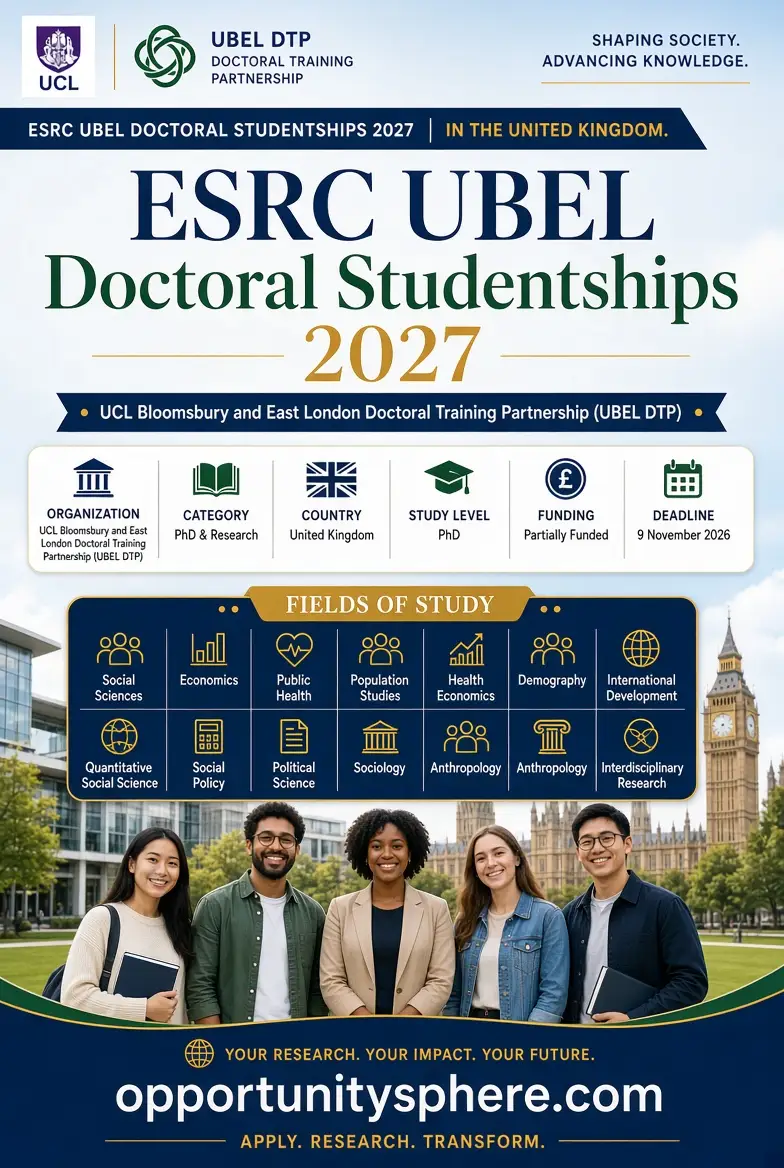
ESRC UBEL Doctoral Studentships 2027 in the United Kingdom
Offered by UCL Bloomsbury and East London Doctoral Training Partnership (UBEL DTP)
Location
United Kingdom
Funding
Partially Funded
Study level
PhD
Field of study
Other, Political Science, Social Sciences, Economics
Application deadline
November 9, 2026
About This PhD and Research Opportunity
International graduates and UK-based applicants interested in doctoral research can apply for the 2027 ESRC Doctoral Studentships offered through the UCL Bloomsbury and East London Doctoral Training Partnership (UBEL DTP). Supported by the Economic and Social Research Council (ESRC), the programme provides competitive funding for postgraduate research across a broad range of social science disciplines.
The studentships are available through participating institutions in London, including University College London, the London School of Hygiene & Tropical Medicine, SOAS University of London, Birkbeck, University of London, the University of East London, and the University of Greenwich.
The programme is particularly relevant to candidates interested in research that addresses social, economic, public health, population, policy and development challenges. Applicants are encouraged to develop a well-defined research proposal, identify suitable academic supervisors and apply through an eligible research pathway.
The preliminary application deadline for the 2027 competition is 9 November 2026. Applicants must also complete pre-registration by 30 October 2026.
About the ESRC UBEL Doctoral Studentships
The UBEL DTP brings together six London institutions to provide advanced research training and doctoral funding across interdisciplinary social science pathways.
Rather than offering a single PhD programme, the partnership coordinates studentships across several research areas. These include health and wellbeing, population and health, quantitative social science, international development, economics, social policy and other related disciplines.
The programme is designed to develop researchers with strong methodological skills and the ability to undertake independent research that contributes to academic knowledge and informs policy or practice.
Depending on the selected pathway and the applicant's previous qualifications, students may enter a doctoral-only route or a structured programme that includes additional master's-level research training before the PhD.
Scholarship Benefits and Funding
Successful applicants may receive the following support, depending on their fee status, award route and applicable funding conditions:
Doctoral funding: The standard ESRC funding model provides 3.5 years of doctoral study for eligible candidates who already possess the appropriate master's-level preparation.
Living stipend: Eligible award holders receive a stipend under the applicable ESRC funding arrangements. The amount follows the relevant UKRI stipend rate for the funding year.
Research training: The programme provides structured research training intended to strengthen analytical, methodological and professional skills.
Additional funded training time: The ESRC funding model includes an additional three months of funded time for training during the doctorate.
Placement opportunity: Students participating in an eligible placement may receive a further three months of funded time, subject to the applicable arrangements.
Research development: Students benefit from the academic expertise and research environment available through their participating institution and pathway.
Important funding information for international applicants
The 2027 competition is open to applicants with both Home and Overseas fee status, and up to 30% of the total awards may be allocated to international applicants.
However, international tuition fees can exceed the standard ESRC tuition-fee contribution. Applicants assessed as Overseas fee status may therefore need an alternative scholarship or funding arrangement to cover the difference.
The LSHTM International Fee Bursary may be available to an eligible applicant applying through the relevant LSHTM route. The number of these bursaries is limited, and priority is given to eligible applicants who are nationals of and residents in low-income or lower-middle-income countries.
Applicants should not assume that the studentship automatically covers the full international tuition fee. They must review the official funding terms and establish how any tuition-fee difference would be covered before accepting an award.
Eligible Research Areas
The UBEL DTP supports doctoral research across a range of social science and interdisciplinary pathways, including:
Health and Wellbeing
Population and Health
Quantitative Social Science
Economics and Health Economics
Demography and Population Studies
International Development
Social Policy and related social science disciplines
Other eligible research topics covered by the partnership's published pathways
The precise research areas available depend on the participating institution and the selected pathway. Applicants should consult the official pathway information before deciding where to apply.
Who Can Apply?
The competition welcomes applicants with Home or Overseas fee status who meet the requirements for an eligible research pathway and doctoral training route.
International applicants, including suitably qualified applicants from Nigeria, may be considered. However, eligibility for funding does not guarantee an award or automatic coverage of all overseas tuition fees.
Candidates should be prepared to demonstrate academic ability, a coherent research proposal, an appropriate research background and a clear fit with the expertise of their proposed supervisors.
Applicants must also follow the preliminary application procedure and any additional requirements imposed by their selected institution or pathway.
Eligibility Requirements
Applicants should:
Have an academic background relevant to their proposed research.
Meet the admission requirements of their chosen institution and doctoral pathway.
Identify a research topic that falls within an eligible ESRC research pathway.
Contact suitable academics and obtain the support required for their application.
Identify two potential supervisors as required by the preliminary application process.
Complete the required pre-registration process by 30 October 2026.
Submit a complete preliminary application by 9 November 2026.
Be prepared to submit a more detailed application if invited to the next stage.
Review the applicable Home or Overseas fee conditions and make arrangements for any funding shortfall.
The required academic qualifications depend on the selected route. Candidates applying directly for a doctoral-only route will generally need a relevant master's degree or equivalent preparation. Other routes include additional master's-level research training.
Application Deadlines
The official 2027 competition timetable includes the following dates:
30 October 2026: Pre-registration deadline, 23:59 UK time.
9 November 2026: Preliminary application deadline, 23:59 UK time.
11 December 2026: Pathway teams communicate preliminary-stage decisions to the partnership.
14 December 2026: Full application stage opens for successful preliminary applicants.
1 February 2027: Deadline for full applications, 23:59 UK time.
Week commencing 19 April 2027: The DTP Board confirms studentship awards for 2027 entry.
Applicants should use the official competition page to confirm the current timetable and instructions before submitting their applications.
How to Apply
Follow these steps to apply for the ESRC UBEL Doctoral Studentships.
Step 1: Explore the research pathways
Visit the official UBEL DTP website and review the available research pathways. Select an area that aligns with your academic background, research interests and intended career direction.
Step 2: Identify a suitable institution and research topic
Choose a participating institution with relevant expertise in your proposed research area. Develop a clear research question and consider how your proposed work could contribute to the field.
Step 3: Contact potential supervisors
Contact the relevant pathway leads and academic staff to discuss your research ideas. Applicants are expected to identify two potential supervisors who can support their preliminary application.
Do this as early as possible because supervisors may need time to assess your proposal and complete the relevant sections of your application.
Step 4: Complete pre-registration
Complete the required pre-registration process through the official competition system by 30 October 2026.
Step 5: Submit the preliminary application
Complete all applicable sections of the preliminary application and ensure the required supervisor contributions are included. Submit the application by 9 November 2026 at 23:59 UK time.
Only one application per applicant for an ESRC studentship beginning in 2027 may be submitted to the UBEL DTP.
Step 6: Complete the full application if invited
Applicants who pass the preliminary stage will be invited to proceed to the full application stage. This stage requires a more detailed research proposal and the other supporting information specified by the partnership.
The full application deadline is 1 February 2027 at 23:59 UK time.
Step 7: Monitor the outcome
Follow the official application instructions and monitor communications from the partnership and your selected institution. The award decisions are expected to be confirmed during the week commencing 19 April 2027.
Tips for Preparing a Competitive Application
A strong doctoral funding application should show that the proposed research is academically sound, feasible and relevant to the selected pathway.
Define a specific research problem rather than relying on a broad topic.
Explain the significance of the research and the gap in existing knowledge it addresses.
Demonstrate that your proposed methods are appropriate for answering the research question.
Identify supervisors whose expertise closely matches your project.
Discuss the research plan with potential supervisors before submitting your application.
Follow the instructions for your selected pathway and institution carefully.
Complete the pre-registration and preliminary application processes before their respective deadlines.
Investigate international tuition-fee arrangements early if you are applying with Overseas fee status.
Frequently Asked Questions
1. Can Nigerian applicants apply?
Yes. The competition accepts eligible international applicants, including candidates from Nigeria. Applicants must meet the relevant academic and pathway requirements and should carefully check the funding provisions for Overseas fee status.
2. Is this a fully funded scholarship?
The award provides doctoral funding and a stipend under the applicable ESRC terms. However, international applicants may need additional funding to cover the difference between the standard ESRC tuition-fee contribution and their university's Overseas tuition fees. For this reason, applicants should not assume that all international costs will automatically be covered.
3. What is the application deadline?
The preliminary application deadline is 9 November 2026 at 23:59 UK time. Pre-registration must be completed by 30 October 2026.
4. Do I need a master's degree?
The required qualifications depend on the pathway and funding route. Doctoral-only routes generally require a relevant master's qualification or equivalent preparation, while certain structured routes include additional master's-level training.
5. Can I apply to more than one pathway?
The 2027 competition permits only one ESRC studentship application per applicant. Review the pathways carefully and select the most appropriate route before applying.
6. How long does the funding last?
The standard ESRC model provides 3.5 years of doctoral funding for eligible candidates who already have the required master's-level preparation. Other routes may include additional training before the PhD. Further funded time may apply for training and eligible placements.
7. When will successful applicants receive their decisions?
The UBEL DTP Board is expected to confirm the award decisions during the week commencing 19 April 2027.
Applicants should consult the official competition guidance for the latest requirements, deadlines, pathway information and international funding conditions.
Final Advice
The ESRC UBEL Doctoral Studentships provide an opportunity for aspiring researchers to pursue doctoral study within a major London research partnership. Candidates should begin by identifying an appropriate research pathway, consulting potential supervisors and preparing a strong preliminary application.
International applicants should pay particular attention to tuition-fee arrangements and investigate any additional funding needed before accepting an award.
Related Opportunities
Explore other scholarships, fellowships, grants, research opportunities and more that may match your interests.