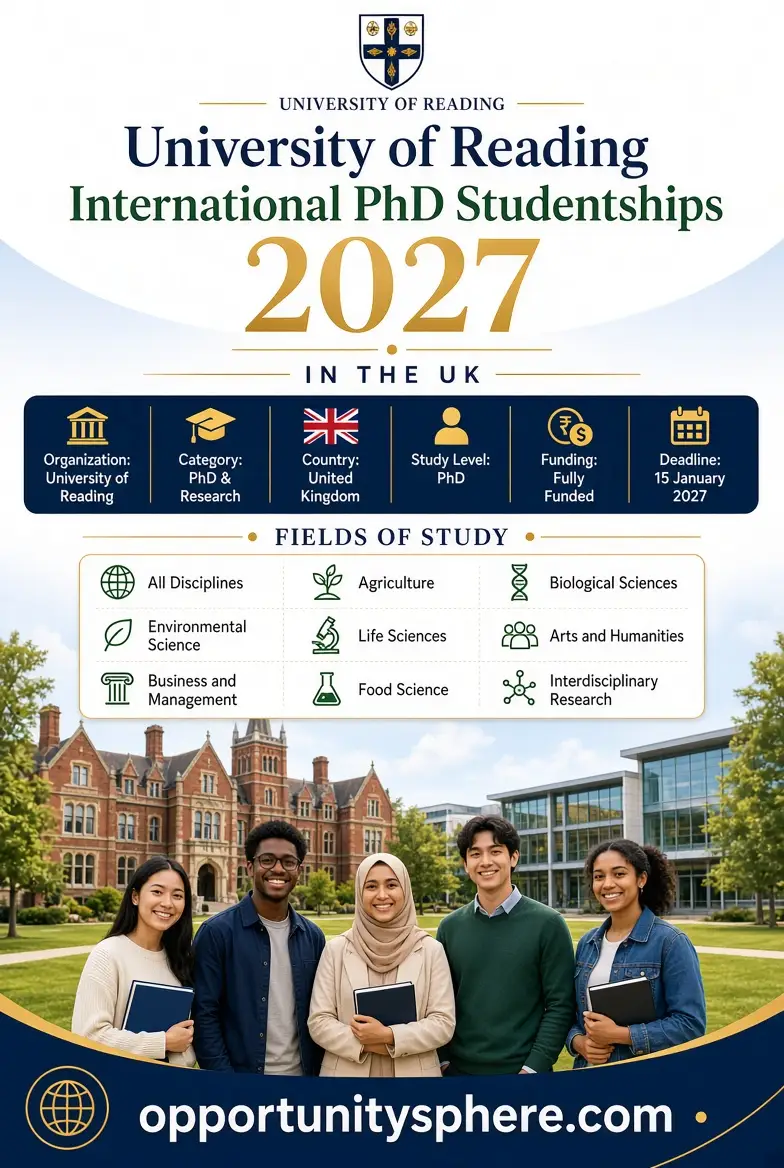
University of Reading International PhD Studentships 2027 in the UK
Offered by University of Reading
Location
United Kingdom
Funding
Fully Funded
Study level
PhD
Field of study
All Fields
Application deadline
January 15, 2027
About This PhD and Research Opportunity
International students seeking doctoral funding in the United Kingdom can apply for the University of Reading International PhD Studentship Competition for the October 2027 intake. The programme offers competitive funding to outstanding applicants undertaking research across a broad range of academic disciplines, including science, life sciences, social sciences, arts and humanities, and Henley Business School.
The competition is designed to support qualified doctoral candidates who demonstrate strong academic potential and the ability to undertake meaningful independent research. Applicants must apply for admission to an eligible PhD programme at the University of Reading and complete the separate studentship application process by the published deadline.
The award is particularly worth considering for international graduates who have a clear research direction, can identify a suitable academic department and are prepared to develop a focused research proposal.
About the University of Reading International PhD Studentships
The University of Reading is a UK higher education institution offering doctoral research opportunities across numerous academic departments. Through its Doctoral and Researcher College, the university coordinates a competitive selection process for international PhD studentships intended to help eligible researchers undertake advanced study.
For the 2027 entry competition, the university states that awards may cover up to four years of full-time study or up to six years of part-time study. The programme considers applicants proposing research in a variety of academic fields, although applicants should confirm that their intended project can be supervised within the relevant department.
An important feature of this opportunity is that applicants must complete both the PhD admission process and the separate funding competition requirements. Admission to the university does not automatically guarantee a studentship.
Scholarship Benefits and Financial Support
Successful applicants may receive the following benefits, subject to the award conditions:
International tuition fees: The studentship covers tuition fees at the university's international fee rate.
Annual training and development allowance: Recipients receive £1,000 per year to support eligible training and professional development activities.
Living stipend for eligible on-campus students: Applicants intending to study based at the University of Reading may receive a subsistence grant broadly aligned with the UK Research and Innovation (UKRI) minimum stipend. The university lists the 2026/2027 stipend rate as £21,805 per year.
Extended funding duration: Awards may last for up to four years for full-time doctoral study or up to six years for part-time study.
Important funding distinction: Applicants intending to study off campus or by distance may qualify for tuition-fee coverage and the annual training and development allowance, but these awards do not include the living stipend. The £21,805 figure is the published 2026/2027 reference rate; applicants should check the university's official page for any revised rate applicable to the 2027/2028 academic year.
The published award description does not establish that every recipient will receive additional travel costs, visa fees, relocation expenses or other benefits. Applicants should budget for expenses not explicitly covered by their award.
Eligible Fields of Study
The university invites applications for research in a wide range of disciplines, including:
Agricultural and environmental sciences
Biological and life sciences
Physical and mathematical sciences
Food and nutritional sciences
Social sciences and development-related research
Arts and humanities
Business and management
Other research areas supported by the university's academic schools
The precise availability of supervision depends on the proposed research topic and the expertise of the relevant school or department. Applicants should contact the appropriate postgraduate research administrator before submitting their admission application.
Who Can Apply?
The competition is open to international applicants who have applied for admission to a PhD programme at the University of Reading and intend to undertake research either at the university or through an approved off-campus or distance arrangement.
Applicants should be prepared to demonstrate strong academic preparation, a coherent research direction and the ability to meet the admission requirements of their chosen doctoral programme.
Candidates must also complete the separate International PhD Studentship Competition application form. Applicants should understand that the award is competitive and that not every eligible candidate will receive funding.
Eligibility Requirements
To be considered, applicants should satisfy the following requirements:
Apply for a PhD programme at the University of Reading.
Identify a research topic that can be supervised by the relevant school or department.
Meet the academic and admission requirements of the chosen doctoral programme.
Complete the International PhD Studentship Competition application form.
Submit the required information before 15 January 2027.
Be prepared to provide a concise research proposal if nominated by their school for the final selection stage.
The university's general doctoral admission guidance notes that many programmes require a master's-level qualification, particularly in areas such as arts, humanities, social sciences and business. However, academic requirements vary by programme, so applicants must confirm the specific requirements for their intended PhD.
English-language proficiency requirements also depend on the programme. The university's general guidance lists IELTS 6.5 for many doctoral programmes, while certain schools require 7.0. Applicants should consult the conditions attached to their intended programme rather than assuming that a single score applies to every subject.
Application Deadline
The deadline for the University of Reading International PhD Studentship Competition is 15 January 2027.
The studentships are intended for candidates starting in October 2027. Applicants should begin their admission and funding preparations early enough to allow their academic department to review their proposed research.
How to Apply
Follow these steps to apply for the University of Reading International PhD Studentships.
Step 1: Identify your research area
Choose a doctoral research topic that matches your academic background and research interests. Review the university's doctoral research areas and identify a school or department with appropriate supervisory expertise.
Step 2: Contact the relevant school or department
Before applying, contact the postgraduate research administrator in your intended school or department. Confirm that your proposed project can be supervised and ask whether there are any additional subject-specific requirements.
Step 3: Apply for PhD admission
Submit your application for admission to the appropriate PhD programme through the University of Reading's online admissions system. Prepare the academic documents and supporting information required by the programme.
In the funding section of the admission application, enter the name of the competition as specified by the university: "International Research Studentship Competition".
If you have already submitted your admission application without entering this information, the university advises you to proceed with the separate studentship application form.
Step 4: Complete the studentship application form
Complete the International PhD Studentship Competition application form linked on the official funding page. This separate form informs the school that you wish to be considered for the competition.
Step 5: Prepare your research proposal if nominated
The university conducts an initial selection process within its academic schools. Each school selects a candidate for nomination to the final competition.
If nominated, you will be asked to prepare a summary research proposal of no more than 700 words, excluding the title and references. Your proposal should explain the research problem, objectives, proposed approach and expected contribution. The university recommends consulting your proposed supervisor and its doctoral research guidance.
Step 6: Await the selection decision
Nominated applicants proceed to the final selection panel within the Doctoral and Researcher College. According to the published timetable, the final selection is expected around the end of March 2027, with successful applicants expected to receive formal award letters around the end of April 2027.
A studentship award is issued separately from the admission offer and remains subject to the university's eligibility checks and other applicable conditions.
Tips for Preparing a Strong Application
A competitive PhD application should show that the proposed research is feasible, relevant and suitable for the expertise available at the university.
Develop a clearly defined research question rather than a broad topic.
Explain the problem your research intends to address and why it matters.
Identify suitable supervisors and establish whether they can support the proposed work.
Ensure your academic records and supporting documents are complete and consistent.
Prepare a concise research proposal that demonstrates originality, sound methodology and a realistic plan.
Submit the separate funding application before the deadline, even if you have already applied for admission.
Review the funding conditions carefully, especially the difference between on-campus and distance-based awards.
Frequently Asked Questions
1. Can Nigerian students apply?
The competition is listed for international applicants, and Nigerian applicants may be considered if they satisfy the relevant admission and funding requirements. Applicants should confirm their individual eligibility with the university.
2. Does the studentship cover full tuition fees?
The published benefits include tuition fees at the international rate. Eligible applicants studying at Reading in person may also receive a living stipend and the annual training and development allowance.
3. Can distance-learning students receive a stipend?
No. The university states that off-campus and distance applicants are eligible for tuition-fee coverage and the training and development allowance only. Their awards do not include a stipend.
4. Is a master's degree compulsory?
This depends on the doctoral programme. Many programmes, particularly in certain humanities, social science and business areas, normally require a master's-level qualification. Check the specific programme's admission requirements.
5. Does applying for admission automatically enter me into the funding competition?
No. Applicants must complete the separate studentship application form. They should also follow the university's instructions for identifying the competition in their admission application.
6. When will successful applicants be notified?
The university expects final selection around the end of March 2027 and formal studentship award letters around the end of April 2027.
7. When does the funded PhD begin?
The competition is advertised for an October 2027 start.
Applicants should use the official university page to access the current competition details and studentship application form. Check the published terms before applying, as funding arrangements and admission requirements may vary.
Final Advice
The University of Reading International PhD Studentships offer a valuable route for eligible international researchers seeking doctoral study in the United Kingdom. The strongest applicants will begin by identifying a suitable research department, preparing a well-defined project and completing both the PhD admission and funding application processes before the deadline.
Prospective applicants should read the official guidance carefully and contact the university if they need clarification about eligibility, supervision or funding conditions.
Related Opportunities
Explore other scholarships, fellowships, grants, research opportunities and more that may match your interests.