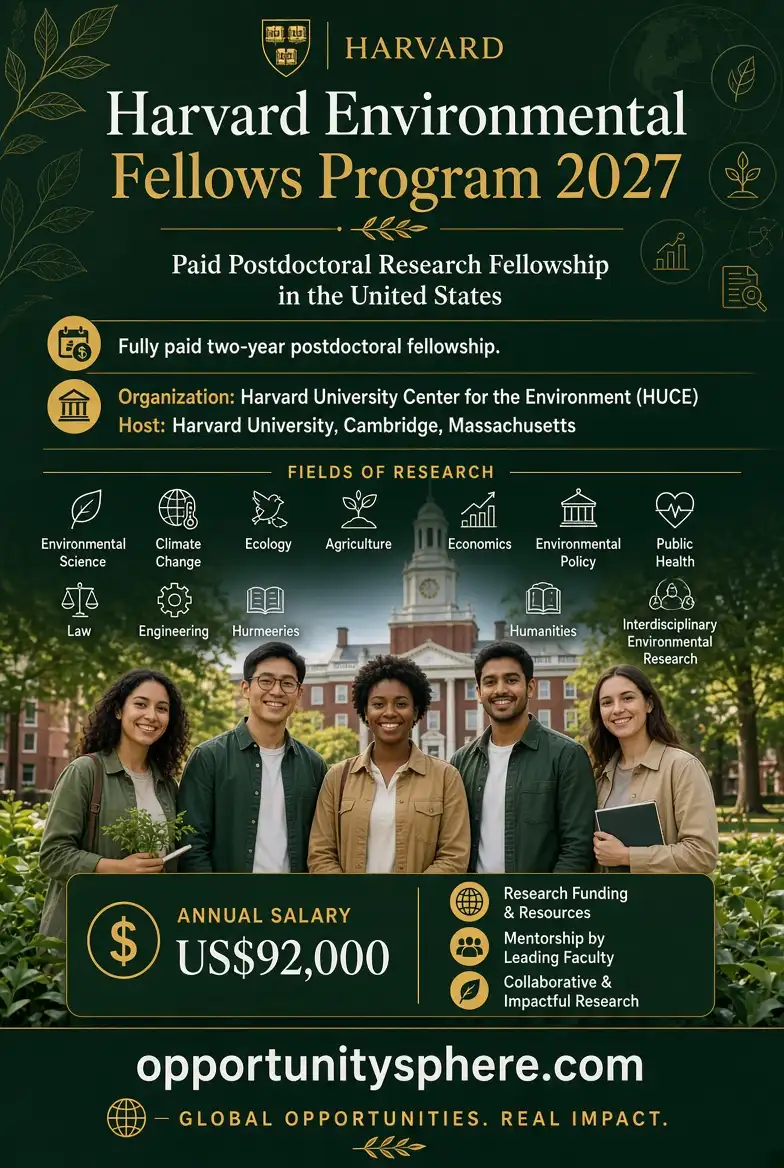
Harvard Environmental Fellows Program 2027 — Paid Postdoctoral Research Fellowship
Offered by Harvard University Center for the Environment (HUCE)
Location
United States
Funding
Paid
Study level
Postdoctoral, Researchers, Faculty & Academics
Field of study
Engineering, Agriculture & Agricultural Sciences, Law, Environmental Sciences, Natural Sciences, Life Sciences, Other, Political Science, Social Sciences, Economics, Health & Medical Sciences
Application deadline
December 1, 2026
About This Fellowship
The Harvard Environmental Fellows Program offers recent doctoral graduates an opportunity to conduct original environmental research while working with faculty members across Harvard University. Administered by the Harvard University Center for the Environment, the programme supports researchers investigating environmental challenges through scientific, social, economic, legal, public health and interdisciplinary approaches.
Environmental issues such as climate change, biodiversity loss, pollution, food security and ecosystem degradation rarely fit within a single academic discipline. Understanding them may require combining evidence about natural processes with insights into economic behaviour, public policy, technology, agriculture and human health.
The fellowship encourages this type of interdisciplinary investigation. Researchers can develop projects that connect their specialist knowledge with complementary expertise at Harvard, potentially broadening the reach and impact of their work.
For example, an agricultural researcher could investigate how environmental changes influence crop pests and sustainable crop protection. An economist might study incentives for adopting low-carbon technologies, while a public health researcher could examine the health implications of environmental exposure. These examples illustrate the programme's scope; applicants must propose their own research questions and establish a suitable relationship with a Harvard faculty host.
A central requirement is intellectual independence. The proposed project should establish a new research direction that extends beyond the applicant's doctoral work and is distinct from the host's ongoing research. Applicants should therefore explain what is original about their project, why the question matters and how the fellowship would enable them to pursue it.
Harvard expects to award approximately five fellowships for the 2027 cohort. Selection is competitive and depends on the strength of the research proposal, the applicant's scholarly preparation and the suitability of the proposed faculty mentorship.
Fellowship Benefits and Financial Support
The fellowship is a paid, two-year research appointment rather than a conventional tuition scholarship.
Potential gross salary over two years: US$184,000, assuming the published annual rate applies throughout the appointment and before taxes or other deductions.
Health insurance: Eligibility for Harvard employee health insurance, subject to applicable enrolment and benefits conditions.
Relocation support: Reimbursement of eligible relocation expenses up to US$2,500.
Professional expenses: An annual allowance of US$2,500 for travel and other professional expenses, subject to programme rules.
Research environment: Opportunities to work with Harvard faculty members across different schools and departments.
Professional exchange: The programme's co-curricular activities include biweekly dinners with Harvard faculty and guest speakers, creating opportunities to discuss research and learn from scholars in other disciplines.
The relocation amount is a reimbursement limit, not an automatic cash bonus. Similarly, the professional allowance is intended for eligible expenses rather than unrestricted personal spending. Applicants should review Harvard's employment and benefits policies before making financial or relocation plans.
Eligibility Requirements
1. Doctoral or equivalent terminal degree
Applicants for the 2027 cohort must have received their doctoral degree or equivalent terminal degree between May 2023 and August 2027.
Candidates who have not formally graduated when they apply may still be eligible, provided they meet the programme's completion requirements before the fellowship begins. Their dissertation must be filed before the September 2027 start. Applicants awaiting formal degree conferral should consult the programme's instructions about documenting completion of their doctoral requirements.
Candidates without a PhD may be considered only where a PhD is not the typical terminal qualification in their field and their alternative qualification satisfies the programme's requirements.
2. Demonstrated research experience
Applicants must demonstrate the ability to conduct scholarly research. Relevant evidence may include a doctoral dissertation, peer-reviewed publications, research reports, conference contributions, fieldwork, datasets or other discipline-appropriate outputs.
The application should make clear what the candidate contributed to previous research, which methods they used and how that experience prepares them to carry out the proposed project.
3. Environmental relevance
Applicants may come from a wide range of academic disciplines, but their proposed research must address an environmental issue.
Eligible topics may involve climate change, ecology, agriculture, environmental health, energy, biodiversity, conservation, economics, law, policy, engineering or the humanities. The proposal must establish a meaningful environmental connection and demonstrate scholarly merit.
4. Harvard faculty host
Every applicant must secure a commitment from one or more eligible Harvard faculty members to mentor them and provide appropriate office or laboratory space for the appointment.
The faculty host must submit a support letter of no more than two pages. Applicants should identify suitable faculty members early, review their research interests and discuss the proposed project before submitting the application.
The programme limits faculty members to hosting one Environmental Fellow at a time. Applicants must also check the current programme requirements for any faculty-host restrictions relevant to the 2027 cohort.
5. Independent research direction
The proposed project must extend beyond the applicant's doctoral research and the host's ongoing work. Simply repeating a dissertation project or proposing a minor continuation of existing research may not meet this requirement.
Applicants should explain the distinction between their previous work and the proposed project, including the new question, methods, conceptual approach or intended contribution.
The programme also has specific requirements concerning work with a thesis adviser and applicants who have existing connections to Harvard. Consult the official requirements if either situation applies.
6. International eligibility and residence
Candidates from universities around the world, including non-US citizens, may apply if they meet the programme's requirements. Harvard indicates that its International Office can assist selected international fellows with the relevant visa process.
Successful fellows must work at Harvard for the full two-year appointment and reside in the Cambridge, Massachusetts, area. International applicants should account for immigration, employment and relocation requirements before accepting an offer.
Who Should Apply?
The fellowship may suit recent doctoral graduates whose research interests connect to environmental challenges and who are ready to establish an independent research direction.
Agricultural researchers investigating sustainable farming, soil health, crop productivity, pest management or environmental effects of agricultural practices.
Ecologists and conservation researchers examining habitat change, species conservation or ecosystem resilience.
Economists studying climate finance, environmental incentives, natural resource management or the economic consequences of environmental change.
Public health researchers investigating the health effects of pollution, heat, climate-related hazards or environmental exposures.
Engineers and technology researchers developing approaches to cleaner energy, sustainable infrastructure, environmental monitoring or resource efficiency.
Law and public policy scholars studying environmental regulation, conservation policy or climate governance.
Humanities and social science researchers examining the cultural, historical, ethical or social dimensions of environmental change.
For instance, a researcher with a doctorate in agricultural entomology might investigate how environmental variability influences insect pest pressure, pesticide use and sustainable crop production. The project would need to establish a distinct research question and a suitable faculty-host relationship rather than simply repeat the doctoral dissertation.
These examples are illustrative, not a guarantee of eligibility or selection. The official programme requirements remain decisive.
How to Prepare a Competitive Research Proposal
The research proposal is one of the most important parts of the application. It must be no longer than five pages, with references counted separately.
Define a focused environmental question
Avoid broad topics such as climate change or pollution without a clearly defined research problem. Identify a question that is important, answerable and suitable for investigation during a two-year appointment.
Establish the research gap
Explain what current scholarship has established, what remains uncertain and why addressing that uncertainty matters. Support your argument with relevant academic literature and avoid unsupported claims that a topic has never been studied.
Demonstrate originality
Show how the project differs from your doctoral research and the proposed host's existing work. Explain the new question, approach or contribution that makes the project an independent line of inquiry.
Describe your methods
Outline how you will investigate the question and why the chosen methods are appropriate. Depending on the project, this could involve experiments, fieldwork, modelling, statistical analysis, remote sensing, interviews, policy analysis or a combination of methods.
Explain why Harvard is the right setting
Identify the faculty expertise, research resources or interdisciplinary connections that would materially support your project. A clear explanation of the academic fit is more useful than general statements about Harvard's reputation.
Present a feasible work plan
Explain how the project can progress during the fellowship, including research design, data collection, analysis and dissemination. Account for practical requirements such as field seasons, laboratory work, approvals or access to data.
Explain the potential contribution
Describe how the findings could advance environmental scholarship or inform practice. Be specific about the knowledge the project could produce without promising results that cannot be guaranteed in advance.
Required Application Documents
1. Curriculum vitae
Include academic qualifications, research experience, publications, relevant awards, methods expertise and other scholarly contributions.
2. Research proposal
Submit a proposal of no more than five pages, excluding references. It should explain the research question, background, originality, methods, environmental relevance and reasons for choosing Harvard.
3. Publications or writing samples
Applicants may submit up to three publications or writing samples. Choose materials that demonstrate research quality, analytical ability and relevant expertise.
4. Three letters of reference
Three references are required, including one from the applicant's dissertation adviser. Contact referees early and give them enough information about the proposed research and programme requirements to prepare their recommendations.
5. Harvard faculty host support letter
The proposed faculty host must submit a letter of no more than two pages explaining their commitment to the candidate and the research, including the mentoring arrangement and provision of appropriate office or laboratory space.
The main application and supporting letters have different deadlines. Applicants should coordinate with their referees and faculty host well in advance rather than waiting until the main application has been submitted.
How to Apply
Review the official requirements. Read the programme details, eligibility rules and frequently asked questions on the Harvard University Center for the Environment website.
Confirm your academic eligibility. Check the qualifying degree dates and any requirements that apply if your degree has not yet been formally conferred.
Develop your research idea. Identify a focused environmental question and establish how your project will extend beyond your doctoral work.
Identify a faculty host. Find eligible Harvard faculty members whose expertise aligns with your project and obtain a clear commitment to mentor you.
Prepare the required materials. Finalise your CV, research proposal and selected publications or writing samples.
Contact your referees. Arrange three recommendations, including one from your dissertation adviser. Explain the deadlines and follow the application system's submission instructions.
Submit the online application. Complete the application through Harvard's official academic positions portal before December 1, 2026, at 5:00 p.m. Eastern Time.
Confirm supporting letters. Ensure that the host letter and all reference letters are submitted by December 11, 2026, at 5:00 p.m. Eastern Time.
Monitor your email. The programme expects to notify applicants of decisions by late January 2027. Selected candidates should follow Harvard's instructions concerning appointment arrangements and relocation.
Important Deadlines
Main application: December 1, 2026, at 5:00 p.m. Eastern Time.
Host and reference letters: December 11, 2026, at 5:00 p.m. Eastern Time.
Expected decisions: Late January 2027.
Expected fellowship start: September 2027.
For applicants in Nigeria, 5:00 p.m. Eastern Standard Time corresponds to 11:00 p.m. West Africa Time on the same date in December. Verify the time zone displayed by the application system before submitting.
Applicants considering a host in Harvard's Department of the History of Science should check the department's separate sponsor-request deadline, which is November 1, 2026.
Frequently Asked Questions
Is this a fully funded scholarship?
The opportunity is a paid research fellowship rather than a conventional tuition scholarship. The published package includes a US$92,000 annual salary, eligibility for employee health insurance, relocation reimbursement of up to US$2,500 and a US$2,500 annual professional expense allowance.
How much is the salary?
The annual salary is US$92,000. Over two years, that equals US$184,000 in gross salary before applicable taxes and deductions, assuming the stated rate applies throughout the appointment.
Can Nigerian researchers apply?
Yes. International applicants, including non-US citizens, may apply if they satisfy the academic and programme requirements and secure an eligible Harvard faculty host.
Can applicants with only a master's degree apply?
Generally, no. The programme is intended for recent doctoral graduates or candidates with an equivalent terminal degree. Exceptions for applicants without a PhD apply only under the programme's rules for fields where a PhD is not the typical terminal qualification.
Must the research focus on climate change?
No. The programme covers a broad range of environmental research, including agriculture, ecology, public health, economics, law, engineering and the humanities. The proposed project must have a clear environmental focus.
Do I need a Harvard faculty host?
Yes. Applicants must secure a faculty commitment to provide mentorship and suitable office or laboratory space. The host must also submit the required support letter.
Can I continue my PhD research?
The project must establish an independent line of inquiry beyond the applicant's doctoral research and the host's ongoing work. Applicants should explain clearly how their proposed project differs from previous research.
How many reference letters are required?
Three letters are required, including one from the dissertation adviser. They must be submitted by December 11, 2026, at 5:00 p.m. Eastern Time.
How many fellows will be selected?
Harvard expects to award approximately five fellowships for the 2027 cohort. The limited number of positions makes a strong research proposal and a suitable faculty-host arrangement especially important.
Does the fellowship guarantee a permanent job at Harvard?
No. It is a fixed-term research appointment and does not guarantee permanent employment or a particular career outcome.
Related Opportunities
Explore other scholarships, fellowships, grants, research opportunities and more that may match your interests.