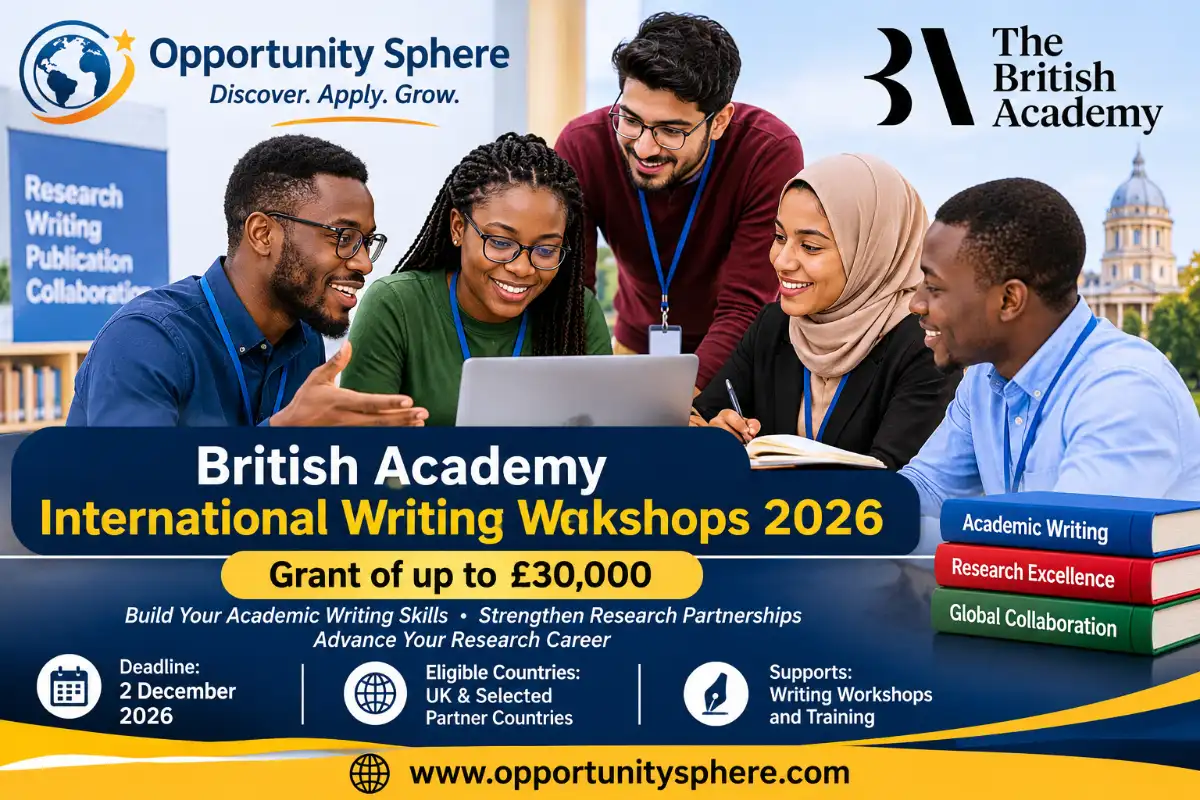
British Academy International Writing Workshops 2026
Offered by The British Academy
Location
United Kingdom / International
Funding
Paid
Study level
Researchers
Field of study
Arts & Humanities, Development Studies, Social Sciences, Education
Application deadline
December 2, 2026
About This Grant
The British Academy International Writing Workshops 2026 programme provides grants of up to £30,000 to support the organisation of specialist academic writing workshops designed to improve the research communication and scholarly publishing capabilities of early-career researchers in eligible developing countries. Administered by the British Academy and supported through the UK Government's International Science Partnerships Fund (ISPF), the programme seeks to address barriers that prevent researchers in developing countries from publishing their work in influential academic journals and establishing strong international research networks.
Unlike conventional research grants that primarily finance the production of new research, this programme focuses on helping researchers communicate, develop and publish research they have already undertaken. It supports structured training, practical writing development, mentorship, journal engagement and professional networking in the humanities and social sciences.
Purpose and objectives
The programme aims to strengthen the research careers of early-career academics by improving their understanding of academic publishing and helping them develop manuscripts suitable for submission to reputable scholarly journals. It also seeks to establish lasting professional relationships between emerging researchers, experienced academics and journal editors.
Funded projects are expected to contribute to several objectives:
Improve the academic writing and publication skills of early-career researchers.
Help participants understand the expectations and standards of national and international academic journals.
Provide opportunities for direct interaction with experienced scholars and journal editors.
Develop professional networks and research partnerships across countries and institutions.
Strengthen researchers' capacity to prepare competitive research grant applications.
Improve the visibility and wider uptake of research originating from developing countries.
Encourage more equitable international research partnerships and address structural inequalities affecting researchers' careers.
The programme is designed around workshops and beneficiaries in Brazil, South Africa, Kenya, Indonesia, Malaysia, Thailand, Ghana, the Philippines, Vietnam and countries classified as Least Developed Countries (LDCs).
The workshops must take place in person in one or more of these eligible countries. Projects involving multiple eligible countries are permitted, provided the applicants explain the rationale and demonstrate that the proposed activities are practical and achievable.
The lead applicant must hold an established position at an eligible university or research institute in the United Kingdom or one of the eligible developing-country locations. Where the Lead is based in the UK, the project must include at least one researcher based in an eligible developing country. Where the Lead is based in an eligible developing country, the project must include at least one UK-based researcher.
Researchers from other countries may be included as additional international collaborators or participants once the essential partnership and geographical requirements have been satisfied. However, the principal beneficiaries and development impact must remain focused on the countries targeted by the scheme.
Important geographical restriction for Nigerian researchers: Nigeria is not specifically listed among the eligible partner countries and is not included in the LDC list reproduced in the 2026 scheme guidance. Consequently, a Nigeria-based researcher or institution cannot assume that it qualifies to lead or host a project under this call. Nigerian academics may potentially participate as additional international researchers or workshop participants, but their involvement must not replace the required eligible-country partnership or the programme's development objectives.
Who can apply?
The scheme is intended for established researchers capable of leading and managing an international academic training project.
The Lead Applicant must:
Hold postdoctoral status or above, or demonstrate equivalent research experience.
Have an established role at an eligible university or research institute.
Hold a position that will remain valid throughout the award period.
Have the institutional support necessary to organise and manage the proposed workshops.
Lead the project, oversee its implementation and take responsibility for reporting to the British Academy.
Co-applicants must also have postdoctoral status or equivalent research experience. The required UK–developing-country research partnership must be included, while other international researchers may participate once the core eligibility conditions are met.
The award must be hosted by an institution recognised by the British Academy. Eligible host organisations include recognised higher education institutions, qualifying research institutes, approved independent research organisations, public-sector research organisations and eligible research organisations in the partner countries. Overseas institutions must obtain British Academy approval before submitting an application.
What types of activities can be funded?
The programme is intended to support practical, structured writing and publication-development workshops rather than conventional writing retreats. A strong proposal should explain how participants will move from developing their manuscripts to understanding the publication process and preparing work for journal submission.
Possible activities include:
Academic writing workshops covering manuscript structure, argument development, literature reviews and scholarly presentation.
Practical sessions on preparing research papers for peer-reviewed journals.
Training on journal selection, publication standards and responding to reviewers.
Mentoring sessions involving experienced academics and journal editors.
Opportunities for participants to receive feedback on draft manuscripts.
Sessions on research visibility, dissemination and the wider uptake of research findings.
Professional networking and the development of research collaborations.
Training on preparing competitive research grant applications.
The British Academy expects proposals to include substantial mentoring and follow-up activities. Applicants may ask participants to submit draft papers before the workshop so that facilitators and mentors can provide more focused feedback. The Academy also encourages applicants to consider developing a thematic collection of articles for the open-access Journal of the British Academy after the workshops.
At least one session must provide guidance on preparing grant applications. The programme is expected to support participants before, during and after the actual workshop, rather than simply finance a short academic event.
Eligible academic disciplines
The primary focus must be the humanities and social sciences. Relevant areas may include history, languages, literature, philosophy, education, sociology, anthropology, economics, political science, law, cultural studies, development studies, social policy and related disciplines.
Interdisciplinary proposals may be considered where their main purpose is clearly relevant to the humanities and/or social sciences. Proposals primarily focused on science, technology, engineering, mathematics or medical research are not eligible simply because they include an academic writing component.
Funding and financial support
Successful projects can receive a maximum of £30,000 for activities delivered over a period of up to 24 months. The British Academy expects to make approximately 25 awards under this call.
The funding is intended for direct workshop delivery and may cover:
Travel and related expenses for project organisers, co-applicants and workshop participants.
Accommodation-related subsistence expenses.
Networking, meetings and conference costs.
Clerical assistance.
Workshop consumables.
Childcare support, including assistance for participants.
Contributions to non-UK-based co-applicants who are directly involved in organising workshops in their country.
The award is paid to the institution where the Lead Applicant is based, rather than directly to individual researchers. The scheme does not operate on a full economic costing basis.
The grant is not a personal scholarship, salary award or general research allowance. It is specifically intended to deliver the approved workshop programme. Costs such as purchasing computers and other equipment, PhD studentships, permanent assets, publication fees, copy-editing, proofreading, printing and institutional overheads are not eligible.
Project duration and implementation
Projects may run for up to 24 months. The British Academy expects successful projects to begin by 31 March 2027.
The proposed timetable should include preparation and participant recruitment, workshop delivery, mentoring, manuscript development and follow-up activities. Applicants should demonstrate how the project will continue to benefit participants after the physical workshop has ended.
Workshops are expected to take place in person in eligible countries. Hybrid delivery may be considered where applicants provide a convincing justification.
Equitable partnerships and development impact
A major consideration in this programme is the quality and fairness of international partnerships. Applicants must explain how responsibilities, resources, expertise and benefits will be shared between participating institutions.
The proposal should demonstrate that local researchers and institutions have meaningful roles in designing and delivering the activities. It should also consider structural inequalities, including gender, disability, age and geographical barriers that can affect researchers' access to professional development.
All proposals must satisfy Official Development Assistance (ODA) eligibility requirements. This means the project's primary objective must be directly and primarily relevant to addressing problems in developing countries. ODA eligibility is an essential condition, not an optional advantage.
Application and selection process
Applications must be submitted online through the British Academy's Flexi-Grant Grant Management System. Applicants should first study the official scheme notes and application guidance, confirm that their institution is eligible, and develop a proposal that clearly addresses the programme's objectives.
All applications must be submitted in English. The Lead Applicant must obtain institutional approval before submission.
Eligible proposals will be assessed through peer review. The British Academy will consider:
The quality and significance of the proposed activities, particularly their potential to improve the careers of early-career researchers in eligible countries.
The feasibility of the workshop structure, timetable and implementation plan.
The applicant's experience and track record.
The strength and fairness of the proposed partnerships.
Evidence that the project satisfies ODA requirements.
The quality of the gender equality statement.
Value for money.
The British Academy expects to notify applicants of the outcome by March 2027. Successful projects will be required to provide an interim report and a post-event report, including information about activities, participants, outcomes, feedback and expenditure.
Important dates
Application deadline: 2 December 2026, 17:00 UK time.
Overseas institutional account request deadline: 18 November 2026, 17:00 GMT.
Expected notification of results: March 2027.
Latest project start date: 31 March 2027.
Project duration: Up to 24 months.
The institutional account deadline is particularly important for eligible overseas organisations that are not already registered with the British Academy. The Academy recommends submitting applications at least five working days before the closing date to allow for institutional approval.
Related Opportunities
Explore other scholarships, fellowships, grants, research opportunities and more that may match your interests.