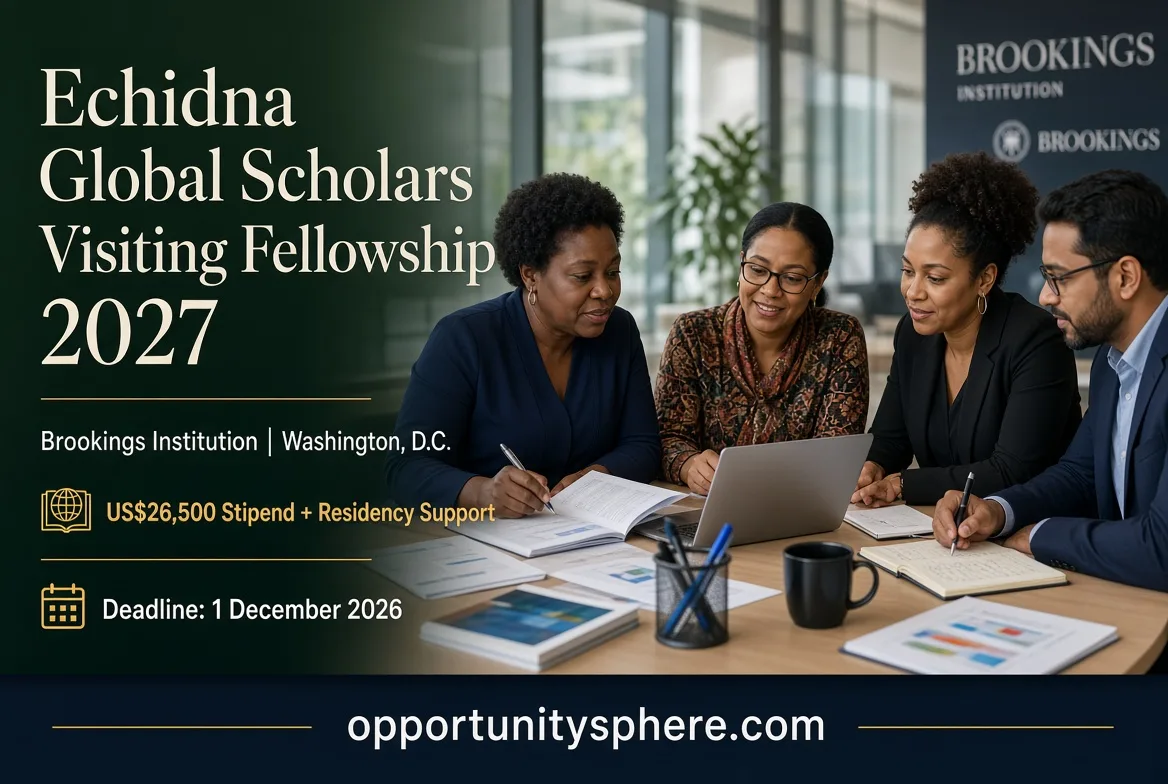
2027 Echidna Global Scholars Visiting Fellowship at Brookings Institution – US$26,500 Stipend
Offered by Brookings Institution – Center for Universal Education (CUE)
Location
United States
Funding
Partially Funded
Study level
Master's
Field of study
Education, Economics, Social Sciences, Development Studies
Application deadline
December 1, 2026
About This Fellowship
The 2027 Echidna Global Scholars Visiting Fellowship is a six-month professional research and leadership development programme hosted by the Center for Universal Education (CUE) at the Brookings Institution in Washington, D.C., United States.
The programme supports experienced professionals from the Global South who are working to advance gender equality through education. It is designed for leaders who understand the educational challenges affecting girls, young women and gender-nonconforming people in their communities and want to use research, policy engagement and institutional leadership to address those challenges.
Unlike conventional academic scholarships, the Echidna Global Scholars Programme focuses on experienced practitioners and researchers who already have a record of professional engagement in education, gender equality, development or related areas. Selected scholars develop an independent research project connected to an important education challenge in their home country and work towards translating their findings into practical policy recommendations.
The programme is hosted by Brookings' Center for Universal Education, which works with educators, researchers, policymakers and communities to improve education systems and expand equitable learning opportunities.
Fellowship structure and activities
The fellowship combines research, professional development, leadership training and an in-person residency at Brookings.
1. Research design retreat – April 2027
Selected scholars participate in an in-person research design retreat with the Center for Universal Education's Gender Equality in and through Education team. During this period, they refine their research questions, identify the policy problem they intend to investigate and plan their data collection.
2. Pre-residency – June to July 2027
Scholars begin collecting and analysing information in their home countries. They also participate in virtual workshops, group meetings and individual advisory sessions. This phase requires approximately 15–20 hours of commitment per week.
3. Washington, D.C. residency – August to December 2027
Scholars undertake a full-time, in-person residency at Brookings. They analyse their research findings, develop policy recommendations, participate in leadership development activities and engage with researchers, education specialists and policy stakeholders.
A major output of the fellowship is an evidence-based policy paper, alongside other research and policy communication activities.
4. Post-residency engagement
Following the residency, scholars are expected to work towards implementing activities in their home countries based on their research findings. They also become part of the Echidna Global Scholars Alumni Network, which supports continued collaboration, shared learning and professional engagement.
Fellowship funding and benefits
Selected scholars receive a stipend of US$26,500 to support living costs during the pre-residency and residency periods. The stipend is subject to applicable United States tax withholding and reporting requirements.
Additional support provided by the programme includes:
Single-occupancy accommodation during the four-month residency in Washington, D.C.
Round-trip travel expenses.
Costs associated with the visa process.
Costs associated with the April 2027 research design retreat.
A limited health insurance plan.
Research guidance and professional development.
Access to Brookings researchers, education specialists and policy networks.
Membership of the Echidna Global Scholars Alumni Network after the residency.
The US$26,500 is a stipend, not a salary. The fellowship is not an employment position. Applicants should review the funding and visa conditions carefully before applying. Brookings provides visa-process support but does not guarantee visa approval.
Eligibility requirements
The programme is intended for established professionals with substantial experience in education, gender equality and development.
Applicants should meet the following requirements:
1. Educational qualification
Applicants must hold a master's degree or a higher qualification. Relevant academic backgrounds include:
Education
Gender and Women's Studies
International Development
Global Development
Public Policy
Economics
Related social sciences and humanities disciplines
2. Professional experience
Applicants must have at least 10 years of professional experience in relevant areas. Experience may come from:
Research institutions and academia
Non-governmental organisations
Community-based organisations
Civil society organisations
Government institutions
Candidates with experience across academic or government institutions and community organisations are particularly encouraged.
3. Demonstrated commitment to gender equality in education
Applicants should have a strong understanding of education development and gender issues, as well as a demonstrated commitment to improving learning opportunities and life outcomes for girls, young women and gender-nonconforming people.
4. Connection to the Global South
Applicants should have substantial professional experience and ties to a country in the Global South. They must also demonstrate a clear intention to return to their home country or another Global South context after completing the Washington residency.
5. English proficiency
Applicants must demonstrate proficiency in English and possess strong research, analytical, writing and collaboration skills.
Priority areas for the 2027 fellowship
The 2027 call gives special consideration to applicants working in:
West and Central Africa
Southeast Asia
Latin America and the Caribbean
The Middle East, Southwest Asia and North Africa
The programme also gives special consideration to work in countries and communities affected by conflict, humanitarian crises and displacement, including post-conflict environments where progress in education has stalled or reversed.
These are priority areas for consideration, not a replacement for the general eligibility requirements.
Required application documents
Applicants must submit two main documents through the Brookings recruitment portal:
1. Curriculum Vitae (CV) or résumé
The CV should provide details of the applicant's:
Educational qualifications
Professional experience
Research and academic publications
Previous fellowships
Honours and awards
Funded research projects
Grants or foundation support received
2. Completed Echidna Global Scholars Programme application
The programme application includes a written questionnaire and a research proposal of approximately 3–5 pages. The proposal should present a research project relevant to improving education opportunities and gender equality in the applicant's country.
The research proposal is particularly important because the fellowship is built around developing evidence that can inform education policy and practice.
Brookings states that separate recommendation letters, academic transcripts and additional writing samples are not required at the initial application stage. Applicants selected for interviews may be asked to provide further information or references.
How to apply
Interested applicants should follow these steps:
Visit the official Brookings Echidna Global Scholar vacancy page.
Review the eligibility requirements and fellowship responsibilities carefully.
Prepare an updated CV containing relevant professional experience, research outputs, publications and awards.
Download and complete the Echidna Global Scholars Programme application document.
Answer the questionnaire and prepare a research proposal of 3–5 pages.
Save the documents using the required naming format: Last Name_First Name_document name.
Open the Brookings recruitment portal and submit both required attachments. The completed programme application should be uploaded in the portal's designated "Writing sample" section.
Submit the application before the deadline.
Application advice
This fellowship is highly specialised, so applicants should not rely on a general motivation letter or a CV that simply lists their academic qualifications.
The research proposal should identify a specific education challenge affecting girls, young women or gender equality in the applicant's country. It should explain why the issue matters, what evidence is missing, how the proposed research will investigate the problem and how the findings could influence education policy or practice.
For example, a candidate working in Nigeria might investigate barriers preventing girls in rural communities from transitioning from secondary school to tertiary education, the effect of gender norms on school participation, or how education policies can better support girls affected by displacement.
Applicants should demonstrate that they have the professional relationships, research experience and understanding of their local context needed to carry out the proposed project. The strongest applications will connect the research question to a practical opportunity for improving education outcomes after the fellowship.
It is also important to demonstrate the ability to commit to the programme's schedule. The pre-residency period requires substantial part-time participation, while the Washington, D.C. residency is a full-time, in-person commitment.
Important dates
Research design retreat: April 2027
Pre-residency: June–July 2027
Washington, D.C. residency: August–December 2027
Application deadline: 1 December 2026, 11:59 p.m. Eastern Time
Only applicants selected for interviews will be contacted. Incomplete applications and applications submitted after the deadline will not be considered.
Related Opportunities
Explore other scholarships, fellowships, grants, research opportunities and more that may match your interests.