The application deadline for this opportunity has passed. You can still review the details, but the listing is no longer presented as open for applications.
Grant
African Plant Nutrition Outreach Fellowship 2026
Offered by African Plant Nutrition Institute (APNI)
Location
Africa
Funding
Paid
Study level
Professionals / Researchers
Field of study
Agriculture & Agricultural Sciences
Application deadline
September 21, 2026
Application Closed
About This Grant
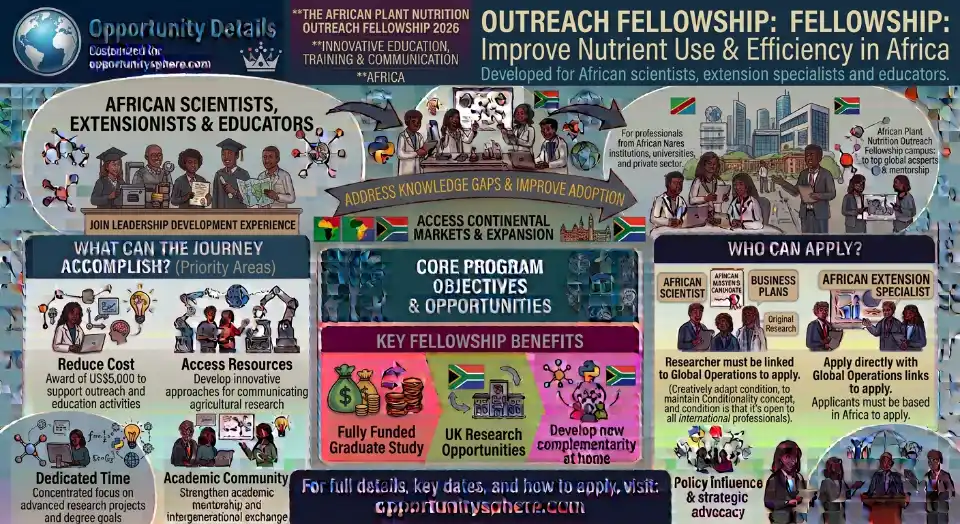
The African Plant Nutrition Outreach Fellowship is an initiative of the African Plant Nutrition Institute (APNI) designed to strengthen agricultural education, research communication and knowledge transfer across Africa. The programme supports professionals who are developing innovative ways to improve plant nutrient management and promote the adoption of effective soil fertility practices in African agricultural systems.
Although scientific research has contributed significantly to understanding crop nutrition and soil fertility, important gaps remain between research findings and the practices used by farmers and other agricultural stakeholders. Useful information about fertiliser management, soil diagnostics, nutrient efficiency and sustainable crop production does not always reach the people who need it in accessible or practical formats.
The fellowship seeks to address this challenge by supporting scientists, agricultural extension specialists and educators who can translate scientific knowledge into useful outreach, training and communication activities. Through these activities, award recipients can help farmers, extension personnel and other stakeholders make better-informed decisions about managing soil nutrients and improving agricultural productivity.
Each selected award recipient receives US$5,000 to support an approved initiative. Depending on the proposed project, the funding may support training events, educational resources, research synthesis, communication tools, outreach activities or relevant travel.
The programme is particularly relevant to professionals who want their research and technical expertise to have a practical impact beyond academic publications. It provides an opportunity to develop initiatives that connect agricultural science with the needs of farming communities and other users of plant nutrition information.
Who Should Apply?
The fellowship is intended for full-time scientists, extension specialists and educators working in eligible organisations in Africa.
It may be suitable for professionals involved in:
Crop science and agronomy
Soil science and soil fertility management
Advertisement
🔒Application Closed
The listed deadline has passed. Check the official website to see whether the organisation has announced an extension or a new application period.
Stay in the loop
Your Next Opportunity Could Be One Email Away
Receive updates about scholarships, jobs, internships, fellowships and grants so you can discover opportunities worth exploring.
Stay Updated
Never miss an opportunity.
Get updates on scholarships, jobs, internships, grants, fellowships, conferences, and other opportunities delivered straight to your inbox.
Sustainable agriculture and climate-resilient farming
Farmer training and agricultural education
Research communication and knowledge dissemination
For example, a crop scientist who has generated useful findings on fertiliser application may develop farmer training materials that explain how to apply those findings under local farming conditions. Similarly, an agricultural extension specialist may design a demonstration programme to help farmers understand soil testing and nutrient management.
These are illustrative project ideas rather than pre-approved activities. Applicants must demonstrate how their proposed initiative addresses a genuine knowledge gap and supports the objectives of the fellowship.
Eligibility Criteria
Applicants for the 2026 fellowship were required to satisfy the following conditions.
1. Professional status
Applicants must be full-time scientists, extension specialists or educators. The programme is intended for professionals who can apply their expertise to education, training, communication or implementation activities relevant to plant nutrition.
2. Eligible organisation
Applicants must work at one of the following types of organisations:
An African National Agricultural Research and Extension System (NARES) institution
A university
A nonprofit organisation
A private-sector organisation
Applicants should confirm that their institution and professional role meet APNI's requirements.
3. African professional base
Applicants must work in Africa and develop activities relevant to African agricultural systems.
4. Relevant professional experience
The proposed project should draw on the applicant's professional knowledge and experience in plant nutrition, soil fertility, agricultural extension, crop production or a related area. The CV should demonstrate relevant qualifications, publications or communication outputs.
5. A clear and creative outreach proposal
Applicants must develop a plan that addresses a knowledge gap or improves the synthesis and communication of existing information. The project should help accelerate the delivery and adoption of improved soil fertility management practices.
A proposal that merely describes a research topic without explaining how the findings will reach intended beneficiaries may not adequately address the fellowship's outreach focus.
6. Alignment with APNI's priorities
Proposals should align with at least one of APNI's high-priority initiatives. These include 4R Nutrient Stewardship, nutrient and water management innovations for African drylands, soil health and diagnostics, precision farming, and farmer-led on-farm innovation.
7. Students are not eligible
The fellowship is intended for eligible working professionals. Students are not eligible for this particular award.
8. Partnerships and collaboration
Evidence of partnerships and collaboration will be favourably reviewed. Applicants may strengthen their proposals by demonstrating meaningful cooperation with relevant research institutions, extension services, farmer organisations or other stakeholders.
9. Encouragement for female applicants
Female candidates are especially encouraged to apply. This encouragement does not remove the other eligibility requirements.
Priority Research and Outreach Areas
APNI identifies several priority areas for projects seeking to improve nutrient management and agricultural sustainability. Applicants should select the area most closely related to their professional expertise and the problem their proposed project will address.
1. 4R Nutrient Stewardship
The 4R framework promotes using the right fertiliser source, at the right rate, at the right time and in the right place. The objective is to improve nutrient-use efficiency while supporting crop productivity and reducing avoidable nutrient losses.
An outreach project in this area could develop practical training resources explaining how farmers can make fertiliser decisions based on crop requirements, local conditions and available soil information.
2. Nutrient and Water Management for African Drylands
Agricultural production in dryland environments can be constrained by irregular rainfall, water scarcity, poor soil fertility and limited access to suitable inputs.
Projects in this area may communicate integrated approaches to nutrient and water management that help farmers make better use of limited resources. Possible activities include demonstrations, training sessions or educational materials adapted to local production conditions.
3. Soil Health, Nutrient Management and Diagnostics
Soil testing and diagnostic tools can help farmers understand soil conditions and make more informed nutrient-management decisions. However, the value of these tools depends partly on whether their results are interpreted correctly and translated into practical recommendations.
An eligible outreach initiative might explain how soil-test results inform fertiliser decisions, develop accessible soil-health guides or train extension personnel to communicate diagnostic information.
4. Precision Farming
Precision farming uses information, measurements and suitable technologies to improve the management of agricultural inputs. In plant nutrition, it can help target nutrient applications according to differences in crop requirements and field conditions.
An outreach project could introduce relevant precision nutrient-management methods to agricultural professionals or develop training materials showing how available data can support more efficient input use.
5. Farmer-Led On-Farm Innovation
Farmers possess practical knowledge of their production systems and often adapt agricultural practices to local conditions. Farmer-led innovation recognises their role in identifying problems, testing approaches and sharing lessons.
Projects in this area could facilitate farmer learning groups, participatory demonstrations or structured exchanges that help communicate and evaluate practical nutrient-management approaches.
Applicants should explain the relationship between their chosen priority area, the intended beneficiaries and the expected improvements in knowledge or practice.
Fellowship Benefits
1. US$5,000 in project support
Each award is valued at US$5,000. The funding is intended to support the applicant's proposed education, training, outreach or communication activities relevant to plant nutrition and soil fertility management.
Applicants should prepare a realistic project budget that connects the proposed expenditure to the planned activities and expected outcomes. The award should not be described as an unrestricted personal stipend.
2. Support for agricultural education and outreach
The fellowship can help professionals develop educational resources, training programmes and communication activities that make scientific information more accessible to farmers and agricultural stakeholders.
3. Opportunities to translate research into practical knowledge
Researchers often communicate findings through academic publications, but practical adoption may require additional explanation, demonstrations and locally appropriate resources. The fellowship supports initiatives that bridge this gap.
4. Contribution to improved soil fertility management
Projects may help improve understanding of nutrient application, soil diagnostics, fertiliser efficiency and other relevant practices. The actual impact will depend on the project's design, implementation and engagement with intended beneficiaries.
5. Support for innovative communication methods
Applicants can propose appropriate approaches such as field demonstrations, training workshops, technical guides, communication materials or other methods suited to their audience.
6. Potential for wider collaboration
Partnerships and collaboration are favourably reviewed. Working with relevant institutions and agricultural stakeholders can help applicants reach intended audiences and improve the usefulness of their outreach activities.
7. Contribution to sustainable agricultural production
By supporting the dissemination and adoption of improved nutrient-management practices, the fellowship aims to contribute to more informed agricultural decision-making and sustainable use of plant nutrients in African agro-ecosystems.
Application Requirements
The 2026 application required applicants to prepare the following documents in English or French.
1. Detailed project or outreach plan
Applicants must describe how the fellowship will improve outreach or implementation of appropriate soil fertility management in agricultural systems.
The plan should explain:
The specific knowledge gap or practical challenge being addressed
The intended beneficiaries and their information needs
The proposed activities, such as new initiatives, research synthesis, communication tools, training events or relevant travel
How the activities will improve the delivery or adoption of useful soil fertility information
What makes the approach original or innovative
The expected results and potential impact
The proposal should be sufficiently detailed for reviewers to evaluate its originality, practicality and likely contribution.
2. Two letters of support
Applicants must provide electronic copies of two letters of support. One letter must come from the applicant's supervisor.
Both letters must:
Be signed
Be written on the organisation's official letterhead
Include the writer's telephone number
Include the writer's email address
Applicants should contact their referees early enough to allow the letters to be prepared correctly.
3. Curriculum vitae or resume
The CV should include academic qualifications and relevant professional experience. It should also identify publications or communication products related to soil fertility management.
Relevant examples may include research publications, extension materials, training manuals, technical reports or other professional outputs that demonstrate the applicant's ability to communicate agricultural knowledge.
4. Electronic supporting documents
The application process requires documents to be uploaded online. APNI recommends preparing electronic copies, preferably in PDF format, in advance.
5. End-of-award report
Recipients are required to submit a short report explaining how the award funds were used to support the proposed activities and outcomes.
Applicants should therefore plan from the beginning how they will document expenditure, record completed activities and report the results achieved.
How to Prepare a Competitive Proposal
A well-developed proposal should connect a specific agricultural problem with a practical outreach intervention and measurable results. The following approach can help applicants structure their plans.
Step 1: Identify a clearly defined knowledge gap
Avoid broad statements such as “farmers need more information about fertiliser.” Instead, identify the particular information gap, the group affected and why the gap matters.
For example, farmers in a particular production area may have limited access to understandable guidance on interpreting soil-test results or adjusting fertiliser applications to local conditions. The applicant should support the problem statement with relevant professional experience, available evidence or documented observations.
Step 2: Define the target beneficiaries
Specify who will use the information produced by the project. Potential audiences include smallholder farmers, agricultural extension officers, farmer cooperatives, agricultural educators or other relevant groups.
A clearly defined audience helps determine the language, format and delivery method of the outreach materials.
Step 3: Choose an appropriate communication approach
Select methods suited to the intended beneficiaries and the knowledge gap. Depending on the project, these could include field demonstrations, practical workshops, illustrated guides, extension training or accessible digital materials.
The proposal should explain why the selected method is appropriate rather than simply listing activities.
Step 4: Establish a realistic implementation plan
Describe the main activities, sequence of implementation, resources required and anticipated timeframe. The plan should be achievable within the proposed budget and the award period.
Step 5: Define measurable outcomes
Distinguish between activities and results. Conducting a workshop is an activity; improved participant understanding or the subsequent adoption of a recommended practice is a potential outcome.
Where practical, identify indicators such as the number of extension professionals trained, educational materials distributed, farmers reached or changes in knowledge measured through participant assessments.
Do not promise results that cannot reasonably be demonstrated within the project's scope.
Step 6: Explain how the project will support adoption
The fellowship emphasises accelerated delivery and adoption of improved soil fertility management practices. Applicants should explain how beneficiaries will use the information and what support may help them apply it in practice.
Step 7: Demonstrate collaboration
Where appropriate, identify relevant partners and explain their roles. Collaboration should contribute something practical, such as access to beneficiaries, technical expertise, facilities or support for delivering the proposed activities.
Step 8: Prepare a transparent budget
Connect each proposed expense to a specific project activity. Ensure that the budget is realistic and that the proposed expenditure complies with the award's conditions.
How to Apply
Applications for the 2026 fellowship closed on 21 September 2026. The following steps summarise the published process for professionals preparing for a future call.
Review the official announcement: Visit APNI's official fellowship page and check the eligibility conditions and application instructions.
Identify a relevant priority area: Select the APNI initiative that best matches the proposed project.
Develop the outreach plan: Explain the knowledge gap, intended audience, planned activities, innovation and expected impact.
Request two letters of support: Ensure that one comes from the applicant's supervisor and that both letters satisfy the formal requirements.
Update the CV: Include relevant qualifications, experience, publications and communication products related to soil fertility management.
Prepare electronic documents: Save the required documents in suitable formats for online submission.
Complete the online application: Follow the instructions on APNI's official website when the next application window becomes available.
Retain project records: Successful applicants should maintain records that will support the required end-of-award report.
Frequently Asked Questions
1. How much is the African Plant Nutrition Outreach Fellowship worth?
Each award is valued at US$5,000. The funding supports approved education, training, outreach and communication activities relevant to plant nutrition and soil fertility management.
2. Who is eligible to apply?
Eligible applicants are full-time scientists, extension specialists or educators working at an African NARES institution, university, nonprofit organisation or private-sector organisation. Students are not eligible.
3. Can a crop scientist or agricultural extension specialist apply?
Professionals in crop science, agronomy, soil science, agricultural extension and related areas may be suitable, provided they satisfy the formal eligibility requirements and propose an activity aligned with the fellowship's objectives.
4. Must the project involve original laboratory or field research?
The programme focuses on education, training, communication and improved implementation of soil fertility management. A proposal may involve research synthesis, communication tools, training or other relevant outreach activities; the key is to demonstrate how the work will help deliver or promote the adoption of useful knowledge.
5. Which priority areas does APNI support?
The priority areas include 4R Nutrient Stewardship, nutrient and water management innovations for African drylands, soil health and diagnostics, precision farming, and farmer-led on-farm innovation.
6. What documents are required?
Applicants must submit a project description, two letters of support including one from their supervisor, and a CV containing academic qualifications and relevant publications or communication products. Documents should be prepared for electronic upload.
7. Can the application be written in French?
Yes. APNI accepts application materials in English or French.
8. Are female applicants encouraged to apply?
Yes. Female candidates are especially encouraged to apply, although all applicants must meet the programme's eligibility requirements.
9. What was the application deadline?
The deadline for the 2026 cycle was 21 September 2026. Applications are now closed.
10. Where can I find official updates?
Visit the African Plant Nutrition Institute's official fellowship page:
Check the page for any future call, revised requirements or updated deadlines before preparing a new application.
Final Note
The African Plant Nutrition Outreach Fellowship offers a targeted opportunity for eligible African agricultural professionals to turn scientific knowledge into practical education, training and communication initiatives. Its US$5,000 award is intended to support projects that address knowledge gaps and encourage the adoption of improved soil fertility and plant nutrient management practices.
Professionals considering a future application should focus on developing a clear, innovative and achievable outreach plan, supported by relevant experience, appropriate partnerships and measurable objectives.
The 2026 application cycle closed on 21 September 2026. Interested professionals should monitor APNI's official website for announcements about future opportunities.
Related Opportunities
Explore other scholarships, fellowships, grants, research opportunities and more that may match your interests.