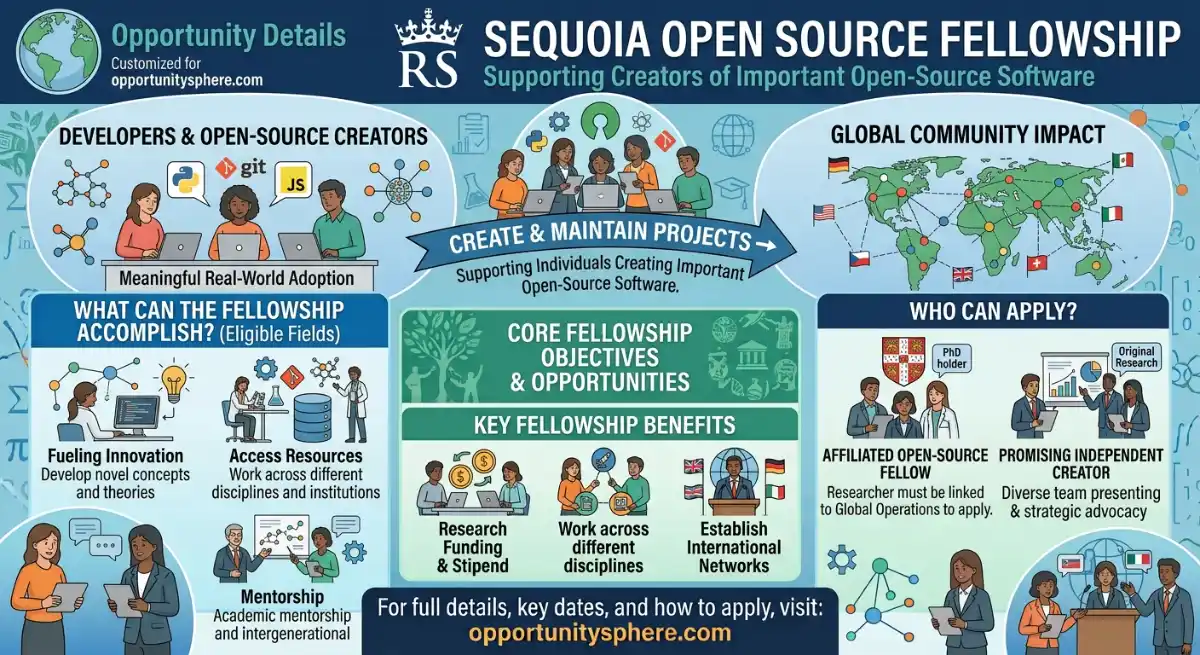
The Sequoia Open Source Fellowship is a funding opportunity established by Sequoia Capital to support developers who build, maintain and improve open-source software. The programme recognizes that essential software infrastructure often depends on individuals and small teams whose contributions benefit developers, businesses, researchers and technology users worldwide, even when those projects do not generate substantial commercial revenue.
Many open-source developers face a difficult challenge: maintaining a useful software project requires sustained time and effort, but community adoption does not automatically translate into a reliable income. Developers may have to balance bug fixes, security updates, documentation, user support and new features with paid employment or other responsibilities. This can slow the development of software that other people and organizations depend on.
The fellowship is designed to help address this challenge by providing financial support so selected developers can dedicate more time to their open-source work. Sequoia is particularly interested in projects with demonstrated real-world adoption and opportunities for meaningful improvement, continued maintenance or expansion.
An important consideration for prospective applicants is that GitHub popularity alone is not the same as real-world impact. A project may have many stars and followers, but its practical usefulness, adoption and contribution to the wider software ecosystem are also relevant. Applicants should therefore be prepared to explain the problem their software solves, who uses it and why further development matters.
The fellowship is not limited to projects intended to become commercial businesses. Applicants do not need to establish a company to participate, and Sequoia states that it does not expect equity in return. Developers retain ownership of their work and can determine their own project roadmaps.
Who Can Apply?
The fellowship is intended for people creating or maintaining open-source software with meaningful real-world adoption or potential for significant development.
Open-source project creators: Developers who have created software that other people use, depend on or contribute to.
Project maintainers: Individuals responsible for keeping an existing open-source project reliable, secure, documented and up to date.
Core contributors: Developers whose technical contributions are important to a project's continued development or expansion.
Developers addressing infrastructure problems: Contributors working on libraries, frameworks, developer tools, software infrastructure or other open-source resources that solve practical problems.
Developers proposing substantial improvements: Applicants with a credible plan to make an existing project more useful, reliable, accessible or capable.
Creators of new projects: Applicants may work on an existing project or begin something new, although Sequoia's stated focus is primarily on projects with real-world adoption.
These descriptions explain the kinds of applicants the programme may suit; they are not a separate official checklist of accepted job titles.
Eligibility Requirements
Applicants should consider the following points before applying:
Open-source involvement: Applicants should be creating, maintaining or developing open-source software, or have a well-defined proposal for significant open-source work.
Evidence of usefulness: The project should demonstrate real-world adoption or have a compelling case for the value of the proposed work.
A meaningful development goal: Applicants should be able to explain what they intend to improve, maintain, expand or build and why the work matters.
Independence from company formation: Applicants do not need to establish a company or legal entity solely to participate in the fellowship.
Location flexibility: The programme is location-independent, allowing fellows to live and work from anywhere.
Project ownership: Sequoia states that fellows retain ownership of the code they create and does not require equity in exchange for sponsorship.
The official programme page does not publish a conventional list of academic qualifications, university degree requirements or a country-by-country eligibility schedule. Applicants should consult the official application for the latest questions and any additional conditions.
Fellowship Benefits and Financial Support
1. Financial Support for Focused Development
The fellowship provides a stipend intended to cover reasonable living expenses for approximately six to twelve months. This support is intended to give selected developers more time to concentrate on their projects instead of relying entirely on unrelated paid work to sustain their contributions.
Sequoia does not publish a standard stipend amount on its main fellowship page. Applicants should therefore avoid assuming that every fellow receives a specific dollar figure.
2. No Equity Requirement
The programme is structured as sponsorship rather than an investment in a company. Sequoia states that it does not take equity in return for the fellowship. This is particularly relevant to developers who want support for their work without entering a conventional startup funding arrangement.
3. Retention of Project Ownership
Fellows retain ownership of their work. Sequoia states that code created before or after the programme remains the fellow's, and that it does not expect to control the fellow's development roadmap.
4. Freedom to Work Remotely
The fellowship is location-independent. Selected developers can work from their existing location without relocating to Silicon Valley or another technology hub.
5. No Requirement to Establish a Startup
Open-source software can be valuable even when its creators have no intention of building a company around it. Applicants can pursue technical improvements, maintenance and community development without being required to turn their projects into businesses.
6. Potential Access to the Wider Technology Ecosystem
Sequoia notes that fellows are welcome to participate in its founder events. This may offer opportunities to connect with people in the broader technology ecosystem, although particular introductions, mentorship arrangements or event invitations should not be assumed to be guaranteed benefits.
What Types of Projects Could Be Relevant?
The official programme emphasizes real-world adoption and significant improvements to open-source projects. The following are illustrative examples of work that could be relevant; they are not a published list of approved project categories.
Developer tools: Software that makes programming, testing, debugging or deployment easier.
Software libraries and frameworks: Reusable components that developers integrate into their applications.
Infrastructure software: Tools that support databases, networking, cloud systems, application delivery or other foundational technology.
Artificial intelligence and machine-learning tools: Open-source software that improves model development, evaluation, deployment or inference.
Security and reliability tools: Software that helps developers identify vulnerabilities, improve resilience or maintain safer systems.
Documentation and accessibility improvements: Significant work that makes an established project easier to use, understand or maintain.
Performance and scalability improvements: Work that helps software handle larger workloads, use resources more efficiently or support additional use cases.
The strongest application is not necessarily the one involving the newest technology. A mature, widely used project with important unresolved maintenance or reliability problems may also have a compelling case for support.
How to Demonstrate Your Project's Impact
Applicants can strengthen their applications by explaining the project's practical value clearly. The following are preparation suggestions rather than confirmed mandatory application fields.
1. Describe the Problem
Explain what problem the software solves, who experiences it and why existing alternatives may not adequately address it.
2. Provide Evidence of Adoption
Where available, include meaningful indicators such as active users, software downloads, package installations, integrations, organizational use, community contributions or documented use cases. Choose metrics that genuinely reflect how people use the project rather than relying on popularity indicators alone.
3. Explain Your Contribution
Clarify your role in creating or maintaining the project. Link to relevant repositories, releases, documentation, pull requests or technical contributions where appropriate.
4. Identify the Work That Needs Funding
Describe the improvements you would prioritize if you had more time to work on the project. These might include resolving technical debt, improving performance, addressing security concerns, expanding documentation, adding requested features or supporting a growing user community.
5. Explain the Expected Outcome
Describe what users and contributors could gain from the proposed work. Where possible, identify measurable outcomes, such as faster processing, improved reliability, better documentation coverage or support for additional use cases.
Application Process
Applications are accepted on a rolling basis, according to Sequoia's published information. There is no fixed deadline stated on the official fellowship page at the time of writing.
Identify the Project: Select the open-source project you want to develop, maintain or expand.
Gather Supporting Evidence: Prepare links to the repository, documentation, releases and examples demonstrating real-world use.
Define Your Proposed Work: Explain the improvements you want to make and why they would benefit the project's users or the wider open-source ecosystem.
Complete the Official Application: Answer the questions provided by Sequoia and submit your information through its official process.
Monitor Your Communications: Check the email address associated with your application for any follow-up from the programme.
These are practical preparation steps, not a representation that Sequoia requires every item listed above as a formal document.
Selection Process
Sequoia's published criteria emphasize open-source creators and projects with real-world adoption, together with the potential to make significant improvements or support further expansion.
Applicants should be prepared to make a clear case for:
The importance of the problem their software addresses.
Evidence that the project is useful in practice, or a persuasive explanation of its potential.
The significance of the proposed development or maintenance work.
The value that additional time and financial support could unlock.
Their role in the project and ability to explain its technical direction.
Sequoia has indicated that it expects to select only a small number of fellows each year. Its published FAQ says it will likely select approximately two to three fellows annually. This makes it important to present a focused, credible proposal rather than a general statement about wanting to contribute more to open source.
The official page does not provide a scoring rubric, guaranteed selection timeline or promise that every eligible applicant will be funded.
Is the Fellowship Open to Applicants Outside the United States?
Yes. The official programme describes the fellowship as location-independent and says fellows can live and work from anywhere. It also states that travel is not required, although fellows are welcome to attend Sequoia founder events.
This makes the fellowship relevant to developers in Africa, Asia, Europe, Latin America and other regions who are building useful open-source software. Applicants outside the United States should still review the current application instructions and confirm any practical payment, tax or administrative requirements that may apply to their circumstances.
Frequently Asked Questions
1. Is There a Fixed Application Deadline?
No fixed closing date is published on the official page. Applications are considered on a rolling basis, so interested developers should check the current application form rather than assume a future deadline.
2. How Much Funding Does the Fellowship Provide?
Sequoia describes the stipend as support intended to cover reasonable living expenses for six to twelve months. A standard monetary amount is not published on the main programme page.
3. Do Applicants Need a University Degree?
The official page does not list a specific degree requirement. Applicants should focus on the current application criteria and their open-source work rather than assume that a particular academic qualification is compulsory.
4. Must I Have a Registered Company?
No. Sequoia explicitly states that applicants do not need to establish a company or legal entity to receive support.
5. Will Sequoia Own My Project or Code?
Sequoia states that fellows retain ownership of their work and that it does not take equity in exchange for the sponsorship.
6. Can I Apply While Living in Nigeria or Another African Country?
The programme is described as location-independent, with fellows able to work from anywhere. Applicants should still check the official application and confirm any relevant payment or administrative arrangements.
7. Can a Newly Created Project Qualify?
Sequoia says applicants may work on existing projects or begin something new, but its stated focus is primarily on existing open-source projects. A new project should therefore be presented with a clear explanation of the problem it addresses and the value of the proposed work.
8. Does the Fellowship Require Relocation or Travel?
No. Sequoia says the programme is location-independent and that travel is not required.
Important Information Before Applying
The fellowship is competitive, and the availability of an application form does not guarantee selection. Sequoia does not publish a standard funding amount on its main programme page, so applicants should not rely on unverified figures circulated by third-party websites.
Before submitting an application, review the official source for the latest eligibility information, application questions and programme terms.
Related Opportunities
Explore other scholarships, fellowships, grants, research opportunities and more that may match your interests.