The application deadline for this opportunity has passed. You can still review the details, but the listing is no longer presented as open for applications.
Fellowship
Royal Society Short Industry Fellowship 2027
Offered by The Royal Society
Location
United Kingdom/International
Funding
Fully Funded
Study level
Postdoctoral, Researchers
Field of study
Engineering, Natural Sciences
Application deadline
October 7, 2026
Application Closed
About This Fellowship
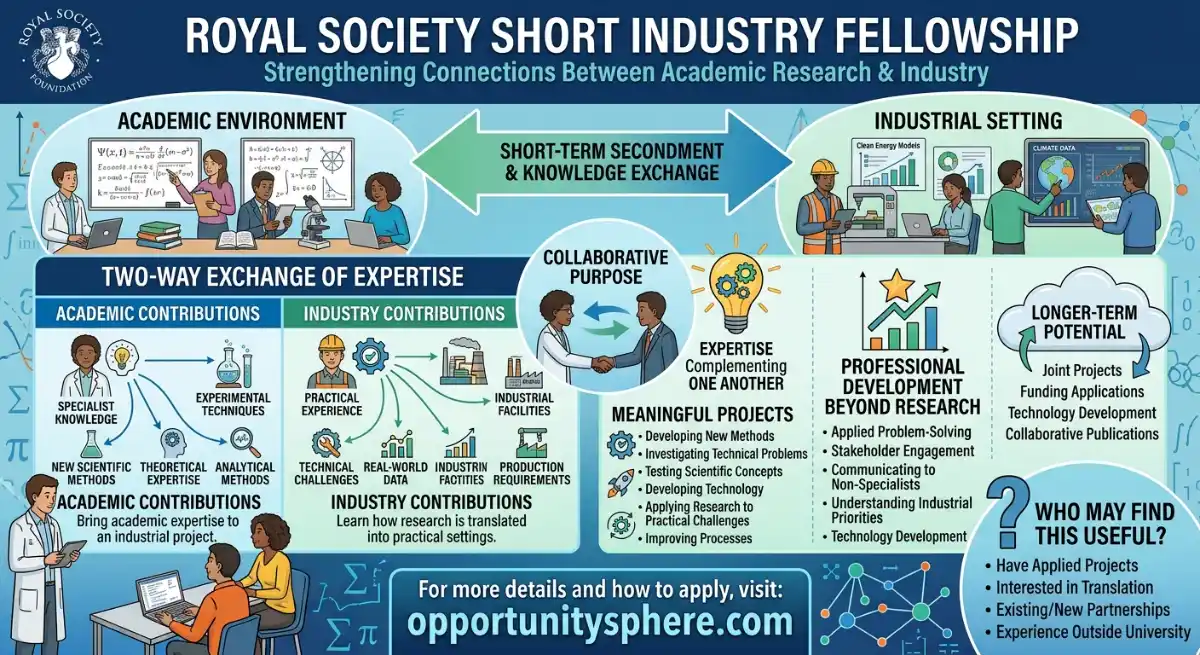
The Royal Society Short Industry Fellowship supports researchers who want to strengthen connections between academic research and industry through a focused period of collaboration.
The fellowship provides an opportunity for researchers to work with an industry partner on a defined research, development or knowledge-exchange project. Rather than requiring researchers to leave their existing academic environment for an extended period, the short fellowship format allows them to gain experience in an industrial setting while concentrating on a specific collaborative objective.
This can be particularly valuable for researchers whose work has potential applications outside the university or laboratory.
Academic research and industrial research can approach scientific and technical problems from different perspectives. Universities may place greater emphasis on generating new knowledge, investigating fundamental questions and publishing research, while industry may focus more directly on practical applications, technological development, production, implementation and solving problems faced by particular sectors.
The Short Industry Fellowship creates an opportunity for these perspectives to meet.
A researcher can bring specialist academic knowledge to an industrial project while learning how research is translated into practical settings. At the same time, the industry partner can contribute knowledge of real-world requirements, technical challenges and potential applications.
The experience can therefore provide benefits that extend beyond the immediate research project.
Why a short industry secondment can matter
Researchers do not always need a long-term placement to gain valuable experience outside their normal academic environment.
A carefully designed short secondment can provide concentrated exposure to the way an industry research team operates while allowing the researcher to remain connected to their existing academic career.
During the secondment, the researcher may work directly with industry scientists, engineers, technical specialists or other professionals.
Advertisement
🔒Application Closed
The listed deadline has passed. Check the official website to see whether the organisation has announced an extension or a new application period.
Stay in the loop
Your Next Opportunity Could Be One Email Away
Receive updates about scholarships, jobs, internships, fellowships and grants so you can discover opportunities worth exploring.
Stay Updated
Never miss an opportunity.
Get updates on scholarships, jobs, internships, grants, fellowships, conferences, and other opportunities delivered straight to your inbox.
How are scientific ideas assessed for practical use?
What technical requirements must a potential solution satisfy?
How does industry approach research timelines?
What happens between an academic discovery and its practical application?
What skills are required to communicate research to non-academic stakeholders?
How can university expertise contribute to industrial innovation?
These experiences can help researchers understand the path from research idea to practical application.
The fellowship is built around collaboration
The Short Industry Fellowship is not simply an opportunity for an academic researcher to observe an industrial workplace.
The proposed fellowship should have a genuine collaborative purpose.
The researcher and industry partner should identify a project in which their expertise can complement one another.
For example, a university researcher may have developed a new scientific method but need an industrial environment in which to explore its practical application.
Alternatively, an industry partner may have a technical problem that requires specialist academic expertise.
The fellowship provides an opportunity to bring these capabilities together through a defined period of research and knowledge exchange.
Designing a meaningful project
The proposed project is one of the most important parts of the fellowship.
Applicants should avoid treating the secondment as simply a general work placement.
Instead, the application should explain exactly what the researcher and industry partner intend to accomplish.
A well-defined project might involve:
Developing a new research method
Investigating an industrial technical problem
Testing a scientific concept
Developing or improving a technology
Applying academic research to a practical challenge
Conducting feasibility research
Exploring a new research application
Improving an existing process
Sharing specialist scientific expertise
Developing knowledge that could support future innovation
The project should be realistic for the available period.
A short fellowship is generally better suited to a focused research objective than to an extremely broad programme of work.
The academic contribution
The academic researcher should bring a clear area of expertise to the collaboration.
This might include specialist scientific knowledge, experimental techniques, modelling approaches, analytical methods, theoretical expertise or experience with a particular research problem.
The applicant should be able to explain how this expertise contributes to the industry partner's needs.
For example, an engineer might bring experience in a specialised modelling technique, while a biotechnology researcher might contribute expertise in laboratory analysis or biological systems.
The exact contribution will depend on the researcher's discipline.
What matters is that the academic expertise has a clear connection with the proposed project.
What the industry partner contributes
The collaboration should also demonstrate what the industry organisation brings to the project.
An industry partner may provide:
Practical knowledge
Access to industrial facilities
Technical expertise
Industry data
Specialist equipment
Knowledge of production environments
Understanding of user or market requirements
Experience with technology development
Access to real-world problems that require research solutions
This complementary relationship is important because the purpose of an academic–industry fellowship is to create value through the combination of different forms of expertise.
Knowledge exchange works in both directions
A successful secondment is not simply about transferring academic knowledge into industry.
Knowledge can move in both directions.
The researcher may introduce new scientific approaches or research techniques, while the industry partner may expose the researcher to practical requirements and challenges that are not always visible in an academic laboratory.
For example, an academic researcher may discover that a method that performs well under laboratory conditions requires significant modification before it can be used in an industrial setting.
Understanding these practical constraints can influence future research.
Similarly, an industry partner may gain access to scientific approaches that could help address an existing technical problem.
This two-way exchange is one of the important features of the fellowship model.
Learning how research is applied
For researchers considering careers that combine academic research with practical innovation, exposure to industry can be particularly valuable.
Industrial research may involve shorter development cycles, defined technical objectives and close interaction with engineers, product developers, managers, customers or other stakeholders.
Researchers can learn how scientific knowledge is adapted to these environments.
This experience may help them understand the stages involved in translating research into practical outcomes, from identifying a problem through experimentation and development to potential implementation.
Who can benefit from this fellowship?
The programme is primarily connected with eligible researchers and organisations based in the United Kingdom, subject to the Royal Society's current scheme conditions.
The opportunity may be particularly relevant to researchers who already have research experience and want to develop a stronger understanding of industry.
It can be useful for researchers who:
Have an applied research project
Are interested in technology development
Want to explore research translation
Have an existing relationship with an industry organisation
Are developing a new academic–industry partnership
Want experience working outside a conventional university environment
Are interested in industrial research and development
Want to develop professional networks beyond academia
Applicants should confirm their precise eligibility using the current Royal Society scheme guidance before applying.
Potential fields of research
The relevance of the fellowship will depend on the specific project and current scheme conditions, but academic–industry collaboration can occur across many scientific and technological areas.
Potential areas may include:
Engineering
Chemistry
Physics
Materials science
Biotechnology
Environmental science and technology
Manufacturing
Energy
Digital technologies
Medical technologies
Applied biological sciences
Advanced scientific research
Applicants should focus on the relationship between their research and the proposed industrial collaboration rather than assuming that every project within a particular discipline will automatically qualify.
Professional development through the secondment
The fellowship can also provide professional development that goes beyond the immediate research objective.
Working in an industrial environment may help researchers develop skills in:
Cross-sector communication
Collaborative project management
Applied problem-solving
Technology development
Research translation
Stakeholder engagement
Understanding industrial priorities
Communicating technical information to non-specialists
Identifying practical applications for research
These skills can complement a researcher's existing academic experience.
The secondment can also help researchers understand how scientific careers operate outside the traditional university pathway.
Developing longer-term relationships
Although the fellowship is short-term, the relationship created through the project does not necessarily have to end when the secondment finishes.
A successful collaboration may provide the basis for further work between the academic and industry organisations.
Future activities could potentially include:
Joint research projects
Larger funding applications
Continued knowledge exchange
Technology development
Further researcher secondments
Collaborative publications
Industrial research programmes
Development of new research partnerships
The short fellowship can therefore function as an initial stage in building a more substantial relationship.
A practical way to test collaboration
For researchers and organisations that have not previously worked closely together, a short fellowship can provide an opportunity to determine whether their research interests and working methods are compatible.
This can be valuable before both organisations commit significant resources to a larger project.
During the secondment, the partners can learn more about each other's expertise, facilities, expectations and research priorities.
They may then identify opportunities for future cooperation that were not obvious before the collaboration began.
What should the project proposal explain?
The project proposal should give reviewers a clear understanding of the proposed collaboration.
Important points to address include:
The research challenge
What scientific, technical or development problem will the project investigate?
The reason for collaboration
Why is an industry–academic partnership particularly appropriate for this problem?
Complementary expertise
What does the academic researcher contribute, and what does the industry partner contribute?
Activities
What will the researcher actually do during the fellowship?
Knowledge exchange
What knowledge or skills will be transferred between the participating organisations?
Expected results
What should be achieved by the end of the secondment?
Future potential
Could the project lead to a longer-term research relationship or additional collaborative work?
Making the secondment realistic
Because the fellowship is short-term, applicants should be careful about the scope of their proposed work.
A project that attempts to solve an entire large-scale industrial problem within a short period may not be realistic.
Instead, applicants could identify a clearly defined research component that can be investigated during the fellowship.
For example, the secondment might focus on testing a particular method, evaluating a technical approach, developing a prototype concept, analysing a defined dataset or investigating the feasibility of a particular application.
A focused objective makes it easier to explain what success will look like at the end of the fellowship.
Potential outcomes
The expected outcomes will vary depending on the discipline and project.
Possible outcomes could include:
New research findings
A tested research method
Preliminary technical results
A proof-of-concept
A new research direction
Improved understanding of an industrial problem
A joint publication
A future funding proposal
A strengthened academic–industry partnership
Development of a longer-term collaborative programme
Applicants should select outcomes that are appropriate to their particular project rather than listing every possible benefit.
Preparing the application
Applicants should begin by identifying the research problem they want to investigate and the industry expertise required to address it.
The next step is to identify an appropriate partner organisation.
The applicant and potential partner should then discuss:
The purpose of the collaboration
The research question
The planned secondment
Responsibilities
Facilities and resources
Expected outcomes
Knowledge exchange
Possible future collaboration
Once the project has been agreed, the applicant can prepare the formal application and supporting documentation.
Documents applicants may need
Applicants should check the current Royal Society guidance for the exact requirements.
The application may require information such as:
Research project proposal
Academic or professional CV
Details of the industry host
Information about the participating organisations
Description of the collaborative activities
Project timetable
Institutional supporting documentation
Other materials requested by the scheme
Applicants should not rely on requirements from previous fellowship rounds because application conditions can change.
The role of the host organisation
The host or industry partner should be able to provide an environment in which the proposed activities can realistically take place.
Applicants should therefore consider whether the organisation has the facilities, expertise and personnel required for the project.
The host should also understand the researcher's objectives and the expected contribution of the secondment.
A well-prepared partnership can make the proposed project much clearer than an arrangement in which the host organisation is selected only because it is available.
From academic discovery to practical use
One of the broader purposes of academic–industry collaboration is to explore how research can move beyond academic publication.
A discovery may have scientific importance but still require additional development before it becomes useful in practice.
Industry collaboration can introduce researchers to issues such as:
Scalability
Reliability
Cost
Technical requirements
Manufacturing considerations
User requirements
Implementation
Regulatory considerations
Commercial constraints
Not every fellowship project will address all of these issues, but exposure to the industrial environment can help researchers understand the practical stages that may follow academic research.
Why researchers may pursue the opportunity
For an academic researcher, the fellowship can provide a chance to step outside the familiar structure of university research and experience another type of scientific working environment.
For an industry partner, the collaboration can provide access to specialist academic expertise and create a connection with a research institution.
For both sides, the short format can make it possible to explore collaboration without immediately committing to a large, long-term programme.
This combination of focused research, professional development and relationship building is central to the opportunity.
Duration
The fellowship is a short-term research secondment or collaboration.
The precise duration and arrangements depend on the approved project and the requirements of the relevant Royal Society funding round.
Applicants should check the current scheme information for the permitted fellowship period and any restrictions concerning the proposed secondment.
Application process
Applicants should:
Confirm that they and their organisations meet the current eligibility requirements.
Identify an appropriate academic or industry partner.
Develop a clearly defined collaborative research project.
Agree on the responsibilities of each participating organisation.
Establish the proposed secondment activities and expected outcomes.
Prepare the research proposal and supporting documents.
Obtain any required institutional approvals.
Submit the application through the Royal Society's designated application system.
Applicants should begin discussions with potential partners early enough to allow time for institutional coordination and preparation of the proposal.
Before you apply
A prospective applicant should be able to answer five basic questions:
What problem am I trying to address?
The project should have a clearly defined scientific or technical purpose.
Why does it require an industry partnership?
The application should explain what the industrial environment adds to the research.
What will I contribute?
The researcher should identify the expertise they bring to the collaboration.
What will I learn or gain?
The secondment should provide meaningful research or professional development.
What could happen afterwards?
The applicant should consider whether the collaboration could lead to further research or a longer-term partnership.
Potential value beyond the fellowship
The significance of a short industry fellowship may ultimately lie in what it enables the researcher to do afterwards.
The experience can help researchers develop a better understanding of how academic knowledge is applied, establish relationships with industrial scientists and identify new research questions.
For some participants, the fellowship may become the starting point for a longer-term academic–industry research programme.
For others, the main outcome may be professional experience and a clearer understanding of how their research can contribute to practical challenges.
The exact outcome will depend on the project, but the fellowship is structured to encourage interaction between research and industry rather than keeping the two environments separate.
Related Opportunities
Explore other scholarships, fellowships, grants, research opportunities and more that may match your interests.