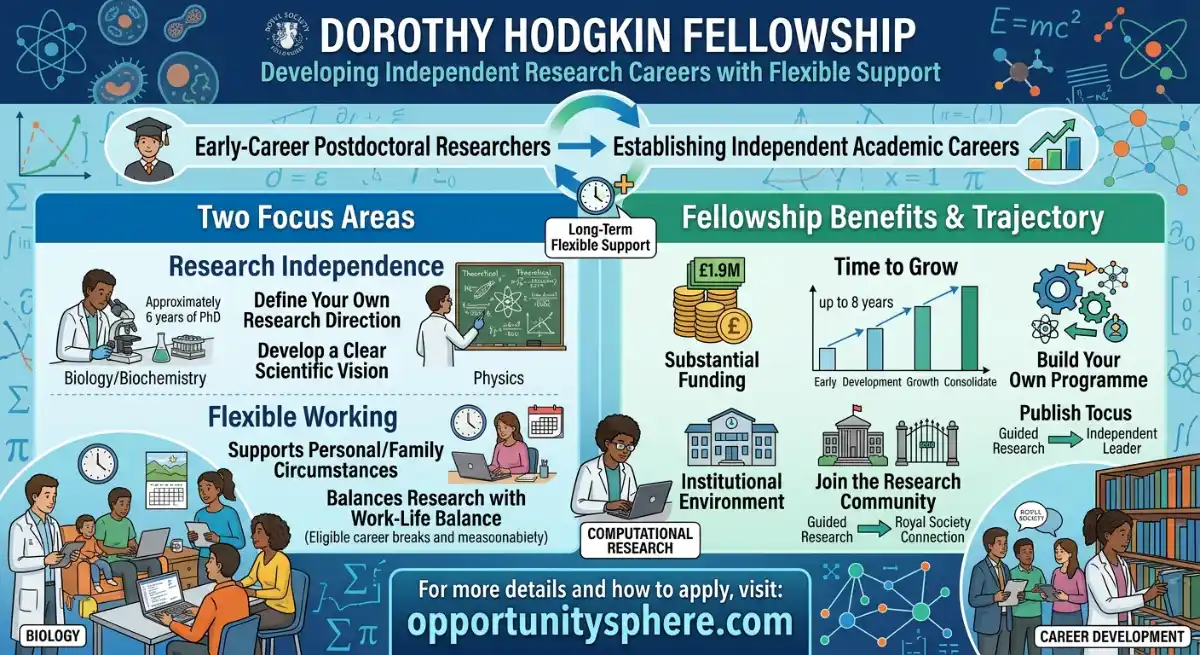
The Dorothy Hodgkin Fellowship supports outstanding early-career researchers who are developing the experience and research independence needed to establish their own academic careers.
The fellowship is particularly distinctive because it combines substantial long-term research support with a flexible working structure. This makes it relevant to researchers who have a strong vision for an independent research programme but whose personal or professional circumstances may require greater flexibility than is normally available through a conventional full-time research position.
Rather than simply funding a short research project, the fellowship is intended to provide researchers with the time, resources and institutional environment needed to develop into independent research leaders.
Successful fellows are able to establish and pursue their own research programmes while becoming part of the wider Royal Society research community.
The long duration of the fellowship is especially significant. With support extending for up to eight years, researchers have an opportunity to develop a substantial body of work, build research expertise, establish collaborations, supervise or work with other researchers where appropriate, and develop a stronger foundation for a long-term academic career.
A fellowship built around research independence
A major feature of the Dorothy Hodgkin Fellowship is the emphasis on independent research development.
At an early stage of a research career, researchers may still be working within projects led by senior academics or within established research groups. Although this experience is important, developing an independent research identity requires the opportunity to define one's own questions and establish a research direction.
The fellowship is designed to support that transition.
A successful applicant should therefore be able to demonstrate more than an interest in continuing their previous research. They should have a clear idea of the research programme they want to develop and how the fellowship would allow them to establish themselves as an independent researcher.
This means the research proposal should communicate a coherent scientific vision rather than simply presenting a collection of unrelated research activities.
Who is the fellowship intended for?
The programme is aimed at early-career postdoctoral researchers who are at an important stage in establishing an independent research career.
Applicants are normally expected to be within approximately six years of obtaining their PhD, taking eligible career breaks into account.
The fellowship is not intended for researchers who already hold a permanent position.
Applicants must also satisfy the Royal Society's specific requirements concerning their research, career stage, host institution and need for the flexible working arrangements supported by the scheme.
Because eligibility can depend on individual circumstances, applicants should carefully examine the current Royal Society call before applying.
Understanding the career-stage requirement
The career-stage requirement is an important part of the fellowship.
Applicants should consider not only the date on which they obtained their doctorate but also any circumstances that may qualify as an eligible career break.
Career interruptions can occur for a variety of reasons, and the scheme takes eligible career breaks into account when determining the relevant postdoctoral period.
Researchers should therefore review the current eligibility guidance carefully rather than assuming that a simple calculation from the date of their PhD determines eligibility in every case.
Why flexibility matters
One of the features that distinguishes the Dorothy Hodgkin Fellowship is its emphasis on flexibility.
Academic research careers can involve demanding workloads, and some researchers may need working arrangements that allow them to balance research with significant personal or family circumstances.
The fellowship recognises that researchers may need a more adaptable structure while developing an independent research career.
Flexible working does not mean that the research programme lacks ambition.
Instead, the fellowship provides a framework within which researchers can pursue substantial scientific work while accommodating eligible circumstances that affect how they work.
This makes the structure particularly relevant to applicants who may not be able to follow a conventional, continuously full-time research pathway.
Building your own research programme
The fellowship gives researchers an opportunity to define a research direction that they can develop over a substantial period.
Applicants should therefore think carefully about the scientific identity they want to establish.
A strong research programme should have:
A clear central research question
A convincing scientific rationale
Defined objectives
A logical progression of research activities
Appropriate methodology
Potential for meaningful research outcomes
A clear connection with the applicant's previous experience
Scope for development during the fellowship period
The programme should also demonstrate why the applicant is well placed to lead the proposed research.
The aim is to show the development of an independent researcher, not simply the continuation of a supervisor's existing programme.
What independence can look like
Research independence can take different forms depending on the discipline.
For one researcher, it may mean developing a new experimental system.
For another, it may involve creating a new theoretical framework, developing a novel computational approach or investigating a research question that has emerged from previous work.
Applicants should explain what is distinctive about their proposed direction and how it develops their own scientific profile.
The fellowship can provide an opportunity to move from being primarily a contributor to existing research programmes towards becoming the person defining and directing a research agenda.
The scale of the support
The Dorothy Hodgkin Fellowship can provide up to approximately £1.9 million in funding, depending on the applicable fellowship conditions and approved requirements.
This is substantial long-term support intended to facilitate the development of an independent research career.
The exact funding available and the eligible expenditure should be confirmed against the current Royal Society call.
Depending on the approved project and scheme rules, fellowship support can contribute to the resources required to conduct the proposed research and develop the fellow's research programme.
Up to eight years of research development
The fellowship can last for up to eight years, providing a much longer period of support than many conventional early-career fellowships.
This extended timeframe can allow a researcher to think beyond a single short project.
A researcher may be able to develop a programme in stages:
Early stage: Establish the research programme, refine methods and begin the initial studies.
Development stage: Expand the research programme, analyse findings and develop collaborations.
Growth stage: Build a stronger body of research, pursue new questions and establish a more distinctive research profile.
Long-term stage: Consolidate the research programme and position the researcher for the next stage of their academic career.
The exact trajectory will differ between disciplines and individual projects.
Research proposal
The research proposal is central to the application.
Applicants should explain not only what they want to investigate but why the research is important and how the programme could develop over time.
A useful proposal should establish:
The scientific problem or question.
The background to the research.
What remains unresolved.
The proposed research approach.
The objectives of the programme.
The anticipated contribution.
How the research will develop during the fellowship.
Why the applicant is well positioned to lead the work.
The proposal should demonstrate ambition while remaining scientifically credible and achievable.
From previous research to an independent future
Applicants should be able to demonstrate a logical connection between their previous research experience and the proposed independent programme.
This does not mean that the new research must be identical to the applicant's previous work.
In fact, developing a new direction can be an important part of establishing independence.
The application should nevertheless make clear how the applicant's existing expertise has prepared them to undertake the proposed research.
For example, previous work may have provided a particular technical skill, methodological expertise, dataset, theoretical foundation or specialist knowledge that forms the basis of the new programme.
The host institution
The host institution forms an important part of the research environment.
Applicants should identify an eligible UK host organisation that can provide an appropriate environment for the proposed research.
The host should have the facilities, expertise and institutional support necessary for the project.
Applicants should consider questions such as:
Does the institution provide the facilities needed for the research?
Are there relevant research groups or collaborators?
Can the proposed project be realistically conducted there?
Is there an environment in which the applicant can develop independently?
What institutional support will be available?
The host should complement the applicant's research ambitions rather than simply provide an administrative base.
Career development
The fellowship is not only about producing research results.
It is also intended to help researchers establish themselves as independent academics.
Over the fellowship period, a researcher can develop experience in areas such as:
Independent research planning
Research leadership
Collaboration
Grant development
Academic networking
Publication strategy
Research communication
Mentoring and supervision where appropriate
Building a sustainable research programme
These elements can contribute to the transition from early-career researcher to established independent scientist.
Joining the Royal Society research community
Successful fellows become part of the wider Royal Society research community.
This provides an opportunity to interact with other researchers supported by the Society and to develop professional relationships beyond the fellow's immediate institution.
Academic communities can be valuable sources of collaboration, advice and intellectual exchange.
For an early-career researcher, developing these networks can also help establish a broader professional identity within their field.
Mentoring and professional development
The fellowship can support researchers as they develop their careers, not merely as they conduct a particular scientific project.
Mentoring and interaction with experienced researchers can provide opportunities to discuss research strategy, career development and the challenges associated with establishing an independent programme.
This can be especially valuable for researchers who are moving from postdoctoral research towards research leadership.
A flexible route into research independence
The combination of long-term funding and flexible working makes the fellowship particularly distinctive.
Researchers may have excellent scientific potential but require a working arrangement that takes account of circumstances outside the laboratory.
The fellowship provides a framework in which flexibility can coexist with ambitious research development.
This is important because career progression does not always occur through a completely uninterrupted sequence of full-time research appointments.
A flexible fellowship can allow researchers to continue developing their scientific identity while working within the circumstances relevant to their lives and careers.
What applicants should think about before applying
Before beginning the application, researchers should consider whether they are genuinely ready to define an independent research programme.
Some useful questions include:
What research area do I want to become known for?
The fellowship can cover many years, so applicants should think beyond the immediate experiment or publication.
What makes my research programme independent?
The proposal should distinguish the applicant's scientific direction from that of previous supervisors or collaborators.
Why is this the right stage of my career?
Applicants should be able to explain how the fellowship would help them make the transition to greater research independence.
Why is flexibility important to my proposed working arrangement?
Applicants should ensure that they understand the scheme's flexibility requirements and can explain their circumstances appropriately within the application.
Why is my host institution suitable?
The research environment should support the applicant's scientific ambitions and provide the necessary facilities and expertise.
Preparing the supporting materials
Applicants should prepare their application well in advance because a fellowship of this scale requires more than a short research statement.
The application may require:
Detailed research proposal
Academic CV
Career information
Host institution information
References
Supporting documentation
Information relating to the applicant's research experience
Other materials specified by the Royal Society
Applicants should follow the current application guidance carefully and ensure that all documents tell a consistent story about their research trajectory.
The importance of the career narrative
For an early-career fellowship, the applicant's career story is important.
Reviewers need to understand how the applicant arrived at the proposed research programme and why the fellowship is an appropriate next step.
The application should therefore connect:
Past: What has the researcher accomplished so far?
Present: What research questions and expertise define their current work?
Future: What independent research programme will they establish through the fellowship?
A clear connection between these three stages can help demonstrate that the fellowship is part of a coherent research-career trajectory.
Peer review and assessment
Applications submitted through the Royal Society's Flexi-Grant system undergo eligibility checks and assessment processes that can include peer review and panel consideration.
Applicants should therefore prepare their proposal for readers who may not be specialists in every aspect of their research.
Technical detail is necessary, but the broader scientific importance of the programme should also be understandable.
The proposal should make clear what the research could contribute and why the applicant is well placed to carry it out.
A long-term opportunity rather than a short project
One of the most important things to consider about the Dorothy Hodgkin Fellowship is its timescale.
Eight years provides room for a research programme to evolve.
Scientific research rarely follows a completely predictable path. Initial experiments can generate unexpected findings, methods can change and new questions can emerge.
A long-term fellowship can provide greater room for researchers to respond to these developments while maintaining a coherent overall research direction.
Applicants should therefore think of their proposal as a research programme with room to grow, rather than simply a single isolated experiment.
Potential benefits for the research career
The fellowship can provide a foundation for researchers to develop:
An independent scientific identity
A substantial research programme
A stronger publication record
Research collaborations
Professional networks
Leadership experience
Grant-development experience
Mentoring and career-development opportunities
Long-term connections within the Royal Society community
The precise opportunities available will depend on the fellow's research area, host institution and individual career development.
Application timeline
Researchers interested in the fellowship should begin preparing early.
A substantial application may require discussions with a prospective host institution, development of a detailed research proposal, preparation of a CV and career statement, coordination of references and completion of institutional requirements.
Starting early also gives applicants time to refine the research programme rather than preparing the proposal immediately before the deadline.
Application process
Applications are submitted through the Royal Society Flexi-Grant system.
The process generally involves:
Reviewing the current eligibility requirements.
Developing an independent research programme.
Identifying an appropriate host institution.
Preparing the research proposal and career information.
Arranging references and supporting documentation.
Completing the online Flexi-Grant application.
Passing the eligibility assessment.
Undergoing peer review and panel assessment.
Applicants should consult the current Royal Society call for the exact timetable and application requirements.
Who may find this fellowship particularly relevant?
The opportunity may be particularly relevant to early-career researchers who have already developed significant postdoctoral experience and are ready to take greater ownership of their research direction.
It may also be relevant to researchers whose career development has been affected by circumstances requiring a flexible working arrangement and who want to continue building an ambitious independent research programme.
The fellowship is intended for researchers who can articulate both a strong scientific vision and a realistic pathway towards developing that vision over the long term.
A final point for prospective applicants
The scale of the Dorothy Hodgkin Fellowship means that applicants should approach it as a major career-development opportunity rather than simply another source of project funding.
The strongest applications should bring together three connected elements:
Scientific ambition — a research programme addressing meaningful questions.
Research independence — a clear demonstration that the applicant is developing their own scientific direction.
Career development — a credible explanation of how the fellowship will help establish a sustainable independent research career.
Applicants should verify all current eligibility conditions, funding details, deadlines and documentation requirements directly with the Royal Society before submitting.
Related Opportunities
Explore other scholarships, fellowships, grants, research opportunities and more that may match your interests.