The application deadline for this opportunity has passed. You can still review the details, but the listing is no longer presented as open for applications.
Fellowship, PhD & Research
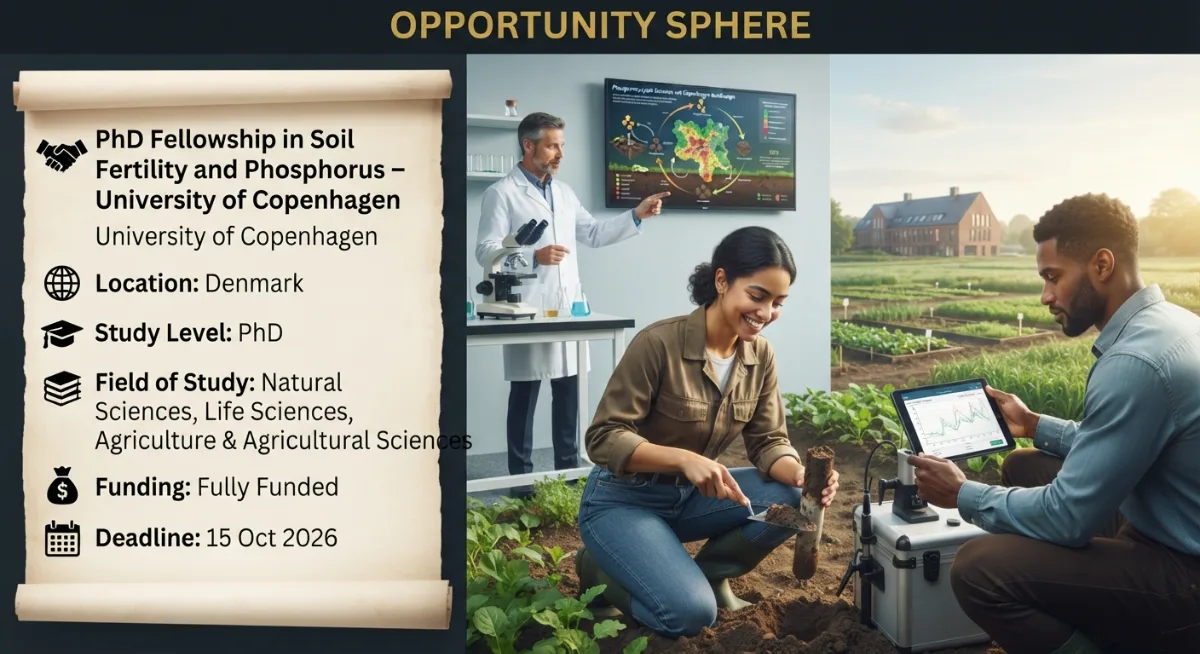
PhD Fellowship in Soil Fertility and Phosphorus – University of Copenhagen
Offered by University of Copenhagen
Location
Denmark
Funding
Fully Funded
Study level
PhD
Field of study
Natural Sciences, Life Sciences, Agriculture & Agricultural Sciences
Application deadline
October 15, 2026
Application Closed
About This Fellowship
The University of Copenhagen is inviting applications for a PhD fellowship in Soil Fertility and Phosphorus within the Department of Plant and Environmental Sciences, Faculty of Science. The position is part of the research project “Can microbial phosphorus mobilization be primed? Organic fertiliser effect on biological soil phosphorus cycling (PRIME-P)”, which is financed by the Novo Nordisk Foundation.
The PhD project investigates how different bio-based fertilisers (BBFs) influence soil organic matter and the microbial processes responsible for phosphorus mobilisation. Bio-based fertilisers can include materials such as sewage sludge, compost and animal manures. Unlike conventional mineral phosphate fertilisers, many of these materials contain substantial amounts of organic phosphorus and calcium phosphate forms that are not immediately available to plants.
Soil microorganisms play an important role in transforming these phosphorus compounds into forms that can become available to plants. The project therefore examines how organic matter supplied through bio-based fertilisers affects microbial activity and phosphorus cycling in soil.
The research is particularly relevant to sustainable agriculture, nutrient recycling, soil health, plant nutrition and resource-use efficiency. Improving understanding of phosphorus cycling can contribute to more effective use of nutrient-rich organic materials while reducing nutrient losses and supporting productive agricultural systems.
Research Objectives
The PhD project will investigate how different forms of organic matter affect microbial phosphorus mobilisation and phosphorus cycling in soil.
The main research questions are:
How do different forms of organic matter affect microbial phosphorus mobilisation?
Do different organic matter fractions result in different levels of phosphorus mineralisation?
How do soil properties influence microbially mediated phosphorus cycling?
Advertisement
🔒Application Closed
The listed deadline has passed. Check the official website to see whether the organisation has announced an extension or a new application period.
Stay in the loop
Your Next Opportunity Could Be One Email Away
Receive updates about scholarships, jobs, internships, fellowships and grants so you can discover opportunities worth exploring.
Stay Updated
Never miss an opportunity.
Get updates on scholarships, jobs, internships, grants, fellowships, conferences, and other opportunities delivered straight to your inbox.
To answer these questions, the researcher will investigate changes in soil phosphorus availability and soil organic matter following recent and historical applications of bio-based fertilisers.
The project may involve laboratory incubation experiments, soil characterisation, organic matter fractionation, measurements of enzymatic activity and isotopic techniques using 33P and 18O-enriched water. Advanced imaging methods will also be used to investigate processes occurring at the microscale. Depending on the development of the project, the researcher may also contribute to implementation of a soil–plant model.
Research Environment
The successful candidate will be based in the Soil Fertility and Nutrient Recycling Group within the Plant and Soil section of the Department of Plant and Environmental Sciences.
The group studies soil fertility challenges associated with sustainable agriculture, with particular attention to nutrient recycling from organic waste materials originating from rural, urban and industrial sources.
Researchers work on understanding how different nutrient-recycling strategies affect soil nutrient dynamics, organic matter and soil ecosystem resilience. The broader objective is to support improved nutrient recycling, nutrient-use efficiency, crop productivity and soil health.
The research environment includes modern laboratories, climate chambers and access to long-term field trials, as well as scientific equipment and analytical methods relevant to soil biogeochemistry.
The PhD project involves collaboration between the University of Copenhagen, Aarhus University, Technische Universität Berlin, ETH Zürich and the University of Guelph. Research visits to Technische Universität Berlin are also part of the research environment.
Eligibility Criteria
Applicants should meet the requirements for admission to the University of Copenhagen's regular PhD programme and have an educational background equivalent to a relevant Danish Master's degree.
Applicants should have:
A Master's degree or equivalent qualification relevant to the PhD project. For the regular 5+3 PhD scheme, the qualification should correspond to a Danish Master's degree, normally equivalent to 180 ECTS bachelor's-level study plus 120 ECTS master's-level study.
An academic background in soil science, soil biogeochemistry, plant nutrition or a closely related discipline.
Knowledge or demonstrated interest in soil biogeochemical processes, particularly phosphorus and soil organic matter dynamics.
Relevant experimental experience, preferably including laboratory work such as soil sampling, soil analysis, organic matter fractionation or related techniques.
The ability to translate scientific questions into practical experimental designs and measurements.
The ability to analyse and interpret complex research data.
The ability to work independently, take initiative and solve research problems.
Strong spoken and written English, including academic writing skills. The University expects English proficiency at approximately C1 level.
Motivation to contribute to research on sustainable and resource-efficient crop systems.
Relevant publications, research experience, professional activities and other evidence of research potential may strengthen an application.
Applicants do not necessarily need to possess every listed technical skill. The University specifically encourages interested candidates to apply where they have relevant potential and willingness to develop additional research skills.
PhD Programme and Employment
The fellowship is a full-time PhD employment position for a maximum of three years under the University's regular 5+3 PhD programme.
Employment is conditional on successful enrolment in the PhD School at the Faculty of Science. The candidate must submit an application for the specific PhD project and receive acceptance into the programme.
During the PhD, the researcher will:
Carry out an independent research project under supervision.
Complete approximately 30 ECTS of PhD courses.
Participate actively in research environments, including research activities at other institutions.
Undertake teaching and knowledge-dissemination activities.
Prepare scientific papers for publication.
Write and defend a PhD thesis based on the research project.
Benefits and Research Opportunities
The successful candidate receives a funded, full-time PhD research position at the University of Copenhagen rather than simply applying for admission to an unfunded doctoral programme.
The position provides an opportunity to:
Conduct original research in soil fertility and phosphorus cycling.
Develop specialist knowledge in soil biogeochemistry and plant nutrition.
Gain practical experience with soil sampling, laboratory analysis and experimental research.
Develop experience with advanced approaches such as isotopic techniques and imaging methods.
Work with researchers from several European and international institutions.
Participate in an international research environment within the University of Copenhagen.
Develop skills in experimental design, data analysis and scientific interpretation.
Produce scientific publications and contribute to a doctoral thesis.
Gain teaching and scientific communication experience.
Build expertise relevant to sustainable agriculture, nutrient recycling and soil health.
Develop transferable skills in research planning, problem-solving, scientific writing and project management.
Establish professional connections with researchers working across soil science, plant science and environmental research.
The completed PhD can provide a foundation for subsequent research and academic careers in universities, research institutes, government agencies, agricultural organisations, environmental institutions and related sectors.
Research Areas
The fellowship may be particularly relevant to applicants interested in:
Soil fertility
Soil biogeochemistry
Phosphorus cycling
Phosphorus mobilisation
Plant nutrition
Soil organic matter
Bio-based fertilisers
Organic fertilisation
Nutrient recycling
Soil health
Sustainable agriculture
Crop production
Environmental soil science
Microbial processes in soil
Nutrient-use efficiency
Application Documents
Applications must be submitted in English through the University's electronic recruitment system.
The official vacancy requires applicants to provide:
Cover letter or motivated letter of application of maximum one page.
Curriculum vitae, including education, experience, language skills and other relevant competencies.
Short reflection on research interests and experience, explaining how the aims of the PhD project could be approached. This should be no more than one page.
Original Bachelor of Science or Master of Science diplomas and transcripts of records in the original language. Documents issued in a language other than English or Danish should include an authorised English translation.
If the degree has not yet been completed, a certified or signed recent transcript of records or an appropriate statement from the institution or supervisor may be accepted.
Publication list, where applicable.
Contact information for two referees, who may be contacted upon request.
How to Prepare the Application
Applicants should demonstrate a clear connection between their previous academic or research experience and the advertised PhD project.
Candidates with experience in soil science, agronomy, plant nutrition, agricultural research, soil management, environmental science, nutrient management or related areas should explain the specific methods, research questions or technical skills they have developed.
The one-page research reflection is particularly important because the University asks applicants to explain their research interests, experience and how the project aims could be approached. Rather than repeating information from the vacancy, applicants can use this section to demonstrate their understanding of the research problem and their ability to think scientifically about the proposed work.
Research Collaboration
The project is conducted through collaboration among several international research institutions:
University of Copenhagen, Denmark
Aarhus University, Denmark
Technische Universität Berlin, Germany
ETH Zürich, Switzerland
University of Guelph, Canada
The successful candidate will be based at the University of Copenhagen and will participate in an international research environment. The project also includes a research stay at Technische Universität Berlin.
Supervision
The principal supervisor is Associate Professor Dorette Müller Stöver of the Department of Plant and Environmental Sciences. Assistant Professor Nelly S. Raymond is the University of Copenhagen project supervisor and a co-supervisor.
Additional project advisors include researchers from Aarhus University, Technische Universität Berlin, ETH Zürich and the University of Guelph.
Selection Process
After the application deadline, a number of candidates will be selected for academic assessment by an independent expert assessor.
The assessment considers applicants' qualifications and experience in relation to the research area, methods, technical skills and other requirements of the position.
Applicants who undergo assessment are given an opportunity to comment on their assessment. Selected candidates may then be invited for interview.
Interviews are expected to take place during weeks 44–45 of 2026.
Important Information for International Applicants
The position is open to international applicants who satisfy the academic and other requirements.
Applicants with qualifications obtained outside Denmark should ensure that their degrees meet the University's requirements for admission to the relevant PhD programme. The University provides information for assessing qualifications from different countries.
International applicants should also ensure that all diplomas, transcripts and translations required by the vacancy are prepared correctly before submission.
Deadline
The application deadline is 15 October 2026 at 23:59 GMT+2.
The expected employment start date is 1 January 2027, or as soon as possible thereafter.
Late applications may not be considered, and applications that do not meet the stated requirements may be excluded from consideration.
Related Opportunities
Explore other scholarships, fellowships, grants, research opportunities and more that may match your interests.