The application deadline for this opportunity has passed. You can still review the details, but the listing is no longer presented as open for applications.
Fellowship
Royal Society Industry Fellowship 2027 Round 1
Offered by The Royal Society
Location
United Kingdom
Funding
Fully Funded
Study level
Postdoctoral, Researchers
Field of study
Life Sciences, Health & Medical Sciences, Natural Sciences, Engineering
Application deadline
September 16, 2026
Application Closed
About This Fellowship
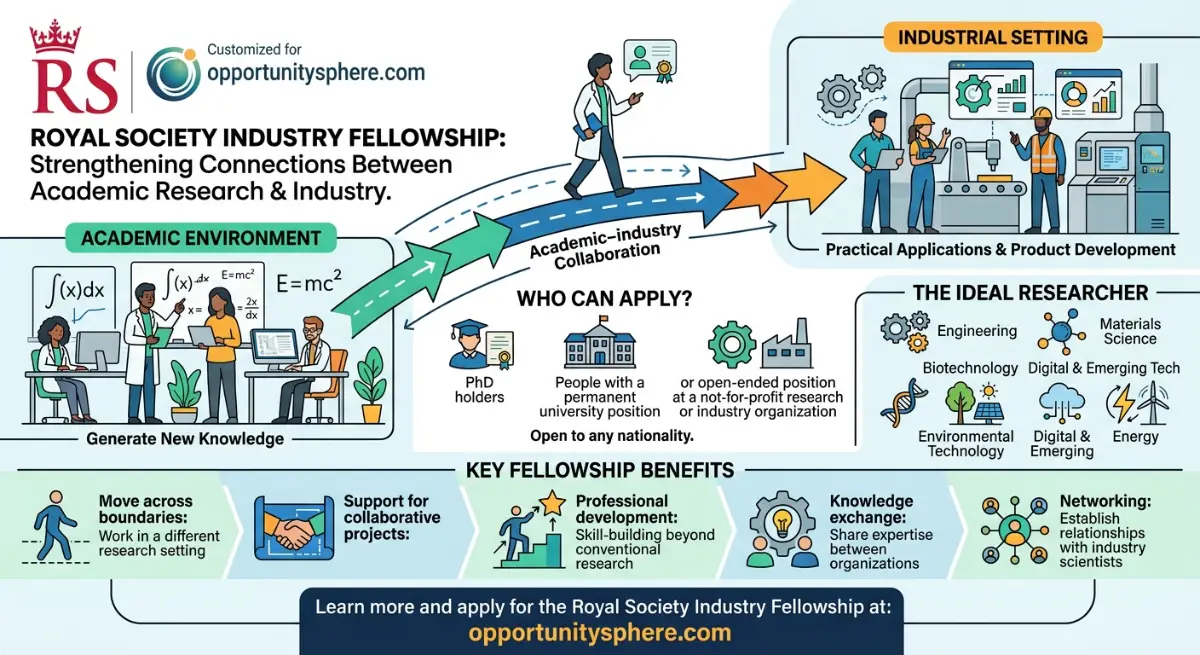
The Royal Society Industry Fellowship is designed for researchers who want to build stronger connections between academic research and industry.
The programme provides an opportunity for researchers to work across academic and industrial environments, allowing them to gain experience of a different type of research setting while developing a collaborative project with a partner organisation.
Academic research and industrial research often operate under different priorities, timelines and working methods. Universities and research institutions may focus heavily on generating new knowledge, while industry may place greater emphasis on product development, commercial applications, technical implementation and solving practical problems.
The Industry Fellowship provides a structured environment in which researchers can work across these boundaries.
For scientists and engineers, this can be particularly useful when their research has potential applications beyond the university or research laboratory. The fellowship can provide an opportunity to understand how academic discoveries can be developed, adapted and translated into practical applications while also allowing industry partners to benefit from academic expertise.
The programme is therefore not simply a conventional research fellowship. Its central feature is collaboration between academia and industry.
Academic–industry collaboration at the centre of the fellowship
The fellowship is built around movement between academic and industrial environments.
A researcher may have extensive experience working within a university but limited exposure to industrial research and development. Conversely, a researcher working in industry may benefit from spending time within an academic research environment.
The fellowship creates an opportunity to bridge these environments through a defined collaborative project.
This can help participants develop a better understanding of how research questions are identified, investigated and applied in different organisational settings.
Advertisement
🔒Application Closed
The listed deadline has passed. Check the official website to see whether the organisation has announced an extension or a new application period.
Stay in the loop
Your Next Opportunity Could Be One Email Away
Receive updates about scholarships, jobs, internships, fellowships and grants so you can discover opportunities worth exploring.
Stay Updated
Never miss an opportunity.
Get updates on scholarships, jobs, internships, grants, fellowships, conferences, and other opportunities delivered straight to your inbox.
The experience can also help researchers build professional relationships that continue beyond the fellowship itself.
Who can apply?
Applicants generally need to hold a PhD or equivalent professional standing appropriate to their field.
They are also generally expected to hold a permanent or open-ended position at an eligible:
UK university
Not-for-profit research organisation
Industry organisation
The programme is open to applicants of any nationality, provided they meet the relevant institutional, employment and other eligibility requirements.
Because eligibility can depend on the applicant's position and the organisations involved in the proposed collaboration, prospective applicants should carefully check the current Royal Society requirements before preparing an application.
The type of researcher this opportunity can suit
The Industry Fellowship may be particularly relevant to researchers whose work has a clear connection with real-world applications.
This can include scientists and engineers working in areas such as:
Engineering
Materials science
Biotechnology
Chemistry
Physics
Environmental technology
Digital and emerging technologies
Manufacturing
Medical and applied technologies
Energy
Advanced research and development
The relevance of a particular research area will depend on the current scheme requirements and the proposed collaboration.
Applicants should therefore focus less on simply identifying their discipline and more on explaining how collaboration with an industrial or academic partner could advance their research.
Why an industry placement can be valuable
Moving between academic and industrial environments can expose researchers to different approaches to problem-solving.
An academic researcher may gain experience with:
Industrial research priorities
Product or technology development
Commercial research environments
Applied problem-solving
Industry-specific technical challenges
Research translation
Professional networks
At the same time, an industrial partner may gain access to academic expertise, research approaches and knowledge that can contribute to the development of new ideas or technologies.
This two-way exchange is an important part of the fellowship's purpose.
Developing the collaborative project
Applicants need to identify a suitable partner and develop a project that provides a meaningful reason for collaboration.
The project should go beyond simply placing a researcher in another organisation.
There should be a clear intellectual or technical purpose behind the collaboration.
A useful project should explain:
What research or development problem is being addressed.
Why the problem is important.
What expertise each participating organisation contributes.
Why collaboration is necessary or particularly useful.
What the researcher will do during the fellowship.
What knowledge or skills will be exchanged.
What outcomes are expected.
How the collaboration could develop after the fellowship.
From research to practical application
One of the potentially important aspects of an academic–industry fellowship is the opportunity to explore how research can move beyond the laboratory or academic publication.
A scientific discovery may have potential applications but require additional development before it can be used in a practical setting.
Industry collaboration can help researchers understand issues such as scalability, technical requirements, implementation, user needs and development timelines.
For researchers working in applied science and engineering, this experience can therefore complement their existing academic expertise.
Benefits of the fellowship
The Royal Society Industry Fellowship can provide several forms of professional and research development.
1. Academic–industry secondment
The fellowship enables researchers to work across academic and industrial environments through an approved collaborative arrangement.
2. Research support
Participants receive support associated with the approved fellowship arrangement and collaborative research project.
3. Professional development
Working in a different research environment can help researchers develop skills that may not be gained through conventional academic research alone.
4. Knowledge exchange
The programme encourages the movement of knowledge and expertise between academic and industrial organisations.
5. Industry networking
Researchers can establish professional relationships with scientists, engineers and organisations outside their usual academic environment.
6. Longer-term collaboration
A successful fellowship can provide a foundation for continued cooperation between the participating organisations after the fellowship period.
What applicants should demonstrate
A strong application should make the reason for the collaboration clear.
Applicants should be able to demonstrate that the proposed project is more valuable because it involves both academic and industrial expertise.
The application should also explain what the researcher expects to learn from the secondment and what knowledge they can contribute to the host environment.
The collaboration should therefore be presented as a genuine exchange rather than simply as an opportunity for the applicant to work somewhere else.
Choosing the right partner
Partner selection is an important part of the application.
Applicants should consider whether the proposed partner has expertise, facilities, technologies, data, equipment or practical experience that complements their own research.
The organisations should ideally bring different but complementary strengths to the project.
For example, an academic researcher might contribute specialist research knowledge while an industrial partner provides access to development facilities, industry data, engineering expertise or a practical application environment.
The precise arrangement will depend on the research field and project.
Professional development beyond research
The value of an Industry Fellowship can extend beyond the immediate research project.
Researchers who spend time in an industrial environment may gain a better understanding of career opportunities outside traditional academic pathways.
They may also develop experience in areas such as:
Project management
Research translation
Communication with non-academic stakeholders
Industrial research and development
Technology development
Collaborative problem-solving
Intellectual property considerations
Commercial research environments
Cross-sector communication
These experiences can complement an established academic research career.
What should be included in the proposal?
The research project should provide enough detail for reviewers to understand the purpose and expected outcomes of the collaboration.
Applicants should consider addressing:
Research problem: What scientific or technical problem will the project address?
Rationale: Why is the problem important?
Collaboration: Why do the academic and industrial partners need to work together?
Roles: What will each organisation contribute?
Research activities: What will the researcher actually do during the fellowship?
Knowledge exchange: What knowledge, methods or expertise will move between the organisations?
Outcomes: What results, developments or new capabilities are expected?
Future potential: Could the relationship lead to further research, development or collaboration?
Required documents
Applicants should prepare the materials requested by the Royal Society for the current application round.
These may include:
Research project proposal
Academic or professional CV
Details of the host organisation
Information about the academic or industrial partner
Description of the proposed collaboration
Supporting documentation
Information relating to the applicant's current position
Other documents specified in the current application guidance
Because fellowship requirements can change between application rounds, applicants should use the current official guidance when preparing their submission.
Application process
The application begins with identifying an appropriate academic or industrial partner and developing a collaborative project.
The applicant and participating organisation(s) should establish how the proposed fellowship will work in practice, including the research activities, exchange of expertise and expected outcomes.
The application is then submitted through the Royal Society's Flexi-Grant system.
Applicants should allow sufficient time to coordinate information from partner organisations and obtain any required institutional approvals before the submission deadline.
A fellowship built around exchange
The Industry Fellowship is particularly distinctive because the researcher is not expected to remain within a single professional environment.
The movement between academia and industry can expose participants to different research cultures and expectations.
For an academic researcher, this may mean gaining a better understanding of how industrial organisations identify technical problems and develop solutions.
For an industrial researcher, the academic environment may provide exposure to fundamental research, alternative methodologies and longer-term scientific investigation.
The fellowship therefore supports a two-way exchange rather than treating one side as simply a host for the other.
Potential longer-term impact
The end of the fellowship does not necessarily have to mark the end of the relationship between the participating organisations.
Researchers may use the experience to establish future collaborative projects, joint research programmes, technology-development partnerships or other forms of cooperation.
The professional networks developed during the fellowship may also become valuable throughout the researcher's career.
For this reason, applicants should consider not only what they want to accomplish during the fellowship but also what the collaboration could make possible afterwards.
Duration
The duration of an Industry Fellowship depends on the approved fellowship arrangement and the requirements of the specific application.
Applicants should consult the current Royal Society call for the applicable duration options and conditions before finalising their proposed project.
Who should consider this opportunity?
This opportunity may be particularly relevant to researchers who already have an established academic or industrial research position and want to gain experience working across the boundary between research and practical application.
It can be relevant to researchers who want to:
Develop an existing academic–industry relationship
Establish a new collaborative partnership
Gain industrial research experience
Bring academic expertise into an industrial setting
Bring industry experience into an academic environment
Develop applied research
Explore technology development
Strengthen research translation
Build longer-term cross-sector partnerships
Before applying
Applicants should first confirm that both their own position and the proposed partner organisation satisfy the current eligibility requirements.
They should then discuss the project with the prospective partner and establish a realistic plan for the fellowship.
Particular attention should be given to the division of responsibilities, research objectives, knowledge exchange and expected outcomes.
The proposal should demonstrate why the project requires collaboration and what both sides stand to gain from participating.
Application platform
Applications are submitted through the Royal Society's Flexi-Grant application system.
Applicants should consult the current scheme guidance for application opening dates, deadlines, eligibility rules, required documents and submission instructions.
Related Opportunities
Explore other scholarships, fellowships, grants, research opportunities and more that may match your interests.