The application deadline for this opportunity has passed. You can still review the details, but the listing is no longer presented as open for applications.
Fellowship
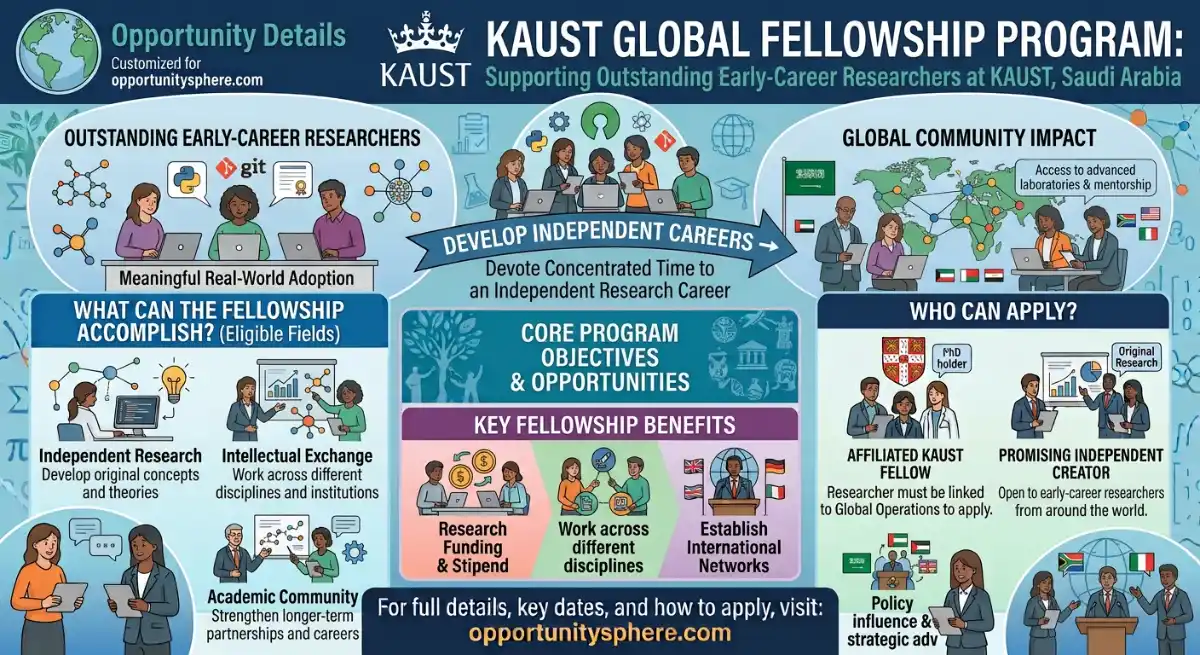
KAUST Global Fellowship Program 2027
Offered by King Abdullah University of Science and Technology
Location
Saudi Arabia
Funding
Fully Funded
Study level
Postdoctoral
Field of study
Environmental Sciences, Engineering, Computer Science & IT
Application deadline
October 1, 2026
Application Closed
About This Fellowship
The KAUST Global Fellowship Program is an initiative associated with King Abdullah University of Science and Technology (KAUST), a graduate research university located in Thuwal, Saudi Arabia. The programme aims to attract promising researchers from around the world and support the development of their research careers in a highly international scientific environment.
KAUST is known for its emphasis on research in areas such as engineering, computer science, physical sciences, biological sciences, environmental science and other fields connected to scientific and technological advancement. Researchers working on complex problems that require specialised facilities, interdisciplinary collaboration or advanced experimental and computational methods may find the university's research environment particularly relevant.
A research fellowship can provide an important transition between doctoral training and a more independent research career. During this stage, researchers typically seek to strengthen their publication records, develop new research collaborations, refine their scientific specialisation and establish a clearer research agenda. Opportunities to work alongside experienced investigators and access specialised facilities can help researchers develop the skills and professional relationships needed for future academic, industrial or research leadership roles.
The KAUST Global Fellowship opportunity is intended for researchers whose qualifications, research interests and proposed work align with the programme's objectives and the university's research environment. Applicants should investigate the relevant research groups and identify how their expertise could contribute to ongoing scientific work or open up new research directions.
Important: The exact fellowship structure, funding package, eligible disciplines, duration and application requirements must be confirmed from the official call. Applicants should not assume that every KAUST fellowship or research position has identical benefits or conditions.
Who Can Apply?
The opportunity is intended for qualified researchers who can demonstrate academic strength, research productivity and the potential to advance an independent research career.
Advertisement
🔒Application Closed
The listed deadline has passed. Check the official website to see whether the organisation has announced an extension or a new application period.
Stay in the loop
Your Next Opportunity Could Be One Email Away
Receive updates about scholarships, jobs, internships, fellowships and grants so you can discover opportunities worth exploring.
Stay Updated
Never miss an opportunity.
Get updates on scholarships, jobs, internships, grants, fellowships, conferences, and other opportunities delivered straight to your inbox.
Early-career researchers: Researchers seeking to strengthen their research independence after completing doctoral training.
Recent PhD graduates: Candidates whose doctoral qualifications and research interests match the requirements of the specific fellowship call.
Researchers with publication records: Applicants who can demonstrate their research contributions through peer-reviewed publications, conference presentations, projects or other relevant achievements.
Interdisciplinary researchers: Scientists and engineers whose work connects multiple research fields and could benefit from collaboration across disciplines.
Researchers developing new research directions: Candidates with a clear plan for advancing a research topic, addressing an important scientific problem or developing new methods.
International researchers: Applicants from different countries whose expertise and proposed research align with the programme's eligibility requirements.
These categories describe potential applicant profiles and should not be treated as a substitute for the formal eligibility criteria in the relevant call.
Eligibility Requirements
Applicants should review the official fellowship announcement carefully and confirm that they meet all requirements before applying.
Doctoral qualification: Applicants should hold a PhD or an equivalent doctoral qualification if required by the specific fellowship call.
Strong academic background: Candidates should demonstrate the academic preparation needed to conduct advanced research in their chosen discipline.
Research productivity: Applicants should provide evidence of research achievements, such as publications, completed projects, conference presentations, technical contributions or other relevant outputs.
Research potential: Candidates should demonstrate the ability to develop promising research questions and carry out rigorous scientific work.
Research alignment: The proposed research should fit the programme's objectives and the relevant research strengths or facilities at KAUST.
Career development potential: Applicants should explain how the fellowship would support their progression towards greater research independence.
Professional competence: Candidates should demonstrate the ability to communicate research findings, collaborate with other researchers and work in an international research environment.
Complete documentation: Applicants must provide the documents and information specified in the official application.
Compliance with the call: Candidates must meet the applicable academic, professional and administrative requirements.
Timely submission: Applications must be submitted within the deadline stated in the relevant official announcement.
Research Areas and Potential Opportunities
KAUST conducts research across a range of scientific and technological disciplines. Depending on the fellowship call and participating research groups, relevant areas may include:
Environmental Science and Sustainability: Research into environmental processes, sustainable resource management, climate-related challenges and environmental technologies.
Biological Sciences: Research involving biological systems, molecular biology, biotechnology and related life-science disciplines.
Plant Science and Food Security: Research relevant to plant biology, crop improvement, agricultural biotechnology and sustainable food systems, where supported by the relevant research group.
Engineering: Research involving advanced materials, chemical engineering, electrical engineering, mechanical systems and related technologies.
Computer Science and Artificial Intelligence: Research into computational methods, machine learning, data science, algorithms and intelligent systems.
Physical Sciences: Research in physics, chemistry, materials science and other foundational scientific disciplines.
Marine Science: Research involving marine ecosystems, ocean processes and related environmental or technological questions.
Energy and Water: Research addressing energy systems, water treatment, desalination, resource efficiency and associated technologies.
This list is intended to help applicants explore possible research connections. It is not a confirmed list of disciplines eligible under every fellowship call.
Researchers should examine the university's current research programmes and laboratory profiles before selecting a proposed topic. The existence of a related research field at KAUST does not automatically establish eligibility for a particular fellowship.
Fellowship Benefits
The precise benefits depend on the official programme terms. Applicants should verify the package offered by the specific fellowship before making financial or relocation plans.
1. Financial Support
The fellowship is intended to provide financial support to successful researchers under the applicable programme terms. Applicants should confirm the stipend or salary arrangement, payment schedule, duration and any applicable allowances in the official call.
2. Access to a Research Environment
KAUST provides a research-focused university environment in which researchers can investigate scientific questions, develop methods and collaborate with specialists in related disciplines.
3. Research Facilities and Equipment
Depending on the host research group and the resources available for the project, fellows may be able to use specialised laboratories, scientific instruments, computational resources and other research infrastructure.
4. Collaboration with Experienced Researchers
Working in a research-intensive institution can create opportunities to exchange ideas with established scientists, doctoral researchers, postdoctoral researchers and other research professionals.
5. Professional Development
Research fellowship experience can help candidates strengthen skills in research planning, scientific communication, project management, collaboration and the preparation of future research proposals.
6. International Research Networking
An international university environment can expose researchers to colleagues from different scientific backgrounds and countries, potentially supporting future collaborations and joint publications.
7. Development of Research Independence
A well-designed fellowship project can help researchers establish a clearer scientific identity, develop a sustained research agenda and build evidence of their capacity to lead future investigations.
8. Interdisciplinary Research
Many contemporary scientific problems require methods and expertise from several disciplines. Depending on the project, researchers may be able to work across research groups and combine different approaches to address a shared problem.
9. Opportunities to Disseminate Research
Researchers may have opportunities to present findings through seminars, workshops, conferences and scientific publications, subject to programme expectations and available support.
10. Contribution to Important Scientific Challenges
Research conducted at KAUST may contribute to work on environmental sustainability, energy, water, food systems, biotechnology, computing and other areas of scientific or technological importance.
The availability of individual benefits, including housing, health insurance, relocation assistance, travel funding and conference support, must be confirmed in the specific fellowship terms. These benefits should not be assumed unless explicitly stated by KAUST.
How to Prepare a Competitive Application
Applicants can improve the clarity of their applications by presenting a focused research plan and demonstrating how their experience prepares them to carry it out.
1. Identify a Clear Research Problem
Begin with a scientific problem that is important, specific and researchable. Explain what is currently known, what remains unresolved and why the proposed investigation matters.
2. Demonstrate Your Research Contributions
Describe the work you have already completed and explain your individual contribution. Where relevant, provide links or references to publications, datasets, software, technical reports or other research outputs.
3. Explain the Originality of Your Proposal
A strong research statement should make clear what is new about the proposed work. This could involve a new hypothesis, method, application, dataset, interdisciplinary approach or solution to an existing limitation.
4. Establish the Connection with KAUST
Investigate the relevant research groups, facilities and scientific interests at the university. Explain how the proposed research aligns with the available expertise and why KAUST is an appropriate environment for the work.
5. Set Realistic Research Objectives
Organise the project around clear questions, achievable objectives and a plausible methodology. Explain how the proposed work could be evaluated and what results would indicate progress.
6. Explain the Expected Contribution
Discuss how the findings could advance scientific understanding, improve a method, address a practical problem or create opportunities for further research.
7. Present a Coherent Career Plan
Explain how the fellowship would help you develop greater research independence and prepare for your next professional stage.
These are general application-preparation recommendations, not a statement that KAUST requires each item in precisely this format.
Application Process
Applicants should follow the application instructions for the specific fellowship call. The following steps provide a general preparation guide.
Review the official announcement: Confirm the programme's current status, eligibility criteria, funding details and application deadline.
Identify relevant research areas: Explore KAUST's research programmes and identify groups whose expertise is related to your interests.
Review potential research connections: Where appropriate, examine the work of relevant faculty members or research teams.
Update your academic CV: Include your qualifications, research experience, publications, technical skills, awards and other relevant achievements.
Prepare your research statement: Explain the research problem, objectives, proposed approach, expected contribution and fit with the programme.
Compile your publication list: Provide accurate bibliographic information for relevant publications and clearly distinguish published work from manuscripts under review or in preparation.
Arrange supporting documents: Gather the certificates, transcripts, references and other documents required by the official application.
Check reference requirements: Determine whether reference letters or referee contact details are required and follow the stated instructions.
Complete the online application: Enter the requested information accurately and ensure that your research experience is presented clearly.
Review the application: Check the consistency of your CV, research statement, publication list and other documents.
Submit through the official channel: Follow the submission procedure and retain any confirmation provided.
Monitor communications: Check your email for requests for additional information, interviews or other assessment stages.
Required Documents
The exact documentation requirements must be confirmed from the official fellowship announcement. Depending on the call, applicants may be asked to provide some of the following:
Academic curriculum vitae: A current CV summarising education, research experience, publications and relevant achievements.
PhD certificate: Evidence of the required doctoral qualification, or other evidence permitted by the official call.
Academic transcripts: Records of academic qualifications where requested.
Research proposal or statement: A description of the proposed research, its objectives, methods and expected contribution, if required.
Publication list: A complete and accurate list of relevant research outputs.
Reference letters or referee details: Provided according to the programme's stated requirements.
Identification documents: Passport or other identification information where requested.
Evidence of research achievements: Relevant awards, presentations, project records, datasets, software or other supporting evidence.
Additional forms: Any declarations, supporting statements or programme-specific documents required by KAUST.
Do not submit sensitive documents through unofficial websites or to unverified contacts. Use the official application channel and follow its instructions.
Selection Process
The selection procedure will depend on the specific fellowship call. Applicants should be prepared for an assessment that may consider:
Eligibility: Whether the applicant meets the formal qualification and other programme requirements.
Academic and research record: The quality, relevance and significance of previous research contributions.
Research potential: The applicant's ability to formulate important questions and carry out rigorous research.
Proposal quality: The clarity, originality, feasibility and potential value of the proposed work, where a proposal is required.
Research alignment: The relationship between the proposed work and KAUST's relevant research expertise and facilities.
Professional readiness: The candidate's ability to communicate research ideas, work collaboratively and develop as an independent researcher.
Further assessment: Shortlisted candidates may be asked to participate in interviews or other evaluation stages if specified by the programme.
Applicants should not assume that meeting the minimum eligibility criteria guarantees an interview or an offer.
Application Deadline and Current Status
The stated deadline for this listing is October 1, 2026. As of October 13, 2026, that date has passed.
Applicants should therefore verify whether KAUST has extended the deadline, opened another application round or published a new call before attempting to apply. Do not assume that the application remains open merely because the university's website is accessible.
Important Note for International Applicants
KAUST is located in Saudi Arabia and attracts researchers from a range of international backgrounds. Applicants outside Saudi Arabia should review the specific call for details on eligibility, appointment arrangements, relocation, visa procedures and any other administrative conditions that may apply.
Researchers should also distinguish between a university research position, a postdoctoral appointment and a named fellowship programme. Although these opportunities can share similar benefits or eligibility criteria, their application procedures and funding terms may differ.
Frequently Asked Questions
1. Is the KAUST Global Fellowship fully funded?
The exact financial package must be verified in the relevant official announcement. Confirm the funding amount, duration, allowances and covered expenses rather than assuming that all costs are included.
2. Do applicants need a PhD?
The stated eligibility for this listing requires a PhD or equivalent doctoral qualification. Applicants should confirm the precise qualification rules and any permitted exceptions in the official call.
3. Can international researchers apply?
The programme is intended to attract researchers internationally, but candidates must meet the eligibility requirements of the particular fellowship announcement.
4. Which research fields are eligible?
KAUST supports research across multiple scientific and technological disciplines. Eligibility for a particular fellowship depends on the scope of the call and the relevant research areas.
5. Are reference letters required?
Reference letters or referee details may be required, depending on the application instructions. Applicants should check the current document checklist.
6. Can I apply after October 1, 2026?
The deadline stated in this listing has passed. Check the official announcement for an extension, a subsequent round or a new call before applying.
7. Does the fellowship guarantee employment after completion?
Applicants should not assume that completion of a fellowship guarantees a permanent academic position or another appointment. Any future employment would depend on separate opportunities and applicable selection procedures.
Related Opportunities
Explore other scholarships, fellowships, grants, research opportunities and more that may match your interests.