The application deadline for this opportunity has passed. You can still review the details, but the listing is no longer presented as open for applications.
Fellowship, PhD & Research
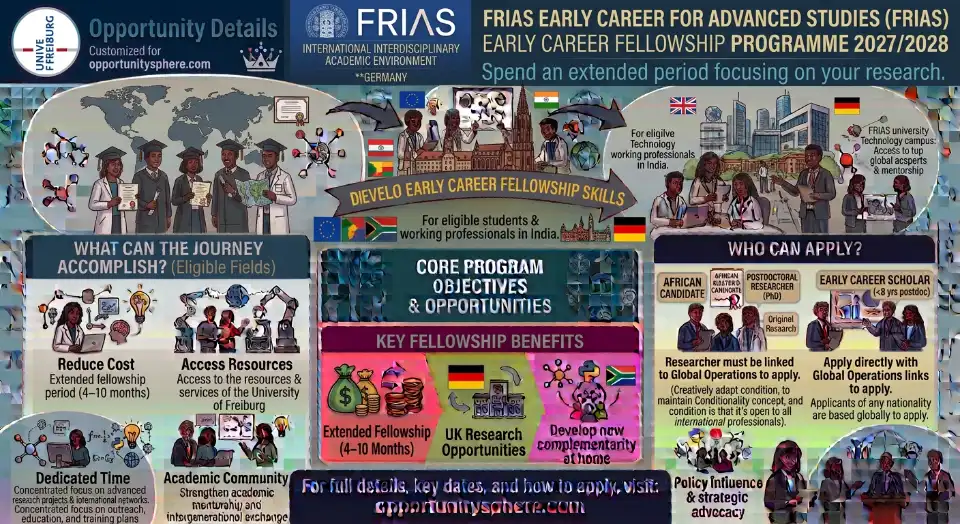
FRIAS Early Career Fellowship Programme 2027/2028
Offered by Freiburg Institute for Advanced Studies, University of Freiburg
Location
Germany
Funding
Fully Funded
Study level
Postdoctoral / Early-Career Researcher
Field of study
All Fields
Application deadline
September 18, 2026
Application Closed
About This Fellowship
The Freiburg Institute for Advanced Studies (FRIAS) at the University of Freiburg in Germany offers the Early Career Fellowship Programme to researchers who have completed their doctoral degrees and are building their independent academic careers.
The programme provides selected researchers with dedicated time to advance their own research projects within an international and interdisciplinary academic environment. Rather than requiring fellows to pursue a single predetermined research topic, FRIAS supports individual research projects that demonstrate academic quality, originality and potential for meaningful scholarly contribution.
The fellowship is designed to give researchers an opportunity to concentrate on their work while exchanging ideas with scholars from different disciplines and academic backgrounds. Such interaction can help researchers reconsider their assumptions, develop new approaches and identify opportunities for collaboration.
For the 2027/2028 academic year, FRIAS invited applications from researchers of all nationalities who had completed their PhDs within the previous eight years and met the programme's additional research and international-experience requirements.
Successful applicants can spend between four and ten months at the University of Freiburg. During this period, fellows become part of the FRIAS research community and gain access to university facilities, academic services and opportunities for scholarly exchange.
The fellowship may be particularly valuable to researchers seeking uninterrupted time to develop a major publication, refine a research framework, advance an existing project or explore a new interdisciplinary direction.
Who Can Apply?
The FRIAS Early Career Fellowship is intended for researchers who have completed their doctoral degrees and have no more than eight years of postdoctoral experience at the time of application.
Applicants may come from any nationality and any academic discipline that can be supported at the University of Freiburg. Researchers based in Germany and those working at institutions abroad were eligible to apply.
However, holding a PhD alone is not sufficient. The 2027/2028 call included specific publication and international-experience requirements that applicants needed to satisfy.
Advertisement
🔒Application Closed
The listed deadline has passed. Check the official website to see whether the organisation has announced an extension or a new application period.
Stay in the loop
Your Next Opportunity Could Be One Email Away
Receive updates about scholarships, jobs, internships, fellowships and grants so you can discover opportunities worth exploring.
Stay Updated
Never miss an opportunity.
Get updates on scholarships, jobs, internships, grants, fellowships, conferences, and other opportunities delivered straight to your inbox.
Applicants for the 2027/2028 cycle were required to meet the following conditions.
1. Completed doctoral degree
Applicants must have completed their PhD or equivalent doctoral qualification by the time required under the official call. Candidates who had not completed their doctorate should not assume that they qualified simply because they were nearing submission or awaiting examination.
2. Maximum of eight years of postdoctoral experience
Applicants must have no more than eight years of postdoctoral experience under the programme's eligibility rules.
Researchers should check the application manual for how their doctoral completion date and any applicable career-break provisions are treated.
3. At least four recent peer-reviewed publications
Applicants must have at least four peer-reviewed publications since 1 January 2022.
Candidates should ensure that their publication record meets the programme's requirements. They should also consult the application manual for guidance on which publication types qualify and how publications should be documented.
4. International academic experience
Applicants must have accumulated at least six months of research or study experience at one or more academic institutions in a country different from the country where they obtained their first academic degree.
This is a separate requirement from nationality. Being a citizen of another country or applying from abroad does not automatically satisfy the international-experience condition.
Applicants should be ready to document the relevant experience and confirm that it meets the official definition.
5. A strong and innovative research project
Applicants must propose a research project that demonstrates originality, academic quality and potential to contribute meaningfully to their discipline.
The proposal should identify a clear research question, explain the significance of the work and show how the fellowship period will help advance it.
6. Research compatible with the University of Freiburg
Applications are welcome across disciplines that can be supported at the University of Freiburg. Applicants should therefore investigate the university's research strengths and relevant academic expertise when developing their proposals.
7. Commitment to full-time presence
The fellowship requires full-time presence at FRIAS. Applicants should be prepared to spend their fellowship period in Freiburg and participate in the academic environment.
Fieldwork conducted outside Freiburg cannot be funded during the fellowship period, so projects that depend on extensive off-site fieldwork need careful planning.
Fellowship Benefits
1. Four to ten months of dedicated research time
Selected researchers can undertake a fellowship lasting between four and ten months during the period from 1 September 2027 to 31 August 2028.
The duration provides an opportunity to concentrate on a defined research project without the usual range of competing academic responsibilities, subject to the arrangements agreed with FRIAS.
2. Fellowship compensation
Depending on their circumstances, successful applicants may receive a fellowship contract with the University of Freiburg or an alternative form of compensation.
Applicants should consult the official application manual for the financial arrangements that apply to their situation. The exact terms should not be assumed to be identical for every fellow.
3. Research-cost contribution
Fellows receive a contribution towards research costs. This support is intended to assist with eligible expenses associated with the research project, according to the programme's conditions.
Applicants should check which expenses are permitted and whether any budget or reporting requirements apply.
4. Travel support
FRIAS provides applicable costs for the inbound and outbound journeys associated with the fellowship. The precise arrangements and eligibility conditions should be checked in the official application manual.
5. Access to the University of Freiburg
Fellows gain access to university services and facilities, including office space and relevant academic infrastructure. These resources can support the development of research, scholarly communication and interaction with the university community.
6. Interdisciplinary research exchange
FRIAS brings together researchers from different academic backgrounds. This setting gives fellows opportunities to discuss their work with scholars whose methods, evidence or theoretical perspectives differ from their own.
Such exchange can be useful when a research project addresses complex questions that benefit from multiple disciplinary perspectives.
7. International academic networking
The fellowship offers opportunities to establish relationships with researchers and academic communities beyond a fellow's home institution.
These connections may support future research collaborations, publications and scholarly exchanges. However, specific collaborations or future grants are not guaranteed.
8. Personalised organisational support
FRIAS provides individual support with practical arrangements, including matters relating to accommodation, childcare and visa applications.
The availability and extent of assistance depend on individual circumstances and the relevant arrangements. Applicants should confirm their specific needs with the institute.
Financial Information: What Applicants Should Know
The FRIAS Early Career Fellowship provides financial support, but applicants should not assume that every recipient receives the same payment arrangement.
The official call indicates that selected fellows may receive a University of Freiburg fellowship contract or alternative compensation, alongside research-cost support and applicable travel costs.
Before accepting an offer, candidates should review:
The applicable compensation arrangement
Any conditions attached to the fellowship contract
The treatment of accommodation and living expenses
Eligible research expenditures
Travel reimbursement conditions
Tax, insurance and visa considerations relevant to their circumstances
The precise terms should be obtained from the official application manual and the institute. A single universal monthly payment amount should not be quoted unless it is confirmed in the relevant official documentation.
How to Prepare a Strong Research Proposal
The research proposal is central to the application. It should demonstrate not only that the proposed topic is interesting, but also that the research question is important, the methods are appropriate and the planned work can make meaningful progress during the fellowship.
1. Define the research problem
Start with a clearly stated problem or question. Explain what is already known, what remains uncertain and why the issue deserves further investigation.
A proposal that describes a broad subject without identifying a specific research gap may be difficult for reviewers to assess.
2. Explain the originality of the project
Identify what distinguishes the proposed research from existing work. This may involve a new conceptual framework, a different interpretation of existing evidence, an innovative method or a fresh approach to an established question.
Claims of originality should be supported by an accurate understanding of relevant literature.
3. Establish the significance of the research
Explain the contribution the project could make to its field. Depending on the discipline, this may involve advancing theory, improving a method, interpreting evidence, developing an analytical framework or addressing an important research problem.
Avoid overstating the expected impact. A credible proposal explains both the potential contribution and the limits of what can reasonably be achieved.
4. Present a feasible work plan
Show what can be accomplished during the proposed four-to-ten-month fellowship. Identify the main tasks, the order in which they will be completed and the expected outputs.
The work plan should match the available time and the resources accessible in Freiburg.
5. Explain the value of the FRIAS environment
Describe how working within an international and interdisciplinary research community could benefit the project. This should be specific to the research rather than a generic statement about wanting international exposure.
For example, a project might benefit from discussions with researchers in a related discipline, access to relevant university resources or the opportunity to reconsider a research framework through cross-disciplinary exchange.
6. Address ethical considerations
The application includes an ethical-issues table. Applicants should identify relevant ethical questions associated with their research and explain how these will be addressed where applicable.
The response should reflect the actual methods and subject matter of the proposed project.
7. Write for both specialists and non-specialists
The application requires both a research abstract and a lay abstract. The specialist abstract should communicate the question, approach and contribution in an academically precise way.
The lay abstract should explain the project in clear language that an informed reader outside the immediate field can understand. Avoid unexplained technical terminology and focus on the problem, purpose and potential significance.
Application Requirements
The official application process requires candidates to provide information about themselves and their proposed research.
The listed requirements include:
Research abstract: A concise account of the research question, approach and intended contribution.
Lay abstract: A plain-language explanation of the project for readers outside the immediate research field.
Motivation statement: An explanation of why the applicant wishes to undertake the fellowship and how it relates to the proposed project.
Ethical-issues table: Information about relevant ethical considerations.
Academic CV: Evidence of qualifications, research experience and scholarly achievements.
Publication record: Information demonstrating that the applicant meets the recent peer-reviewed publication requirement.
Two evaluators: Contact information for two evaluators who know the applicant personally and are willing to provide an evaluation.
Applicants should consult the official application manual for the exact formatting requirements, length limits and any additional documents needed.
Application Process
The deadline for the 2027/2028 cycle was 18 September 2026 at 13:00 CET. Applications are now closed. The following steps summarise the process for reference and for researchers preparing for a future call.
Step 1: Confirm eligibility
Check your doctoral completion date, postdoctoral experience, recent peer-reviewed publications and international academic experience against the official criteria.
Step 2: Identify a suitable research project
Develop a research question that can be advanced during the fellowship period and is compatible with the academic resources and expertise available at the University of Freiburg.
Step 3: Prepare the proposal and abstracts
Write the research abstract, lay abstract, motivation statement and ethical-issues table. Make sure the documents communicate a coherent project and comply with the application manual.
Step 4: Update your academic CV
Include your education, appointments, research experience and relevant scholarly outputs. Clearly present the publications needed to demonstrate eligibility.
Step 5: Identify two evaluators
Contact two suitable evaluators who know your work and are willing to provide an evaluation. Ensure that you have their correct contact information and that they understand the process.
Step 6: Read the application manual
Review the official manual carefully. It contains the detailed instructions needed to prepare a complete application and understand the fellowship's financial and administrative conditions.
Step 7: Complete the online application
Enter the required information, upload the requested materials and provide the evaluator details through the official application system.
Step 8: Submit before the deadline
For a future call, check the exact closing date and time, then allow sufficient time to resolve any document or submission problems. Do not rely on the final minutes before a deadline.
Selection Process
FRIAS uses an international peer-review process, with final decisions made by an independent Scientific Advisory Board.
The programme is highly competitive and merit-based. The official call indicates an expected success rate of approximately 5% of eligible applications.
Reviewers consider the academic quality and originality of the proposed project alongside the applicant's research record and suitability for the fellowship.
Meeting the eligibility criteria is therefore only the first step. Applicants need to demonstrate that their project is academically strong, feasible and likely to benefit from the FRIAS research environment.
Frequently Asked Questions
1. Is the FRIAS Early Career Fellowship open to all nationalities?
Yes. The 2027/2028 call was open to researchers of any nationality, provided they met the eligibility requirements.
2. Can researchers from any discipline apply?
Applications are welcome from all disciplines that can be supported at the University of Freiburg. Applicants should check the university's research strengths and relevant academic expertise before developing their proposal.
3. What is the maximum postdoctoral experience allowed?
Applicants must have no more than eight years of postdoctoral experience under the 2027/2028 eligibility rules.
4. How many publications are required?
The call requires at least four peer-reviewed publications since 1 January 2022. Applicants should verify publication eligibility and documentation requirements in the official manual.
5. Is international experience compulsory?
Yes. Applicants must have at least six months of research or study experience at an academic institution in a country different from the country where they earned their first academic degree.
6. How long does the fellowship last?
The fellowship lasts between four and ten months, with the programme period running from 1 September 2027 to 31 August 2028.
7. Does FRIAS provide financial support?
Yes. Depending on individual circumstances, fellows receive a University of Freiburg fellowship contract or alternative compensation, a research-cost contribution and applicable travel support. Exact terms should be confirmed in the official application manual.
8. Must fellows live in Freiburg during the fellowship?
Full-time presence at FRIAS is mandatory. Applicants should be prepared to undertake the fellowship in Freiburg and participate in the institute's academic environment.
9. Can the fellowship fund fieldwork outside Freiburg?
The official call states that fieldwork conducted outside Freiburg cannot be funded during the fellowship period. Researchers whose projects depend on external fieldwork should take this limitation into account when planning their work.
10. What was the application deadline?
The deadline was 18 September 2026 at 13:00 Central European Time. Applications for the 2027/2028 cycle are closed.
11. Where can applicants find official information?
Visit the official FRIAS Early Career Fellowship announcement:
The official programme page and application manual provide further details about eligibility, required documents and financial arrangements.
Final Note
The FRIAS Early Career Fellowship offers researchers an opportunity to devote four to ten months to advancing their own projects within an international and interdisciplinary research environment at the University of Freiburg in Germany.
It is particularly relevant to early-career researchers who have completed their PhDs, developed a strong recent publication record and gained international academic experience. Successful applicants benefit from research time, access to university resources, academic exchange, research-cost support and applicable travel assistance.
The programme is highly competitive, and applicants must satisfy all eligibility conditions as well as demonstrate the quality and feasibility of their research proposals.
Applications for the 2027/2028 cycle closed on 18 September 2026. Researchers interested in a future opportunity should monitor the official FRIAS website for new announcements.
Related Opportunities
Explore other scholarships, fellowships, grants, research opportunities and more that may match your interests.