The application deadline for this opportunity has passed. You can still review the details, but the listing is no longer presented as open for applications.
Fellowship
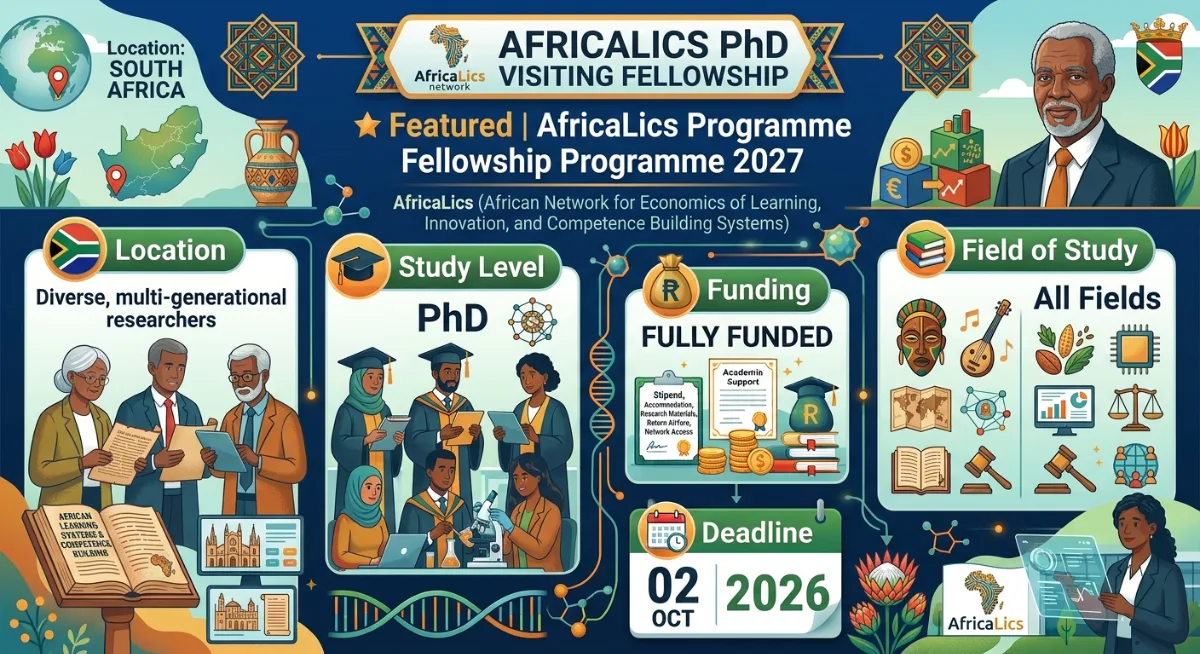
AfricaLics PhD Visiting Fellowship Programme 2027
Offered by AfricaLics (African Network for Economics of Learning, Innovation, and Competence Building Systems)
Location
South Africa
Funding
Fully Funded
Study level
PhD
Field of study
All Fields
Application deadline
October 2, 2026
Application Closed
About This Fellowship
The AfricaLics PhD Visiting Fellowship Programme (VFP) 2027 provides eligible African PhD students with an opportunity to strengthen their doctoral research through international academic exposure, research training, mentoring and a three-month study visit at the University of Johannesburg in South Africa.
The programme focuses on Innovation and Development (I&D) and is designed for doctoral researchers whose work examines relationships between innovation and economic, social or environmentally sustainable development. AfricaLics uses a broad, multidisciplinary understanding of innovation, meaning that applicants do not necessarily need to be enrolled in a conventional economics or innovation programme.
Research may come from areas such as agriculture, energy, manufacturing, engineering, technology, development studies, sociology, political science, geography, science and technology policy, health, gender, digital transformation and other fields where the research addresses the relationship between innovation and development.
The 2027 fellowship combines online academic activities with a physical research period at the University of Johannesburg. Online activities are expected to begin in the first half of February 2027. The main study visit will take place from 6 September to 3 December 2027, followed by additional online activities in December 2027 and early 2028.
The fellowship is intended to complement the student's existing PhD rather than replace the doctoral programme at the home university. Selected fellows remain under the academic responsibility of their home university and supervisors while receiving additional mentoring, training and research exposure through AfricaLics.
Who Can Apply
The programme is open to PhD students enrolled at universities in African countries classified by the OECD/DAC as low-income or lower-middle-income countries under the programme's eligibility framework.
Applicants should preferably have completed their first year of PhD studies by December 2026 and must already be actively working on a doctoral research project relevant to Innovation and Development.
Advertisement
🔒Application Closed
The listed deadline has passed. Check the official website to see whether the organisation has announced an extension or a new application period.
Stay in the loop
Your Next Opportunity Could Be One Email Away
Receive updates about scholarships, jobs, internships, fellowships and grants so you can discover opportunities worth exploring.
Stay Updated
Never miss an opportunity.
Get updates on scholarships, jobs, internships, grants, fellowships, conferences, and other opportunities delivered straight to your inbox.
The programme is multidisciplinary. Applicants may come from economics, sociology, political science, science and technology policy, geography, history, development studies and related disciplines. Researchers working in STEM, manufacturing and other technical areas may also be considered when their research addresses Innovation and Development from a relevant perspective.
Female PhD students and applicants from low-income African countries are particularly encouraged to apply.
Research Areas
Applicants should demonstrate a clear connection between their doctoral research and Innovation and Development in Africa.
Research may address areas such as:
Agricultural innovation and innovation systems.
Energy and sustainable development.
Climate-resilient and inclusive innovation.
Manufacturing and industrialisation.
Global value chains.
Technology development, adoption and diffusion.
Science, technology and innovation policy.
Digital transformation and the Fourth Industrial Revolution.
Health innovation.
Gender and innovation.
Entrepreneurship and innovation.
Organisational and workplace innovation.
Knowledge, learning and competence building.
Innovation for economic and social development.
For the 2027 cohort, applicants working in one or more of AfricaLics' four Research Coordination Areas are particularly encouraged to apply.
These are:
STI Measurement in Africa
Global Value Chains, Innovation and Industrialization
Innovating Resilience: Advancing Inclusive Agricultural Innovation for Climate Resilience in Sub-Saharan Africa
Innovation and Sustainable Energy Transition in Africa (i-SET Africa)
Fellowship Structure
The programme provides a year-long learning and research experience combining online activities, mentoring and the physical study visit.
Online activities begin in February 2027 and include research and academic-writing activities. Fellows will also participate in paper presentation seminars and are expected to have an opportunity to present their work during the AfricaLics PhD Academy 2027, expected to take place in April 2027.
The central physical component is the study visit to the University of Johannesburg from 6 September to 3 December 2027.
During the visit, fellows will join an international research environment focused on Innovation and Development, including transformative innovation and the Fourth Industrial Revolution. They will interact with UJ researchers, other PhD students and visiting fellows while receiving dedicated time to strengthen their doctoral research.
The study period can be used to analyse fieldwork data, develop dissertation chapters, prepare journal articles, improve theoretical or conceptual frameworks and receive feedback on ongoing research.
Academic Mentoring
Each fellow will be matched with one or two scholars with expertise relevant to the student's research area.
Mentors may provide guidance on research development, academic writing, theoretical approaches, methodological questions, conference papers and other aspects of doctoral research.
The AfricaLics mentors do not replace the student's official PhD supervisors. Responsibility for the student's doctoral programme remains with the home university and its supervisors.
The fellowship encourages close interaction between the fellow, home supervisor and AfricaLics mentors. Fellows are expected to integrate the visiting fellowship activities into their existing doctoral work plan.
At the beginning of the fellowship, each selected fellow will develop a specific one-year work plan in consultation with their home supervisor, mentors and the VFP academic coordinator. The finalised work plan will identify the principal research outputs to be developed during the fellowship.
Training and Academic Activities
Fellows will participate in online courses and academic development activities, including training related to:
Academic journal article writing.
Systematic literature reviews.
General academic writing and research communication.
Research presentation.
Development of dissertation chapters and academic papers.
Each fellow will also have opportunities to present research through paper presentation seminars. Up to five paper presentation seminars may be available during the fellowship programme.
Two face-to-face meetings are planned for the 2027 cohort: one connected with the AfricaLics PhD Academy in April 2027 and another expected during the November 2027 study period in Johannesburg.
Benefits
The AfricaLics VFP is primarily a research-capacity and academic-development fellowship rather than a scholarship that finances an entire PhD degree.
Selected fellows receive:
A three-month study visit at the University of Johannesburg from 6 September to 3 December 2027.
Online academic and research activities beginning in February 2027.
Academic mentoring from scholars in Innovation and Development.
Exposure to researchers and PhD students at the University of Johannesburg.
Access to the wider AfricaLics and Globelics research communities.
Academic-writing training.
Training related to journal article writing and systematic literature reviews.
Opportunities to present doctoral research.
Expected opportunity to present research at the AfricaLics PhD Academy 2027.
Dedicated time to analyse research data and develop dissertation chapters or academic papers.
Exposure to research on transformative innovation, the Fourth Industrial Revolution and sustainable development.
Support in organising accommodation for the Johannesburg study visit.
Working space near the UJ-TRCTI offices during the study visit.
Development of a structured one-year doctoral research work plan.
Opportunities for continued participation in AfricaLics alumni activities, webinars and research events after the fellowship.
AfricaLics may also offer travel support for relevant future conferences or activities where funding is available, but such support is not guaranteed and fellows must apply under the applicable conditions.
Important Funding Requirement
This fellowship does not replace the basic funding for the applicant's existing PhD.
Applicants must already have secured basic funding for their doctoral studies from another source, such as government funding, another organisation or self-financing.
The AfricaLics fellowship is intended to provide additional research exposure, mentoring, training and international academic mobility alongside the student's existing PhD programme.
Eligibility
Applicants must:
Be enrolled as a PhD student at a university in an African country.
Be enrolled at a university in an African country classified by the OECD/DAC as low-income or lower-middle-income under the programme's eligibility framework.
Be actively working on a doctoral research project relevant to Innovation and Development.
Demonstrate how their research relates to innovation and economic, social or environmentally sustainable development.
Preferably have completed their first year of PhD studies by December 2026.
Have a research topic that fits the AfricaLics Innovation and Development research agenda.
Present clear research questions and a sufficiently developed theoretical or conceptual framework.
Demonstrate methodological clarity and appropriate research methods, data sources and data-collection approaches.
Be able to participate in the online activities and the physical study visit in Johannesburg.
Already have basic funding for their PhD from another source.
Have adequate English-language literacy for participation in the programme.
Female PhD students and applicants from African low-income countries receive particular consideration as part of the programme's effort to strengthen diversity and research capacity in Innovation and Development studies.
Selection Criteria
Applications are assessed on the quality and relevance of the proposed research.
The selection process considers:
Focus and relevance: How clearly the proposed research relates to Innovation and Development studies in Africa and the AfricaLics research agenda.
Theoretical and conceptual framework: Whether the research has a well-developed framework rooted in Innovation and Development studies and connected clearly to the research questions.
Methodological clarity and rigour: Whether the proposed methods, data sources and data-collection approaches are appropriate for addressing the research questions.
Stage of PhD: Whether the applicant is at an appropriate stage to benefit from the fellowship.
Mentoring possibilities: Whether suitable AfricaLics mentors are available for the applicant's research topic.
Diversity considerations: Particular consideration is given to female applicants and applicants from low-income African countries.
The final number of fellows depends on the quality and relevance of applications, available funding and the ability to identify appropriate mentors.
Required Documents
Applicants should submit:
A one-page or approximately 500-word statement explaining their academic background, motivation for applying and expected outcomes from participating in the fellowship.
A brief outline of the current PhD project, including the PhD training plan, with a maximum length of five pages.
Curriculum Vitae, including PhD courses already completed.
A letter of support from the main PhD supervisor confirming completion of the required upgrade/probation or explaining why the applicant is suitable for the fellowship if this requirement has not been completed.
A letter of support from the university administration of the institution where the applicant is enrolled.
Copies of academic certificates, including at minimum Bachelor's and Master's certificates.
One writing sample, such as an academic article or chapter from the applicant's current PhD programme.
A passport copy is not required at the application stage. Successful candidates will receive further information about visa arrangements.
Application Timeline
Online activities begin: First half of February 2027
AfricaLics PhD Academy: Expected April 2027
Study visit at University of Johannesburg: 6 September – 3 December 2027
Additional online activities: December 2027 and early 2028
Application deadline: 2 October 2026 at 23:00 East Africa Time
Shortlisted candidate interviews: 27 and 30 November 2026
Expected notification of successful applicants: Mid-December 2026 or early January 2027
Accommodation and Visa
AfricaLics and University of Johannesburg staff will assist in organising accommodation for fellows during the Johannesburg study visit. Accommodation is expected to be located near the UJ-TRCTI offices, where fellows will have working space.
Successful candidates are responsible for ensuring that their passports are valid and for handling the requirements associated with their legal stay in South Africa. AfricaLics and UJ will provide relevant support, including invitation documentation and information concerning visa arrangements.
After the Fellowship
The relationship with AfricaLics does not necessarily end when the formal fellowship period concludes.
Former fellows are encouraged to remain engaged through AfricaLics alumni activities, webinars, conferences and other network events. Alumni may also participate in activities organised through AfricaLics national chapters, including networks in Nigeria, Ethiopia and Burkina Faso.
Fellows may also pursue opportunities to present or develop research for future AfricaLics and Globelics conferences, subject to the relevant application processes and available funding.
How to Apply
Applicants should prepare all required documents and submit them through the online application form provided in the official 2027 AfricaLics PhD Visiting Fellowship call.
Applications must be complete and submitted with all relevant attachments by:
2 October 2026 at 23:00 East Africa Time
Questions concerning the fellowship can be directed to: