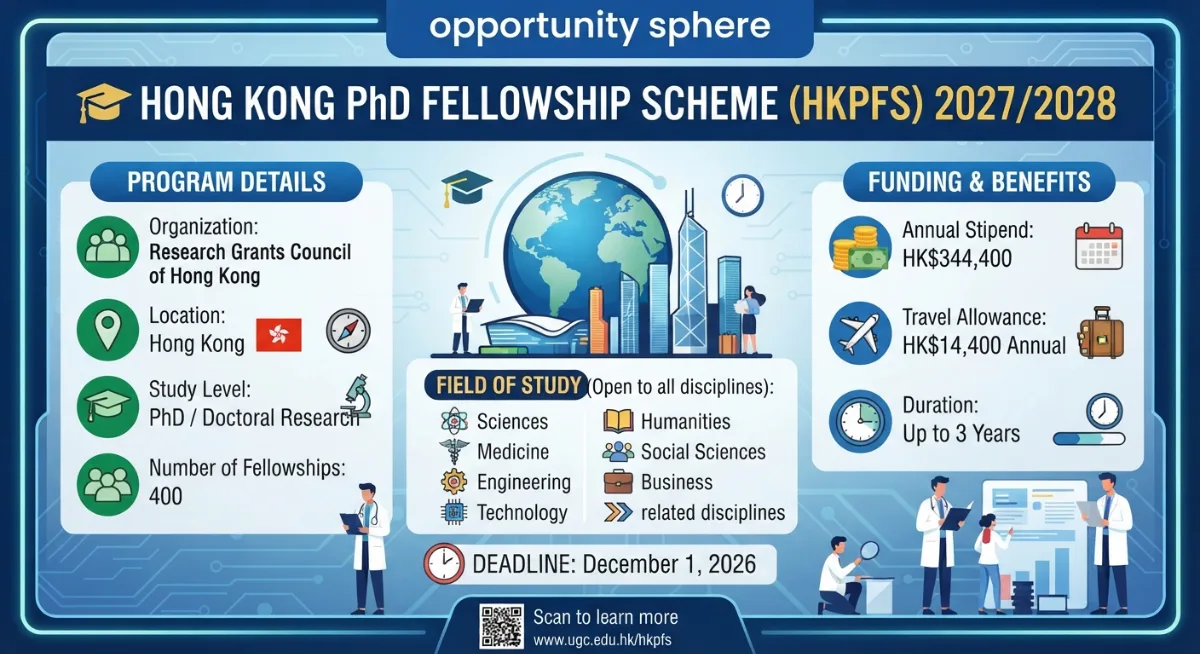
Offered by Research Grants Council (RGC), Hong Kong
Location
Hong Kong
Funding
Fully Funded
Study level
PhD, Researchers
Field of study
All Fields
Application deadline
December 1, 2026
About This Fellowship
The Hong Kong PhD Fellowship Scheme (HKPFS) is a competitive doctoral funding programme established by Hong Kong's Research Grants Council to attract high-achieving international students to pursue full-time PhD studies at participating universities in Hong Kong.
For the 2027/28 academic year, 400 fellowships are available. The scheme covers a wide range of disciplines and evaluates applicants through two broad academic panels:
Sciences, Medicine, Engineering and Technology
Humanities, Social Sciences and Business Studies
The fellowship is attached to a PhD admission application, rather than being an independent scholarship that can be won without university admission. Applicants therefore need to identify a suitable doctoral programme, understand its research environment and satisfy the university's own admission requirements.
HKPFS selection considers more than academic grades. The RGC assesses academic excellence, research ability or potential, communication and interpersonal skills, and leadership ability. This makes the programme particularly suitable for applicants who can demonstrate both strong academic preparation and a convincing capacity for doctoral-level research.
Participating Universities
Applicants can apply for HKPFS-funded PhD study at eight participating universities:
City University of Hong Kong
Hong Kong Baptist University
Lingnan University
The Chinese University of Hong Kong
The Education University of Hong Kong
The Hong Kong Polytechnic University
The Hong Kong University of Science and Technology
The University of Hong Kong
These universities do not offer identical doctoral programmes or research environments. A strong HKPFS application therefore starts with identifying a specific department, research area and potential supervisor, rather than choosing a university based only on its overall reputation.
Fellowship Benefits
Each HKPFS fellow receives:
HK$344,400 per year as a fellowship stipend.
HK$14,400 per year for conference and research-related travel.
Fellowship support for up to three years.
The conference and research travel allowance is separate from the main stipend and can help support academic activities connected with the doctoral programme.
The HKPFS award itself covers three years. Applicants should check the funding arrangements of their chosen university for any additional period of doctoral study and for other possible benefits such as university studentships, fee support, accommodation assistance or other institutional funding.
Additional support is not necessarily identical across all eight universities, so applicants should not assume that a funding package offered by one institution will automatically apply at another.
Who Can Apply
The scheme is open to applicants of any nationality seeking admission as new, full-time PhD students at one of the participating universities.
Applicants must satisfy both the general HKPFS requirements and the admission requirements of their chosen PhD programme.
A suitable applicant will normally be able to demonstrate:
Strong academic performance.
Research experience or clear research potential.
A well-defined academic or research direction.
Effective communication and interpersonal skills.
Evidence of leadership or meaningful involvement beyond coursework.
Applicants who are already enrolled in a PhD programme in Hong Kong are not applying as new PhD entrants and therefore do not fall within the normal HKPFS applicant route.
Individual departments may impose additional requirements relating to previous qualifications, English proficiency, research experience or subject-specific preparation.
The Two-Stage Application
The most important procedural point is that HKPFS involves two connected but separate applications.
Stage 1 — RGC Initial Application
Applicants first submit an initial application through the Research Grants Council's HKPFS Electronic System.
This application generates an HKPFS Reference Number, which must then be used in the university admission application.
An applicant may select up to two PhD programmes in the initial HKPFS application. The two choices can be at the same university or at two different participating universities.
Stage 2 — University PhD Application
After obtaining the HKPFS Reference Number, the applicant must submit the full PhD admission application directly to the university or universities selected.
This second application is essential. Submitting the RGC application alone does not complete the HKPFS application process.
The university assesses the applicant for PhD admission while the HKPFS selection process considers the fellowship application. Applicants therefore need to satisfy the requirements of both processes.
How to Choose Your Two Programme Choices
The option to select two programmes should be used strategically.
Do not simply select two highly ranked universities. Instead, compare:
The research area of the department.
Faculty members whose research closely matches yours.
Availability of suitable supervisors.
The department's recent research and publications.
Laboratory, fieldwork or other facilities relevant to your project.
The structure and expectations of the PhD programme.
Any programme-specific admission requirements.
Additional funding or support available from the university.
The strongest combination is usually two programmes where your academic background, proposed research and potential supervisor fit naturally together.
Selection Criteria
The RGC evaluates applicants across four main areas:
1. Academic Excellence
Academic performance is a major consideration, including the quality of previous degrees and academic preparation for doctoral study.
2. Research Ability and Potential
Applicants need to demonstrate that they can undertake meaningful doctoral research. Evidence may include research projects, publications, dissertations, conference presentations, technical skills or a well-developed research proposal.
3. Communication and Interpersonal Skills
Applicants should demonstrate that they can communicate their ideas clearly and work effectively with supervisors, researchers and other members of an academic community.
4. Leadership Ability
Leadership does not necessarily mean holding a formal leadership position. Applicants can demonstrate it through research coordination, professional activities, student organizations, community initiatives, project responsibility or other situations where they have taken meaningful responsibility.
Universities also conduct interviews as part of their admissions process.
Documents to Prepare
Requirements vary between universities and departments, but applicants should begin preparing:
Academic transcripts.
Degree certificates.
Curriculum vitae.
Research proposal or research statement.
Statement of purpose or study plan where required.
Academic reference letters.
Evidence of English-language proficiency where required.
Passport or identification information.
Details of previous research, publications and academic achievements.
Applicants should not wait for the HKPFS portal to open before contacting potential supervisors or preparing their research materials.
Research Proposal and Supervisor Fit
For applicants pursuing research-intensive PhDs, the proposed research should be more than a broad statement such as "I want to study climate change" or "I want to research artificial intelligence."
A stronger proposal identifies a defined research problem, explains why the problem matters, indicates how it could be investigated and shows how the proposed work fits the expertise of the department or prospective supervisor.
Before selecting a programme, applicants should investigate whether faculty members at the university actually work in the proposed research area. A strong research idea matched with an unsuitable department can weaken an otherwise competitive application.
Application Advice
Start by identifying two realistic PhD programmes, rather than beginning with the scholarship form.
For each programme, research the department, potential supervisors, current research projects and admission requirements. Your application should make it obvious why that particular academic environment is appropriate for your proposed research.
Your research statement should also demonstrate development from your previous academic work. Explain how your bachelor's and master's training, dissertation, research experience, publications or professional work have prepared you for the proposed PhD.
Avoid submitting essentially the same research statement to both universities if the programmes have substantially different research strengths. The central research question can remain consistent, but the explanation of programme fit, supervisor fit and research environment should be tailored.
Because HKPFS evaluates leadership and communication alongside academic performance, applicants should not rely entirely on grades. Include meaningful examples that demonstrate initiative, research responsibility, collaboration or leadership where these genuinely apply.
Most importantly, treat the RGC application and university application as two parts of one application strategy. Obtaining an HKPFS Reference Number does not mean that the university admission application has been completed.
What Happens If You Are Not Selected for HKPFS?
An unsuccessful HKPFS application does not necessarily mean that the university will reject the applicant for PhD admission.
Applicants who are not selected for the fellowship may still be considered for admission by the universities to which they applied. Depending on the institution and programme, an applicant may also be considered for other university-funded scholarships, studentships or financial support.
This makes it worthwhile to research the alternative funding available at each selected university before applying.
Application Timeline
1 September 2026: HKPFS applications open.
1 December 2026, 12:00 noon Hong Kong Time: RGC initial HKPFS application deadline.
1 December 2026, 11:59 p.m. Hong Kong Time: Current university deadline listed for HKPFS applicants.
July–September 2027: Normal registration period for successful fellows.
Applicants should check the individual university and department pages because programme-specific requirements and procedures can differ.
Important Deadline
The initial HKPFS application must be submitted by:
1 December 2026 at 12:00 noon Hong Kong Time (GMT+8)
This is particularly important because the RGC deadline is 12 hours earlier than the 11:59 p.m. university deadline listed for HKPFS applications.
Applicants should not interpret the later university deadline as an extension of the RGC deadline.
The RGC online system also has a 30-minute inactivity timeout, so applicants should prepare their information before beginning the online form rather than composing lengthy responses directly in the portal.
Application Process
Identify suitable PhD programmes at the participating universities.
Research potential supervisors and confirm that your proposed research fits the department.
Check the specific admission requirements of your chosen programmes.
Prepare your CV, academic records, research proposal and supporting documents.
Submit the initial HKPFS application through the RGC Electronic System.
Obtain your HKPFS Reference Number.
Submit the full PhD admission application to the selected university or universities.
Complete any additional departmental requirements, including interviews where applicable.
Monitor both the RGC and university application channels for subsequent instructions.
Related Opportunities
Explore other scholarships, fellowships, grants, research opportunities and more that may match your interests.