Offered by University of Cambridge — Cambridge Biosciences Doctoral Training Programme (BBSRC DTP)
Location
United Kingdom
Funding
Fully Funded
Study level
PhD
Field of study
Agriculture & Agricultural Sciences, Life Sciences
Application deadline
December 8, 2026
About This Scholarship
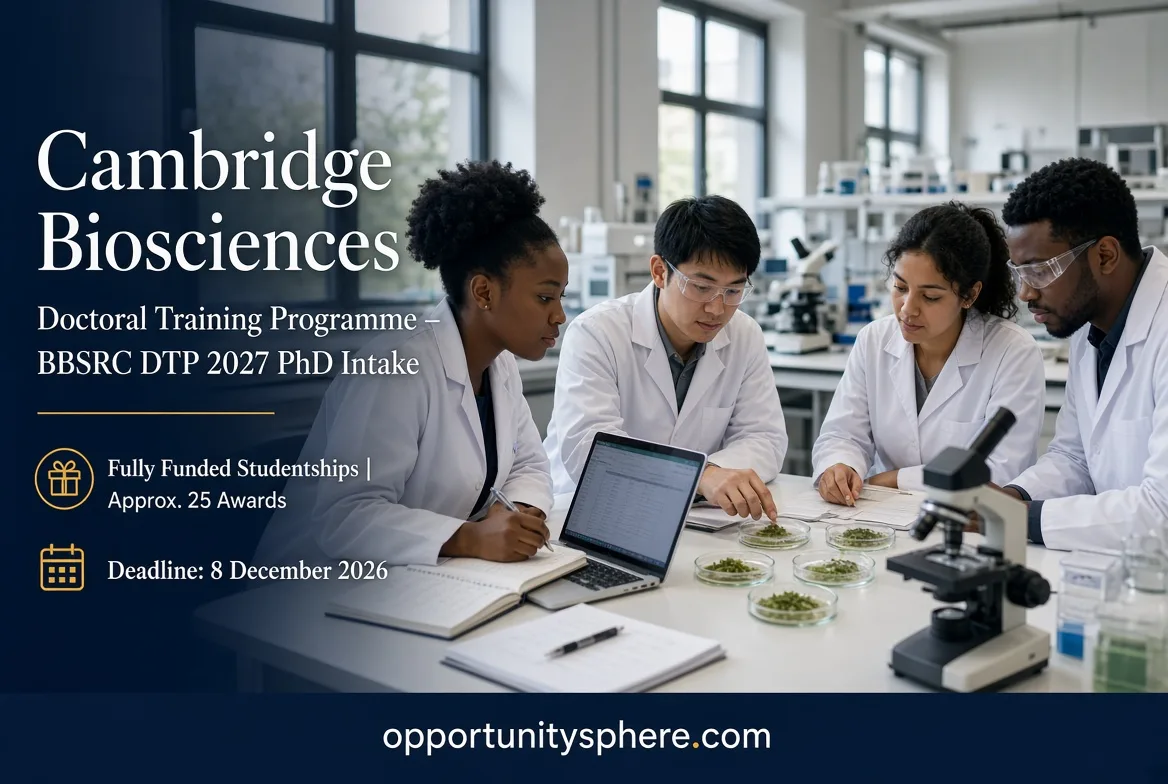
The Cambridge Biosciences Doctoral Training Programme (BBSRC DTP) at the University of Cambridge is accepting applications for its 2027 PhD intake. The programme offers research training across a wide range of biological sciences disciplines, bringing together University departments, research institutes and partner organisations.
Approximately 25 studentships are expected to be available through the programme's Targeted and Industrial Collaborative Awards in Science and Engineering (iCASE) routes. Successful candidates can undertake advanced doctoral research while receiving structured training intended to develop their scientific, research and professional skills.
The programme is designed for graduates who want to pursue a research career in the biosciences, including academic research, biotechnology, industry and related scientific fields.
Advertisement
Funding Benefits
Successful applicants offered a funded studentship can receive:
Full tuition fees: University tuition fees are covered under the studentship, subject to the award's terms.
Annual stipend: The published stipend is £21,805 for the 2026–2027 academic year. The amount applicable to the 2027 intake should be confirmed in the final funding offer.
Research support: Funding includes support for research costs associated with the studentship.
International student support: A limited number of studentships are available to eligible international applicants. Check the programme's current terms for details of eligible visa and health surcharge costs.
Funding is competitive, and not every applicant is guaranteed a studentship.
Who Can Apply?
The programme is intended for applicants with an appropriate academic background who wish to undertake a PhD in a relevant biological sciences research area.
Applicants should:
Hold, or be on track to obtain, suitable university qualifications for admission to a PhD programme at Cambridge.
Demonstrate a strong academic background relevant to their selected research project.
Show an interest in biological sciences research and the potential to undertake doctoral-level study.
Identify and review the available research projects before submitting an application.
Provide the required academic records, references and supporting documents through the official application portal.
Meet the University of Cambridge's course-specific admission and English-language requirements, where applicable.
International applicants, including applicants from Nigeria, may be eligible. However, international studentships are limited, so applicants should confirm the current funding and fee arrangements before applying.
Research Areas
The Cambridge Biosciences DTP covers a broad range of research areas across participating departments and institutes. Depending on the projects advertised for the 2027 intake, these may include:
Biological sciences and biotechnology
Molecular and cellular biology
Genetics and genomics
Biochemistry and microbiology
Plant and related life sciences
Other research areas aligned with the programme's bioscience themes
Applicants should select from the projects actually advertised for the 2027 intake rather than assume every discipline is available.
How to Apply
Visit the official Cambridge Biosciences DTP application page.
Review the available projects and the programme's eligibility requirements.
Select up to two preferred projects, following the programme's application instructions.
Begin the relevant University of Cambridge postgraduate application through its Applicant Portal.
Complete the application and upload all required documents, including academic information and references.
Review the application carefully and confirm that all required materials have been submitted before the deadline.
Applicants should read the project descriptions carefully and explain how their academic background, research interests and experience relate to their selected projects.
Application Tips
1. Choose your research project strategically.
Study the available project descriptions before applying. Select projects that closely match your academic background, research interests and previous experience. Avoid choosing a project solely because it sounds prestigious or because it is associated with a well-known university.
2. Demonstrate research readiness.
Use your application to show how your previous studies, dissertation, laboratory work, fieldwork, research projects or relevant professional experience have prepared you for doctoral research. Explain your contribution to any research work rather than simply listing activities.
3. Tailor your application to the selected project.
Clearly connect your research interests and relevant skills to the project's objectives and methods. If you have experience with techniques, data analysis, scientific writing or experimental design that relates to the project, explain this accurately.
4. Prepare a strong academic CV.
Include your qualifications, relevant research experience, dissertation or thesis topic, technical skills, publications where applicable, conference presentations, awards and relevant training. Keep the information accurate, clear and easy to assess.
5. Contact potential supervisors where appropriate.
Read the programme's instructions on contacting supervisors. If contact is encouraged or required, send a concise and professional message that identifies the project, explains your relevant background and asks a specific, thoughtful question. Do not send generic messages to multiple researchers.
6. Arrange references early.
Contact suitable academic referees well before the deadline. Choose people who can comment meaningfully on your academic ability, research potential, independence and suitability for doctoral study. Make sure they know the submission process and timing.
7. Check international funding conditions.
If you are applying from outside the UK, confirm whether the specific studentship is open to international applicants and what costs it covers. Do not assume that every project or award offers identical funding conditions.
8. Proofread every section before submission.
Check names, dates, qualifications, project selections and supporting documents. Make sure your statements are consistent across the application and that all required sections have been completed.
9. Submit before the deadline.
Aim to finish several days early in case you encounter portal problems or need to correct missing information. Follow the official instructions on whether references and other supporting materials must also arrive by the deadline.
Application Deadline
8 December 2026
The programme is recruiting for the 2027 intake, with the course expected to begin in October 2027. Applicants should verify the deadline and any requirements specific to their selected projects on the official website before submitting.
Important Notes
Admission to the PhD programme and the award of funding are competitive.
International studentships are limited; eligibility to apply does not guarantee full funding.
The stipend amount and funding conditions for the 2027 intake should be checked against the latest official information.
Research projects, eligibility requirements and application instructions may vary.
Applicants should rely on the official programme website for the latest information.
Frequently Asked Questions
1. Is the Cambridge Biosciences DTP PhD programme fully funded?
Successful studentship recipients receive funding according to their award terms, which may cover tuition fees, a stipend and research costs.
2. Can international students apply?
Yes. International applicants can be considered, but the programme has a limited number of international studentships. Applicants should confirm the conditions for their selected project.
3. What is the application deadline?
The advertised deadline for the 2027 intake is 8 December 2026. Check the official application page for confirmation.
4. When does the PhD programme begin?
The 2027 intake is expected to begin in October 2027.
5. How many studentships are available?
Approximately 25 studentships are expected across the programme's Targeted and iCASE routes.
6. Where should applicants apply?
Applicants should follow the instructions on the official Cambridge Biosciences DTP application page and submit the required application through the University of Cambridge Applicant Portal.
Related Opportunities
Explore other scholarships, fellowships, grants, research opportunities and more that may match your interests.