The application deadline for this opportunity has passed. You can still review the details, but the listing is no longer presented as open for applications.
Scholarship, Study Abroad
Chevening Scholarships 2027–2028
Offered by UK Foreign, Commonwealth & Development Office
Location
United Kingdom
Funding
Fully Funded
Study level
Master's
Field of study
All Fields
Application deadline
October 6, 2026
Application Closed
About This Scholarship
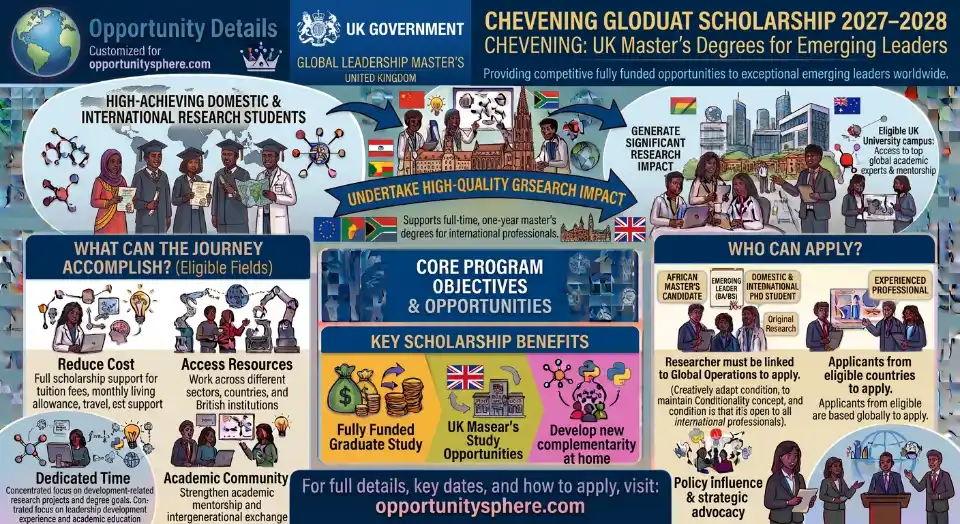
The Chevening Scholarship is the United Kingdom Government's international scholarship programme for individuals with leadership potential who want to pursue postgraduate study in the UK.
Funded by the Foreign, Commonwealth & Development Office and partner organisations, the programme enables eligible applicants to undertake a one-year Master's degree at a UK university while developing their academic knowledge, professional skills and international networks.
Chevening looks beyond academic qualifications alone. The programme seeks applicants who can demonstrate leadership, influence, professional experience and a clear vision for how their education will contribute to their future goals and their home country.
Successful scholars join a diverse international community of professionals and emerging leaders. Through their university studies and engagement with the Chevening community, they have opportunities to exchange ideas, build professional relationships and gain perspectives from people working in different sectors and countries.
The scholarship is particularly relevant to applicants who have gained meaningful experience after completing their undergraduate degrees and are ready to take the next step in their careers through specialised postgraduate education.
For the 2027–2028 academic year, applications opened on 4 August 2026 and closed on 6 October 2026 at 11:00 UTC. The application period has ended, so prospective applicants should monitor the official website for announcements about future application cycles.
Who Can Apply?
Chevening is open to citizens of eligible countries and territories who meet the programme's academic, professional and other eligibility requirements.
The scholarship is intended for people who can demonstrate leadership potential, build professional relationships and explain how their proposed Master's degree supports their long-term career plans.
Applicants do not need to hold a formal management position to demonstrate leadership. Relevant examples may come from professional responsibilities, community initiatives, voluntary activities, academic projects or other situations in which they have taken initiative and contributed to meaningful outcomes.
Advertisement
🔒Application Closed
The listed deadline has passed. Check the official website to see whether the organisation has announced an extension or a new application period.
Stay in the loop
Your Next Opportunity Could Be One Email Away
Receive updates about scholarships, jobs, internships, fellowships and grants so you can discover opportunities worth exploring.
Stay Updated
Never miss an opportunity.
Get updates on scholarships, jobs, internships, grants, fellowships, conferences, and other opportunities delivered straight to your inbox.
However, applicants must meet the formal eligibility requirements, including the required work experience, an eligible undergraduate qualification and a commitment to return to their country of award for at least two years after the scholarship ends.
Eligibility Criteria
Applicants for the 2027–2028 cycle were required to meet the following conditions.
1. Citizenship of an eligible country or territory
Applicants must be citizens of a country or territory covered by the relevant Chevening award.
Eligibility can vary according to the award and any special conditions published for a particular country or territory. Applicants should check the official country-specific page rather than assume that the same conditions apply everywhere.
2. Commitment to return home
Applicants must agree to return to their country of award for at least two years after their scholarship ends.
Chevening is designed to help scholars develop knowledge, skills and networks that they can use after returning home. Applicants should ensure that this commitment is compatible with their plans.
3. An eligible undergraduate degree
Applicants must hold an undergraduate qualification that meets the requirements for entry to a Master's programme at a UK university.
The qualification must satisfy the relevant university's admission requirements. Applicants should check both the scholarship criteria and the entry requirements of their intended courses.
4. At least 2,800 hours of eligible work experience
Applicants must have at least 2,800 hours of eligible work experience acquired after completing their undergraduate degree. This is approximately equivalent to two years of full-time work, but Chevening calculates eligibility using hours rather than simply counting calendar years.
Eligible experience can include full-time employment, part-time employment, voluntary work and paid or unpaid internships, subject to the programme's rules.
Applicants should enter their work history accurately and avoid counting the same period twice.
5. Applications to eligible Master's courses
Applicants must select three eligible Master's degree courses at UK universities in their Chevening application.
The courses should meet the programme's eligibility conditions and align with the applicant's academic background, professional experience and future plans.
Applicants must also apply to the universities separately and satisfy their individual admission requirements.
6. Leadership and networking potential
Applicants should demonstrate that they can influence others, develop productive professional relationships and contribute to their communities or sectors.
Strong examples explain the applicant's own actions, the challenges encountered and the results achieved. General claims about being a leader are less informative than specific evidence.
7. Compliance with other Chevening requirements
Applicants must satisfy the additional conditions applicable to their award and application cycle. These may include restrictions relating to previous study supported by certain UK Government-funded scholarships and other eligibility provisions.
Candidates should read the official eligibility guidance carefully before applying in a future cycle.
Scholarship Benefits
The Chevening Scholarship is designed to support eligible scholars throughout their Master's studies in the United Kingdom. The exact financial arrangements are governed by the applicable award terms.
1. Tuition fees
The scholarship covers eligible tuition fees for the approved Master's programme, subject to the award's terms and any applicable fee conditions.
Applicants should review the current scholarship guidance for the treatment of courses with fees above any applicable funding limit.
2. Monthly living allowance
Scholars receive a living allowance to help meet eligible living expenses during their studies in the UK.
The amount and payment arrangements are determined by the applicable scholarship terms. Applicants should budget carefully and consult their award documentation for the current allowance.
3. Travel costs
The scholarship includes eligible travel support associated with travelling to and from the United Kingdom under the programme's arrangements.
Scholars should follow the official instructions concerning travel booking and reimbursement.
4. Arrival and departure allowances
Applicable allowances may be provided to assist with eligible expenses associated with arriving in the UK and departing at the end of the scholarship.
The precise arrangements are subject to the award terms.
5. Visa-related support
The scholarship includes support for the cost of the required UK visa under the applicable terms.
Applicants should still follow the official visa process and provide the documentation required by the relevant authorities.
6. Chevening events and activities
Scholars may receive travel support for eligible Chevening events or activities, in accordance with programme arrangements.
These activities provide opportunities to engage with other scholars, professionals and members of the wider Chevening community.
7. International professional network
After completing the scholarship, scholars join the Chevening alumni community.
This network offers opportunities to maintain professional relationships and exchange knowledge with people working across different sectors and countries. Membership does not guarantee employment, funding or any particular career outcome.
Which Master's Courses Are Eligible?
Chevening Scholarships support eligible one-year Master's degrees at UK universities. Not every postgraduate course qualifies, so applicants must check the official course eligibility rules before selecting their programmes.
Applicants are required to choose three eligible courses in their scholarship application. They should select programmes that are academically appropriate and connected to their professional interests and future goals.
When comparing courses, applicants should consider:
The degree's relevance to their career plans.
The course content and areas of specialisation.
The university's entry requirements.
Whether the course meets Chevening's eligibility conditions.
The application deadline set by the university.
Whether the programme can be completed within the scholarship period.
Applicants should also check whether their selected courses have additional requirements, such as relevant professional experience, prerequisite qualifications or particular English-language standards.
Work Experience Requirements Explained
Work experience is a formal eligibility requirement and should not be treated as an optional advantage.
For the 2027–2028 cycle, applicants needed at least 2,800 hours of eligible experience gained after completing their undergraduate degree.
Experience could be accumulated through multiple eligible positions rather than one continuous period of employment. Chevening's application system calculates hours using the employment details supplied by applicants.
For example, an applicant may have combined paid employment, a part-time role and an eligible internship. Whether the total satisfies the requirement depends on the actual dates, hours and eligibility of each period.
Applicants should therefore prepare a reliable record of their employment and other eligible experience before completing the form.
It is also important to distinguish the minimum eligibility threshold from the strength of an application. Meeting the required hours allows an applicant to satisfy this condition, but does not guarantee selection.
How to Demonstrate Leadership and Networking Skills
Chevening evaluates applicants on their demonstrated qualities and achievements, not merely on job titles.
Applicants preparing for a future cycle should identify specific examples that show how they have taken initiative, influenced others or contributed to meaningful change.
Leadership examples may include coordinating a project, introducing an improvement at work, addressing a community problem, mentoring colleagues or taking responsibility for delivering a challenging task.
Networking examples may include building professional partnerships, bringing different groups together, maintaining productive working relationships or using connections to achieve a shared objective.
For each example, applicants should explain:
The situation or challenge.
Their personal responsibility.
The actions they took.
The result or impact of those actions.
What they learned and how they would apply that experience in the future.
The strongest examples are specific, accurate and supported by genuine experience. Applicants should not exaggerate their responsibilities or claim results they cannot substantiate.
Application Process
Applications for the 2027–2028 cycle are closed. The following steps describe the general process for reference and for applicants preparing for a future Chevening round.
Step 1: Check eligibility
Confirm that your country or territory is covered by the relevant award and that you satisfy the undergraduate qualification, work-experience and return-home requirements.
Step 2: Research eligible Master's courses
Identify three courses that fit your academic background and professional goals. Check each course against the official Chevening rules and the university's admission requirements.
Step 3: Prepare your work history
Gather accurate information about your employment, internships, voluntary work and other potentially eligible experience. Record the dates and hours worked so that you can complete the work-experience section correctly.
Step 4: Prepare leadership and networking examples
Identify genuine examples that demonstrate initiative, influence, collaboration and measurable contributions. Explain your own role rather than describing only what a team accomplished.
Step 5: Develop your career plans
Be ready to explain why you want to study your selected courses, what skills you hope to gain and how you intend to use them after returning to your country of award.
Step 6: Complete the online application
During an open application cycle, use the official Chevening application route for your country or territory. Complete each section carefully and follow the instructions provided by the application system.
Step 7: Submit the scholarship application
Review your entries for accuracy and completeness, then submit before the official deadline. The application system does not remain accessible indefinitely after the closing time.
Step 8: Apply separately to universities
Submit applications to your chosen UK universities and respond to any requests for additional documents. A Chevening application does not automatically constitute an application for university admission.
Step 9: Complete the selection stages
Eligible applications are reviewed, and shortlisted candidates may be invited to an interview at the relevant British embassy or high commission.
Candidates who progress must follow the official instructions for submitting supporting documents and preparing for the interview.
Step 10: Meet the university-offer deadline
For the 2027–2028 cycle, successful candidates were required to obtain and submit at least one unconditional offer from an eligible UK university course by the published deadline of 8 July 2027 at 17:00 UK time.
Applicants should always verify the deadline and any course-specific conditions in the official guidance for their cycle.
Selection Process and Timeline
Chevening is competitive, and meeting the eligibility requirements does not guarantee a scholarship.
For the 2027–2028 cycle, the published timeline included the following stages:
4 August 2026: Applications opened.
6 October 2026, 11:00 UTC: Applications closed.
October 2026: Applications began being checked against eligibility criteria.
Mid-October 2026 to January 2027: Reading committee assessments.
Mid-February 2027: Interview shortlisting.
March–April 2027: Interviews.
Mid-June 2027: Results announced.
8 July 2027: Deadline for submitting at least one unconditional UK university offer.
September/October 2027: Scholars expected to begin their studies.
These dates relate to the 2027–2028 cycle and may be updated by Chevening. Applicants should rely on official communications for any changes.
What Applicants Should Prepare for a Future Cycle
Prospective applicants can use the period before the next application window to strengthen their readiness.
Useful preparation includes:
Reviewing the official eligibility rules for their country or territory.
Building a clear record of eligible work experience.
Researching suitable Master's courses at UK universities.
Keeping academic records and qualification documents organised.
Developing accurate examples of leadership and networking.
Clarifying career objectives and plans for contributing after returning home.
Identifying potential referees and understanding the relevant reference requirements.
Monitoring official Chevening announcements for future application dates.
Preparation does not guarantee selection, but it can help applicants submit a more complete and considered application when the next cycle opens.
Frequently Asked Questions
1. Is the Chevening Scholarship fully funded?
Chevening is a fully funded scholarship programme for eligible one-year Master's study, with benefits governed by the applicable award terms. The package includes eligible tuition fees, a living allowance and specified travel and other support.
2. Are applications for 2027–2028 still open?
No. The application deadline was 6 October 2026 at 11:00 UTC. Applications for the 2027–2028 cycle are closed.
3. Can applicants from Nigeria apply?
Nigeria is a Chevening-eligible country. However, the 2027–2028 application round is closed. Nigerian applicants interested in a future cycle should consult the official Chevening Nigeria page for updated eligibility and application information.
4. How much work experience is required?
Applicants needed at least 2,800 hours of eligible work experience gained after completing their undergraduate degree for the 2027–2028 cycle.
5. Can voluntary work and internships count?
Eligible voluntary work, paid or unpaid internships, and full-time or part-time employment may count, subject to Chevening's rules and the accuracy of the information provided.
6. Do I need to choose a university before applying?
Applicants are required to select three eligible Master's courses in their Chevening application. They must also apply separately to the universities and meet their admission requirements.
7. Does Chevening cover undergraduate study?
No. Chevening Scholarships support eligible Master's degrees, not undergraduate degrees.
8. Is there an age limit?
Chevening's general eligibility guidance states that there is no upper age limit. Applicants must still satisfy all other applicable requirements.
9. Does receiving a Chevening Scholarship guarantee a UK university admission offer?
No. Scholarship selection and university admission are separate processes. Candidates must meet the requirements of their selected courses and obtain the required university offer.
10. Must scholars return to their home country?
Scholars must commit to returning to their country of award for at least two years after the scholarship ends, in accordance with Chevening's conditions.
The Chevening Scholarship offers eligible applicants an opportunity to pursue a one-year Master's degree in the United Kingdom with substantial financial support and access to an international professional network.
The programme places considerable emphasis on leadership, professional experience, academic readiness and the applicant's plans after completing their studies. Candidates considering a future application should begin by checking their eligibility, recording their work experience accurately and researching suitable Master's courses.
Applications for the 2027–2028 cycle closed on 6 October 2026. Prospective applicants should monitor the official Chevening website for announcements about the next application cycle and use the latest published requirements when preparing their submissions.
Related Opportunities
Explore other scholarships, fellowships, grants, research opportunities and more that may match your interests.