The application deadline for this opportunity has passed. You can still review the details, but the listing is no longer presented as open for applications.
Job
Gender and Protection Advisor
Offered by International Humanitarian Organization
Location
International
Funding
Paid
Study level
Professional
Field of study
Development Studies, Social Sciences, Communication & Media
Application deadline
October 10, 2026
Application Closed
About This Job
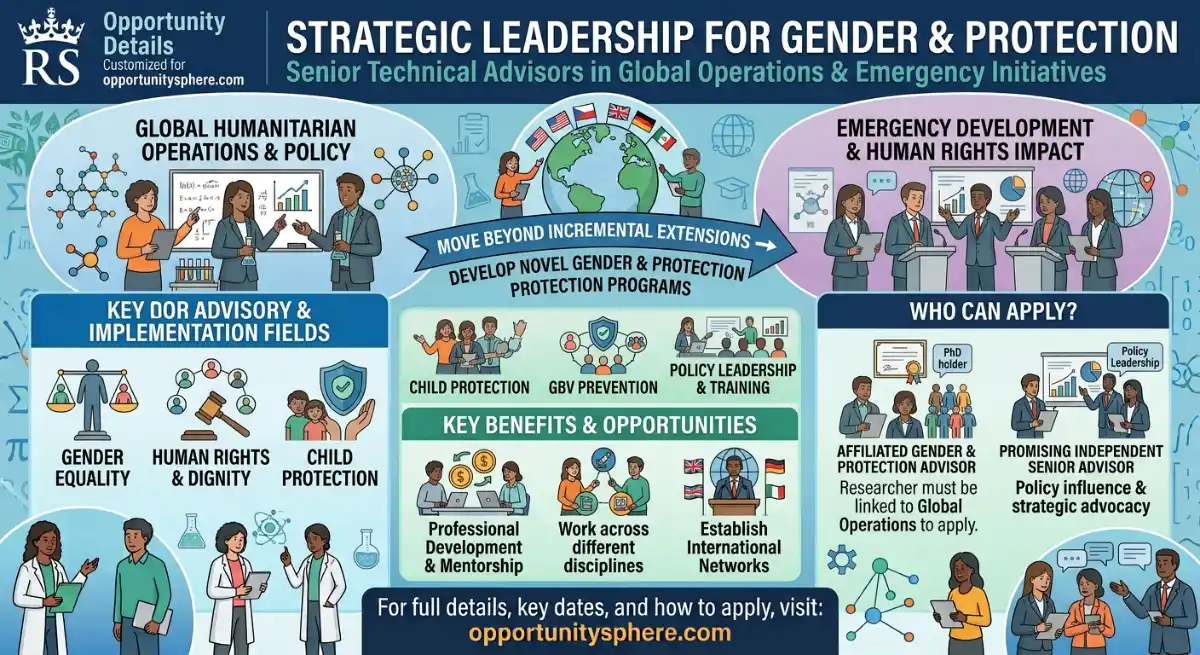
The Gender and Protection Advisor position represents a critical senior technical role within global humanitarian operations, conflict mitigation efforts, and emergency development initiatives. This strategic vacancy is officially open to both national and international experts who bring a robust combination of advisory expertise, field implementation experience, and policy-level leadership in gender equality, human rights, child protection, and Gender-Based Violence (GBV) prevention.
1. Comprehensive Executive Opportunity Summary
Parameter
Operational Specification
Position Title
Senior Gender and Protection Advisor
Operational Sector
Humanitarian Response, Human Rights, & Protection Mainstreaming
Recruitment Scope
Open to National and International Candidates
Contract Duration
12-Month Renewable Contract (Subject to Funding & Performance)
Employment Status
Full-Time Professional Salaried Staff
Application Deadline
October 10, 2026
Primary Location
Field-Based Country Office (with frequent hardship field site travel)
In modern complex emergencies, armed conflicts, natural disasters, and prolonged socio-economic crises, vulnerable populations—specifically women, girls, children, elderly persons, and individuals with disabilities—suffer disproportionately from violence, exploitation, discrimination, and denial of basic human services.
The mission of the Gender and Protection Advisor is to provide cross-cutting technical oversight, institutional direction, and quality assurance across all active sector interventions. The Advisor serves as the primary technical authority ensuring that every emergency response activity adheres strictly to the Inter-Agency Standing Committee (IASC) Gender in Humanitarian Action guidelines, the Core Humanitarian Standard (CHS), Protection Against Sexual Exploitation and Abuse (PSEA) protocols, and the Do No Harm principles.
3. Detailed Core Accountabilities & Key Performance Areas
Strategic Technical Leadership & Program Quality
Provide strategic leadership to country management and project directors to ensure protection mainstreaming, GBV risk mitigation, and gender equality are systematically integrated into all emergency operations (WASH, Health, Nutrition, Shelter, Cash Assistance, and Education).
Conduct baseline gender analysis, socio-cultural assessment, and protection risk mapping prior to project startup to identify specific vulnerabilities, power dynamics, and barriers to access.
Develop, roll out, and monitor contextualized protection SOPs, safety audit tools, and risk management matrices for field operational teams.
Design comprehensive training curricula on Gender Mainstreaming, Protection Principles, Safe Identification and Referral, PSEA, and Child Safeguarding for staff, local NGO partners, and community leaders.
Organize structured technical workshops for national protection officers, establishing tailored peer mentorship plans to strengthen local institutional capacity and sustainability.
Facilitate briefing sessions for incoming international personnel, contractors, and field consultants on context-specific protection protocols and mandatory ethical behavioral codes.
Monitoring, Evaluation, Accountability, and Learning (MEAL) Integration
Collaborate directly with MEAL departments to establish disaggregated data systems (Sex, Age, and Disability Disaggregated Data
SADDD) across all monitoring mechanisms.
Lead routine safety audits, beneficiary feedback reviews, and protection impact evaluations at community distributions and service points.
Synthesize qualitative and quantitative research into actionable policy recommendations, publishing technical learning briefs and success stories for global distribution.
Represent the organization in national and sub-national coordination mechanisms, including the Protection Cluster, GBV Sub-Cluster, Child Protection Area of Responsibility (AoR), and national PSEA Networks.
Build strategic bilateral relationships with UN agencies (UN Women, UNHCR, UNICEF, UNFPA), national ministries, local civil society organizations, and international donors.
Produce high-quality technical inputs for multi-million-dollar donor proposals, grant modifications, and quarterly statutory reporting requirements (ECHO, USAID/BHA, FCDO, GAC).
Emergency Rapid Response & Field Surge Capacity
Deploy on rapid assessment missions immediately following sudden-onset emergencies or violent escalations to evaluate protection risks and identify immediate emergency needs.
Lead the rapid establishment of safe spaces, child-friendly spaces, and gender-sensitive community feedback mechanisms in newly established displacement camps or informal settlements.
Advanced Degree: Master’s degree (or foreign equivalent) in Gender Studies, International Human Rights Law, Humanitarian Action, Social Work, International Relations, Development Sociology, or a closely aligned discipline.
Alternative Qualification Track: A Bachelor’s degree in a relevant social science discipline combined with a minimum of 10 years of direct, verified field advisory experience in complex humanitarian settings may be considered in lieu of a Master's degree.
Professional Work Experience & Field Exposure
Substantive Experience: Minimum of 7 years of progressively responsible professional experience in designing, implementing, and advising on gender and protection programs within INGOs or UN agencies.
Field Operations: Minimum of 3 years of direct on-the-ground operational experience in complex, high-risk, or conflict-affected emergency environments.
Budget & Team Management: Demonstrated track record of managing technical staff teams, overseeing project budgets, and supervising field assessments.
Technical Proficiencies & Specialized Knowledge
Framework Expertise: Advanced knowledge of international humanitarian legal frameworks, the 1951 Refugee Convention, CEDAW, UN Security Council Resolution 1325 (Women, Peace, and Security), and IASC Gender Guidelines.
GBV & PSEA Mastery: Deep operational knowledge of GBV referral pathways, clinical management of rape guidelines, psychosocial support protocols, and survivor-centered approaches.
Data Analysis & Assessment: Expertise in utilizing technical software (Kobo Toolbox, SPSS, QGIS, or PowerBI) for protection assessment analysis and spatial risk mapping.
Core Behavioral Competencies & Soft Skills
Cross-Cultural Diplomacy: Proven ability to navigate delicate cultural nuances, negotiate with local authorities, and foster trust among marginalized community members.
Stress Management & Resilience: Ability to maintain operational focus, sound analytical judgment, and emotional stability in volatile, dynamic, and security-restricted environments.
Multilingual Proficiency: Excellent command of professional written and spoken English. Strong working knowledge of French, Arabic, Spanish, or relevant regional dialects is considered a major asset.
Competitive Salary: Senior-level baseline international/national salary scale commensurate with qualifications, experience, and institutional pay grades.
Annual Leave Entitlement: 30 paid working days of annual leave per full calendar year of employment.
Insurance, Health, & Welfare Coverages
Full Medical Coverage: Comprehensive international health insurance including primary care, hospitalization, specialist access, and dental/vision benefits.
Emergency Medevac: 100% covered emergency medical evacuation insurance for international staff and eligible dependents residing in hardship locations.
Life & Disability Insurance: Full occupational hazard, life, and short/long-term disability coverage.
Operational & Duty Station Allowances
Hardship Allowance: Tiered financial hardship supplement calculated according to the assigned duty station’s official security and quality-of-life rating.
Rest & Recuperation (R&R): Fully paid R&R travel allowance and leave cycles (e.g., 6-week or 8-week cycles depending on duty station classification).
Housing & Relocation: Comprehensive relocation flight coverage, shipment of personal effects, and monthly housing stipend or secure compound accommodation provided.
Review Detailed Job Specifications: Thoroughly review the complete terms of reference to verify that your specific technical focus matches the duty station requirements.
Determine Application Channel: Verify whether you qualify under the National recruitment track (citizens or legal residents with full work authorization) or the International recruitment track.
Tailor Your Curriculum Vitae (CV): Format your CV chronologically, detailing technical duties, quantifiable grant budgets managed, number of staff mentored, and specific inter-agency clusters chaired.
Prepare a Targeted Motivation Letter: Write a maximum 2-page letter outlining your core humanitarian philosophy, field-proven emergency experiences, and specific suitability for this role.
Compile Certified Supporting Documents: Scan and combine certified copies of your university degrees, language proficiency certificates, and relevant professional references.
Complete Online Submission: Submit your complete application bundle through the official talent portal before the strict deadline of October 10, 2026.
Stage 1 – Automated & HR Screening: Applications are vetted against basic eligibility prerequisites, academic criteria, and minimum required years of field experience.
Stage 2 – Technical Written Assessment: Shortlisted candidates undertake a 48-hour timed technical assignment designed to evaluate rapid gender analysis skills, PSEA incident handling, and protection concept note drafting.
Stage 3 – Technical Competency Interview: Successful candidates appear before a joint panel consisting of Technical Directors, HR Leads, and Regional Protection Experts to defend their written submission and answer situational scenario questions.
Stage 4 – Peer & Leadership Oral Presentation: Finalists deliver a 15-minute strategic presentation on a simulated emergency protection context to senior operations managers.
Stage 5 – Background Vetting & Offer: Verification of past employment history, academic credential authentication, complete reference checks, and mandatory screening against global safeguarding/PSEA registers prior to final contract issuance.
Zero-Tolerance Policy
The hiring organization maintains an absolute zero-tolerance policy towards any form of sexual exploitation, abuse, harassment, fraud, corruption, or child abuse. All staff members are subject to strict pre-employment screening and continuous monitoring.
Protection Against Sexual Exploitation and Abuse (PSEA)
All employees are legally bound by the organizational Code of Conduct and PSEA principles. Any substantiated breach results in immediate summary dismissal, potential criminal referral to host nation authorities, and blacklisting in the global Misconduct Disclosure Scheme.
Equal Opportunity Employer Statement
Qualified female candidates, persons with disabilities, and individuals from marginalized backgrounds are strongly encouraged to apply. The organization is committed to maintaining a diverse, inclusive, and accessible working environment free of discrimination.
9. In-Depth CV & Motivation Letter Optimization Guidelines
How to Structure Your CV for Senior Advisory Positions
Technical Summary: Start with a 3-sentence summary highlighting your total years of advisory experience, primary emergency contexts (e.g., East Africa, MENA, South Asia), and core protection sectors mastered.
Quantifiable Impact: Use concrete numbers when listing achievements (e.g., "Trained 450+ national field staff across 6 field bases," "Mainstreamed GBV risk mitigation into a $15M multi-sectoral WASH/Food Security grant").
Clear Role Distinction: Clearly differentiate between field implementation roles (e.g., Protection Officer) and technical advisory roles (e.g., Regional Protection Advisor).
How to Frame Your Motivation Letter
Paragraph 1: State the specific position title, your current professional standing, and your motivation for applying.
Paragraph 2: Highlight a complex field situation where your technical advice directly mitigated a severe protection risk or improved gender equality outcomes.
Paragraph 3: Demonstrate your familiarity with current inter-agency protection frameworks, humanitarian reform debates, and donor priorities.
Paragraph 4: Reiterate your operational readiness for emergency deployment and confirm your availability status.
Q1: Can national staff apply for international postings under this vacancy notice? A: Yes. National staff from any country who meet the international experience requirements, possess advanced language proficiencies, and are willing to relocate internationally are fully eligible to apply for international contract terms.
Q2: Is relocation assistance provided for accompanying family members?
A: Relocation support for dependents depends directly on the duty station's official security classification. Family duty stations provide dependent flight, housing, and schooling allowances, whereas non-family (hardship) duty stations restrict accompanying family members.
Q3: What specific written exercise format is used during Stage 2?
A: The assessment typically presents a realistic scenario involving an emergency displacement context. You will be asked to draft a 3-page Protection Strategy, identify immediate GBV referral gaps, and create a protection mainstreaming matrix for cash-based interventions.
Q4: How long does the complete recruitment and selection process take?
A: The standard recruitment timeline from the closing date (October 10, 2026) to the final offer issuance usually spans between 6 to 8 weeks due to the multi-stage assessment and comprehensive background checks.
Q5: Are candidate expenses reimbursed for panel interviews?
A: All technical assessments and panel interviews are conducted virtually via secure video conference platforms, eliminating travel costs for applicants.
Q6: What is the expected proportion of field travel versus office work?
A: The Advisor position typically requires approximately 40% to 50% field travel time to conduct site assessments, monitoring visits, safe audits, and community consultations across regional bases.
Q7: Can I apply if my Master's degree is currently in progress?
A: You must possess your finalized degree certificate at the time of application submission unless you meet the alternative Bachelor's degree qualification track with 10+ years of verified field experience.
Q8: How does the organization ensure survivor confidentiality in protection reporting?
A: All data management and incident reporting systems utilize strict end-to-end encryption, anonymized tracking codes, and controlled access levels adhering strictly to global GBV Information Management System (GBVIMS) standards.
Related Opportunities
Explore other scholarships, fellowships, grants, research opportunities and more that may match your interests.