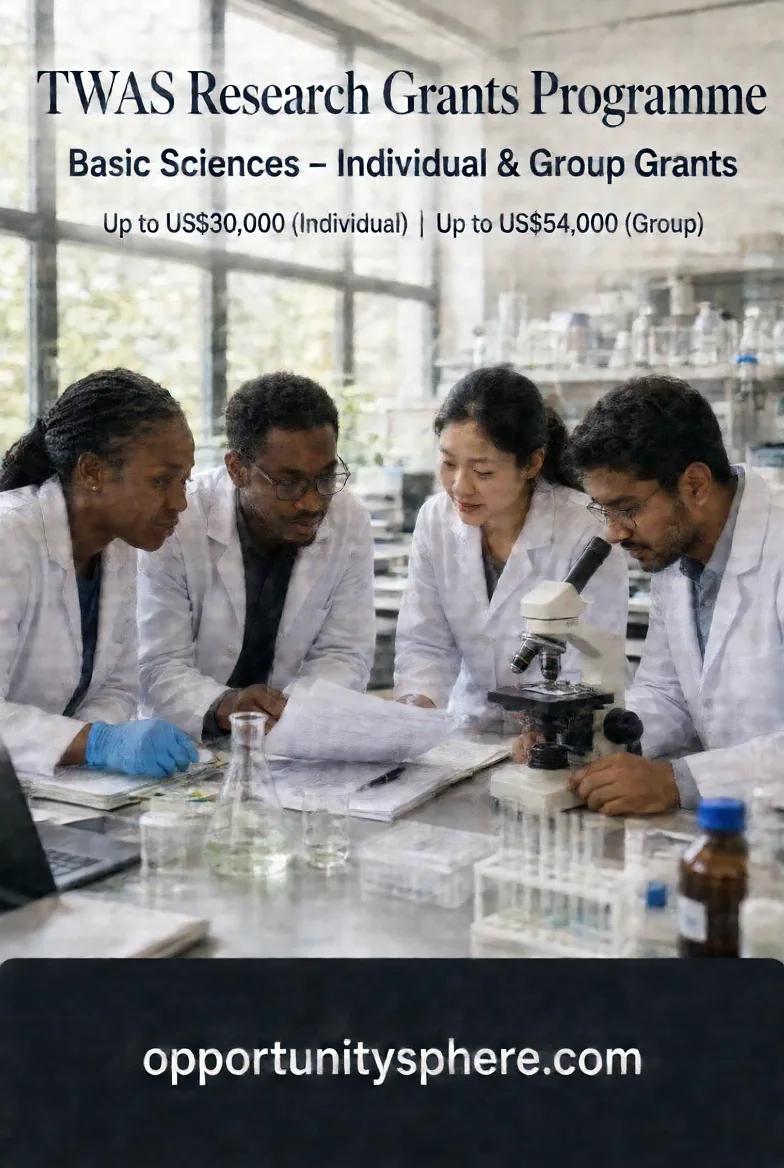
🔬 TWAS Research Grants Programme: Up to US$54,000 for Scientific Research in Developing Countries
Offered by The World Academy of Sciences (TWAS)
Location
Eligible developing countries, subject to the specific grant scheme
Funding
Fully Funded
Study level
PhD, Researchers, Postdoctoral
Field of study
Life Sciences, Physical Sciences, Mathematics & Statistics
Application deadline
Not specified
About This Grant
The World Academy of Sciences (TWAS) supports scientific research and research capacity in developing countries through grant programmes designed to strengthen scientific institutions, improve research facilities and enable scientists to investigate important scientific questions.
One of its established funding schemes is the TWAS Research Grants Programme in Basic Sciences, supported by the Swedish International Development Cooperation Agency (Sida). The programme has historically supported research in biology, chemistry, mathematics and physics, with funding available through two main routes: individual grants for eligible early-career scientists and group grants for qualifying research units.
These grants are particularly relevant to researchers working in countries where access to specialised scientific equipment and research materials may be limited. Rather than providing a personal scholarship for university tuition, the programme funds eligible research activities and approved scientific resources.
💰 How Much Funding Is Available?
The published programme guidelines describe two funding categories:
Individual Research Grants: Up to US$30,000 for eligible individual scientists conducting research in the specified basic sciences.
Research Group Grants: Up to US$54,000 for eligible research units working within qualifying universities or research institutions.
Under the published guidelines, grants normally support projects over a period of 24 months. Individual grants may allocate up to US$20,000 towards equipment and consumable supplies, while group grants may allocate up to US$40,000 for these purposes.
Eligible expenditure can include approved scientific equipment, laboratory consumables and specialised scientific literature, such as textbooks and conference proceedings. The programme does not ordinarily cover researchers' or students' salaries, field expenses, travel costs, laptops, tablets, drones or laboratory animals under the published Basic Sciences grant rules.
The stated amounts describe the established programme terms and should not be interpreted as a guarantee that the next call will retain identical funding limits. Applicants must check the guidelines for any future round before preparing a budget.
The Basic Sciences Research Grants focus on four main disciplines:
Biology: Research into living organisms, biological processes and related scientific questions.
Chemistry: Studies involving chemical substances, reactions, materials and analytical methods.
Mathematics: Research addressing mathematical theories, models and applications.
Physics: Investigations into physical processes, matter, energy and related scientific principles.
The research proposal must fit the scope of the relevant grant scheme. Scientists working in agriculture, medicine, environmental science, engineering or other interdisciplinary areas should not assume that their projects qualify under the Basic Sciences call simply because they involve scientific research. They should check whether a separate TWAS programme is more appropriate.
👩🔬 Who Can Apply?
The individual grant route is intended for early-career scientists who have already obtained a PhD and have some research experience. Applicants must meet the programme's nationality, institutional and age requirements.
The group grant route is designed for qualifying research units based at eligible universities or research institutions. It is not a general-purpose grant for any student group or informal research collaboration.
Both routes are subject to the programme's list of eligible science-and-technology-lagging countries. Eligibility must be established from the official country list and the applicable guidelines rather than assumed from a country's developing-country status alone.
📋 Eligibility Requirements for Individual Researchers
According to the published Basic Sciences guidelines, individual applicants must generally:
Be nationals of eligible developing countries identified by TWAS for the programme.
Hold a PhD and be at the beginning of their research careers, with some research experience already demonstrated.
Hold a position at a university or research institution in an eligible science-and-technology-lagging country.
Be 45 years old or younger.
Propose a research project within the programme's approved basic science disciplines.
Not hold an active TWAS or OWSD research grant at the time of application.
Applicants must also prepare a strong research proposal and satisfy any additional requirements specified in the next official call. Women scientists and researchers working in least-developed countries have been particularly encouraged under the published scheme.
🏛️ Eligibility Requirements for Research Groups
The group grant route has different requirements from the individual award. A qualifying research unit must operate within an eligible university or research institution in a designated country. It must be led by a suitably experienced principal investigator who holds a PhD and is a national of a developing country.
The published guidelines specify a research unit comprising the principal investigator, at least two additional PhD-qualified researchers, and other appropriate team members such as doctoral and master's students or technical personnel. The principal investigator must meet the scheme's experience and institutional requirements.
Research units should confirm the precise composition, institutional documentation and other conditions in the official guidelines before preparing a submission. The group grant has no age limit for the unit leader under the published programme terms, although other eligibility requirements remain applicable.
📝 How to Prepare a Competitive Research Proposal
Although the next call has not been announced, prospective applicants can use the waiting period to develop a research project that is scientifically rigorous, feasible and relevant to their institution's needs.
1. Define the research problem. Identify a specific scientific question, explain why it matters and establish what existing research has not yet resolved.
2. Demonstrate the scientific contribution. Review relevant literature and explain how the proposed study could generate new knowledge or strengthen research capacity in the applicant's country.
3. Develop a realistic methodology. Describe the research design, experimental procedures or analytical methods, expected outputs and approach to evaluating the results.
4. Prepare an itemised budget. Link each requested item to a clearly explained research need. Ensure that equipment and consumables fall within the scheme's permitted expenditure categories.
5. Explain the institutional benefit. Show how the proposed resources will strengthen research capability at the host institution and support the project's objectives.
6. Plan the research schedule. Develop a realistic work plan for the proposed grant period, taking into account equipment procurement, experiments, data analysis and reporting.
For group applications, the proposal should also explain the responsibilities of the participating researchers and how the team will coordinate the project. Applicants should avoid requesting costs that the programme expressly excludes.
🖥️ How to Apply
The next standard Basic Sciences Research Grants call has not been announced, so applications should not be submitted on the assumption that the previous application window remains open.
When a new call is published, eligible researchers should:
Visit the official TWAS Research and Project Grants page.
Select the appropriate individual or research group grant scheme.
Read the current guidelines, including country eligibility, academic qualifications, age requirements where applicable and permitted expenditure.
Prepare the research proposal, budget and institutional documents required for that round.
Submit the application through the official online application system during the published application window.
Retain confirmation of submission and follow the programme's instructions for any subsequent communication or reporting requirements.
Researchers who need clarification about the established programme can consult the TWAS Research Grants Office through the contact information provided on the official website.
🌍 Why This Programme Matters for Researchers in Developing Countries
Access to specialised scientific equipment and laboratory materials can be a major barrier to research productivity. By supporting approved research resources, TWAS grants have been designed to help eligible scientists and institutions strengthen their ability to undertake scientific investigations.
For universities and research institutions, these resources may contribute to more consistent experimental work, improved research capacity and opportunities to train postgraduate researchers. However, the value of a grant depends on the quality of the proposal, the suitability of the requested resources and the programme's selection criteria.
The opportunity is therefore most appropriate for researchers who already have a clear project and an eligible institutional base, rather than students seeking general financial assistance for their studies.
❓ Frequently Asked Questions
Is the TWAS Research Grants Programme currently accepting applications?
The official TWAS website states that the standard Basic Sciences Research Grants will not open in 2026. The next call has not been confirmed. Prospective applicants should monitor the official programme page for updates.
Can a PhD student apply for an individual grant?
The published individual scheme requires applicants to hold a PhD, have research experience and meet the other eligibility conditions. Being enrolled in a PhD programme alone does not satisfy this requirement.
Can Nigerian researchers apply?
Applicants must check whether Nigeria and their host institution meet the eligibility conditions for the particular call. Eligibility should be confirmed against the official country list and programme guidelines before preparing an application.
Does the grant pay the researcher's salary?
The published Basic Sciences guidelines exclude researchers' and students' salaries. Funding is intended for specified research resources and other approved expenditure.
Can the funding be used for travel or fieldwork?
The published Basic Sciences grant rules exclude travel and field expenses. Applicants should consult the current guidelines for the exact list of permitted and prohibited costs.
Is the grant fully funded?
This is a research grant, not a personal scholarship. It provides funding for approved project expenses up to the relevant award limit. It does not necessarily cover every cost associated with conducting research.
📅 Current Application Status
The standard TWAS Research Grants Programme in Basic Sciences is not opening in 2026. No next application deadline has been confirmed. The published individual and group grant pages contain information about the established schemes, but their previous application dates must not be treated as future deadlines.
Researchers interested in this opportunity should monitor the official TWAS website and review any newly published call before applying.
Related Opportunities
Explore other scholarships, fellowships, grants, research opportunities and more that may match your interests.