The application deadline for this opportunity has passed. You can still review the details, but the listing is no longer presented as open for applications.
Grant
Royal Society International Exchanges – Round 3
Offered by The Royal Society
Location
United Kingdom/International
Funding
Fully Funded
Study level
Postdoctoral, Researchers
Field of study
Natural Sciences
Application deadline
September 24, 2026
Application Closed
About This Grant
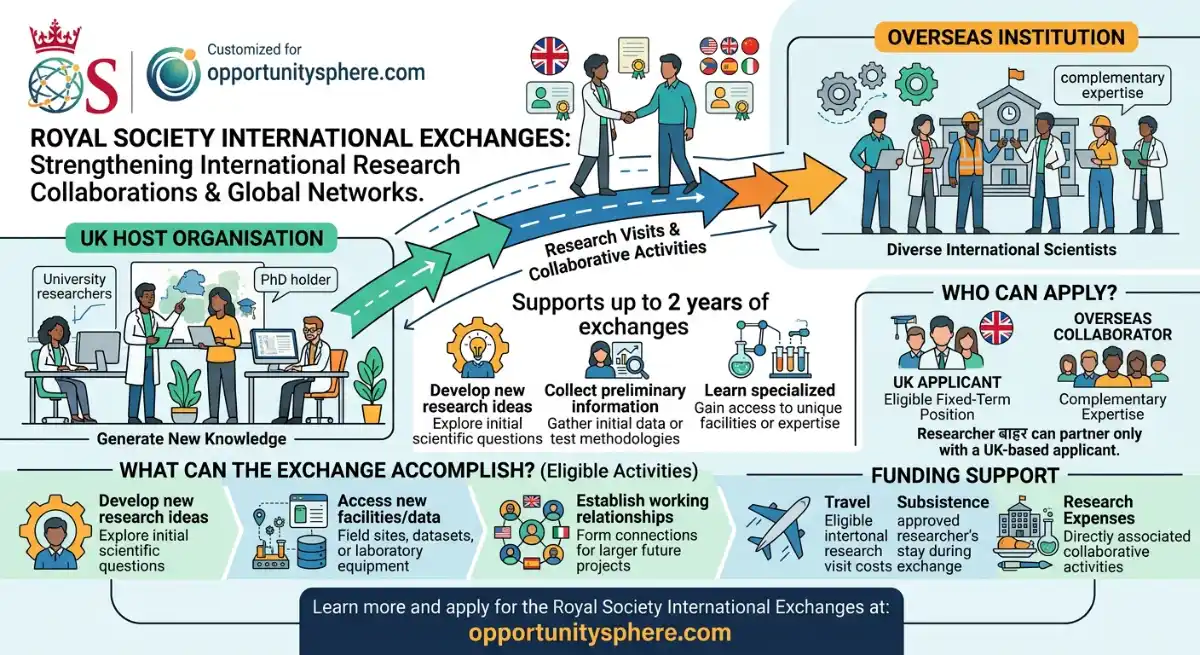
The Royal Society International Exchanges scheme supports researchers based in the United Kingdom who want to establish, develop or strengthen research collaborations with scientists and researchers in other countries.
The programme is designed around the idea that international research partnerships can provide access to expertise, facilities, knowledge and research environments that may not be available within a researcher's home institution.
Rather than being a conventional degree scholarship or a long-term overseas fellowship, International Exchanges funding is intended to support research visits and collaborative activities between UK-based researchers and overseas partners.
A funded exchange may allow researchers to visit a collaborating institution abroad, host an overseas collaborator, or undertake a combination of eligible exchange activities, depending on the rules of the particular funding round.
These exchanges can be useful at an early stage of a collaboration. Researchers may use the opportunity to develop a new research idea, collect preliminary information or data, test a methodology, learn a technique, access specialist expertise or establish the working relationship needed for a larger future project.
For researchers who already have an international collaborator, the scheme can also provide support for strengthening an existing research relationship.
What is the purpose of an International Exchange?
International research collaboration often begins with relatively small activities.
Researchers may have identified a common scientific problem but have not yet worked together closely enough to develop a substantial joint project.
An exchange can provide the opportunity to move from an initial academic connection to practical collaboration.
For example, researchers might use a visit to:
Discuss and refine a joint research question
Develop a research methodology
Learn a specialist laboratory or analytical technique
Collect preliminary data
Advertisement
🔒Application Closed
The listed deadline has passed. Check the official website to see whether the organisation has announced an extension or a new application period.
Stay in the loop
Your Next Opportunity Could Be One Email Away
Receive updates about scholarships, jobs, internships, fellowships and grants so you can discover opportunities worth exploring.
Stay Updated
Never miss an opportunity.
Get updates on scholarships, jobs, internships, grants, fellowships, conferences, and other opportunities delivered straight to your inbox.
The emphasis is therefore on creating meaningful scientific interaction rather than simply funding international travel.
Who can apply?
The scheme is primarily intended for scientists based in eligible UK organisations.
Applicants generally need to hold a PhD or equivalent research experience and an eligible fixed-term or permanent position at an organisation that satisfies the Royal Society's requirements.
The UK researcher acts as the applicant under the scheme, while the overseas researcher participates as the international collaborator.
This distinction is important for researchers outside the United Kingdom.
An overseas scientist who is interested in participating in an exchange would generally need to collaborate with an eligible UK-based researcher rather than submitting an independent application through the UK applicant route.
Prospective applicants should always check the current call because institutional eligibility, career-stage requirements and other conditions can vary between funding rounds.
The overseas collaborator
The international partner is a central part of the application.
Applicants should identify a researcher whose expertise complements their own and develop a clear reason for working together.
The strongest collaborations are likely to be those where each researcher contributes something meaningful to the proposed research.
This could involve differences in:
Scientific expertise
Research methodology
Equipment or laboratory facilities
Data
Field sites
Research populations
Analytical techniques
Geographic knowledge
Theoretical approaches
The application should make the relationship between the two researchers understandable rather than simply naming an overseas institution.
What can the exchange accomplish?
An international visit can be particularly valuable when the research is at a stage where direct interaction will make a substantial difference.
For instance, a researcher may have developed an idea that requires access to a particular technique available only at the collaborating institution.
Another researcher may have preliminary results that need to be discussed with a specialist overseas before a larger research programme is designed.
In other cases, the main objective may be to establish whether two research groups can work effectively together before pursuing a major international grant.
This makes the scheme particularly relevant to researchers who have a promising collaboration but need resources to turn the relationship into active research.
Funding support
The scheme can provide support for eligible costs associated with the exchange activities.
Depending on the specific funding round and approved project, support may include:
Travel: Costs associated with eligible international research visits.
Subsistence: Support connected with the researcher's stay during an approved exchange.
Research expenses: Eligible costs directly associated with the collaborative research activities.
The precise amounts, eligible expenditure categories and funding limits should be checked in the current Royal Society call before preparing a budget.
A useful opportunity for building new collaborations
One of the practical advantages of an international exchange is that it allows researchers to develop a relationship through direct academic interaction.
Email correspondence and virtual meetings can be useful for maintaining collaborations, but they do not always provide the same opportunity for researchers to work side by side.
A research visit can allow collaborators to spend concentrated time discussing their work, examining data, developing experiments and planning future studies.
This can be particularly valuable when the researchers are considering a longer-term partnership.
Developing preliminary research
The scheme can also be useful for researchers who are not yet ready to apply for a large international research grant.
A short exchange can provide an opportunity to generate preliminary evidence or refine the research question before developing a much larger project.
For example, collaborators might use the exchange to:
Develop a pilot methodology.
Collect preliminary observations.
Test a research protocol.
Compare research findings from different locations.
Evaluate whether a proposed research approach is feasible.
Develop the evidence needed for a larger funding application.
The exchange therefore has the potential to act as a starting point for more substantial collaborative research.
International research partnerships
Researchers increasingly work across national boundaries because scientific questions often require expertise and resources from multiple locations.
International collaboration can be particularly useful when a research question involves geographical variation, specialised facilities or expertise concentrated in a particular country.
The International Exchanges scheme provides a mechanism for researchers to establish these relationships through direct research interaction.
For early-stage collaborations, the experience can help both partners determine how their expertise fits together and what a larger joint research programme might look like.
What should the research proposal explain?
The proposal should clearly establish why the exchange is necessary.
Applicants should consider explaining:
The scientific question or problem
The background to the proposed research
The expertise of the UK researcher
The expertise of the overseas collaborator
Why the two researchers need to work together
What activities will take place during the exchange
Why the proposed visit or visits are appropriate
What research outputs are expected
How the collaboration could develop afterwards
The proposal should connect the planned activities with concrete research objectives.
Simply stating that an overseas visit will provide an opportunity to "network" is unlikely to explain the scientific purpose of the exchange adequately.
Examples of collaborative activities
The precise activities will depend on the discipline and project, but an exchange could potentially involve activities such as:
Laboratory research
Field research
Data collection
Data analysis
Method development
Training in specialist techniques
Research planning
Joint experiments
Academic workshops
Development of joint publications
Preparation of future grant proposals
Applicants should ensure that proposed activities comply with the current scheme's eligibility rules.
Duration of the exchange
International Exchanges may involve one-off visits or multiple visits, with the overall collaboration potentially extending over a period of up to two years, depending on the relevant funding round.
This flexibility can be useful because not every collaboration requires the same type of international engagement.
A project may benefit from one concentrated visit, while another may require researchers to meet at different stages of the research process.
Applicants should check the current call for the permitted duration, visit arrangements and any restrictions applicable to their proposed project.
Benefits for the UK researcher
Participation can provide researchers with opportunities to:
Establish an international research partnership
Gain access to overseas expertise
Develop new research ideas
Learn research methods or techniques
Access relevant facilities
Collect preliminary research data
Develop joint publications
Strengthen their international academic network
Prepare larger collaborative funding applications
The professional value of the exchange may therefore extend beyond the immediate visit.
Benefits for the overseas collaborator
Although the UK researcher is the applicant under the scheme, the international collaborator can also become an important participant in the research relationship.
The collaboration may provide opportunities to exchange scientific knowledge, contribute specialist expertise and develop a pathway towards future joint research.
For researchers in countries with specialised research facilities, unique field environments or particular expertise, collaboration with a UK research group may also create opportunities for longer-term academic engagement.
Building towards a larger research project
An important potential outcome of an exchange is the development of a more substantial research programme.
Researchers may discover during an initial visit that their combined expertise could support a much larger project.
They can then use the knowledge and preliminary results generated through the exchange when developing future applications to larger research funding programmes.
The International Exchanges scheme can therefore be particularly relevant to researchers who see the exchange as one stage in the development of a broader research partnership.
Required application information
Applicants should prepare the information requested by the Royal Society for the relevant application round.
Materials may include:
Research collaboration proposal
Details of the UK applicant
Academic or research CV
Information about the overseas collaborator
Description of the collaborating institution
Proposed exchange activities
Project timetable
Detailed budget
Institutional information
Supporting documentation required by the scheme
Applicants should use the current official guidance because requirements and eligible costs can change between funding rounds.
Applying through Flexi-Grant
Applications are submitted through the Royal Society's Flexi-Grant system.
The process begins with the development of a research collaboration between the UK applicant and the overseas partner.
The researchers should agree on the scientific objectives, planned activities, exchange arrangements and expected outcomes before beginning the formal application.
The budget should then be developed around the eligible activities and costs permitted under the current scheme.
Applicants should also allow time for their institutions to complete any required approvals before submission.
For researchers outside the UK
International researchers should note that this is not normally a scheme through which an overseas researcher applies independently for funding.
The UK-based researcher generally leads the application, while the overseas researcher participates as the international collaborator.
Researchers based outside the UK who are interested in the programme should therefore consider identifying an eligible UK research partner whose expertise aligns with their own.
The two researchers can then determine whether their proposed collaboration fits the current funding requirements.
What makes a strong collaboration?
A useful international collaboration should have a clear scientific reason for bringing the researchers together.
The project should demonstrate complementarity rather than simply geographical diversity.
For example, the UK researcher might have expertise in a particular analytical approach while the overseas collaborator has access to a unique field site or specialised dataset.
Alternatively, the overseas partner may have developed a technique that the UK researcher wants to learn and apply to a new research question.
Explaining this complementarity helps demonstrate why an exchange is necessary and what the researchers can accomplish together that would be more difficult separately.
Before submitting an application
Applicants should confirm:
Their eligibility as UK-based researchers
Their institution's eligibility
The eligibility of the overseas collaborator
The scientific purpose of the exchange
The proposed visit or visit schedule
The activities to be undertaken
The expected research outcomes
The eligible costs
The required institutional approvals
The current application deadline
The researchers should also discuss what they hope will happen after the funded exchange ends.
A clear pathway towards future collaboration can strengthen the overall rationale for investing in the exchange.
Who should consider this opportunity?
The scheme may be relevant to UK-based researchers who have identified an overseas scientist or research group with complementary expertise and want to develop the relationship through direct research collaboration.
It may be particularly useful for researchers who are:
Starting a new international collaboration
Developing preliminary research
Exploring a new research methodology
Seeking overseas expertise
Planning a larger collaborative project
Building an international research network
Developing a joint publication
Preparing a future grant application
For overseas researchers, the key consideration is finding an eligible UK-based researcher with whom a meaningful collaborative project can be developed.
Related Opportunities
Explore other scholarships, fellowships, grants, research opportunities and more that may match your interests.