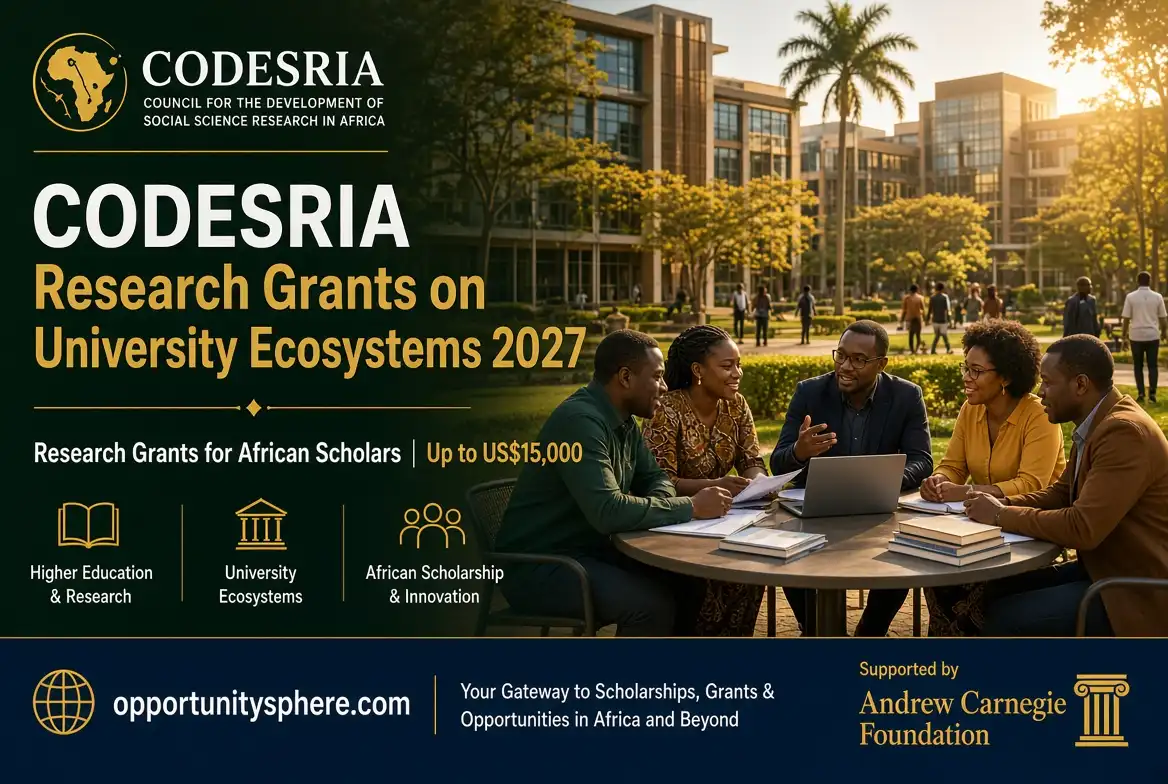
CODESRIA Research Grants on University Ecosystems 2027 – Research Funding of Up to $15,000
Offered by Council for the Development of Social Science Research in Africa (CODESRIA)
Location
Africa (Pan-African Programme)
Funding
Fully Funded
Study level
Researchers
Field of study
Education, Political Science, Development Studies, Other
Application deadline
January 16, 2027
About This Grant
The Council for the Development of Social Science Research in Africa (CODESRIA) invites applications from qualified African researchers for its 2027 Research Grants on University Ecosystems, a research initiative designed to strengthen understanding of the institutional, social, political and economic factors shaping higher education across Africa.
Supported by the Andrew Carnegie Foundation, the programme seeks to promote original research into the conditions influencing African universities, with particular attention to gender relations, academic freedom, university governance, institutional autonomy and the quality of intellectual and associational life.
African universities are important centres of knowledge production, professional training, scientific advancement and social transformation. Beyond awarding academic qualifications, they contribute to public policy, democratic participation, economic development and the preparation of future leaders. Their effectiveness, however, depends on more than the availability of academic programmes and physical infrastructure. Institutional governance, funding arrangements, academic independence, gender equality, research opportunities and the ability of university communities to participate in decision-making all influence the quality of higher education.
Across the continent, universities continue to face challenges involving unequal access to institutional opportunities, restrictions on academic expression, inadequate research resources, gender-based discrimination, political interference and changing expectations arising from technological and economic developments.
Through this research grant programme, CODESRIA intends to support studies that investigate these challenges, examine their underlying causes and generate evidence that can contribute to improving African university systems.
The programme will run for 15 months and is intended for researchers whose work can contribute to academic debates, institutional development and policy discussions about the future of higher education in Africa.
The call focuses particularly on two interconnected areas: gender and associational life in African universities, and academic and intellectual freedom. It also welcomes research addressing related questions of governance, funding, technology, knowledge production, social justice and institutional development.
1. Gender and Associational Life in African Universities
This theme examines how gender relations influence participation, representation, leadership, professional advancement and everyday experiences within African universities.
Although access to higher education has expanded in many African countries, inequalities may persist in academic leadership, research opportunities, institutional decision-making and the treatment of women and other marginalised groups.
Research may investigate women's representation in university management, gender-based discrimination, campus safety, harassment, institutional culture, student participation and the role of staff and student associations in promoting equality.
Possible research questions include:
What institutional barriers affect women's access to leadership positions in African universities?
How do gender relations influence academic promotion, research opportunities and professional development?
What factors contribute to gender-based discrimination and violence within university environments?
How effective are university policies for protecting students and staff from harassment and exclusion?
How do student unions, academic associations and staff organisations contribute to institutional accountability?
How do women and minority groups participate in university governance and decision-making?
Researchers may also examine the experiences of female academics in male-dominated departments, the relationship between gender and academic career progression, and the institutional measures required to create safer and more inclusive university environments.
2. Academic and Intellectual Freedom
Academic freedom allows lecturers, researchers and students to investigate issues, express ideas, exchange knowledge and participate in intellectual debates without inappropriate interference or intimidation.
However, political pressure, institutional restrictions, administrative decisions and funding arrangements can affect the independence of universities and the freedom of academic communities.
Research under this theme may investigate government influence on university administration, restrictions on academic expression, institutional autonomy, freedom of research, the independence of academic associations and the relationship between university management and public authorities.
Possible research questions include:
How does political interference influence the autonomy of African universities?
What factors affect the freedom of researchers to investigate controversial social and political issues?
How do university governance structures protect or undermine academic independence?
How do funding arrangements influence research priorities and institutional decision-making?
What protections are available to academics who experience intimidation or restrictions on their work?
How does academic freedom influence knowledge production and public debate?
Research may also examine how staff unions, student associations and professional academic networks contribute to protecting intellectual freedom and strengthening university accountability.
3. University Governance, Autonomy and Accountability
This area focuses on how African universities are managed, how institutional decisions are made and how university authorities are held accountable.
Applicants may investigate the roles of governing councils, university management, academic boards, government agencies and other institutional structures.
Possible research areas include political appointments, institutional transparency, staff and student participation in governance, administrative accountability and the relationship between university autonomy and government oversight.
4. Higher Education Funding, Equity and Quality
The availability and distribution of financial resources influence university infrastructure, research capacity, teaching quality and student access.
Research may examine government funding, tuition arrangements, private investment, research grants, international partnerships and differences in financial resources between institutions.
Studies could also investigate whether existing funding arrangements create inequalities between public and private universities, academic departments, geographical regions or groups of students.
5. Digital Transformation, Artificial Intelligence and Teaching Innovations
Digital technologies and artificial intelligence are changing how universities teach, conduct research, assess students and manage academic activities.
Research may investigate the adoption of AI in higher education, digital learning platforms, online assessment, research automation, digital libraries and the challenges associated with unequal access to technology.
Other relevant issues include academic integrity, data protection, digital infrastructure, the quality of online education and the implications of artificial intelligence for lecturers, researchers and students.
6. Research Ecosystems, Knowledge Production and Epistemic Justice
This theme examines the conditions under which knowledge is produced, recognised, published and shared within African universities and the wider international academic community.
Researchers may investigate barriers to research funding, publication opportunities, institutional research infrastructure, international research collaborations and the representation of African scholarship in global academic discussions.
Projects may also explore how African intellectual traditions, local knowledge systems and research priorities are recognised within universities and international research networks.
7. Gender, Minority Inclusion and Social Justice
Research may examine how institutional policies and university cultures affect the participation and experiences of women, minority groups and other marginalised communities.
Relevant topics include disability inclusion, unequal access to academic opportunities, discrimination, gender-based violence, representation and institutional responses to social exclusion.
8. Neoliberalism, Globalisation and University Autonomy
Applicants may investigate how commercialisation, international competition, market-oriented reforms, private-sector partnerships and performance-based funding affect the academic mission of African universities.
Research could examine whether these changes strengthen institutional development or create new forms of dependence and inequality.
9. Private Universities and Technical and Vocational Education and Training Institutions
The expansion of private universities and technical and vocational education and training (TVET) institutions has changed the higher education landscape across Africa.
Studies may examine institutional regulation, quality assurance, access, graduate employability, academic freedom, funding arrangements and the contribution of these institutions to national development.
10. University Contributions to Sustainable Development and Agenda 2063
Research may explore how African universities contribute to the United Nations Sustainable Development Goals (SDGs) and the African Union's Agenda 2063.
Possible areas include agricultural development, public health, environmental sustainability, technological innovation, entrepreneurship, governance and community development.
11. Graduate Outcomes and Changing Labour Markets
Researchers may examine the relationship between university education and employment, including graduate unemployment, underemployment, professional skills, entrepreneurship and the changing competencies required by employers.
Studies may also investigate how universities adapt their programmes to technological developments and changing labour-market demands.
12. University-Community Partnerships
This area examines how universities collaborate with government, industry, civil society organisations and local communities.
Research may investigate university extension services, community-based research, consultancy, knowledge transfer, public engagement and the contribution of academic institutions to solving practical social and economic problems.
Who Can Apply?
The programme is intended for researchers affiliated with recognised African higher education institutions or research institutions.
Eligible applicants may include university lecturers, academic staff, social science researchers, education researchers, policy analysts, research fellows and other scholars with relevant research interests and institutional affiliations.
The following applicant groups are particularly encouraged:
Women researchers: Female academics and scholars are strongly encouraged to submit proposals, particularly those investigating gender relations, institutional inequality, women's participation and other issues affecting university communities.
Early-career researchers: Researchers developing their academic careers are encouraged to apply with relevant and well-designed research proposals.
Researchers from less well-resourced institutions: Academics working in institutions with limited research infrastructure or financial resources are particularly encouraged.
African diaspora scholars: Researchers living outside Africa may participate in collaboration with colleagues affiliated with African-based institutions.
Interdisciplinary researchers: Scholars from different academic backgrounds are encouraged to work together where their combined expertise can address complex higher education challenges.
Applicants must have the required institutional affiliation. Simply having an academic qualification or being interested in higher education research does not automatically establish eligibility.
Individual and Collaborative Applications
Both individual and collaborative research proposals are accepted.
Individual researchers may submit their own proposals if they meet the eligibility conditions and can demonstrate the ability to complete the proposed research.
Collaborative applications must involve teams of three to five researchers. CODESRIA encourages interdisciplinary, inter-institutional and multi-country research collaborations.
For example, a research team investigating gender inequality in university leadership could bring together researchers in sociology, gender studies, education and public administration.
Similarly, a project examining academic freedom across different African countries could involve scholars from several universities who can compare institutional policies, governance arrangements and academic experiences.
Each team should clearly explain the responsibilities of its members and demonstrate how their different areas of expertise contribute to the research.
African scholars in the diaspora should collaborate with colleagues affiliated with African-based institutions.
Applicants with outstanding or pending deliverables from previous or ongoing CODESRIA-funded projects are not encouraged to apply.
Funding and Programme Support
The programme requires applicants to submit a proposed research budget ranging from US$5,000 to US$15,000 per project.
The budget must be connected to the research methodology, proposed activities and expected outputs. Applicants should provide a realistic explanation of the resources required to conduct their studies rather than simply requesting the maximum amount.
Depending on the nature of the proposed research, relevant budget items may include fieldwork, research travel, data collection, research assistance, transcription, research materials and other justified project-related expenses.
The proposed budget range should not be interpreted as a guaranteed individual payment. Final support is subject to the selection process and assessment of the proposed project budget.
Selected researchers will participate in the 15-month programme, which includes research activities, knowledge-exchange workshops and peer-learning opportunities.
Programme Duration and Responsibilities of Successful Applicants
The research programme will run for 15 months.
During this period, selected researchers are expected to:
Conduct original research addressing the programme's thematic priorities.
Participate in knowledge-exchange workshops.
Engage in peer-learning activities with other selected researchers.
Develop at least one publishable manuscript, such as a journal article and policy brief or an equivalent combination of outputs.
Participate in public dialogue and policy engagement activities.
Submit periodic research progress reports.
Prepare and submit a final consolidated research output.
Applicants should therefore propose research that can realistically be completed within the programme period. Their work plans should provide sufficient time for research preparation, data collection, analysis, writing and dissemination.
Required Application Documents
Applicants should prepare the following documents:
1. Curriculum Vitae (CV)
A recent CV highlighting the applicant's academic qualifications, research experience and relevant publications.
For collaborative applications, CVs of all team members should be provided.
2. Research Proposal Synopsis
A research proposal of no more than 4,000 words. It should contain:
Research question or problem statement.
Review of relevant literature.
Conceptual or theoretical framework.
Research methodology.
Research work plan and timeline.
Draft project budget.
Proposed research outputs.
The proposal should clearly explain the problem being investigated, why it deserves further study and how the proposed research will contribute to knowledge about African university ecosystems.
3. Draft Project Budget
Applicants must provide a proposed budget between US$5,000 and US$15,000.
The budget should identify the major research expenses and explain how the requested resources will support the proposed activities.
4. Institutional Affiliation or Endorsement Letter
Applicants must provide a formal letter confirming their affiliation with or endorsement by a recognised African higher education or research institution.
How to Prepare a Competitive Research Proposal
A strong proposal should do more than select one of the listed themes. It should identify a specific problem, explain why the problem matters and establish how the proposed research will produce useful findings.
Applicants should consider the following:
Choose a focused research question: Avoid attempting to investigate every challenge affecting African universities. Select a clearly defined issue that can be studied within 15 months.
Establish the research gap: Explain what previous studies have already established and what remains insufficiently understood.
Use an appropriate theoretical framework: Select a framework that genuinely supports the research problem and explain how it will guide the analysis.
Develop a practical methodology: Identify the institutions, participants, data sources and research methods required to answer the research questions.
Demonstrate feasibility: Ensure that the proposed activities, research locations, timeline and budget are realistic.
Explain the policy relevance: Show how the findings could contribute to university management, institutional reforms, academic freedom, gender equality or higher education policy.
Plan for publication: Design the study so that it can generate a substantial scholarly manuscript and other useful research outputs.
For collaborative proposals, applicants should also explain how the team will coordinate research activities and how the different members will contribute to the project's success.
How to Apply
Applications must be submitted online through the official CODESRIA grants and subventions application portal.
Interested researchers should follow these steps:
Visit the official CODESRIA call page and read the complete announcement.
Confirm that they meet the institutional affiliation and other eligibility requirements.
Identify a research topic that addresses one or more of the programme's thematic priorities.
Decide whether to apply individually or as part of a team of three to five researchers.
Prepare a proposal synopsis of no more than 4,000 words.
Prepare the required CVs, draft project budget and institutional affiliation or endorsement letter.
Visit the online application portal and complete the application.
Upload the required documents and review the submission before completing the application.
Applicants should retain any application confirmation and monitor their email for communications from CODESRIA.
Application Deadline and Important Information
The application deadline is 16 January 2027. Applicants should submit their proposals before the closing date because late applications will not be considered.
Researchers should pay particular attention to the 4,000-word proposal limit, the required institutional affiliation, the three-to-five-member team size for collaborative applications and the US$5,000–US$15,000 proposed project budget range.
This opportunity is especially relevant to African university lecturers, early-career academics, social scientists, education researchers and interdisciplinary scholars interested in producing evidence that can improve higher education institutions across the continent.
The programme offers more than research funding: it provides a structured opportunity to investigate important institutional challenges, engage with other African scholars, develop publishable research and contribute to discussions about the future of African universities.
Related Opportunities
Explore other scholarships, fellowships, grants, research opportunities and more that may match your interests.