The application deadline for this opportunity has passed. You can still review the details, but the listing is no longer presented as open for applications.
Grant, PhD & Research
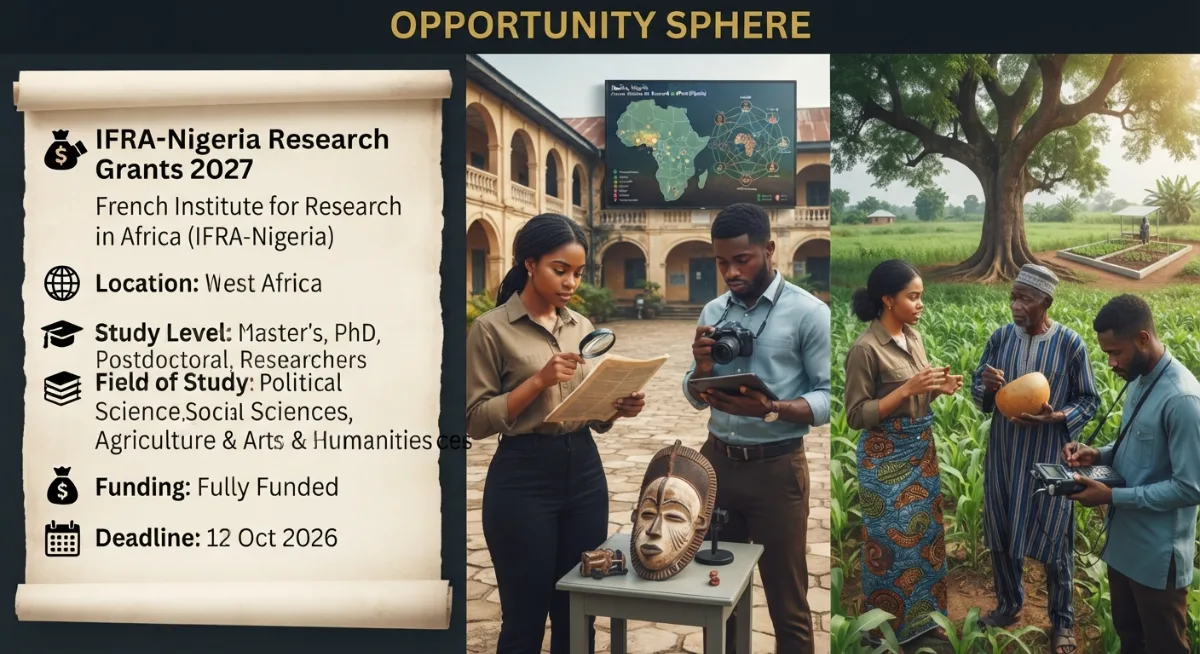
IFRA-Nigeria Research Grants 2027
Offered by French Institute for Research in Africa (IFRA-Nigeria)
Location
West Africa
Funding
Fully Funded
Study level
Master's, PhD, Postdoctoral, Researchers
Field of study
Political Science, Social Sciences, Arts & Humanities
Application deadline
October 12, 2026
Application Closed
About This Grant
The French Institute for Research in Africa (IFRA-Nigeria) is inviting applications for its 2027 Research Grants, supporting individual and collaborative research projects in the humanities and social sciences focused on countries within the Institute's geographical mandate.
The call is open to second-year Master's students, doctoral students, postdoctoral students and researchers. IFRA-Nigeria plans to finance approximately a dozen research projects during the January–October 2027 period. Supported projects are expected to involve activities such as fieldwork missions and/or stays in archives.
The programme is designed for researchers who already have a defined research project and need targeted financial support to carry out research activities that contribute to a substantive academic or scholarly project. It is therefore a research grant rather than a general scholarship for university tuition or degree admission.
There is no nationality requirement for applicants. However, the proposed research must fall within IFRA-Nigeria's geographical and disciplinary scope.
Geographical Scope
IFRA-Nigeria's regional mandate covers nine West African countries:
Nigeria
Benin
Burkina Faso
Cameroon
Côte d'Ivoire
Ghana
Niger
Chad
Togo
Research may focus on one country or involve comparative or cross-border work involving several countries within this geographical area.
Research Areas
Projects must fall within the humanities and social sciences and align with at least one of IFRA-Nigeria's four research axes:
Advertisement
🔒Application Closed
The listed deadline has passed. Check the official website to see whether the organisation has announced an extension or a new application period.
Stay in the loop
Your Next Opportunity Could Be One Email Away
Receive updates about scholarships, jobs, internships, fellowships and grants so you can discover opportunities worth exploring.
Stay Updated
Never miss an opportunity.
Get updates on scholarships, jobs, internships, grants, fellowships, conferences, and other opportunities delivered straight to your inbox.
This axis covers research examining beliefs, health, bodies and related social and cultural questions.
2. Citizenship, Gender and Mobilisation
Projects may examine citizenship, gender, political or social mobilisation and related processes affecting societies in the region.
3. Heritage Dynamics and Environment
This area includes research concerning heritage, processes of heritage-making, environmental questions and related social and cultural dynamics.
4. Digital Humanities
This transversal axis supports research applying digital approaches or tools to humanities and social-science questions.
Projects outside the humanities and social sciences are not eligible under this call.
Who Can Apply?
The 2027 call is open to:
Second-year Master's students
Doctoral students
Postdoctoral students
Researchers
Applicants should already have a clearly defined research project that fits both the Institute's geographical mandate and at least one of its research axes.
The programme does not impose a nationality requirement. Researchers from outside the countries covered by IFRA-Nigeria may therefore apply, provided their proposed research concerns an eligible country or countries and satisfies the other conditions of the call.
What the Grant Supports
IFRA-Nigeria is particularly supporting projects involving:
Fieldwork missions
Archival research or stays in archives
Research activities necessary to complete the proposed project
Individual research projects
Collaborative research projects
The grant amount can reach a maximum of €1,000, depending on the nature and budget of the proposed project.
Applicants should therefore present a realistic budget showing the total cost of the research and clearly explaining how the amount requested from IFRA-Nigeria will be used.
Funding Period
The supported research projects will take place between January 2027 and October 2027.
For successful applicants, IFRA-Nigeria will initially pay 50% of the awarded grant at the beginning of the project in January 2027.
The remaining 50% will be paid after submission of the required final report.
Final reports must be submitted before 15 November 2027.
Research Partnerships
IFRA-Nigeria strongly encourages applicants to establish sustainable partnerships with institutions and/or researchers in the country where the research will take place.
For collaborative projects, applicants should clearly identify all participating researchers and explain each person's role in the project.
For an individual project, the proposed research must be carried out personally by the applicant.
Research Outputs and Valorisation
Every proposed project must include a valorisation component connected to IFRA-Nigeria's editorial and research activities.
Applicants should explain how the findings or results of their research could be communicated or disseminated. Possible forms include academic publications, oral presentations and other appropriate scholarly outputs.
The proposal should therefore demonstrate not only what research will be conducted, but also how its findings can contribute to wider scholarly discussions.
Eligibility Criteria
Applicants should:
Be a second-year Master's student, doctoral student, postdoctoral student or researcher.
Propose research within the humanities or social sciences.
Conduct research concerning at least one country within IFRA-Nigeria's geographical mandate.
Align the proposed project with at least one of IFRA-Nigeria's four research axes.
Have a clearly defined and feasible research project.
Explain the planned research activities, including dates, itinerary and objectives where relevant.
Identify relevant institutional or research partnerships where applicable.
Include a valorisation component explaining how the research findings will be disseminated.
Prepare the required research proposal, budget, CV and cover letter.
Submit all required documents together as a single PDF file through the designated application form.
Comply with IFRA-Nigeria's requirements concerning scientific integrity and the use of artificial intelligence.
Submit the application before 30 October 2026 at 23:59 WAT.
Benefits
The grant provides targeted financial support for eligible humanities and social-science research rather than general educational expenses.
Successful applicants can receive:
Up to €1,000 in research funding, depending on the project and budget.
Support for eligible fieldwork missions and/or archival stays.
Funding for research activities taking place between January and October 2027.
The opportunity to undertake research within IFRA-Nigeria's West African geographical mandate.
An opportunity to develop research aligned with one of the Institute's established research axes.
Potential collaboration with researchers and institutions in the country where the research is conducted.
An opportunity to produce research outputs connected with IFRA-Nigeria's scholarly and editorial activities.
For Master's and doctoral researchers, the grant can provide financial support for research activities forming part of a dissertation or thesis. Postdoctoral and other researchers can use the grant for eligible independent or collaborative research projects.
Application Documents
Applicants must prepare the following:
1. Cover Letter
A cover letter of no more than one page, using Arial 12 font with the formatting specified by IFRA-Nigeria.
2. Curriculum Vitae
A CV of no more than three pages.
3. Research Budget
The budget must state the total cost of the project and explain in detail how the funding requested from IFRA-Nigeria will be used.
Applicants must also disclose any other amount requested or received from other funding sources.
The official budget template should be used.
4. Research Project Description
A detailed research project description of no more than four pages, excluding the bibliography and budget.
The proposal should include:
Scientific project
Research objectives
Detailed work plan
Dates and itinerary where relevant
Research activities
Objectives of the proposed fieldwork or archival work
Institutional partnerships
Valorisation perspectives
Bibliography
Applicants should use the official research-project template.
Application Format
All required documents must be combined into one PDF file.
Incomplete applications will be automatically rejected.
Scientific Integrity and AI
IFRA-Nigeria has specific requirements concerning scientific integrity and the use of artificial intelligence in research proposals.
Applicants should read the Institute's AI guidance before preparing their application. The call states that the research proposal must not be written by another person and that any use of AI tools must be properly disclosed and justified according to IFRA-Nigeria's rules.
Failure to comply with the Institute's scientific-integrity requirements can lead to disqualification.
How to Prepare a Strong Proposal
Applicants should make the connection between their research question and IFRA-Nigeria's mandate clear from the beginning.
A strong proposal should establish:
What the research problem is
Where the research will take place
Why the research is important
Which IFRA-Nigeria research axis it addresses
What research activities will be undertaken
When and where those activities will occur
How the requested funding will be used
Which institutions or researchers may be involved
How the findings will be disseminated
The proposed activities should also be realistic within the available funding and January–October 2027 research period.
Application Deadline
The deadline for the IFRA-Nigeria Research Grants 2027 is:
30 October 2026 at 23:59 West African Time (WAT).
Applicants should submit the complete application before the deadline. IFRA-Nigeria states that responses to applicants will be sent by email by December 2026 at the latest.
How to Apply
Applicants should prepare the required documents and combine them into a single PDF file before submitting through the official IFRA-Nigeria application form.
Related Opportunities
Explore other scholarships, fellowships, grants, research opportunities and more that may match your interests.