Offered by The Huntington Library, Art Museum, and Botanical Gardens
Location
United States
Funding
Fully Funded
Study level
Graduates, PhD, Postdoctoral, Researchers
Field of study
Arts & Humanities
Application deadline
November 15, 2026
About This Fellowship
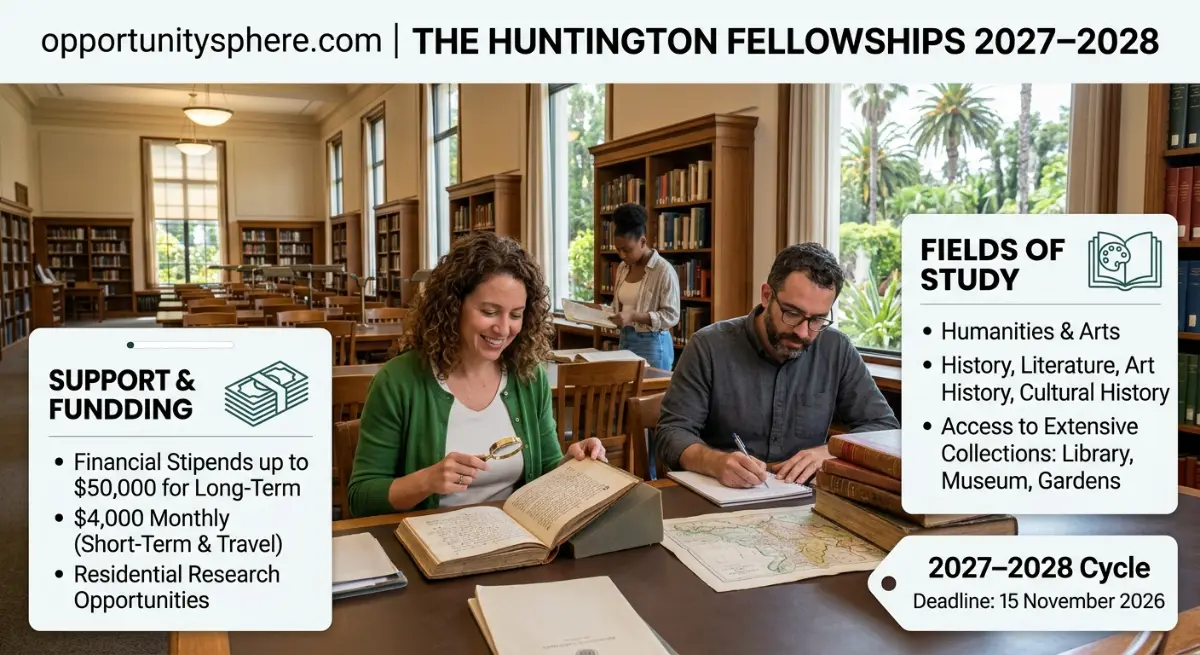
The Huntington Fellowships 2027–2028 provide financial support and residential research opportunities for scholars conducting advanced research in the humanities and arts. The programme is particularly suited to researchers whose projects require substantial use of the collections, archives, rare books, manuscripts, artworks and other research resources held by The Huntington Library, Art Museum, and Botanical Gardens in San Marino, California.
The Huntington is an important research institution with extensive collections covering subjects including American and British history, literature, art history, cultural history and related areas of the humanities. Its fellowship programme is designed to support scholars who need sustained or specialised access to these resources while developing original research.
For the 2027–2028 fellowship year, The Huntington offers several forms of support, including long-term academic-year fellowships, academic-term fellowships, short-term fellowships, travel grants and exchange fellowships. The appropriate opportunity depends on the applicant's academic status, research project, required period of residence and the nature of the collections needed.
The programme can therefore accommodate researchers at different stages and with different research requirements. Some awards support several months of residential research, while others are intended for shorter periods of concentrated archival or library work.
1. Eligibility
Eligibility depends on the specific Huntington fellowship category being applied for. Because the programme contains several distinct forms of support, applicants should carefully identify the award that corresponds to their academic status and research needs.
Applicants may include scholars affiliated with universities, research institutions and other recognised academic organisations. The fellowship is particularly relevant to researchers whose projects require direct access to The Huntington's collections.
Applicants should generally demonstrate:
A clearly defined research project in the humanities or arts.
A strong academic or scholarly background appropriate to the fellowship category.
A specific reason for requiring access to The Huntington's collections.
Evidence that the proposed research can be meaningfully advanced through work at the institution.
A research plan that is appropriate for the duration of the fellowship being requested.
Because eligibility requirements can differ substantially between long-term, short-term, travel and exchange fellowships, applicants should consult the requirements for their chosen category before beginning an application.
2. Long-Term Fellowships
The Huntington's long-term fellowships are designed for scholars who require an extended period of residential research.
For the 2027–2028 cycle, approximately 11–13 academic-year fellowships are available for nine months of research. Each academic-year fellowship provides a stipend of .
These awards are particularly relevant to researchers whose projects require sustained engagement with The Huntington's library, archives, manuscripts, rare books, visual materials or other collections over an extended period.
The longer residency allows fellows to develop their research beyond short archival visits. Depending on the nature of the project, researchers may use the period to examine primary sources, undertake comparative research, develop manuscripts, prepare scholarly publications or advance larger academic projects.
The Huntington also offers academic-term fellowships for researchers who require a shorter residential period. These fellowships support approximately four to five months of research and provide a stipend of $25,000.
The academic-year and academic-term options therefore provide different levels of research residency while maintaining the central objective of enabling scholars to make substantial use of The Huntington's resources.
3. Short-Term Fellowships
The Huntington also provides a substantial number of short-term fellowships for researchers whose projects can be advanced through a concentrated period of archival or library research.
Approximately 120 short-term fellowships are available for research periods of one to three months.
Short-term fellows receive a stipend of $4,000 per month.
This option may be particularly appropriate for scholars who have already developed a substantial research project and need to consult specific materials that are difficult to access elsewhere.
For example, a researcher may require several weeks of direct access to manuscripts, rare books, archival documents, historical records, visual materials or other specialised resources. A short-term fellowship can provide the opportunity to undertake this focused research without requiring a full academic-year residency.
Applicants should explain clearly which collections they need to consult and how access to those materials contributes to the objectives of their project.
4. Travel Grants
The Huntington also offers travel grants intended to support research outside the United States or Canada.
For the 2027–2028 cycle, six one-month travel grants are available, with a stipend of $4,000.
These awards are distinct from residential research at The Huntington. They are designed to help scholars undertake research in libraries and archives located outside the United States or Canada.
Travel grants may therefore be useful for projects that require researchers to consult complementary collections held by international institutions. Applicants should demonstrate the importance of the proposed travel to their research and explain how the destination collections contribute to the overall project.
5. Exchange Fellowships
The fellowship programme also includes exchange opportunities involving partner institutions in the United Kingdom and Ireland.
Exchange fellowships provide researchers with opportunities to undertake scholarly work through partner institutions while benefiting from an international academic environment.
Depending on the specific exchange institution, fellows may receive financial support in the form of a stipend, room and board or other arrangements associated with the particular exchange.
Because exchange fellowships are connected to specific partner institutions, applicants should carefully review the requirements and conditions applicable to the exchange they intend to pursue.
6. Research Areas
The Huntington Fellowships primarily support research in the humanities and arts.
Potential research areas may include:
History and historical studies.
Literature and literary studies.
American studies.
British studies.
Art history.
Cultural history.
Manuscript and archival studies.
Book and print history.
Intellectual and cultural history.
Other related humanities disciplines that make meaningful use of The Huntington's collections.
The programme is particularly relevant to projects involving primary-source research.
A strong application should establish a clear connection between the proposed research and the collections available through The Huntington. Applicants should not simply describe an interesting academic project; they should demonstrate why the institution's specific resources are important to completing that project.
7. Research Collections
One of the major advantages of the Huntington Fellowships is the opportunity to conduct research using the institution's extensive collections.
The Huntington's research resources include significant holdings in areas such as history, literature, manuscripts, rare books, art and cultural materials.
For applicants, the ability to work directly with these resources can be particularly important when research depends on primary sources that cannot easily be examined remotely.
A proposal should therefore identify the relevant materials as specifically as possible. Applicants should explain:
What collections or materials they intend to consult.
How those materials relate to their research questions.
Why access to The Huntington is important.
What they expect to accomplish during the proposed fellowship period.
This connection between the research project and the collections is an important consideration when preparing an application.
8. Benefits
The financial support available through the Huntington Fellowship programme varies according to the selected category.
Depending on the award, researchers may receive:
Up to $50,000 for a nine-month academic-year fellowship.
$25,000 for an academic-term fellowship lasting approximately four to five months.
$4,000 per month for eligible short-term fellowships.
$4,000 for selected one-month international travel grants.
Financial support associated with certain exchange fellowships.
In addition to financial assistance, fellows benefit from the opportunity to conduct research within a major scholarly environment.
Residential researchers can devote concentrated time to their projects while accessing relevant library and archival resources. The fellowship environment can also provide opportunities for interaction with other researchers and scholars working in related fields.
For researchers working on books, dissertations, archival studies, historical investigations or other substantial humanities projects, uninterrupted access to primary materials can be particularly valuable.
9. Why the Fellowship May Be Useful for Researchers
Many humanities research projects depend on materials that cannot be fully replaced by online sources. Manuscripts, rare books, archival records, historical documents, artworks and other primary materials can provide evidence that is essential to scholarly research.
The Huntington Fellowships are designed around this need.
A researcher who has identified important materials within The Huntington's collections can use the fellowship period to examine those resources systematically and incorporate the findings into a larger research project.
The longer fellowship options may be particularly useful for researchers developing substantial scholarly manuscripts, while short-term awards can suit projects requiring targeted archival investigation.
The range of fellowship categories means that applicants can select an opportunity based on the amount of time their project requires.
10. Application Requirements and Preparation
Applicants should prepare their application around the specific fellowship category they intend to pursue.
A strong research proposal should clearly communicate:
The central research question or objective.
The academic significance of the project.
The current stage of the research.
The materials or collections required.
Why The Huntington is an appropriate research destination.
What the applicant expects to accomplish during the fellowship period.
Why the proposed duration is appropriate for the project.
Applicants should also ensure that all supporting materials required by their selected fellowship category are submitted through the online application system.
Because different awards have different conditions, applicants should avoid assuming that the requirements for one fellowship automatically apply to another.
11. Application Information
Applications for the 2027–2028 fellowship year opened on 1 September 2026.
The application deadline is 15 November 2026 at 11:59 PM Pacific Standard Time.
Applicants must create an account through The Huntington's online application system and submit the required materials before the deadline.
Researchers should allow sufficient time to prepare their proposal and supporting documents rather than waiting until the final day of the application period.
The research proposal should clearly demonstrate the significance of the project and explain why access to The Huntington's collections is necessary for the proposed research.
12. Important Note
The Huntington offers several different fellowship categories, and the eligibility requirements, duration, stipend and application conditions vary between them.
Applicants should therefore identify the specific fellowship that best matches their research project before applying. They should also review the official guidelines carefully to confirm eligibility, required materials, residency conditions and any category-specific requirements.
The fellowship is especially relevant to scholars whose research depends on specialised humanities and arts collections and who can demonstrate a clear academic reason for conducting research at The Huntington.
Application Deadline: 15 November 2026
Funding: Up to $50,000 for selected nine-month fellowships; amounts vary by fellowship category
Related Opportunities
Explore other scholarships, fellowships, grants, research opportunities and more that may match your interests.