The application deadline for this opportunity has passed. You can still review the details, but the listing is no longer presented as open for applications.
Fellowship
Tech Policy Press Fellowship Program 2027
Offered by Tech Policy Press
Location
Internation/ Remote
Funding
Paid
Study level
Researchers, Professional
Field of study
Computer Science & IT, Law, Political Science
Application deadline
September 24, 2026
Application Closed
About This Fellowship
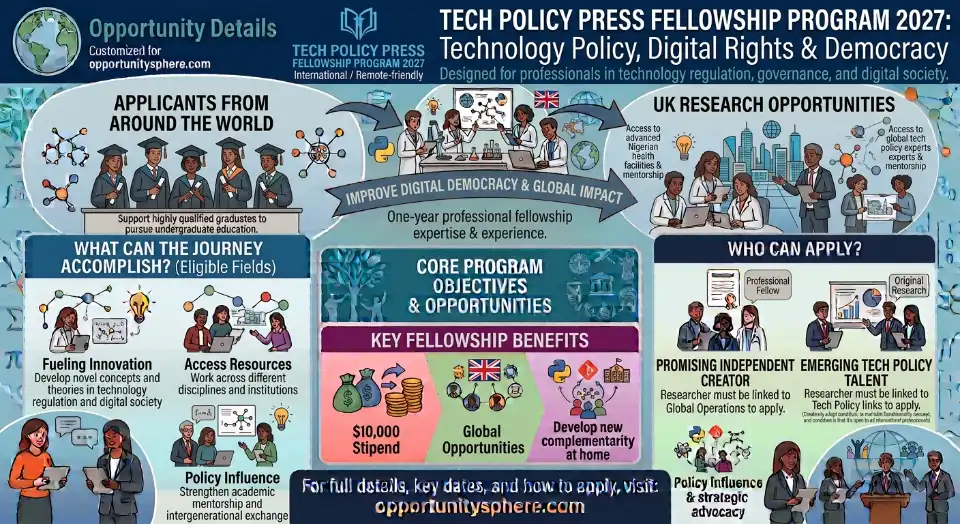
The Tech Policy Press Fellowship Program 2027 is a professional development and knowledge-production opportunity for people interested in examining how technology affects democracy, public institutions, human rights and society. The year-long, part-time fellowship is designed for individuals who want to investigate important technology-policy questions through independent research, journalism, reporting, analysis or commentary.
Technology increasingly influences how people communicate, access information, participate in public life and interact with governments. Artificial intelligence systems, social media platforms, digital surveillance, online political communication and the growing power of technology companies raise complex questions about accountability, transparency, privacy, freedom of expression and democratic governance.
Understanding these issues requires contributions from different professional backgrounds. Journalists can investigate developments and explain their public significance. Researchers can examine evidence and evaluate the consequences of technological change. Lawyers can analyse regulatory frameworks and fundamental rights. Public policy professionals can explore policy options, institutional responsibilities and the practical effects of proposed regulations.
The Tech Policy Press Fellowship provides a framework for fellows to develop work addressing such questions. Depending on the approved project and the programme's arrangements, fellows may focus on reporting, research, policy analysis or commentary that helps readers understand the relationship between technology and democracy.
The fellowship is particularly relevant to professionals who already have an interest in technology-policy issues and want to develop a substantial body of work in this area. Rather than being a conventional academic scholarship, it is a part-time professional fellowship centred on research, analysis, writing and public discussion.
Applicants should be prepared to propose a clear project or area of inquiry, explain why it matters and demonstrate how their experience equips them to contribute meaningfully to technology-policy debates.
Fellowship Objectives
Advertisement
🔒Application Closed
The listed deadline has passed. Check the official website to see whether the organisation has announced an extension or a new application period.
Stay in the loop
Your Next Opportunity Could Be One Email Away
Receive updates about scholarships, jobs, internships, fellowships and grants so you can discover opportunities worth exploring.
Stay Updated
Never miss an opportunity.
Get updates on scholarships, jobs, internships, grants, fellowships, conferences, and other opportunities delivered straight to your inbox.
The programme's central focus is to support informed analysis and public understanding of the policy questions arising from technological change.
Its thematic objectives may include:
Improving Public Understanding of Technology Policy: Encourage clear, evidence-based explanations of complex technology-policy developments and their implications for society.
Examining Technology and Democracy: Support work investigating how digital technologies affect democratic institutions, civic participation, political communication and public accountability.
Strengthening Technology Governance Discussions: Encourage research and analysis that helps readers understand policy choices, regulatory approaches and institutional responsibilities.
Exploring Artificial Intelligence Governance: Support examination of issues such as AI accountability, transparency, safety, bias, oversight and the effects of automated decision-making.
Investigating Digital Rights: Encourage attention to privacy, freedom of expression, access to information, online safety and other rights affected by digital technologies.
Supporting Independent Research and Reporting: Provide an opportunity for fellows to pursue a defined topic through sustained investigation, analysis or commentary.
Encouraging Cross-Disciplinary Perspectives: Bring relevant professional experience from journalism, law, research and public policy into discussions about technology and society.
These are relevant themes for the fellowship, not a confirmed list of mandatory project topics. Applicants should consult the official 2027 announcement for the programme's current priorities and expectations.
Who Can Apply?
The fellowship is intended for people with relevant professional experience or demonstrated interest in the intersection of technology, public policy and democracy.
Potential applicants include:
Journalists and Reporters: Professionals who investigate technology companies, digital platforms, artificial intelligence, internet governance, regulation or the effects of technology on public life.
Academic and Independent Researchers: Individuals who study technology governance, political communication, digital rights, AI policy, online platforms or related topics.
Lawyers and Legal Researchers: Professionals interested in technology regulation, privacy, human rights, competition policy, intermediary liability or legal accountability.
Public Policy Professionals: Individuals who work on policy development, regulatory analysis, government affairs, digital transformation or technology-related public programmes.
Civil Society Professionals: People whose work involves digital rights, freedom of expression, transparency, accountability or responsible technology governance.
Technology Policy Analysts: Professionals who assess the social, political, legal or institutional consequences of emerging technologies.
Other Relevant Applicants: Candidates from different professional backgrounds who can demonstrate relevant experience, a strong proposed project and the ability to produce meaningful research, reporting or analysis.
Applicants do not necessarily need to hold a degree specifically in technology policy. Relevant professional experience, a well-developed project idea and the ability to communicate complex issues clearly may be important. However, the official application requirements determine the qualifications and experience accepted for the 2027 cohort.
Eligibility Requirements
Based on the programme description, prospective applicants should be prepared to demonstrate the following:
Relevant Professional Background: Work as a journalist, researcher, lawyer, public policy professional or another individual with experience relevant to technology-policy issues.
Interest in Technology and Democracy: Demonstrate a clear interest in how technology affects public institutions, rights, governance, political participation or society.
Relevant Expertise or Experience: Provide evidence of relevant work, such as published articles, research, policy documents, legal analysis, reports, commentary or professional projects.
A Meaningful Project Proposal: Identify a technology-policy issue worth investigating and explain the intended focus, significance and potential contribution of the proposed work.
Strong Communication Skills: Demonstrate the ability to conduct research, analyse information and communicate findings in an appropriate written format.
Required Supporting Materials: Submit the application documents specified by the programme, which may include writing samples, a project proposal, a CV and references.
Commitment to the Fellowship: Be able to manage the programme alongside other professional responsibilities for the full year.
Compliance With Programme Conditions: Meet any additional eligibility, participation, publication or administrative requirements included in the official 2027 announcement.
Important: These points are based on the programme description supplied for this listing. Applicants should confirm the precise eligibility rules, geographical conditions, selection criteria and required materials from the official 2027 call.
Fellowship Benefits
1. $10,000 Fellowship Stipend
The programme description identifies a fellowship stipend of $10,000. This financial support can help fellows dedicate time to developing their projects while managing the demands of a year-long, part-time commitment.
Applicants should confirm the payment schedule, currency, tax implications, eligibility conditions and whether the stipend is paid in instalments or through another arrangement. They should also verify whether any additional expenses are covered.
2. One-Year Professional Fellowship Experience
The year-long structure offers time to investigate a topic, develop an argument, gather evidence and refine written work. This can be valuable for professionals who want to deepen their understanding of technology policy without necessarily leaving their existing careers.
3. Editorial and Professional Support
The programme description identifies editorial and professional support as a benefit. Such support can help fellows improve the clarity, structure, evidence and accessibility of their work.
The precise nature of this support—including editorial meetings, mentoring, feedback arrangements and publication guidance—should be confirmed in the current programme announcement.
4. Opportunity to Publish Research and Analysis
Fellows may have opportunities to develop work for publication through the programme's approved channels, subject to the fellowship's editorial and publication arrangements.
Publication can help professionals communicate research findings, explain policy developments and contribute evidence-based perspectives to public discussions.
Applicants should not assume that every proposed project or piece of work will automatically be published. Publication conditions and editorial decisions should be checked with the programme.
5. Networking With Technology-Policy Professionals
The fellowship can provide opportunities to connect with people who work on technology governance, digital rights, public policy, journalism and related fields.
Professional connections can encourage knowledge exchange, collaboration and continued engagement with technology-policy questions after the fellowship ends.
6. Fellowship Learning Sessions
The programme description includes learning sessions as part of the fellowship experience. These may provide opportunities to explore relevant issues, exchange perspectives and learn from other participants or professionals involved in technology policy.
Applicants should consult the official announcement for the actual format, schedule and attendance expectations.
7. Contribution to Technology and Democracy Discussions
The fellowship gives participants an opportunity to develop work that contributes to public understanding of how technology intersects with democratic life.
A well-researched article, investigation or policy analysis can help explain complicated issues, clarify competing policy considerations and identify questions that deserve further public attention.
8. Development of a Professional Portfolio
Completing a substantial research, reporting or analysis project can strengthen a participant's portfolio of work. Depending on the project and its outcomes, this may be useful when pursuing future opportunities in journalism, research, policy analysis, law, advocacy or technology governance.
The fellowship does not guarantee future employment, additional funding or a particular career outcome.
Possible Research and Reporting Areas
Applicants should choose a topic that matches their expertise, interests and ability to conduct meaningful work during the fellowship. The following examples illustrate potential areas of inquiry; they are not confirmed commissioned topics.
1. Artificial Intelligence Governance
Possible questions include how AI systems should be regulated, what forms of accountability are appropriate for high-impact systems, and how policymakers can evaluate the social consequences of automated decisions.
Projects might examine transparency, bias, human oversight, public-sector AI procurement or the responsibilities of organisations deploying AI tools.
2. Social Media and Democratic Participation
Researchers and journalists could examine how social media platforms influence political communication, public debate, civic participation and access to information.
Possible topics include platform governance, political advertising, content moderation, online mobilisation and the transparency of platform decisions.
3. Digital Rights and Freedom of Expression
Projects could investigate the relationship between digital technologies and fundamental rights, including privacy, freedom of expression, access to information and protection against unlawful surveillance.
A strong project would identify a specific legal, institutional or policy question and use evidence to explain its significance.
4. Technology Regulation and Public Policy
Applicants could examine how governments develop, implement and enforce rules governing technology companies and digital services.
Relevant questions might include the effectiveness of regulatory approaches, the challenges facing enforcement agencies or the consequences of different policy choices.
5. Technology Companies and Public Accountability
Research could explore how powerful technology companies influence public institutions, information systems or policy decisions.
Potential areas include transparency reporting, corporate lobbying, platform accountability, competition and the relationship between private technology infrastructure and public interests.
6. Digital Governance in Africa
Applicants with relevant experience in African technology policy could investigate how digital technologies intersect with governance, development, rights and public services in African countries.
Possible themes include digital identification, data protection, AI policy, online political participation, digital inclusion and the regulation of digital platforms.
A project should avoid treating Africa as a single policy environment. Strong analysis identifies the particular country, institutions, laws, stakeholders or communities under consideration.
7. Technology, Elections and Political Information
Research might examine online political advertising, the transparency of digital campaign communication, access to reliable election information or the governance of technologies used in electoral processes.
Such projects should use credible evidence and clearly distinguish documented findings from speculation.
8. Privacy, Data Protection and Surveillance
Projects could investigate how personal data is collected, shared and used by public institutions or private companies, and what safeguards exist to protect individuals.
Potential approaches include legal analysis, investigative reporting, comparative policy research or examination of a specific regulatory problem.
How to Develop a Strong Fellowship Proposal
A well-developed proposal should show that the applicant understands the issue, has a credible plan for investigating it and can produce useful work within the fellowship period.
1. Define a Specific Problem
Avoid proposing a topic that is too broad, such as "technology and democracy." Instead, identify a clear question, policy problem, institution, technology or regulatory issue that can be examined in depth.
2. Explain Why the Topic Matters
Describe who is affected by the issue and why the question deserves attention. Explain its significance for governance, public policy, democratic participation, rights or society.
3. Identify the Contribution of Your Work
Explain what your project could add to existing public discussion. It might clarify an overlooked policy issue, bring evidence to a debate, compare regulatory approaches or explain the consequences of a particular technology.
4. Choose an Appropriate Method
Depending on the project, methods may include document analysis, interviews, legal research, comparative policy analysis, data analysis, literature review or investigative reporting.
Use methods that are appropriate to the question and realistic within the available time and resources. Interview-based or investigative projects may require additional attention to consent, source protection and verification.
5. Demonstrate Your Ability to Complete the Project
Use previous work, relevant professional experience and a realistic project outline to demonstrate that you can complete the proposed work alongside the fellowship's other commitments.
6. Consider Publication and Audience
Think about who would benefit from the work and how best to communicate the findings. A project may be technically sophisticated but still need clear explanations so that non-specialist readers can understand its significance.
7. Maintain Accuracy and Independence
Distinguish established facts from interpretation, use credible sources and acknowledge uncertainty where evidence is limited. Technology-policy topics often involve competing interests and contested claims, so careful analysis is important.
How to Apply
Applicants should consult the official Tech Policy Press website for the 2027 fellowship announcement and application instructions.
Locate the Fellowship Announcement: Find the Tech Policy Press Fellowship Program 2027 or the relevant application notice.
Review the Eligibility Rules: Confirm the accepted professional backgrounds, geographical eligibility and participation requirements.
Develop Your Project Idea: Identify the technology-policy question you intend to investigate and explain its significance.
Prepare Your Writing Samples: Select work that demonstrates your ability to research, analyse and communicate relevant issues.
Prepare Your CV: Highlight relevant professional experience, publications, research, policy work or other achievements.
Arrange References: If required, identify referees who can credibly discuss your experience and suitability for the fellowship.
Complete the Application: Follow the official instructions for the project proposal, written responses and supporting materials.
Submit Before the Deadline: Confirm the closing date and time zone, then submit the completed application through the designated channel.
Monitor Official Communications: Check the contact details provided in your application and follow any instructions about interviews or subsequent selection stages.
This is a practical preparation guide, not a verified list of the exact steps in the 2027 application portal. The official call should determine the final process.
Documents Applicants May Need
The supplied programme description indicates that writing samples and references may be required. The official announcement should confirm the full list of materials. Depending on the application instructions, candidates may need:
A current CV or résumé.
A project proposal or statement of research interests.
Writing samples, such as published articles, reports, research papers, legal analysis or policy commentary.
A statement explaining their interest in technology policy and the fellowship.
Professional or academic references, if requested.
Links to previous publications or relevant professional work.
Other information required by the programme.
Applicants should submit genuine work that they are authorised to share. If a writing sample was co-authored, clearly identify their contribution. Do not present another person's work as your own.
How to Select Effective Writing Samples
Writing samples can help demonstrate whether an applicant is prepared to undertake independent research, reporting or analysis.
Choose samples that relate closely to technology, policy, democracy, law, digital rights or another relevant subject.
Demonstrate analytical depth rather than relying only on opinion.
Use work that shows how you support claims with evidence.
Select samples that communicate complex issues clearly to the intended audience.
If your experience is in a related field rather than technology policy specifically, explain how the work demonstrates transferable skills.
Follow the official instructions on the number, format, length and publication status of samples.
Do not assume that unpublished work is acceptable unless the application instructions permit it.
Time Commitment and Fellowship Format
The fellowship is described as part-time and lasts one year. This structure may make it relevant to professionals who are already employed or engaged in research, journalism, legal work or policy development.
However, part-time does not mean that participation requires no substantial commitment. Fellows may need to reserve time for project development, research, writing, revisions, learning sessions and communication with programme staff.
Before applying, candidates should consider:
Whether they can dedicate consistent time to the project throughout the year.
Whether their employer permits the proposed outside activity, if relevant.
Whether their project can be completed within the programme's timeframe.
Whether they can attend any required meetings or learning sessions.
Whether they understand the programme's publication, confidentiality and intellectual-property conditions.
The official announcement should clarify the expected workload, scheduling arrangements and any mandatory activities.
Application Deadline
The exact deadline for the Tech Policy Press Fellowship Program 2027 should be confirmed through the official fellowship announcement.
Do not assume that the 2027 application window is open or that dates from a previous cohort remain valid. Applicants should also check the deadline's time zone and whether applications must be submitted through a specific portal or by another method.
Frequently Asked Questions
1. Is the Tech Policy Press Fellowship fully funded?
The programme description provided for this listing identifies a $10,000 fellowship stipend. Applicants should confirm the current award terms and whether any additional costs are covered.
2. Is the fellowship open to international applicants?
The supplied description states that applicants from around the world may apply. The official 2027 announcement should be checked for any geographical, residency or other restrictions.
3. Is this an academic degree programme?
No. It is described as a professional fellowship focused on independent research, reporting, analysis or commentary. It is not presented as a university degree.
4. Must I be a journalist to apply?
Not necessarily. The supplied eligibility description includes journalists, researchers, lawyers, public policy professionals and other people with relevant experience. Applicants should check the official call for the accepted professional backgrounds.
5. Do I need to propose a project?
The supplied description states that applicants should propose a meaningful area of research, reporting or analysis. Check the official application instructions for the required proposal format and level of detail.
6. Can I apply if I work on digital rights or technology policy in Africa?
Potentially, provided your experience and proposed project satisfy the official requirements. Applicants working on African technology governance could consider topics such as data protection, AI policy, digital inclusion or technology regulation, but should ensure their proposal aligns with the fellowship's stated scope.
7. Does the stipend guarantee that all project expenses will be covered?
No such conclusion should be assumed. The $10,000 stipend and any reimbursement or additional funding arrangements should be checked against the official terms.
8. Will all fellows have their work published?
The supplied description identifies opportunities to publish research and analysis. Applicants should confirm the publication process, editorial expectations and any conditions attached to publication.
9. Can I participate while working full-time?
The fellowship is described as part-time, but applicants should check the expected workload and required activities to determine whether they can manage the commitment alongside their existing responsibilities.
Related Opportunities
Explore other scholarships, fellowships, grants, research opportunities and more that may match your interests.