Offered by Stellenbosch Institute for Advanced Study
Location
South Africa
Funding
Fully Funded
Study level
PhD, Postdoctoral
Field of study
All Fields
Application deadline
October 31, 2026
About This Fellowship
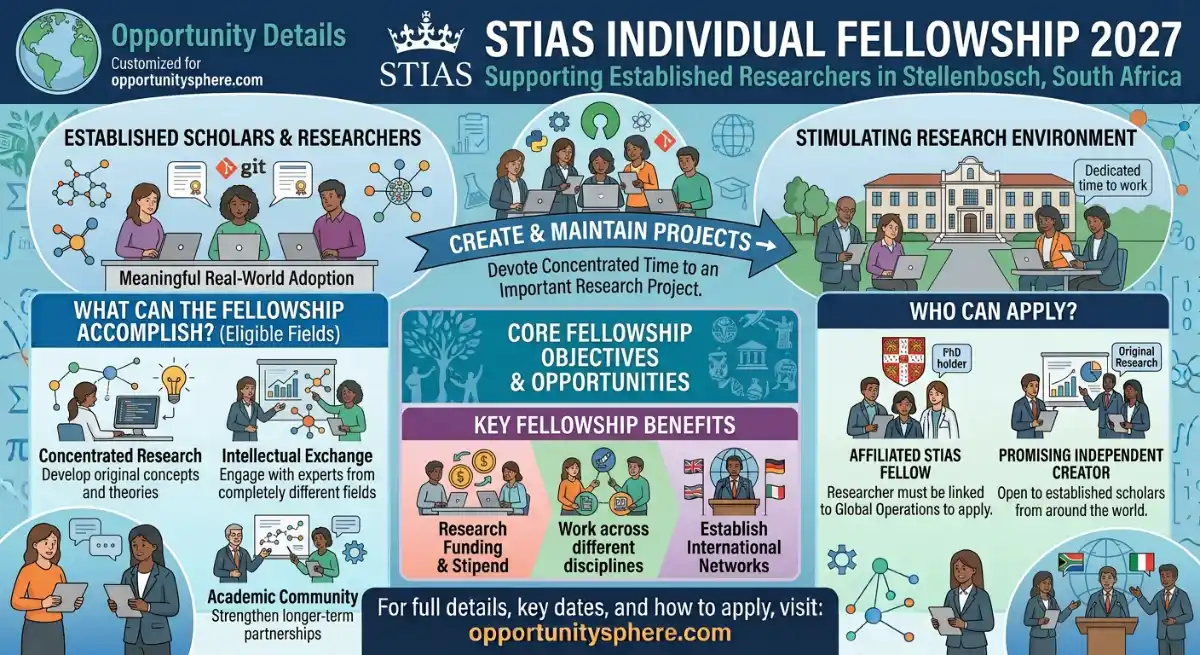
The STIAS Individual Fellowship 2027 offers established scholars and researchers an opportunity to step away from the routine demands of teaching, administration and other institutional responsibilities and devote concentrated time to an important research project.
Hosted by the Stellenbosch Institute for Advanced Study (STIAS) in South Africa, the fellowship is built around the idea that significant intellectual work often benefits from having dedicated time, a stimulating research environment and opportunities to engage with researchers working in completely different fields.
Rather than functioning as a conventional degree programme or a fellowship tied to a particular academic department, STIAS provides a residential research environment in which fellows can focus on their own scholarly projects while participating in the intellectual life of the Institute.
The programme is particularly relevant to researchers who already have a substantial academic record and are at a stage where uninterrupted time could help them develop a major research project, complete an important manuscript, advance a long-term research programme or explore a new area of scholarship.
A distinctive feature of the STIAS model is its multidisciplinary character. Researchers from different academic backgrounds work alongside one another, creating opportunities for conversations that may not normally occur within a conventional university department.
For applicants, therefore, the value of the fellowship is not simply having a place to conduct research. It is the combination of protected research time, residence in an international scholarly community and exposure to ideas from disciplines outside one's immediate area of specialization.
What makes the STIAS fellowship different?
STIAS is designed around research time and intellectual exchange.
Many established academics divide their time between research, teaching, supervision, meetings, administration and institutional responsibilities. A residential fellowship can provide an opportunity to concentrate much more heavily on a specific scholarly project.
The Institute also brings together researchers from different disciplines. A fellow working in agriculture, environmental science, economics, history, law, medicine, education, engineering or the humanities may therefore interact with scholars whose approaches and research questions are very different.
This multidisciplinary setting can be especially useful for projects that cross traditional academic boundaries.
The fellowship is consequently not simply about producing more pages of research. It provides an environment in which researchers can reconsider questions, test ideas through discussion and develop work that may benefit from perspectives outside their own discipline.
Who is the fellowship intended for?
The STIAS Individual Fellowship is intended primarily for with a strong academic or research record.
Applicants should be able to demonstrate that they have developed sufficient expertise in their field to undertake an independent research project.
A doctoral degree or equivalent research qualification is relevant to eligibility where required, but the fellowship is not intended as a general postgraduate scholarship for someone who is only beginning an academic career.
The strength of an application is therefore likely to depend not only on the proposed project but also on the applicant's previous scholarly achievements.
Evidence of academic development may include:
Peer-reviewed publications
Books or substantial scholarly works
Research projects
Academic appointments
Previous research experience
Contributions to a particular field of study
Evidence of independent scholarly work
Other achievements demonstrating research capacity
The research project is central
One of the most important parts of an STIAS application is the proposed research project.
Applicants should therefore think beyond simply describing their general research interests.
A strong proposal should communicate clearly:
What question or problem the research addresses.
Why the question matters.
What is already known about the subject.
What gap, difficulty or unresolved issue the project will address.
What the applicant intends to investigate during the fellowship.
What approach or methodology will be used where applicable.
What outputs are expected from the period of research.
Why STIAS provides a useful environment for completing the work.
The project should be sufficiently developed to demonstrate that the applicant knows what they intend to accomplish, while still allowing room for intellectual development during the fellowship.
This is particularly important for researchers proposing a major manuscript, book, research programme or interdisciplinary project. The application should make it possible for reviewers to understand what can realistically be achieved during the fellowship period.
A fellowship for concentrated scholarship
The residential nature of STIAS can be especially valuable for academics working on projects that require extended periods of concentration.
For example, a researcher may use the fellowship period to:
Develop a book manuscript
Complete a major research project
Analyse an important body of evidence
Develop a new theoretical framework
Advance interdisciplinary research
Prepare substantial scholarly publications
Rework an existing research programme
Establish new intellectual collaborations
Develop a research agenda for subsequent projects
The exact output will naturally depend on the applicant's discipline and the nature of the proposed work.
The important point is that the fellowship provides an environment in which research can become the central activity rather than something fitted around a crowded academic schedule.
The multidisciplinary environment
One of the defining features of STIAS is the opportunity to work within a community of researchers from different fields.
This can be particularly valuable because academic problems do not always fit neatly into disciplinary boundaries.
A researcher studying climate change, for example, may benefit from conversations with scholars working in economics, political science, history, environmental science or sociology. Similarly, researchers in the humanities may find new perspectives through interaction with colleagues in science, technology or social sciences.
Applicants should therefore consider whether their project could benefit from intellectual exchange beyond their immediate specialist community.
The fellowship does not require applicants to abandon their discipline. Rather, the residential environment creates opportunities to encounter alternative ways of approaching research questions.
Life as a resident fellow
STIAS fellows are expected to participate in the Institute's intellectual environment while maintaining substantial time for their own research.
Residence is an important part of the fellowship experience. Applicants should therefore be prepared to spend the fellowship period at the Institute for the required duration, unless alternative arrangements have been agreed where applicable.
Living and working in the same scholarly environment can encourage informal discussions as well as more structured academic interaction.
A conversation over coffee, a seminar discussion or an exchange with another fellow can sometimes lead to a new perspective on a research problem that would not have emerged in isolation.
For researchers accustomed to working within a single university department, this can provide a substantially different academic experience.
Who may benefit most from the opportunity?
The fellowship may be particularly relevant to researchers who already have a clear body of scholarly work but need dedicated time to move an important project forward.
It could suit an academic who has:
A manuscript that requires concentrated attention
A major research question that needs extended investigation
An interdisciplinary project requiring intellectual exchange
A substantial publication project
A developing research programme that would benefit from uninterrupted work
A need to engage with researchers outside their normal academic environment
Applicants should, however, assess the fellowship against their own career stage and project requirements before applying.
What applicants should demonstrate
The application should bring together two important elements: the applicant's scholarly record and the significance of the proposed research.
A strong academic record demonstrates that the applicant has the experience necessary to undertake independent research.
The research proposal then shows how the fellowship period would be used.
These two elements should support each other.
For example, an applicant with extensive research experience should be able to explain how the proposed project develops naturally from their previous work while also demonstrating what is new about the project.
Likewise, an ambitious project should be supported by evidence that the applicant has the expertise and experience needed to complete it.
Academic interaction and collaboration
Although the fellowship centres on individual research, STIAS also provides opportunities for intellectual interaction with other fellows and members of the wider academic community.
This can be valuable for researchers interested in developing collaborations or testing ideas outside their immediate field.
The benefits of such interaction do not necessarily need to result in a formal collaboration. Exposure to different academic perspectives can influence the way a researcher frames a question, interprets evidence or develops a theoretical argument.
For interdisciplinary researchers, this aspect of the STIAS environment may be particularly relevant.
What the fellowship provides
The STIAS fellowship provides researchers with access to a residential research environment designed around sustained scholarly work.
The fellowship experience includes opportunities for:
Dedicated research time
Residence at the Institute
Interaction with international scholars
Participation in the Institute's intellectual activities
Access to research resources and facilities
Academic seminars and discussions
Development of scholarly networks
Interaction with researchers from different disciplines
Opportunities for future academic collaboration
The exact financial and logistical arrangements should be checked against the official fellowship announcement for the relevant fellowship cycle before applying.
Preparing the application
Applicants should begin by identifying the specific research project they want to develop during the fellowship.
Rather than starting with a generic statement about why they want to visit South Africa, the application should be centred on the proposed research and the academic value of undertaking it within the STIAS environment.
A useful preparation process is:
Step 1 — Define the project
Write down the central research question and the specific problem the project addresses.
Step 2 — Establish the significance
Explain why the project matters to the relevant field and what contribution it could make.
Step 3 — Connect the project to your record
Show how your previous research has prepared you to undertake the proposed work.
Step 4 — Explain the fellowship fit
Describe why a period at STIAS would be particularly useful for this project.
Step 5 — Prepare the supporting documents
Ensure that your academic CV, research proposal, writing samples and references present a consistent picture of your research experience and current scholarly direction.
Step 6 — Review the application
Check the official call carefully for document requirements, formatting instructions, eligibility conditions and submission procedures before submitting.
What makes a research proposal convincing?
A research proposal does not need to be unnecessarily complicated.
It should instead allow the reader to understand the project without having to guess what the applicant intends to accomplish.
The proposal should make clear:
The central question
The research background
The problem or gap
The proposed contribution
The approach to the research
The expected outcomes
The relevance of the fellowship period
Researchers working in highly specialized fields should also remember that a multidisciplinary institute may include readers who are not specialists in their exact research area.
Clear writing is therefore important.
Technical terminology can be used when necessary, but the wider significance of the project should remain understandable to an informed academic reader outside the applicant's immediate specialization.
Application documents
Applicants should prepare their materials carefully and check the current STIAS call before submission.
Depending on the fellowship requirements, applicants may be expected to provide materials such as:
Academic curriculum vitae
Research proposal
Description of the proposed project
Writing sample or examples of previous scholarly work
Academic references
Evidence of academic qualifications
Other supporting information requested in the official call
Applicants should use the current official instructions rather than relying on requirements from an older fellowship cycle.
Why the residential period matters
For some researchers, the greatest benefit of a fellowship is not a single financial award but the ability to create a sustained period in which one major intellectual task receives priority.
This is particularly relevant for academics working on books, major publications, theoretical projects or complex research programmes.
The STIAS model is built around that principle.
By bringing researchers into a shared residential environment, the Institute creates a setting where concentrated individual work can happen alongside regular intellectual exchange.
The result can be a useful balance between independence and academic community.
Important considerations before applying
Before submitting an application, prospective applicants should consider whether they can realistically commit to the residential requirements of the fellowship.
They should also assess whether their proposed project is sufficiently mature for a research fellowship.
A general statement such as "I want to continue my research in my field" is unlikely to communicate the same level of clarity as a defined project with a specific question, contribution and set of intended outcomes.
Applicants should also ensure that their proposal is achievable within the fellowship period.
A project that is too broad may be difficult to complete, while an overly narrow project may not demonstrate the full value of a residential research fellowship.
Application deadline
The application deadline for the STIAS Individual Fellowship 2027 is 31 October 2026.
Applicants should not wait until the final day to begin preparing their materials, particularly because academic references and supporting documents may take time to arrange.
Fellowship location
The fellowship is hosted by the Stellenbosch Institute for Advanced Study (STIAS) in Stellenbosch, South Africa.
The residential setting places fellows within an established academic community while also providing access to the wider research environment of Stellenbosch and South Africa.
Who should consider applying?
Researchers who already have a strong scholarly record and a clearly defined project may find this fellowship relevant if they are looking for a period of concentrated research in an international and multidisciplinary environment.
It is especially worth considering for academics whose current project would benefit from uninterrupted research time and interaction with scholars from different disciplines.
The most important question for a prospective applicant is not simply whether they are interested in spending time in South Africa, but whether the STIAS research environment would meaningfully contribute to the development of the proposed scholarly work.
Final application reminder
Before submitting an application, verify the current eligibility requirements, fellowship dates, documentation requirements and submission instructions directly with STIAS.
Applicants should also ensure that their research proposal, CV and references present a coherent picture of their academic development and explain clearly what they intend to accomplish during the fellowship.
Related Opportunities
Explore other scholarships, fellowships, grants, research opportunities and more that may match your interests.