Undergraduate Graduates; Master's; PhD; Young Professionals
Field of study
All Fields
Application deadline
October 26, 2026
About This Fellowship
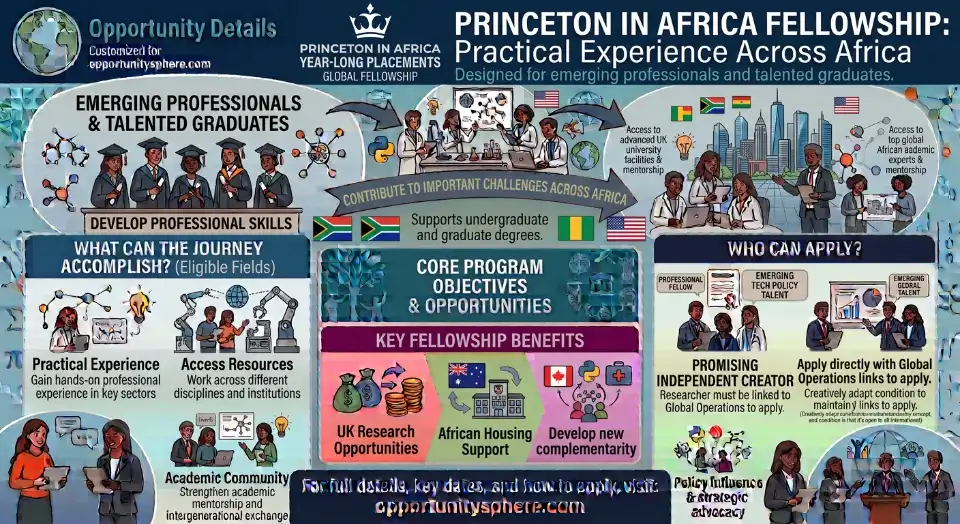
The Princeton in Africa Fellowship is a professional development programme that connects talented graduates and emerging professionals with organisations working on important challenges and opportunities across the African continent. Through year-long placements, fellows gain practical experience while contributing to the work of host organisations in areas such as education, public and community health, agriculture, economic development, humanitarian assistance, conservation, entrepreneurship and youth development.
The programme is designed for graduates who want to apply their academic knowledge in a professional setting, develop practical workplace skills and better understand the work of organisations contributing to Africa’s social and economic development.
Unlike a conventional university scholarship, Princeton in Africa is not primarily an award for financing a degree. It is a 12-month professional fellowship in which participants work with a host organisation and receive a package of support intended to help them undertake their placement. Fellows are expected to make a meaningful contribution to their host organisation while developing their own professional abilities.
Placements may involve programme coordination, research, communications, data analysis, operations, grant writing, budgeting, community engagement or other responsibilities determined by the host organisation. The precise role depends on the needs of the organisation and the skills of the selected fellow.
The programme also provides professional development, orientation and opportunities to connect with other fellows and alumni. These experiences can help participants build professional networks, gain exposure to different organisational environments and clarify their longer-term career interests.
For applicants who studied at African universities, the programme’s Nexus pathway is particularly relevant. Nexus was established to expand access for eligible young professionals who are citizens of African countries, were educated at African universities and reside on the African continent. Nexus and general applicants use the same application portal and application process.
What Does a Princeton in Africa Fellow Do?
The fellowship is based on practical work rather than full-time classroom study. Fellows are placed with host organisations that need early-career professionals to support their programmes, operations and projects.
Depending on the placement, responsibilities may include:
Supporting the planning and delivery of development programmes.
Conducting background research and preparing reports.
Collecting, organising or analysing programme data.
Assisting with communications, public engagement and content development.
Supporting grant writing, budgeting and project administration.
Contributing to agricultural, education, health or community initiatives.
Helping organisations document results and communicate their work.
Supporting innovation, entrepreneurship or economic development projects.
These are examples of possible responsibilities, not a guarantee that every fellow will perform all these tasks. Each placement has its own job description, supervisor, location and organisational priorities.
Applicants should consider the kind of work they can contribute to, the skills they want to develop and the settings in which they would be comfortable working. Some placements are based in major cities, while others may be in smaller towns or rural communities with more limited amenities.
Sectors and Areas of Work
Princeton in Africa works with a range of organisations across the continent. Placement opportunities vary from year to year, so applicants should not assume that every sector or country will have an available position in the 2027–2028 cycle.
1. Education and Youth Development
Education-focused placements may involve supporting teaching and learning initiatives, youth leadership programmes, education administration, training, research or institutional development.
These roles may suit graduates interested in education policy, youth empowerment, programme management, communications or community engagement.
2. Public and Community Health
Health-related organisations may work on public health programmes, community health services, health systems, research, patient support or health education.
Depending on the position, fellows may contribute to programme coordination, data management, communications, administration or research support. A placement description should be reviewed carefully to determine whether professional qualifications or specialised experience are required.
3. Agriculture and Rural Development
Agricultural and rural development placements may focus on smallholder livelihoods, agricultural enterprise, food systems, market access, rural communities or development projects.
Applicants with backgrounds in agriculture, agricultural economics, environmental studies, business, research or community development may find some roles relevant to their experience.
4. Business and Economic Development
Some host organisations support entrepreneurship, business growth, investment, enterprise development and economic opportunity.
Possible responsibilities may include market research, business operations, project coordination, data analysis, communications or support for entrepreneurs and local organisations.
5. Humanitarian and Community Development
Some placements involve organisations working with communities affected by poverty, displacement, health challenges or other social and economic pressures.
Depending on the host organisation, fellows may support programme implementation, monitoring, reporting, research, logistics or community-facing initiatives.
6. Conservation and Environmental Work
Environmental placements may involve conservation programmes, environmental education, sustainability, natural-resource management or community-based environmental initiatives.
The specific responsibilities depend on the host organisation and the role offered for the fellowship year.
7. Innovation and Entrepreneurship
For the 2027–2028 cycle, Princeton in Africa is expanding its focus on organisations and investors working in Africa’s innovation economy through a targeted Innovation Fellowship track.
This track is intended to connect emerging professionals with organisations working on innovation, technology, entrepreneurship and economic opportunity. Applicants interested in these positions should indicate their interest in the application and complete the additional Innovation Fellowship questionnaire.
Skills that may be relevant include data analysis, product development and technology management. Applicants should check the current programme guidance for the precise expectations of the innovation-focused roles.
Eligibility Criteria
Applicants must satisfy all the general eligibility requirements for the 2027–2028 fellowship cycle.
1. Graduate or Early-Career Professional Status
Applicants must be young professionals or current undergraduate students who will graduate by June 2027.
The programme is intended for emerging professionals who are ready to undertake a full-time, year-long placement. Applicants with postgraduate qualifications or some professional experience may still be eligible, provided they meet the other requirements.
2. Eligible University Qualification
Applicants must hold, or be on track to receive, a Bachelor’s, Master’s or PhD from either:
A four-year U.S.-accredited university; or
A locally accredited university based in an African country.
For applicants educated at African universities, the Nexus pathway is especially relevant. The university must meet the programme’s accreditation and location requirements.
Applicants who are uncertain whether their institution or qualification qualifies should contact the programme before submitting an application.
3. Professional English Proficiency
Applicants must have full professional proficiency in speaking, reading and writing English, defined by the Common European Framework of Reference for Languages (CEFR) as Level C1 or above.
This means applicants should be able to communicate effectively in a professional environment, understand detailed written information, participate in workplace discussions and prepare clear reports or other written materials.
4. Additional Languages
Professional proficiency in Arabic, French, Kiswahili or Portuguese may be preferred for certain placements.
These additional languages are not stated as a universal requirement for every fellowship. Their importance depends on the host organisation, the location and the duties of the particular position.
Applicants should accurately describe their language abilities and avoid claiming professional proficiency unless they can use the language effectively in a work setting.
5. Age Requirement
Applicants must be no older than 35 for the duration of the fellowship year. For the 2027–2028 cycle, the programme specifies that eligible applicants must have been born on or after 1 September 1992.
Applicants should use the official date and eligibility wording rather than relying on a general description such as “young graduate.”
6. Valid Passport
Applicants must hold a passport that remains valid for at least six months after the end of the fellowship year.
Because placements may involve work in countries other than an applicant’s country of citizenship or residence, passport validity and destination-country visa requirements are important practical considerations.
7. No Concurrent Graduate or Doctoral Enrolment
Fellows must not be enrolled in a graduate, doctoral or equivalent advanced academic programme during their fellowship year.
Applicants planning to begin a Master’s or PhD during 2027–2028 should consider this requirement carefully. A fellowship is a full-year professional commitment, and applicants should not assume that they can undertake a graduate programme simultaneously.
8. Commitment to the Full Fellowship Year
All fellowships last 12 months. Applicants must be prepared to complete the placement and attend the mandatory virtual orientation in real time on the scheduled dates.
The ability to commit to the full year is important because host organisations plan their staffing and programme activities around the fellow’s participation.
Can Graduates From African Universities Apply?
Yes. Princeton in Africa explicitly includes eligible graduates of locally accredited universities based in African countries.
The Nexus pathway was created to broaden access to young professionals educated and living in Africa. To qualify as a Nexus applicant, a candidate must be a citizen of an African country, reside on the African continent and be a recent graduate or graduating student from an African university.
Nexus and general applicants use the same application portal and application forms. Applicants should follow the official guidance to determine which pathway applies to their circumstances.
For example, an eligible Nigerian citizen who graduated from a locally accredited Nigerian university and resides in Africa may be able to apply through Nexus, provided they satisfy the degree, language, age, passport and other programme requirements.
Who Is Not Eligible?
Applicants may be ineligible if they:
Do not meet the university accreditation or qualification requirements.
Cannot demonstrate the required professional English proficiency.
Exceed the programme’s age limit.
Do not have a passport meeting the validity requirement.
Plan to remain enrolled in a graduate or doctoral programme during the fellowship year.
Cannot commit to the full 12-month placement.
Do not meet the programme’s graduation or professional-status requirements.
Eligibility should be confirmed against the official 2027–2028 rules before applying.
Fellowship Benefits and Financial Support
Princeton in Africa fellowships include financial and practical support, but the exact package varies according to the host organisation and placement. Applicants should therefore avoid treating the programme as a standard scholarship with a guaranteed fixed cash amount.
1. Living Stipend
Fellows receive a living stipend intended to support living costs directly related to their placement.
The stipend is designed to help cover ordinary expenses while working in the host location. However, Princeton in Africa does not publish one universal stipend amount for all placements on its main application page.
Applicants should review the financial terms provided for the specific placement before accepting an offer. The stipend is not intended to cover unrelated expenses in the fellow’s home country.
2. Housing or Housing Support
Princeton in Africa and its host organisations provide housing or housing-related support as part of the fellowship package.
The exact arrangement can vary. Applicants should confirm whether housing is provided directly, whether an allowance is offered or whether they must make their own arrangements within the support available.
Location matters: accommodation arrangements and living costs can differ significantly between a large city and a rural placement.
3. Visa and Work-Permit Support
Certain visa and work-permit expenses may be covered by the programme or host organisation. However, the official guidance notes that fellows may have to contribute towards these costs depending on the placement.
Applicants should confirm which expenses are covered, what documentation is needed and whether any costs must be paid before reimbursement.
4. Medical Insurance
Fellows receive medical insurance, medical evacuation insurance and security evacuation insurance under the programme’s stated support arrangements.
These protections are important for placements that require fellows to live and work away from home. Applicants should still review the policy details, coverage limits, exclusions and claims procedures rather than assuming every medical or travel-related expense is covered.
5. Professional Development and Orientation
All fellows must attend the mandatory virtual pre-departure orientation. The programme also provides a mid-year retreat designed to support professional development and community building.
The orientation prepares participants for the fellowship year, while the retreat offers opportunities to connect with other fellows and reflect on the professional experience.
For the 2027–2028 cohort, the mandatory virtual orientation is scheduled for 4–6 June 2027.
6. Alumni Network
Fellows join the Princeton in Africa community and its wider alumni network. This can help participants maintain professional connections after their placements and learn from others who have worked with different organisations across the continent.
The network may be useful for exchanging knowledge, learning about sectors and exploring future professional opportunities. It does not guarantee employment or a particular career outcome.
7. Practical Work Experience
Perhaps the most important benefit is the opportunity to contribute to a real organisation over a full year. Fellows can develop workplace skills, learn from colleagues, build professional confidence and gain a clearer understanding of the operational challenges facing their host organisations.
The experience can be particularly valuable for recent graduates who want to move from academic study into applied work.
Important Costs Applicants Should Budget For
Although the programme and host organisations provide substantial support, not every expense is necessarily covered.
According to the official guidance, fellows should expect to cover:
A US$350 programme placement fee after accepting a fellowship offer.
Round-trip airfare to and from the host country, depending on the placement.
Pre-departure medical expenses, such as required immunisations and consultations.
Some visa or work-permit expenses, depending on the placement.
Part of the travel cost associated with the mid-year retreat.
Princeton in Africa states that financial assistance may be available to fellows with demonstrated financial need. Applicants who are offered a placement and are concerned about costs should ask about the financial-aid process.
Before accepting a position, request a clear explanation of the stipend, housing, travel, visa, insurance and other financial arrangements. The written offer should be the basis for deciding whether the package is suitable for your circumstances.
How to Apply: Step-by-Step Guide
Step 1: Read the Official Eligibility Requirements
Begin with the official Princeton in Africa application page. Confirm that you meet the degree, university accreditation, age, English-language, passport and full-year commitment requirements.
If you graduated from an African university and reside in Africa, review the Nexus information to determine whether that pathway applies to you.
Step 2: Review the Fellowship Experience and Possible Sectors
Learn about the programme’s work and the kinds of organisations that have hosted fellows in previous cycles.
The list of placements for 2027–2028 may change as organisations and positions are finalised. Applicants should not assume that a role or country offered in a previous year will necessarily be available again.
Step 3: Prepare Your CV or Résumé
The official application requires a CV or résumé of no more than two pages, in PDF format, with a font size of at least 10 points.
Your CV should clearly present your education, work experience, internships, volunteering, leadership activities, relevant skills and language abilities. Prioritise evidence that demonstrates your ability to contribute to a professional organisation.
Include your name, email address, phone number and relevant hard skills. Check the document carefully for spelling, formatting and consistency.
Step 4: Arrange Your Official Academic Transcript
An official transcript must be sent directly by your university to piafapp@princetoninafrica.org through an accepted secure digital service or the university’s official email address.
Applicants should not simply forward a transcript themselves. The programme requires direct submission from the university.
Transcripts must be in English or accompanied by an English translation. Contact your university’s registrar well before the deadline to understand how official digital transcripts are issued.
Step 5: Request One Letter of Recommendation
The application requires one letter of recommendation. The recommender should know your work well enough to discuss your character, professional skills, leadership, academic work or performance in a relevant setting.
The recommendation must be specific to Princeton in Africa. Once you enter the recommender’s details in the application, the system sends instructions for submitting the letter.
Request the recommendation early and confirm that your recommender has enough time to complete the submission before the deadline. Only one recommendation letter is accepted for review.
Step 6: Complete the Online Application
Create an account through the official application portal and complete all sections of the online application.
The application includes questionnaires and essay responses. Applicants interested in the Innovation Fellowship should also complete the additional questionnaire for that track.
Use your own experience to explain your interests, motivation and suitability. Your responses should be consistent with the CV and the professional examples you provide.
Step 7: Check All Supporting Materials
Before submission, make sure that:
All application questionnaires and essay responses are complete.
Your CV is no longer than two pages and is saved as a PDF.
Your official transcript has been requested from your university and sent directly.
Your recommender has submitted the required letter.
Any additional materials required for your application pathway have been provided.
Your contact details are correct and you can access the email account used to register.
Applicants can track their materials through the application portal. Princeton in Africa states that it does not confirm receipt of each individual item by email.
Step 8: Submit Before the Deadline
The deadline for the 2027–2028 fellowship application is 26 October 2026 at 11:59 p.m. Eastern Daylight Time.
Submit well before the closing time, allowing for internet problems, file-upload issues and delays in receiving materials from your university or recommender.
Incomplete applications will not be considered, and the programme does not accept late materials.
How Selection and Placement Work
Applying to Princeton in Africa is not the same as applying directly for a particular job. Applicants apply to the fellowship programme, after which the organisation conducts its selection and placement process.
1. Application Review
Applications are reviewed after the deadline. Applicants selected to progress are notified about interviews.
2. Virtual Interviews
For the 2027–2028 cycle, interviews are scheduled for January 2027. Applicants invited to interview must be available during the programme’s designated interview sessions.
3. Candidate Pool and Placement Matching
Candidates who progress may be considered for particular host organisations and roles. Princeton in Africa considers candidates’ skills, backgrounds and preferences alongside the needs of each host organisation.
Applicants may indicate preferences for region, country or position type, but the programme does not guarantee that a fellow will receive their preferred location or role. Flexibility can be useful because the available placements and organisational needs vary.
4. Host Organisation Interviews and Offers
Candidates may be put forward for consideration by a host organisation. If a candidate is selected for a specific placement, the programme communicates the offer and the candidate must respond within the stated period.
Read the role description and financial package carefully before accepting. Placement offers can require a prompt decision.
5. Orientation and Fellowship Start
Successful fellows must attend the mandatory virtual orientation from 4–6 June 2027 and complete the full 12-month placement.
The exact start and end dates depend on the placement, with fellowship start dates expected between June and August 2027 and end dates between June and August 2028.
How to Make Your Application More Competitive
Show Practical Contribution, Not Just Interest
Explain what you have actually done in your academic, professional, volunteer or community experience. Use examples that demonstrate responsibility, problem-solving, collaboration, communication or initiative.
Connect Your Skills to Organisational Needs
Think about the tasks a host organisation may need help with. Skills such as writing, research, data handling, project coordination, budgeting, communications and administration can be useful across different sectors.
Describe the skills you can genuinely demonstrate and provide examples where possible.
Explain Why a Year-Long Placement Fits Your Goals
A strong application should explain why you want a practical professional placement and what you hope to contribute and learn. Avoid treating the fellowship merely as a travel opportunity or a route to a future degree.
Be Open to Different Locations and Roles
The placement process matches candidates with organisational needs. Applicants who are willing to consider different sectors, roles and locations may have a broader range of potential matches, although flexibility does not guarantee selection.
Write in Your Own Voice
Princeton in Africa specifically warns applicants against using AI-generated content to draft or outline application materials and against copying AI-generated text into an application. The organisation says applications should reflect the applicant’s unique voice and experiences; it permits uses such as brainstorming and grammar or spelling review.
Accordingly, use this article to understand the opportunity, but write your application essays yourself. Focus on your real experiences, motivations and professional goals.
Frequently Asked Questions
1. Is Princeton in Africa a scholarship or a job?
It is a professional fellowship involving a 12-month placement with a host organisation. Fellows receive a support package that can include a living stipend and housing, but it is not a university scholarship for funding a degree.
2. Can Nigerian graduates apply?
Eligible Nigerian citizens may apply. Those who graduated from a locally accredited Nigerian university and reside in Africa may qualify under the Nexus pathway, provided they meet all other requirements.
3. Must I have studied at Princeton University?
No. The programme is open to eligible applicants who meet the university qualification requirements. Princeton University alumni do not have reserved places.
4. Is previous work experience required?
The programme is intended for young professionals and graduating students. Applicants with some professional experience or postgraduate degrees may apply if they meet the requirements. The best fit depends on the placement and the candidate’s skills.
5. Is the fellowship fully funded?
The programme provides housing and a living stipend, along with certain visa and work-permit support and insurance. However, packages vary by placement, and fellows may need to cover the placement fee, some travel costs, pre-departure medical expenses and other costs. Read the offer carefully before accepting.
6. Do I need to know French or another African language?
Professional English proficiency at CEFR C1 or above is required. Arabic, French, Kiswahili or Portuguese may be preferred for particular placements but are not stated as universal requirements.
7. Can I continue my PhD during the fellowship?
No. Fellows must not be enrolled in a graduate, doctoral or equivalent advanced academic programme during the fellowship year.
8. How long does the fellowship last?
Every placement lasts 12 months. The exact start and end dates vary by host organisation.
9. Can I choose the country where I will work?
Applicants may indicate preferences, but placements depend on the available roles and host-organisation needs. A preferred country or position is not guaranteed.
10. Is there an application fee?
The programme states that there is no application fee. However, fellows who accept an offer should budget for the US$350 programme placement fee and other expenses specified in the official guidance.
11. What is the application deadline?
The deadline is 26 October 2026 at 11:59 p.m. Eastern Daylight Time. All required application materials must be submitted according to the programme’s instructions.
12. When will selected applicants begin their placements?
Placements are expected to begin between June and August 2027, with each fellowship lasting 12 months. The exact dates depend on the host organisation.
Final Advice
The Princeton in Africa Fellowship 2027–2028 offers eligible graduates and emerging professionals an opportunity to gain practical experience with organisations working across the continent. Its value lies in the combination of a year-long professional placement, living and housing support, insurance, professional development and access to a wider community of fellows and alumni.
Before applying, confirm your eligibility, prepare your CV, arrange direct submission of your official transcript and request the required recommendation letter early. Also remember that the financial package varies by placement and that the programme does not guarantee a particular country, organisation or role.
Related Opportunities
Explore other scholarships, fellowships, grants, research opportunities and more that may match your interests.