NSF Mathematical Sciences Postdoctoral Research Fellowships 2026
Offered by U.S. National Science Foundation
Location
United States
Funding
Fully Funded
Study level
Postdoctoral
Field of study
Mathematics & Statistics
Application deadline
October 21, 2026
About This Fellowship
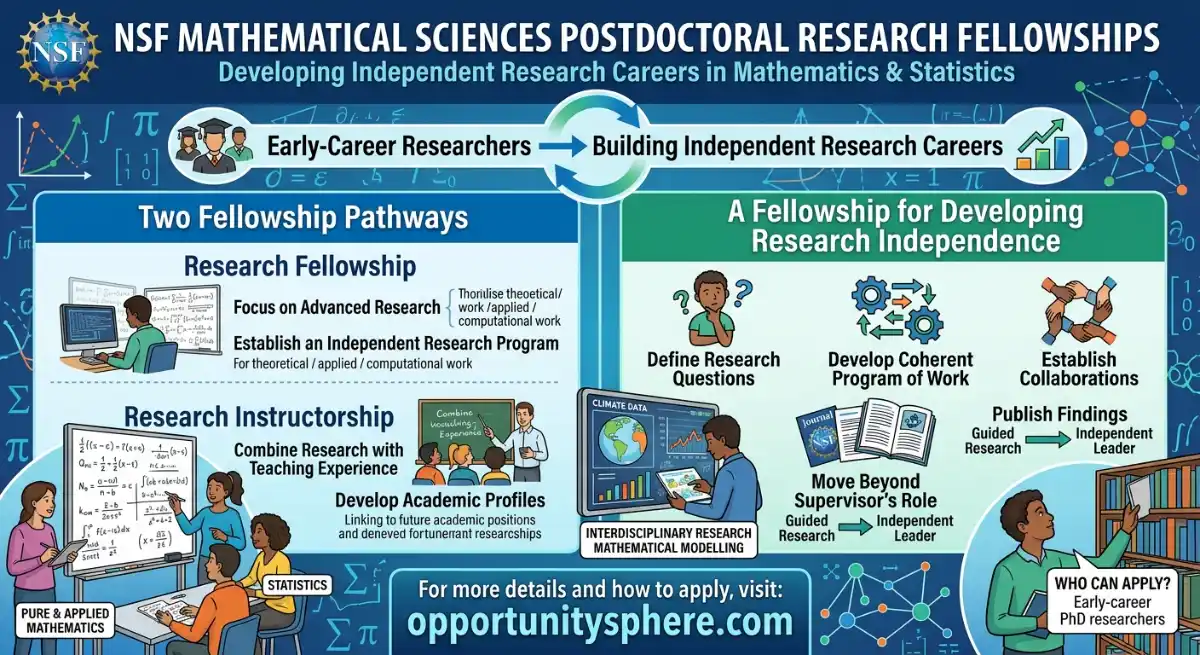
The NSF Mathematical Sciences Postdoctoral Research Fellowships support early-career researchers who are building independent research careers in mathematics, statistics and related mathematical sciences.
The programme is designed for researchers at an important stage of their professional development: the period after doctoral training when they are beginning to establish their own research identity, develop original research programmes and build the professional experience needed for a longer-term academic or research career.
Rather than focusing only on a single short research project, the fellowship provides an opportunity for postdoctoral researchers to develop their research direction while gaining additional experience, professional connections and, where applicable, teaching experience.
A distinctive feature of the programme is its two fellowship pathways. Applicants may pursue a Research Fellowship, which is centred primarily on advanced research and the development of an independent research programme, or a Research Instructorship, which combines research with an opportunity to develop teaching experience.
The programme can support research in fundamental areas of mathematics and statistics as well as work involving mathematical and statistical approaches to problems in other scientific disciplines. This makes the opportunity relevant not only to researchers working in traditional mathematical fields but also to applicants whose research connects mathematical sciences with broader areas of science and technology.
A Fellowship for Developing Research Independence
For many researchers, the transition from doctoral study to an independent research career involves more than simply completing another research project.
Early-career researchers need opportunities to define research questions of their own, develop a coherent programme of work, establish collaborations, publish their findings and demonstrate the ability to contribute independently to their field.
The NSF Mathematical Sciences Postdoctoral Research Fellowships are intended to support this stage of professional development.
A successful fellow can use the postdoctoral period to move beyond the role of working primarily within a supervisor's research programme and begin developing a research identity of their own.
This means that applicants should think carefully about what they want their research career to look like after the fellowship. The proposed project should not simply be an extension of previous doctoral work without a clear new direction. Instead, applicants should be able to explain how the proposed research contributes to their development as an independent mathematician or statistician.
Two Ways to Approach the Fellowship
The programme provides two distinct pathways, allowing applicants to select the route that best matches their professional objectives.
The Research Fellowship pathway is focused on advanced research in the mathematical sciences.
It provides a setting in which postdoctoral researchers can concentrate on developing their research programme, producing scholarly work and establishing a stronger foundation for an independent career.
This route may be particularly relevant to researchers whose immediate priority is to deepen their expertise, pursue ambitious mathematical or statistical questions and develop a sustained programme of research.
The research may involve theoretical developments, methodological advances, computational approaches, mathematical modelling or applications of mathematical and statistical techniques to other disciplines, provided that the proposed work falls within the scope of the current NSF programme.
2. Research Instructorship
The Research Instructorship provides a somewhat different professional-development pathway by combining research with teaching experience.
For researchers interested in academic careers, developing teaching experience can be an important part of postdoctoral preparation. The Research Instructorship therefore provides an opportunity to continue advancing a research programme while also gaining experience relevant to future academic positions.
Applicants considering this route should carefully examine the current NSF solicitation for the specific expectations associated with teaching, research and professional development.
The two pathways should not be treated as interchangeable labels. Applicants should select the option that genuinely corresponds to the type of professional development they want from the fellowship period.
Who Can Apply?
The programme is intended for early-career researchers who have completed, or are completing, doctoral-level training appropriate to the mathematical sciences.
Applicants should have an academic and research background that prepares them to undertake advanced research in mathematics, statistics or an appropriate related field.
The fellowship may be relevant to researchers working in areas such as:
Pure mathematics
Applied mathematics
Statistics
Mathematical statistics
Computational mathematics
Mathematical modelling
Interdisciplinary mathematical research
Applications of mathematics to scientific problems
Applications of statistics to other disciplines
Other research areas falling within the programme's current mathematical sciences scope
However, having a background in one of these areas does not by itself establish eligibility. Applicants must satisfy the full requirements contained in the current NSF programme solicitation.
Career Stage and Doctoral Requirements
Because this is a postdoctoral fellowship programme, applicants should pay close attention to the doctoral-degree provisions.
The NSF may specify requirements concerning when the doctoral degree must have been earned, whether applicants who are still completing their doctorate are eligible, and how particular career circumstances are treated.
These details can be important because postdoctoral fellowship programmes often distinguish between applicants based on the timing of their doctoral completion.
Applicants should therefore avoid relying on general descriptions of postdoctoral eligibility when preparing an application. The current NSF solicitation should be treated as the authoritative source for doctoral-degree timing and all related requirements.
Research Areas Supported
The mathematical sciences cover a wide range of disciplines, and the fellowship is not restricted to one narrow mathematical specialty.
Depending on the current programme scope, proposed research may involve areas such as:
Pure Mathematics
Research may address theoretical questions in areas of mathematics where the principal objective is to develop new mathematical knowledge, structures, theories or methods.
Applied Mathematics
Applicants may propose mathematical approaches to problems arising in science, engineering, technology or other disciplines.
Statistics and Mathematical Statistics
Research may involve statistical theory, methodology, inference, probability-related work or the development of statistical approaches to important research problems.
Computational Mathematics
Computational approaches may be relevant where mathematical research requires numerical methods, algorithms, simulation, computation or related techniques.
Mathematical Modelling
Applicants may use mathematical models to investigate complex systems or problems arising in areas outside traditional mathematics.
Interdisciplinary Research
Mathematics and statistics increasingly contribute to research in areas such as biology, medicine, environmental science, engineering, computer science, economics and other disciplines.
Researchers working at these intersections may therefore consider whether their proposed work fits the programme's current scope.
The important consideration is not simply whether an applicant's discipline contains mathematics or statistics. The proposed research itself must satisfy the programme's research requirements.
What Should the Research Programme Demonstrate?
A central part of the application is the proposed research programme.
Applicants should think beyond describing a research topic. A competitive proposal needs to communicate what problem will be investigated, why the problem matters, what is currently known, what remains unresolved and how the proposed work will contribute something new.
The proposal should make the research direction understandable to reviewers while retaining sufficient technical detail to demonstrate scholarly depth.
A useful research programme should establish a clear connection between:
The research question.
Existing knowledge in the field.
The gap or problem being addressed.
The proposed mathematical or statistical approach.
The expected contribution.
The applicant's preparation for the work.
The research environment in which the work will be conducted.
The applicant's longer-term development as an independent researcher.
The proposal should also make clear why the fellowship period is an appropriate stage at which to undertake the work.
From Doctoral Research to an Independent Programme
Applicants should consider how their proposed fellowship research relates to their previous doctoral work.
Continuity can be valuable. A researcher does not necessarily need to abandon their doctoral research area in order to demonstrate independence.
However, the fellowship should provide a convincing basis for further development.
For example, an applicant might take a methodological problem encountered during doctoral research and develop a broader independent research programme around it. Another applicant may extend an established area into a new application, develop a new theoretical framework or introduce a substantially different methodology.
The important issue is that the proposed work should demonstrate intellectual direction rather than simply reproduce the applicant's previous doctoral research.
Choosing a Research Environment
The research environment can play an important role in the success of a postdoctoral fellowship.
Applicants should therefore consider whether the proposed host or research setting provides access to the expertise, facilities, collaborators, computational resources, datasets or other resources needed for the proposed work.
A strong research environment should complement the applicant's expertise rather than merely duplicate it.
Where collaboration is important, applicants should be able to explain how the proposed environment will contribute to the research while still allowing the applicant to develop an independent research identity.
Any specific host-institution requirements should be checked against the current NSF solicitation.
Professional Development Beyond the Research Project
The value of a postdoctoral fellowship is not limited to publications.
During the fellowship period, researchers can develop a range of skills and professional relationships that contribute to their longer-term careers.
Depending on the pathway and award arrangements, these may include:
Development of an independent research profile
Research collaboration
Participation in seminars and academic activities
Presentation of research findings
Development of new methodological expertise
Professional networking
Research communication
Preparation for future academic positions
Teaching development through the Research Instructorship pathway
Experience managing an independent research programme
Applicants should therefore consider how the fellowship fits into their broader career trajectory rather than viewing it only as a source of short-term research funding.
The Research Instructorship and Teaching Development
For applicants considering academic careers, teaching can form an important part of professional preparation.
The Research Instructorship pathway provides an opportunity to combine research development with teaching experience.
This can allow an early-career researcher to strengthen two complementary aspects of an academic profile: the ability to conduct independent research and the ability to contribute to teaching.
Applicants pursuing this route should review the current programme requirements carefully and ensure that their proposed activities are consistent with the expectations established by NSF.
The teaching component should also fit naturally with the applicant's professional development rather than appearing as an unrelated addition to the proposal.
Financial Support
Successful applicants receive fellowship support under the applicable NSF award arrangements.
The fellowship may provide financial support associated with the postdoctoral appointment and approved research and professional-development activities.
However, applicants should not rely on figures from previous application cycles when planning their finances.
The exact award amount, eligible costs, salary arrangements, institutional costs and other financial conditions should be confirmed from the current NSF solicitation and award terms.
This is particularly important because funding conditions can change between programme cycles.
How Long Is the Fellowship?
The fellowship duration is governed by the current NSF programme solicitation and the specific award conditions.
Applicants should therefore confirm the applicable fellowship period directly from the current programme documentation before publishing or submitting an application.
The length of the award should also be considered when developing the research plan. A proposal should have a realistic relationship between its objectives, methodology, expected outputs and the time available under the fellowship.
What Applicants Need to Prepare
The exact application package should be taken from the current NSF solicitation and applicable proposal-submission instructions.
Depending on the programme requirements, applicants may need to provide materials such as:
Research proposal
Curriculum vitae or biographical information
Doctoral-degree information
Academic and research background
Supporting narrative statements
Information about the proposed research environment
References or reference-related information
Professional-development information where required
Other supporting documentation specified by NSF
Applicants should use the current solicitation as their final checklist rather than relying on an old application guide or information from a previous fellowship cycle.
Preparing the Research Proposal
The research proposal should be developed well before the submission deadline.
A useful preparation process may begin with a broad research idea and gradually develop it into a clearly defined research programme.
Applicants should be able to answer several fundamental questions:
What problem are you trying to solve?
The research question should be sufficiently specific to guide the proposed work.
Why does the problem matter?
The proposal should establish the significance of the research rather than assuming that reviewers will immediately recognise its importance.
What is already known?
Applicants should demonstrate familiarity with relevant literature and existing approaches.
What remains unresolved?
The proposal should identify the gap that the research intends to address.
What will you do differently?
The proposed methodology or theoretical approach should be explained clearly.
What contribution could result?
Applicants should identify the potential mathematical, statistical, scientific or interdisciplinary contribution.
Why are you prepared to do this work?
The applicant's previous research experience should provide a credible foundation for the proposed programme.
How will the fellowship help you become independent?
The proposal should connect the research programme with the applicant's longer-term development.
Building the Career Narrative
An important part of a postdoctoral fellowship application is the story connecting the applicant's previous research, proposed fellowship work and future career.
The application should allow reviewers to understand how the fellowship represents a logical next step.
For example, an applicant may have developed specialised expertise during doctoral research and now wish to broaden that expertise into a new area.
Another applicant may have identified an important mathematical problem during earlier research and now be ready to pursue it independently.
A third applicant may be moving toward interdisciplinary research and need the fellowship environment to establish collaborations outside their original field.
There is no single career pathway that applicants must follow. What matters is that the proposed research and professional-development activities form a coherent progression.
For Researchers Interested in Interdisciplinary Work
Mathematical and statistical methods are increasingly used to address questions that originate outside mathematics departments.
Researchers may apply mathematical modelling, statistical inference, computational methods or theoretical approaches to problems in other scientific fields.
For applicants working across disciplinary boundaries, the proposal should make the mathematical or statistical contribution particularly clear.
Reviewers should be able to understand both the broader problem and the specific contribution that mathematical or statistical research will make to addressing it.
This can be especially important when the application involves collaboration with researchers from another discipline.
Application Roadmap
Applicants can use the following general preparation sequence:
Step 1 — Read the current NSF solicitation
Begin with the official programme documentation rather than relying on summaries or older fellowship announcements.
Step 2 — Check eligibility
Confirm doctoral-degree, career-stage, institutional, citizenship or nationality and any other applicable requirements.
Step 3 — Decide on the pathway
Determine whether the Research Fellowship or Research Instructorship is more appropriate for the proposed professional development.
Step 4 — Develop the research idea
Define the research problem, objectives, methodology and anticipated contribution.
Step 5 — Identify the research environment
Consider the expertise, facilities and collaborations required to carry out the project.
Step 6 — Build the application materials
Prepare the proposal, CV, supporting statements and other required documents.
Step 7 — Review the proposal
Check that the research question, significance, methodology and applicant preparation are clearly connected.
Step 8 — Confirm submission requirements
Make sure the application follows current NSF proposal preparation and submission rules.
Step 9 — Submit before the deadline
Allow sufficient time for institutional approvals or submission-system requirements where applicable.
Step 10 — Monitor the application
Follow NSF procedures for any subsequent communications or requests.
Common Areas Applicants Should Check Carefully
Before submitting, applicants should pay particular attention to details that can affect eligibility or submission.
These include:
Doctoral-degree timing
Career-stage requirements
Nationality or citizenship provisions
Institutional eligibility
Research-area eligibility
Fellowship pathway
Host or research-environment requirements
Proposal format
Required supporting materials
Reference requirements
Submission system requirements
Current deadline
Page or formatting restrictions
Any programme-specific instructions
These details should always be confirmed against the current NSF solicitation.
Why This Fellowship Can Matter at the Postdoctoral Stage
The transition from doctoral researcher to independent researcher can be an important period in a mathematical scientist's career.
A postdoctoral appointment can provide time to deepen research expertise, but a fellowship that is designed around research independence can also provide an opportunity to define a longer-term research direction.
For researchers in mathematics and statistics, this may involve moving toward a distinctive research programme, developing new collaborations, strengthening publication activity, gaining teaching experience or establishing expertise at the intersection of mathematical sciences and another discipline.
The NSF Mathematical Sciences Postdoctoral Research Fellowships are structured around this broader stage of professional development.
Before You Apply
Applicants should begin preparation well before the submission deadline.
The most important early task is not simply completing forms. It is developing a research programme that is sufficiently focused to be feasible while ambitious enough to demonstrate meaningful scholarly development.
Applicants should also ensure that their supporting materials tell a consistent story.
The CV, research proposal, career information and host arrangements should collectively demonstrate that the applicant has the preparation to undertake the proposed work and that the fellowship represents a meaningful step toward research independence.
Important Programme Notes
The programme provides two pathways: Research Fellowship and Research Instructorship.
Eligibility is governed by the current NSF programme solicitation.
Applicants should carefully verify doctoral-degree and career-stage requirements.
Research must fall within the scope of the Mathematical Sciences Postdoctoral Research Fellowships programme.
Nationality, citizenship and institutional requirements should be confirmed directly from the current NSF rules.
The Research Instructorship pathway includes a teaching-development component and should be assessed separately from the Research Fellowship pathway.
The exact financial support and allowable costs should be confirmed from the current award information.
Fellowship duration should be confirmed from the applicable solicitation.
Required documents and proposal requirements may change between funding cycles.
Applicants should submit through the NSF-approved submission system and follow all current proposal-preparation instructions.
Applicants should verify the current deadline before beginning their final submission.
Who May Find This Opportunity Relevant?
This fellowship may be particularly relevant to researchers who have recently completed or are completing doctoral training and are looking for a structured opportunity to develop an independent research programme in mathematics, statistics or a related field.
It may also interest researchers whose work sits between mathematics and another scientific discipline and who want to use mathematical or statistical methods to address broader scientific questions.
Researchers who are considering academic careers may also find the Research Instructorship pathway relevant if teaching development is an important part of their professional plans.
Final Overview
The NSF Mathematical Sciences Postdoctoral Research Fellowships provide an opportunity for early-career mathematicians and statisticians to develop their research careers at the postdoctoral stage.
The programme combines postdoctoral research support with opportunities for professional development and independent research development. Its two pathways allow applicants to pursue a research-focused fellowship or a route that combines research with teaching experience.
For applicants, the most important preparation step is to understand the current NSF requirements and then build a research proposal that clearly connects the research problem, methodology, expected contribution, applicant preparation and longer-term career direction.
Because fellowship rules, award conditions, deadlines and submission requirements can change between cycles, prospective applicants should always consult the latest NSF programme documentation before applying.
Related Opportunities
Explore other scholarships, fellowships, grants, research opportunities and more that may match your interests.